In the October 2010 issue of The Carriage Journal, I wrote the entry for “The Last Word” (our personal-opinion column, on the last page of each issue). In it, I declared my love of history, genealogy, old photos and, especially, old photos with ancestors in them.

As I said in the column, old photographs may be beautiful and fascinating on their own, but when they have family members in them, we’re able to look our own personal history right in the eye.

I also put out a call for CAA members to share old family photos with carriages in them. We all may enjoy looking at old images of horse-drawn vehicles, but these become so much more interesting when there’s a story attached.

Here’s one I received from Kathy Graves in California:

.
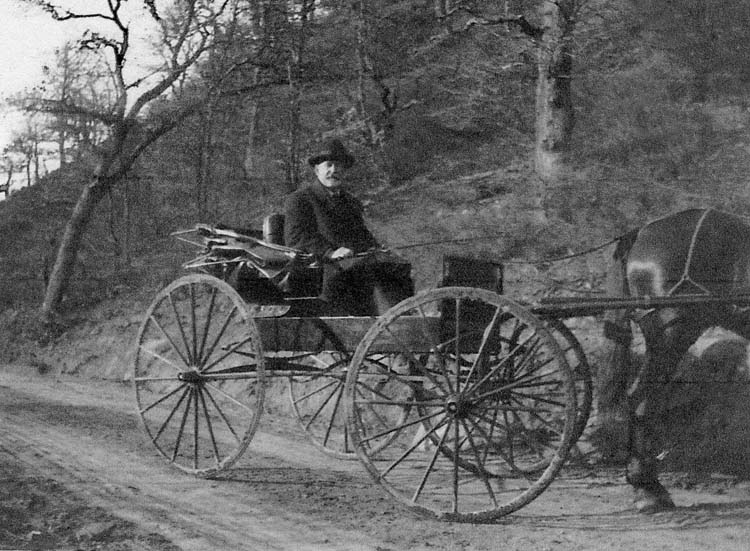
John William Lill (photo courtesy of Kathy Graves)

.

Kathy says:

“This photo is of my maternal great grandfather, John William Lill, just above the town of Hood River, Oregon. It is not known if this was a rented turnout, or if he owned it, using it to travel from his home in Hood River to his couple of acres just outside of town, where he raised chickens. The photo is undated, but it most likely was taken sometime after 1900, but before 1916, when my mother was born.”

Thank you, Kathy, for sharing this wonderful photo!
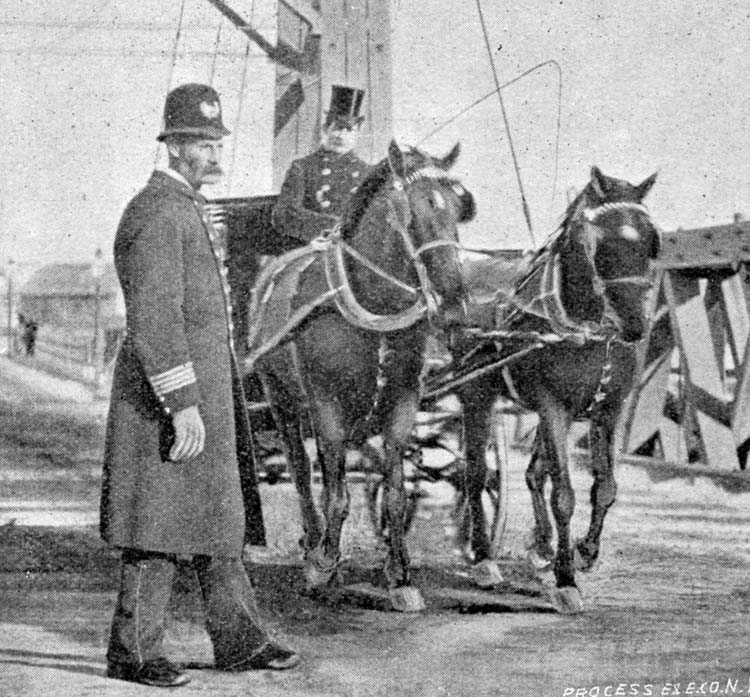
From the April 8, 1893, issue of Rider & Driver:

Charley, on the Bridge

Charles H. Francis, better known as “Charley,” the policeman, at Macomb’s Dam Bridge, has stood guard over the safety of the driving public at that point for more than twenty years, hardly missing a day. He was born in what is now called North New York — Port Morris — and will be fifty years old next June. While tall and rather slender his is not at all delicate. Few men can take a frightened horse by the head with more firmness. His manner, with just the right word which he drops into the timid driver’s ear, has often proved reassuring and a lesson to the recipients for the rest of his life. The many travelers over that famous old bridge can remember Charley’s well-known figure, as he has been ever at his post, in sunshine and in storm. Charley knows all the drivers, great and small. He knows no favorites.

A driver on the road tells of seeing Charley make the late Commodore Vanderbilt keep his place at the bridge entrance. Someone, driving in company, said to the Commodore: “Don’t you think Charley is pretty strict?” “No,” said the Commodore, “he’s just right. Best man they ever had here.”

A few years ago a pair were running away, up Eighth Avenue. The driver had strength enough to steer them, but could not stop them. It was about four o’clock in the afternoon. Charley was near the west end of the bridge and as ever on the alert. He saw the pair coming and saw that they were likely to hit a carriage about to enter upon the bridge. He rushed at the carriage driver and said: “Runaway!” in a loud voice, motioning for him to turn into Johnny Barry’s shed. Then he ran the other way as fast as a deer, turning all the teams to the right side of the bridge. They just managed to give room enough to let the runaway pass. Charley reached the east end about as soon as the runaways, and commanded the pale-faced driver and paler companion to turn up the hill to the left. The driver did so and before half-way to the top he stopped his horses. It was the work of a moment to set the bridge drivers all going in order again. The runaways had been hitched too near the wagon, so that when an effort was made to stop them their heels would strike the wheels and so frightened them that they ran faster.

Charley is the right man in the right place.

Charley, the policeman, on the bridge (from Rider & Driver, April 8, 1893)

Even though the big day was yesterday, I offer the following guest post by Martha Miles, in honor of Valentine’s Day:

Valentine for a Coachman

by Martha Miles

Valentine’s Day often takes us away from our sweethearts, an experience that drivers in the transportation business have had for centuries. Nearly 200 years ago, in 1826, this affectionate Valentine appeared in a tiny booklet published in London. It captures a coachman’s feelings for a laundry maid as he sees her at work. Perhaps you’d like to share it with someone you love this February.

From a Coachman to a Laundry Maid:

Early this morning at the tub,
I heard you sing, and saw you scrub;
The rising suds were seen to flow
About your arm like driven snow;
I smack’d my whip, and drove away,
But gave a blessing to the day–
That made you my fair Valentine,
And hope in wedlock you’ll be mine.

The answer:

I heard you give your whip a smack,
Peep’d out, but only saw your back–
So nice you mount the box and drive,
You are the smartest lad alive;
I write to say that I incline,
To take you for a Valentine.

… in 1893, that is.

In the advertising section of the April 8, 1893, issue of Rider & Driver is this tidbit:

“There are many carriage novelties this spring in new and beautiful designs. Blue appears to be the favorite color, and the adornments are artistic carvings. The leaders are fancy Traps and Road Wagons. There is a larger demand than ever for Cabriolets, Victorias, and Spider Phaetons. One style of Cabriolet is devised to carry a child, the seat being in the apron, and when not in use it is concealed. The colors of some Cabriolets run in olive and black, yellow and blue, and trimmed with buff corduroy. The four-passenger full-springed Traps and four-wheeled Dog-carts are very showy. Victorias are made so that they can be changed into a lady’s driving Phaeton. Another specialty in carriages is the triple Surrey and triple Buckboard. The light Breaks and Omnibuses are fitted up with new and novel attachments, and are gotten up in new colors. Road Wagons are mostly in natural wood and combinations of colors. Many specialties in four-in-hand Traps are noticed; some showing the seats arranged dos-a-dos fashion. For skilled workmanship, beauty of style and superior finish, and moderate prices, for town and country use  and the Park, or for novelties in sporting Traps we recommend a visit to the establishments of Flandrau & Co., 372 Broome Street, and Broadway and Fifty-first Street, also to R. M. Stivers, 144 to 152 East Thirty-first Street, New York.”

Now on to something a bit out of the ordinary.

How about a quadrille with six-horse hitches??

.