This blog post has nothing to do with horses or carriages.

Rather, we are here today to discuss the weather. And how much we’re all longing for spring right about now, after a colder-than-normal winter that started earlier than normal.

Here in Lexington, we were spoiled several days ago with a gloriously sunny, warm weekend. It was just enough to get all the snowdrops in our yard to bloom and to trick us into thinking about that early spring we were promised by a certain groundhog.

And so today, of course, it’s been snowing, and the temperature is nearly thirty degrees colder than it was yesterday.

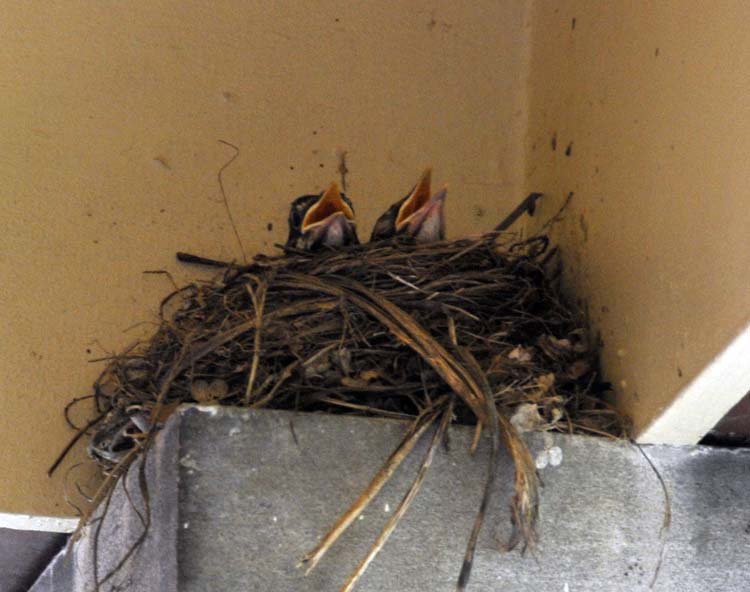
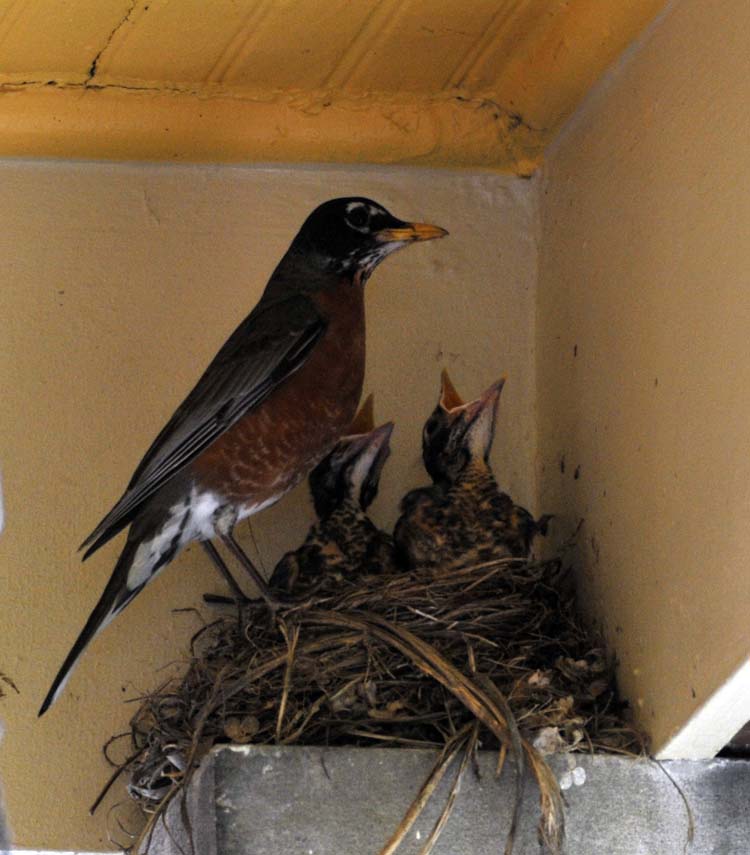
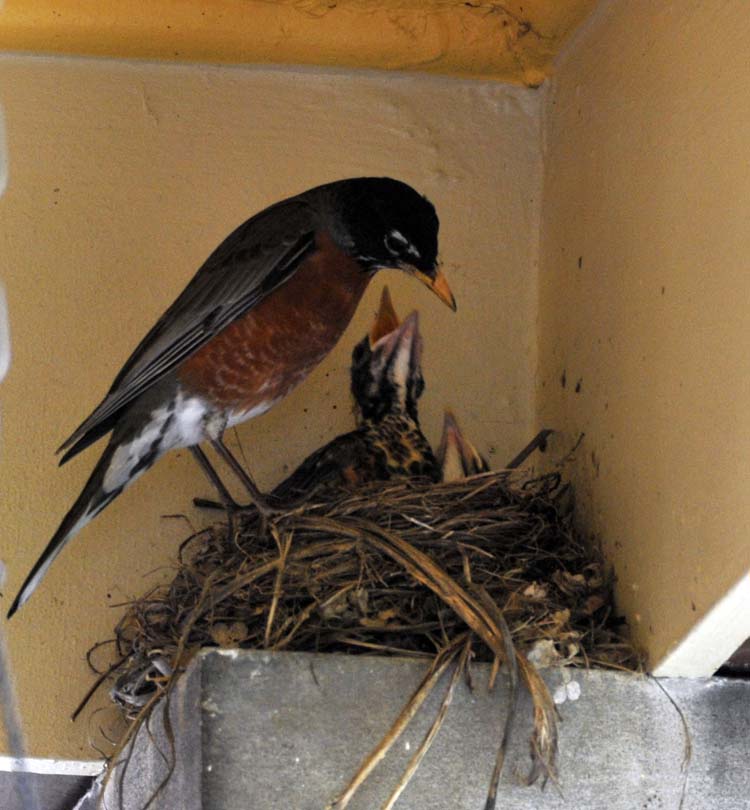
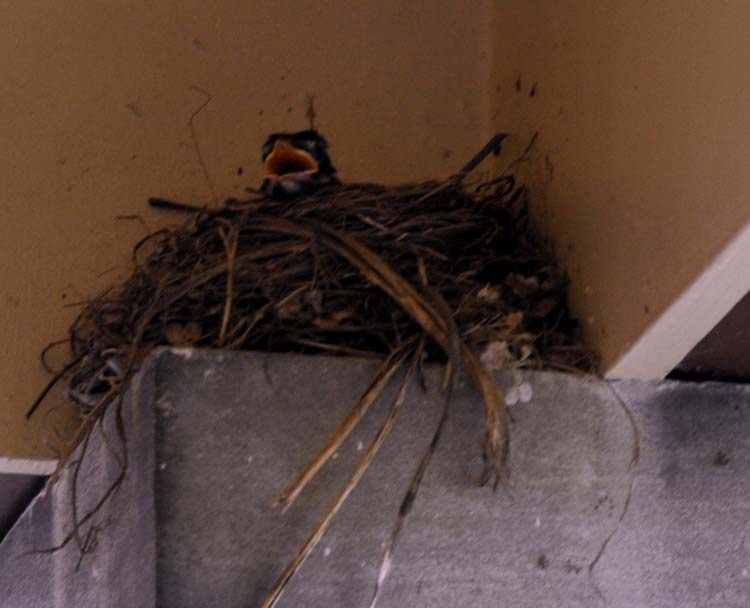
In trying to do my part to encourage spring along, I offer these few photos of a family of robins that set up house under our porch ceiling last year. 

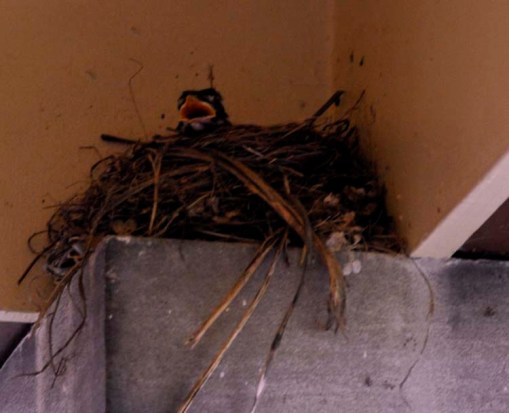
last spring, a robin pair built this nest on our front porch; by mid-May, we could see first one baby bird …

.


... then two baby birds ...


 .


... and both parents kept feeding them and feeding them and feeding them


 .

... and feeding them some more, until they were big enough to fly away

One hundred sixteen years ago this Wednesday, this story appeared in Rider & Driver:

“While the sleighing in this vicinage was at its best a few days since there started from the Suburban Club, one crisp evening, a trim cutter drawn by an equally clean-cut and racy-looking roadster. The driver, almost buried in furs, was in partial eclipse, so that his identity was completely hidden by the frost-defying robes. As the fleet-footed trotter skimmed along, setting time and the municipal limit of “seven miles an hour” at defiance, a mounted police officer came into view. Passing this living picture of an equestrian statue in a trice, the occupant of the sleigh heard the sharp command, “Pull up, you’re going too fast.” Instead of complying literally, the reins were the only part of the flying equipage that were “pulled up,” and the result was more speed. Noting the utter disregard of his mandate, the officer spurred his steed and started in hot pursuit of the offender. Another call on the nimble roadster was like pulling the throttle valve of an Empire State express engine wide open, and the galloping guardian of the peace was soon left hopelessly behind. When this phantom road driver had eluded his would-be captor he took it easier and jogged along to Van Cott’s stable on West Fifty-eighth Street. “What sort of a drive did you have, Superintendent?” was the query put to the man who had just run the gauntlet. “Out of sight,” was the appropriate response, as the mass of robes was flung aside and the stalwart form of the Byrnes stood revealed. And then the Chief of the New York police told how his trotter had “won in a walk” over one of his own patrolmen. The latter’s discomfiture would have been complete could he have got a glimpse of the quarry he had tried to run down and carry off to the station house. The Superintendent was testing the efficiency of his force. He will advocate better mounts.”

The cover of the October 2010 issue of The Carriage Journal featured a beautifully restored 1903 Cretors “Model C” popcorn wagon, owned by Richard Scott of Ohio.

You may have read more about it in this previous blog post: https://carriageassociation.wordpress.com/2010/11/16/hot-buttered-popcorn-fresh-roasted-peanuts/

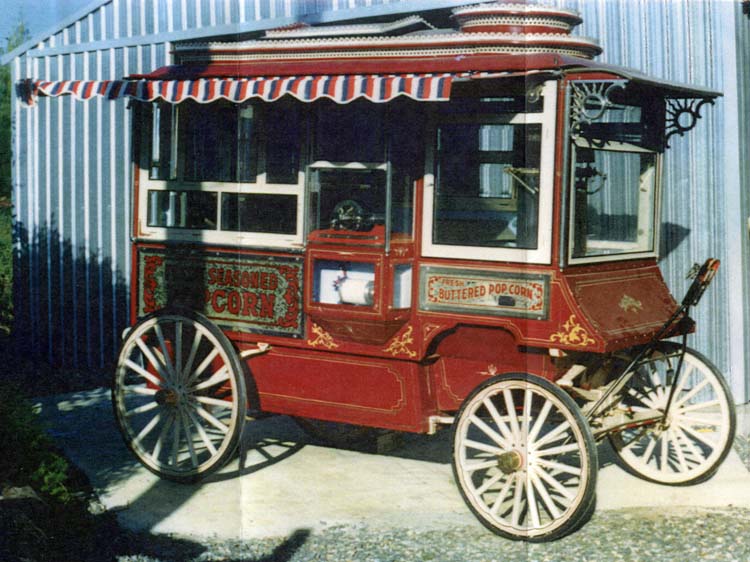
That magazine cover prompted CAA members Robert & Lori Babcock, of California, to send some photos of their own Cretors “Model C” popcorn wagon. The first of these shows the wagon at home; the second is a bit more out of the ordinary.

.

the Babcocks' Model C Cretors popcorn wagon (photo courtesy of Robert & Lori Babcock)

.

... and the same popcorn wagon, with "movie ageing," on the set of Water for Elephants, which is due in theaters in April (photo courtesy of Robert & Lori Babcock)

.

The movie, based on the best-selling book of the same name, stars Robert Pattinson, Reese Witherspoon, and Christoph Waltz. You can watch the trailer here:

.

Here’s an unusual “new” sport for a Saturday, which I found in the March 18, 1893, issue of Rider & Driver:

Equestrian Football

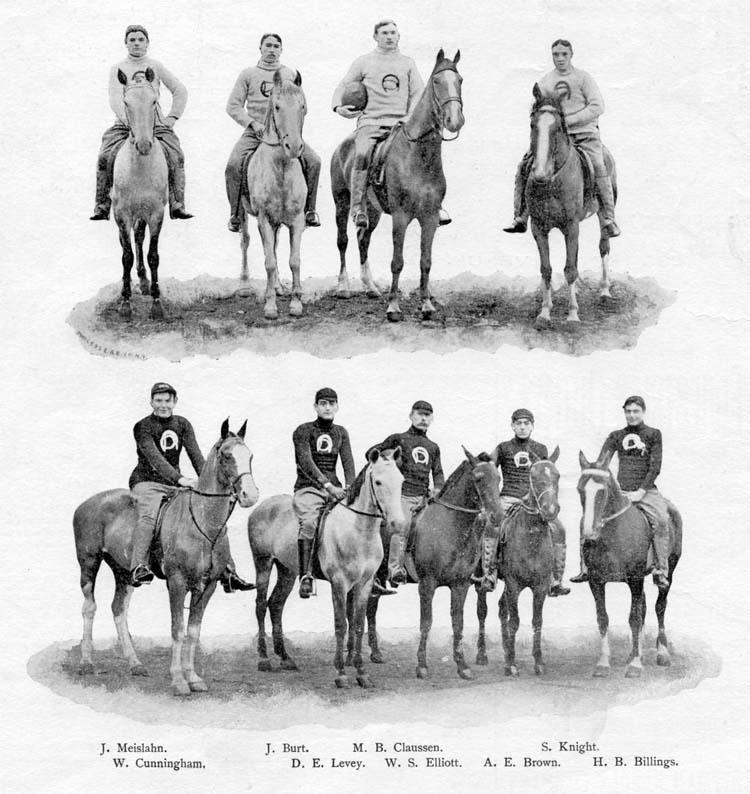
In December 1892, five members of Durland’s Riding Academy got together and drew up preliminary rules for equestrian football.

Having no guide and no experience, the rules were necessarily very crude, but since that time they have been materially changed. Two teams of four players each were then organized, and on the 24th of December, 1892, the first game of equestrian football ever undertaken in this city was played.

The first public exhibition game was on December 28, 1892, at Durland’s annual Christmas ride. The teams were [as follows]. Reds: W. S. Elliot, captain; A. F. Brown; D. E. Levey; and H. B. Billings. Whites: M. B. Claussen, captain; W. E. Kotman, J. Meislahn, and F. Staylor. Referee: L. E. Brown. Umpire: B. W. B. Brown. The game resulted in a victory for the Reds by a score of 3 goals to 1. It was a great success and immediately became a recognized sport at Durland’s. Since that time the teams have played at Durland’s on alternate Wednesday evenings; the Reds winning all the games, with one exception.

The game has become very popular, and the teams very proficient. So proficient, in fact, that they would like to try their skill with the Brooklyn Riding and Driving Club team, and have sent a challenge to them through The Rider & Driver.

Summarized, the rules are as follows:  The game shall consist of eight men, four on a side, and no horse over 15 hands high shall be used. The ball shall be placed in the center of the field. The game shall be started by one player on each side riding from his goal, dismounting in the center and trying to obtain possession of the ball. The remaining players stay at their own goal until the whistle is blown by the referee. The ball will not be in play until the player who obtains it has his leg across the saddle. Then the whistle shall be blown. A foul shall consist of a player grasping an opponent with two arms around the body or neck, or where the ball is passed forward. The ball can be taken by a player from an opponent if he rides up on the opposite side from that on which the ball is held. A player is not allowed to grasp another player’s bridle, except the bridle of the player holding the ball. In case of a foul, the side making it shall forfeit the ball and five yards. A goal is made by a player carrying the ball to the opponent’s goal, and when the touch is made the player must be mounted. Interference shall consist of a player riding in front of or beside one of his own players who is carrying the ball and warding off the opponents. Interference shall be allowed.

The umpire is the judge for the players, and his decision is final regarding fouls and unfair tactics; the referee is the judge for the ball, and his decision is final on all points not covered by the umpire; both umpire and referree shall use whistles to indicate cessation of play on fouls and expiration of time. The referee shall keep the time. The game shall consist of two ten-minute halves and intermission of five minutes. The goal shall be a piece of canvas twelve feet by eighteen inches, stretched at each end of the field, and shall be covered with chalk. A player shall be disqualified for unnecessary roughness, striking a player, or throwing a man from his horse. A player may throw or pass the ball in any direction except toward his opponent’s goal. A player is not allowed to run with the ball while dismounted, if he does so he forfeits the ball to his opponents. After the goal is made the ball shall be put in play as in the beginning of the game; at the end of the game the side having the most points shall be declared the winner. A player losing his horse after or while obtaining the ball forfeits the ball to his opponents.

.
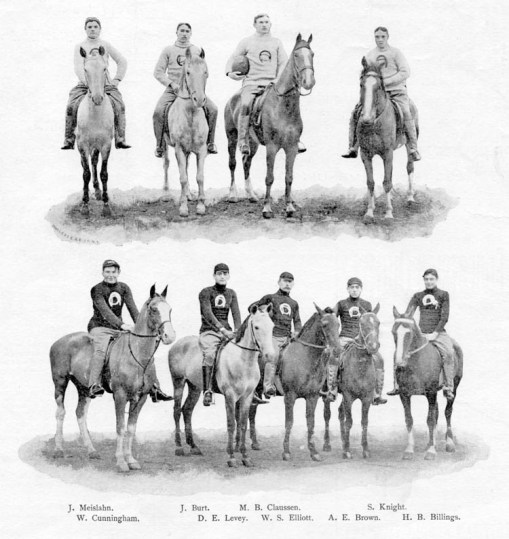
the Whites and the Reds, ready to play a game of equestrian football (from the cover of the March 18, 1893, issue of Rider & Driver)
This image …

.

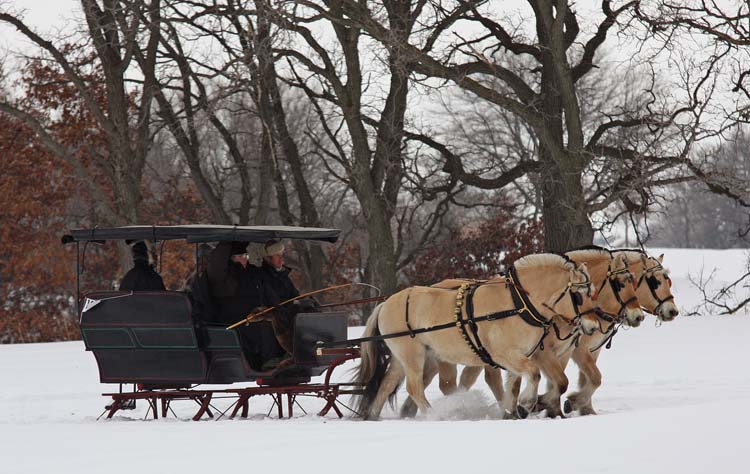
CAA member Ted Swendson drove his Fjords, three abreast, to his antique sleigh at the 2011 CAA Winter Conference in Minnesota (photo by Else Bigton)

.

… is included in our photo essay on the 2011 CAA Winter Conference, in the upcoming (March) issue of The Carriage Journal.

Unfortunately, we didn’t have room in the magazine to give too many details about this lovely old sleigh, so I thought we’d do so here.

Ted Swendson (of Calgary, Alberta, Canada) shared this information about his sleigh: It’s a Wagonette Bob-sleigh that was built around 1900. Ted described it as a “true” Bob-sleigh, meaning that the vehicle’s body was meant to be on wheels but was adapted with bobs for driving in the snow (although he believes that this particular vehicle has always had its bobs). Early in its life, this sleigh was used as a taxi in Ontario.

Ted bought this sleigh from the collection of Jack Pemberton of Ontario, and it was Jack who had it restored. The current colors are the same as they were originally, and the upholstery is all original.

Another interesting note: the Canadian government has declared this piece a “heritage” vehicle, which means that Ted is not allowed to sell it outside of Canada.