competitions


The KY Horse Park sent this press release yesterday:

With the help of First Lady Jane Beshear and executive cabinet members, the Kentucky Horse Park (KHP) announced plans for several new permanent “greening” initiatives that will be in place by September 25, 2010, the start of the Alltech FEI World Equestrian Games (WEG).

The park has been approved for a combination of American Recovery and Reinvestment Act (ARRA) stimulus funds and low-interest loans, totaling nearly $5.7 million that will be repaid by the cost savings in energy and maintenance resulting from the projects.

“By taking these aggressive efficiency measures, the Kentucky Horse Park is demonstrating the value of energy conservation and how it has a positive impact on our environment now and in the future,” said Mrs. Beshear. “As a World Equestrian Games board member and as a Kentuckian, I am confident that when our international guests arrive for the Games, they will be impressed with our world-class facility in the Kentucky Horse Park.”

She added, “I am a firm believer in leading by example, and over the last couple of years, the Commonwealth of Kentucky has made great strides to make state-owned facilities more energy efficient and environmentally friendly.”

The energy conversation measures range from renewable energy solutions to innovative and traditional energy conservation measures and cost savings. Once the cost of the design, installation, and maintenance of the energy conversation measures are paid, all further savings will generate revenue for the park indefinitely.

“It is imperative that we protect and improve the integrity of our land, water, and air, which have had fundamental roles in making Kentucky the Horse Capital of the World,” said John Nicholson, executive director of KHP. “I’m very proud that the Kentucky Horse Park will be a flagship in the movement toward better stewardship of these treasures, while operating the park more efficiently. In addition to being the right thing to do at this time, the progressive measures we’re taking now will benefit the people, animals, and environment of our great commonwealth for many years to come.”

The park secured funding from two sources: an Energy Savings Performance Contract (ESPC) and an ARRA grant, administered by the Kentucky Infrastructure Authority’s Clean Water State Revolving Fund. The $1.95 million ARRA award will be structured as fifty percent low interest and fifty percent principal forgiveness loans.

An ESPC is an agreement between a state government facility and an Energy Services Company (ESCO) in which energy-efficiency improvement projects are financed through the savings these projects are guaranteed to produce. The ESCO for this project is Ameresco Inc., the largest independent energy services provider in North America. Ameresco has an office in Louisville.

Kentucky’s Energy and Environment Cabinet receives the federal funding for the ESPC program, which is administered by the Finance and Administration Cabinet.

“ESPCs are a great resource for government buildings to conserve energy and money through facility improvements and upgrades that will pay for themselves and eventually earn revenue,” said Jonathan Miller, secretary of the Finance and Administration Cabinet. “Energy reduction measures that may seem futuristic to us now will become more routine in daily life and in new construction as we learn more ways to reduce our carbon footprint.”

An extensive inflow and infiltration project at KHP will benefit the park and also the Lexington Fayette Urban County Government (LFUCG) sewer district. The existing antiquated KHP sanitary sewer system has historically been affected by infiltration and inflow when it rains. This has caused the sewer bills to rise for this facility disproportionately when compared to potable water consumption.

This ESPC project includes repairing the sanitary sewer manholes and repairing or replacing the sewer piping, resulting in an annual savings on the sewer bill of about $149,000. Preventing the infiltration of rain water into the system will keep approximately 26 million gallons of waste water from going to the LFUCG sewer plant for treatment.

Another project that will provide multiple cost-saving benefits to the park is the “Energy from Waste” facility, funded by the ARRA award. It will use a biomass gasification process for the disposal of horse manure. In the gasification process, horse manure will be converted into so-called “producer gas,” which can be used to generate electricity.

Based on historic and projected muck generation at the park, there is an opportunity to produce about 1.6 Megawatts of electricity each year. This will offset the park’s electrical needs, thereby reducing the annual cost for electricity by about $84,000. It will also eliminate the cost of muck disposal, also saving the park $133,899 annually. The Energy from Waste facility will produce less greenhouse gases than the continued transport of muck to a landfill.

The total estimated annual cost savings for all of these energy-efficiency measures: $582,000.

In addition, forty-four solar-tracking skylights will be installed at the park’s existing covered arena. These skylights consist of highly reflective mirror panels within a clear plastic enclosure, which move continuously to follow the sun’s position in the sky, eliminating the need for electric lighting in the arena during daylight hours.
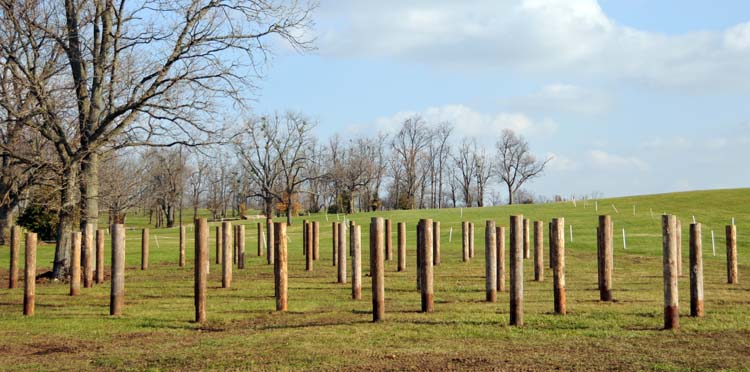
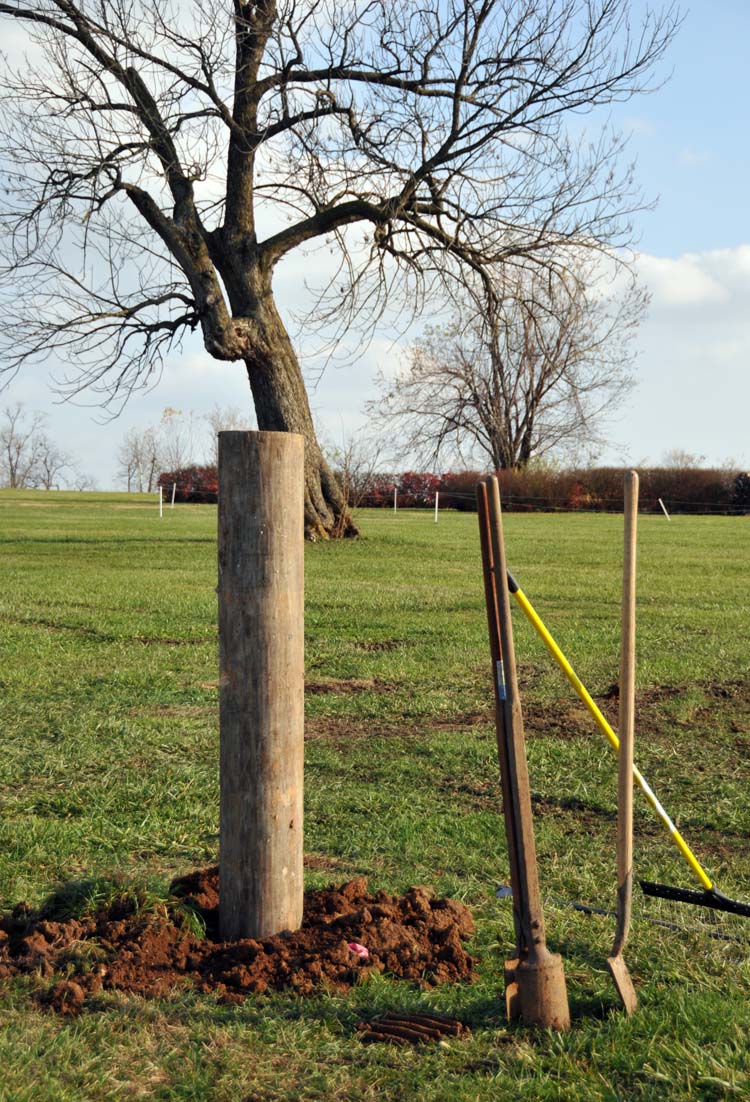
… after adding water (it has, indeed, rained several times over the past week or so) … the collection of orange and pink flags grew into a collection of posts:

a crop of posts has sprouted at the site of a new WEG marathon obstacle, where before there was a crop of flags (which you can see in the second photo from the Nov. 12 post)

Of course, I’m joking. There’s a whole lot more effort involved in putting all these posts in place. Today, I went out to the site of yet another new WEG marathon obstacle, which I think will be known as “The Hedges.” There, posts were still being wrestled into the ground. And mighty hard work it appears to be, too. As you can see in this photo, some of the posts are firmly in the ground and some aren’t quite yet. While I was there, Aaron, Isaac, and Lenny were hard at work: setting posts in their deep holes (dug by hand with post-hole diggers), making sure they were plumb and level, and laboriously tamping the soft dirt (it has rained, remember) in around them.

some posts at the new “Hedges” obstacle … some are set and some are still being placed

one of the posts, in place but not yet firmly set

Back over at Mick’s Mountain, it appears that the pergola (shown recently while in progress) is now finished:

my, what a pretty pergola

And, finally, here’s one of the sculptural new posts (yes, it’s a former tree) at yet another obstacle:

a beautiful new post, made from a tree, over at … wait, I’m not going to say which obstacle this is … we don’t want to give EVERYTHING away

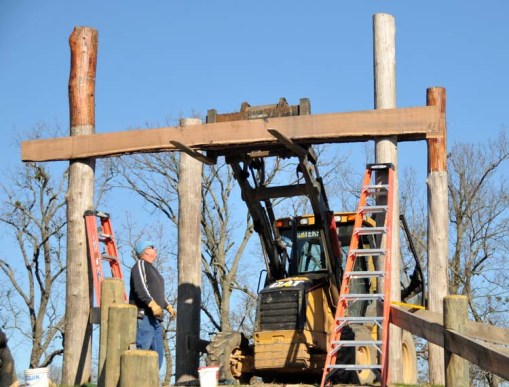
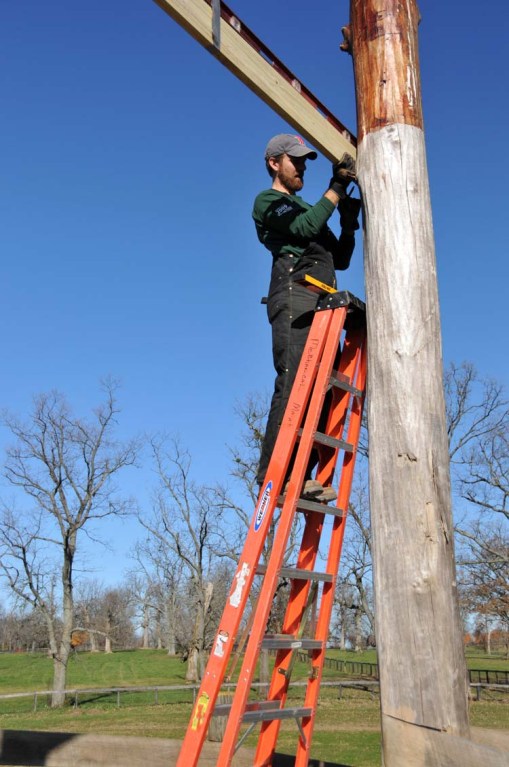
Yesterday was a perfect fall day for working outside: sunny but not hot, breezy but not cold, and with a bright blue sky overhead. I was working at my computer, as usual, when Mick (the course builder for the WEG cross-country and marathon courses) called to say they were just starting work on some of the decorative additions to the big hill obstacle — “Mick’s Mountain.” So, naturally, I grabbed my camera and went out into the sunshine to get some photographic evidence of the work being done.

the first two supports being added to either side of the pillars at the top of the hill … these are being held up at the moment by the front-loader’s forks, before they’re actually attached to the pillars

Isaac (on the left) checks whether the boards are level, while Mick (on the right) gets into position to help hold them in place while they’re attached

gathering the boards for the two pillars on the other side of the hilltop

while Mick collects the next set of boards, Isaac marks where they should go

the second set of boards is hoisted up into place

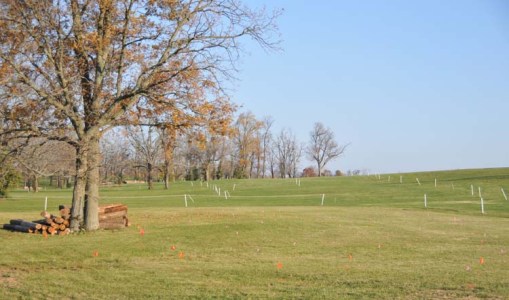
I tweeted a week ago about all the flags that have sprouted in areas that will soon (well, sometime within the next eight or nine months) be new marathon obstacles for next year’s WEG.

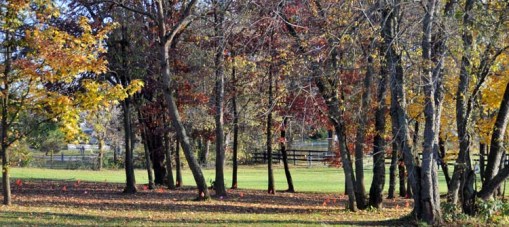
Admittedly, they don’t look like much at this stage, but see if you can pick out the spots of orange and pink in these two photos … these are the “way-before” photos of two new marathon obstacles.

can you see them? under the trees, there in the “grove” are flags marking a new obstacle for next year’s WEG driving marathon (10/9/10)

this one is near the Sunken Road and Mick’s Mountain

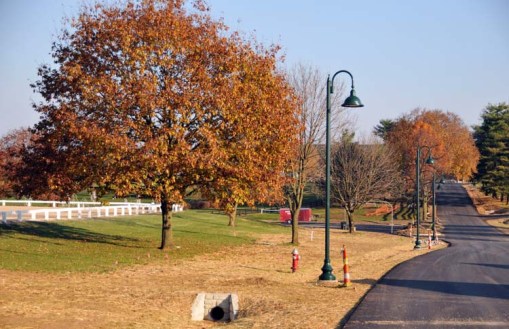
And, on a separate note, here are a portion of the newly re-surfaced Nina Bonnie Rd and one of the pretty new streetlights. Aren’t we getting fancy here at the Horse Park?

new streetlights along the re-paved Nina Bonnie Rd at the Kentucky Horse Park

The most recent test event for next year’s WEG was yesterday’s endurance race … and endure they did, both the horses and the riders. We’ve had an oddly wet October here in Lexington, and yesterday’s weather varied from pouring rain to misty and windy, with temps that never climbed out of the 40s. It’s usually the safety and well-being of the horses that is topmost in everyone’s mind during an endurance race, but I read in the newspaper this morning that one of the riders was treated for hypothermia at the first vet check. The track, which wound through the Horse Park and a dozen or so neighboring and nearby farms, turned into slippery grass and/or sloppy mud in most places. 

There were actually two races being contested at the same time: a CEI** of 120 km (approx. 75 miles) and a CEI*** of 160 km (approx. 100 miles). In the end, the 3-star event was reduced to 120 km as well because the conditions were becoming dangerous, with horses slipping and sliding too much in the mud and, as one vet said, a lot of “low-level lameness” showing up in the vet checks.

It had all started well enough, with a big, impressive first horse inspection on Tuesday in the new outdoor arena. Horses were presented in teams, or by nation. Six jogging lanes arranged side by side allowed for several horses to be inspected at any one time. Because the sport of endurance depends so much on purely objective factors — whether the horse is fit to continue — the judges here are all veterinarians.

Over to the side, away from the jogging lanes, riders were being weighed with their tack.

In a fantastic show of international support for this test event and, we can only hope, for the WEG itself, riders from 23 countries competed at this event. They came from all over the Americas, Europe, the Middle East, the Far East, and Africa. Some brought their own horses and some borrowed or leased them (this is a fairly typical practice in endurance, unlike many of the other WEG sports).

I didn’t make it out to the start/finish line yesterday to watch everyone leave in the early-morning gloom (and pouring rain), but I did make it just in time in the afternoon to hear the announcer welcome the first-place finisher in the 2-star event. Of course, crossing the finish line first doesn’t mean that you’ve won the race. Once over the line, there is a final cool-down period and a final vet check. Even at the end, the horse must be declared by the vets to be “fit to continue” before it’s officially done for the day. Surprisingly, given the mud and water one had to slop through to get to the back field where the finish line, vet check lanes, two-story VIP “party” tent, food vendors, etc, were set up, there were quite a lot of people there.

This morning, I happened in to the awards ceremony in the Horse Park’s covered arena. There had been a delay in getting things started, which allowed the crowd to continue to enjoy the huge breakfast spread that had been laid out for them (hot egg casserole, scones, croissants, yogurt, fruit, juice, coffee).

In the 2-star event, 22-year-old HE Sheikh Majid bin Mohammed Al Maktoum, son of HH Sheikh Mohammed bin Rashid Al Maktoum (ruler of Dubai; husband of the FEI president, Princess Haya; and horse- and land-owner here in Kentucky), won the race with a ride time of six hours, five minutes, and thirty seconds. The ride time, of course, doesn’t indicate the actual time elapsed on course. During each event, there are a number of vet checks (also known as gates). When the horse and rider arrive at the check, the rider jumps off and the crew strips the saddle and begins cooling the horse down. Once the horse’s heart rate has reached the maximum allowed (64 bpm), he is checked by a veterinarian. Once deemed “fit to continue,” the horse enters a mandatory rest period of either 30 or 50 minutes. When that’s done, out they go again.

The medals in the KY Cup event (the 3-star) were all won by American women. Danielle McGunigal (daughter of endurance superstar Valerie Kanavy) won the gold medal with a ride time of 6:30:41. Ellyn Rapp won the silver medal with a ride time of 6:52:16; and Jan Worthington won the bronze medal (and her mount, Golden Lightning, won the Best Conditioned Award) with a ride time of 7:01:33.

The poignant moment in the awards ceremony came when we all were asked to stand for the national anthem … and the music wouldn’t play. So everyone in the audience sang the Star-Spangled Banner instead of just humming along.

« Previous PageNext Page »