I’m not sure whether the stuff on the street in this photo is rain or snow … it looks suspiciously like snow, although it could be rain and the “white” we see might actually be sunshine. A summer storm, perhaps? Nevertheless, the somewhat dreary mood I pick up from this photo matches our still-cool, dreary “spring” weather here today.

This photo was taken in Montreal, Canada, c. 1916. There are two work vehicles with teams (pairs) of draft horses; two men driving light, private vehicles to single horses; a couple of motorcars; and streetcars in the background.

On Monday, Jill was looking for something in the CAA library and came across a reprint of an old book of photographs. The second edition of the original book (the edition that’s been reprinted) was published in 1876, so I don’t actually know when the collection was originally published, or when the photos were taken … but it’s safe to say that they’re all from the mid-nineteenth century.

I’ll be sharing most of these wonderful old photos here, and I thought I would start with two of my favorites:

.

.

.

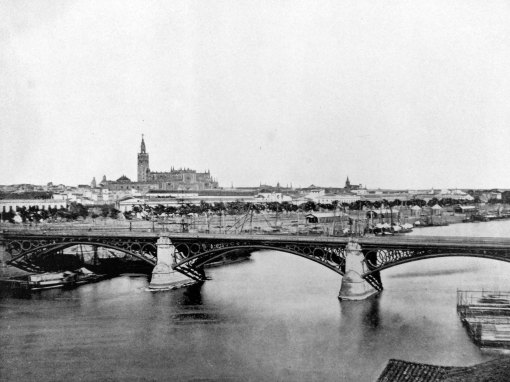
For the final day on our brief visit to Sevilla, here’s another Glimpses of the World photo, which shows a panoramic view of the beautiful city:

.
.

The book’s caption for this photo reads: “From the summit of the old Moorish spire, the Giralda [the tall spire in the photo above, originally a minaret and now the cathedral’s bell tower], the view of Sevilla is one of exquisite beauty. Clasping it in beauty, like a silver girdle, is that stately river, whose Moorish name (the Guadalquiver) sounds, even when pronounced in English, like a strain of music. It is a very ancient city, famous for distinguished men, lovely women, palm trees and orange groves, charming courtyards, fine churches, and many rare paintings by Murillo and Velasquez. From Sevilla two of the most celebrated Roman emperors, Hadrian and Trajan, went forth to wear the imperial purple of the world. Here the gifted Moors reigned for many centuries in splendor. Each house in Sevilla, however plain its exterior may be, will have its pretty courtyard paved with marble and enclosed by walls enameled with glazed tiles. In these charming patios occur in the soft delightful evenings of Sevilla the little informal social parties, which render a residence here agreeable. A few modern squares are to be found here, but it is often unpleasant to cross their broad expanse of fiery sunlight, and the narrow, Moorish streets, into which the sun only fully enters for an hour at noon, seem better suited to its climate.”

.

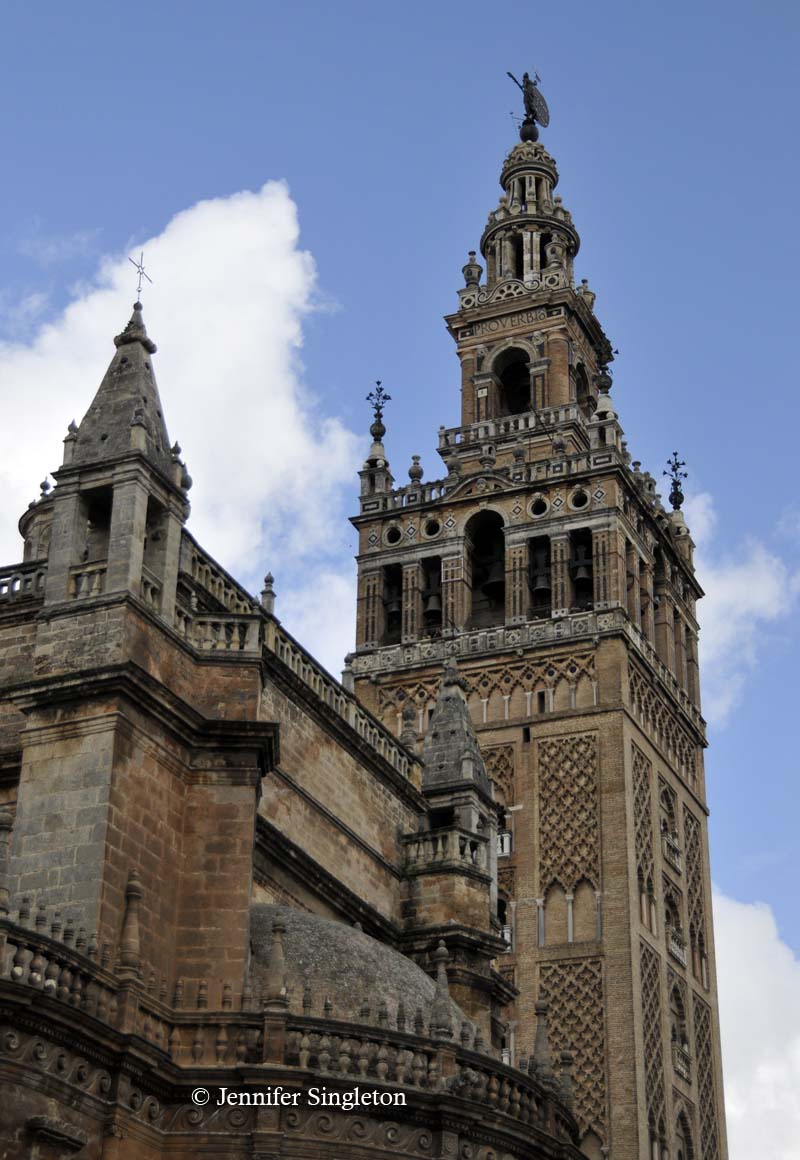
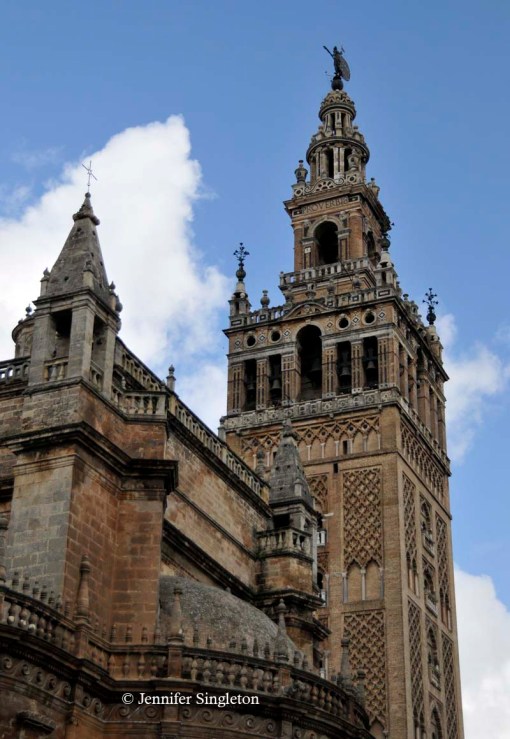
From among the many photos I took in Sevilla in 2010 here, first, is one of the Giralda and a bit of the city’s massive cathedral.

.
.

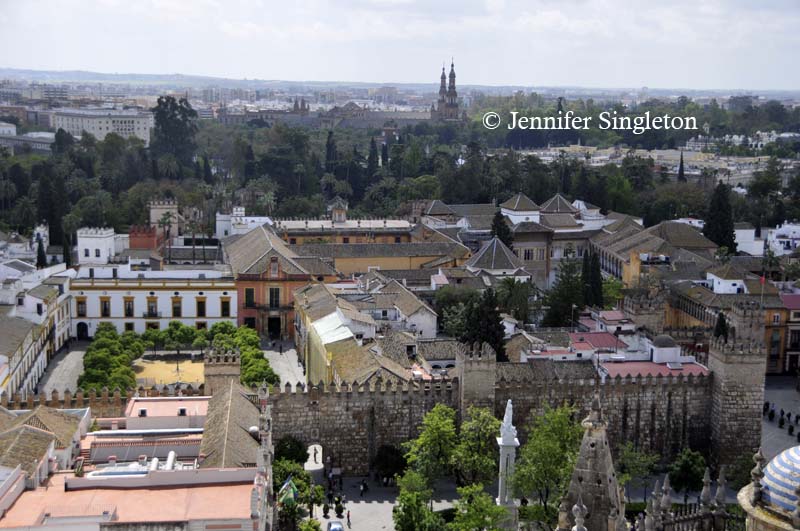
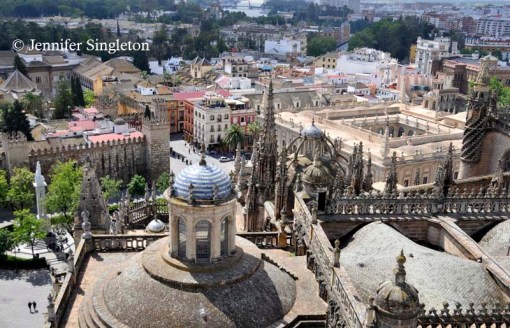
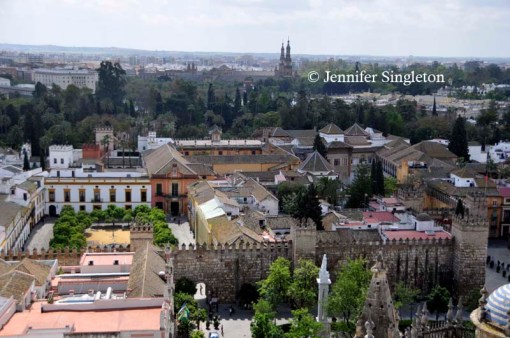
And as you can see here, the view from the Giralda (the first photo is from one of the windows on the climb up the tower, and the other two are from the top) is still one of “exquisite beauty,” as our book’s authors claimed 120 years ago.

.

.
.
.

In this photo, the complex with the crenellated wall is the Real Alcázar, which we peered inside in yesterday’s post.
Even though Semana Santa and Easter are behind us, I think we’ll stay in Sevilla for a couple more days.

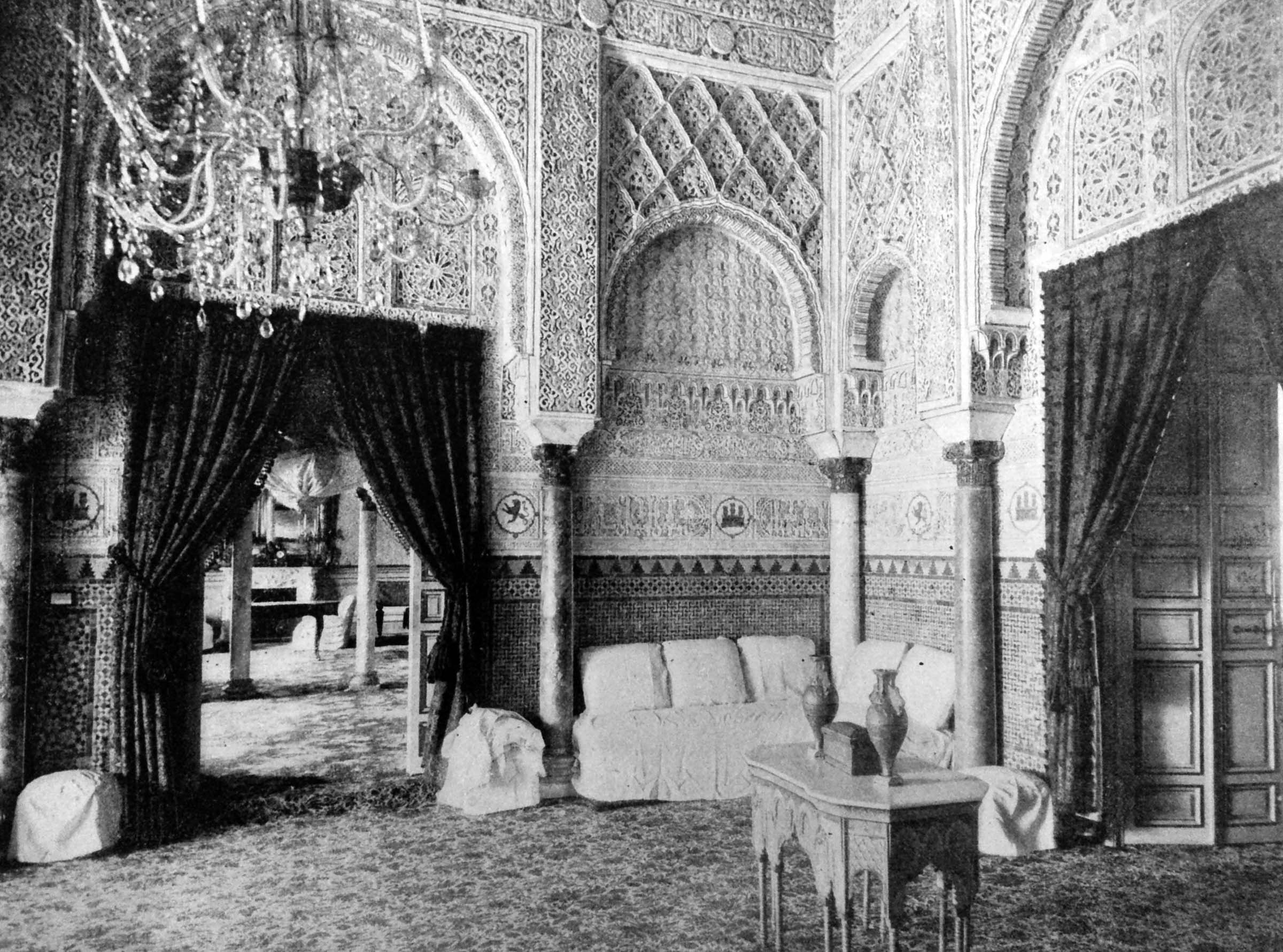
Going back to our Glimpses of the World book, here’s a late-nineteenth-century interior photo of the Real Alcázar … which is remarkable because the rooms are shown furnished.

.

.

The book’s caption for this photo says: “The Alcázar (a name derived from Al Kasr, the “house of Caesar”) is a Moorish palace, begun when Arabian Caliphs ruled in Spain in 1181. It was, however, largely rebuilt by the [fourteenth-century] Christian sovereign, Pedro the Cruel. The room portrayed in this illustration is the boudoir of Maria de Padilla, the beautiful lady whom Pedro loved and secretly married. … The Alcázar of Sevilla is in some respects more beautiful than the Alhambra. At all events its Moorish ornamentation has suffered less from the ravages of Time and Man. Its exquisite tile-work and the stucco tapestry of its walls are like mantles of finely woven lace. Behind this palace are lovely gardens, laid out by Charles V, and abounding in myrtle hedges and orange groves, bright with their glistening leaves and fruit of gold. The windows of this apartment command a view of those gardens, and no doubt the beautiful Maria de Padilla has often looked out upon their charming terraces and breathed their perfume-laden air.”

.

If you were to tour the Real Alcázar today, you could wander through gorgeous — but empty — rooms, and lovely courtyards and gardens.

Here are a few glimpses of the elaborately beautiful walls and doorways in the Real Alcázar, which I took in 2010:

.

.

.

.

.

If you’re still following along with my trip back to Spain for Holy Week, here is a lovely (about half-an-hour-long) video of a portion of the Easter Sunday “Resurrection” procession in Sevilla. Each procession has two pasos: one that depicts a particular point in the Holy Week story, and one that features an elaborately dressed Virgin Mary. The pasos, many of them hundreds of years old, are carried along their route by a multitude of men who are underneath the paso. The points in the videos you may’ve watched from Friday’s post and in this one, where the paso stops, is when those men have a bit of a break. Then you can sometimes hear the bang of a doorknocker-type contraption that is the signal for the men to hoist the paso back up and begin its “dance” down the street. All of this is unbelievably impressive in person, especially given their size and apparent weight, but you can get a feel for it from these various videos.

.

.

When I followed this particular procession on Easter Sunday 2011, the candles on the Virgin’s paso had burned way down and were dripping wax rather alarmingly by the third time I saw her, in the early afternoon. And I think people on balconies along the route must toss rose petals onto the fabric of the canopy as she passes by, because by that third time I saw her, petals came floating down every time the paso was hoisted back up.

.

Again, if the embedded video won’t play, click here to watch it on YouTube.