Lexington & KHP


The KY Horse Park sent this press release yesterday:

With the help of First Lady Jane Beshear and executive cabinet members, the Kentucky Horse Park (KHP) announced plans for several new permanent “greening” initiatives that will be in place by September 25, 2010, the start of the Alltech FEI World Equestrian Games (WEG).

The park has been approved for a combination of American Recovery and Reinvestment Act (ARRA) stimulus funds and low-interest loans, totaling nearly $5.7 million that will be repaid by the cost savings in energy and maintenance resulting from the projects.

“By taking these aggressive efficiency measures, the Kentucky Horse Park is demonstrating the value of energy conservation and how it has a positive impact on our environment now and in the future,” said Mrs. Beshear. “As a World Equestrian Games board member and as a Kentuckian, I am confident that when our international guests arrive for the Games, they will be impressed with our world-class facility in the Kentucky Horse Park.”

She added, “I am a firm believer in leading by example, and over the last couple of years, the Commonwealth of Kentucky has made great strides to make state-owned facilities more energy efficient and environmentally friendly.”

The energy conversation measures range from renewable energy solutions to innovative and traditional energy conservation measures and cost savings. Once the cost of the design, installation, and maintenance of the energy conversation measures are paid, all further savings will generate revenue for the park indefinitely.

“It is imperative that we protect and improve the integrity of our land, water, and air, which have had fundamental roles in making Kentucky the Horse Capital of the World,” said John Nicholson, executive director of KHP. “I’m very proud that the Kentucky Horse Park will be a flagship in the movement toward better stewardship of these treasures, while operating the park more efficiently. In addition to being the right thing to do at this time, the progressive measures we’re taking now will benefit the people, animals, and environment of our great commonwealth for many years to come.”

The park secured funding from two sources: an Energy Savings Performance Contract (ESPC) and an ARRA grant, administered by the Kentucky Infrastructure Authority’s Clean Water State Revolving Fund. The $1.95 million ARRA award will be structured as fifty percent low interest and fifty percent principal forgiveness loans.

An ESPC is an agreement between a state government facility and an Energy Services Company (ESCO) in which energy-efficiency improvement projects are financed through the savings these projects are guaranteed to produce. The ESCO for this project is Ameresco Inc., the largest independent energy services provider in North America. Ameresco has an office in Louisville.

Kentucky’s Energy and Environment Cabinet receives the federal funding for the ESPC program, which is administered by the Finance and Administration Cabinet.

“ESPCs are a great resource for government buildings to conserve energy and money through facility improvements and upgrades that will pay for themselves and eventually earn revenue,” said Jonathan Miller, secretary of the Finance and Administration Cabinet. “Energy reduction measures that may seem futuristic to us now will become more routine in daily life and in new construction as we learn more ways to reduce our carbon footprint.”

An extensive inflow and infiltration project at KHP will benefit the park and also the Lexington Fayette Urban County Government (LFUCG) sewer district. The existing antiquated KHP sanitary sewer system has historically been affected by infiltration and inflow when it rains. This has caused the sewer bills to rise for this facility disproportionately when compared to potable water consumption.

This ESPC project includes repairing the sanitary sewer manholes and repairing or replacing the sewer piping, resulting in an annual savings on the sewer bill of about $149,000. Preventing the infiltration of rain water into the system will keep approximately 26 million gallons of waste water from going to the LFUCG sewer plant for treatment.

Another project that will provide multiple cost-saving benefits to the park is the “Energy from Waste” facility, funded by the ARRA award. It will use a biomass gasification process for the disposal of horse manure. In the gasification process, horse manure will be converted into so-called “producer gas,” which can be used to generate electricity.

Based on historic and projected muck generation at the park, there is an opportunity to produce about 1.6 Megawatts of electricity each year. This will offset the park’s electrical needs, thereby reducing the annual cost for electricity by about $84,000. It will also eliminate the cost of muck disposal, also saving the park $133,899 annually. The Energy from Waste facility will produce less greenhouse gases than the continued transport of muck to a landfill.

The total estimated annual cost savings for all of these energy-efficiency measures: $582,000.

In addition, forty-four solar-tracking skylights will be installed at the park’s existing covered arena. These skylights consist of highly reflective mirror panels within a clear plastic enclosure, which move continuously to follow the sun’s position in the sky, eliminating the need for electric lighting in the arena during daylight hours.
This blog is of course focused on carriages, driving, and horses. But with the World Equestrian Games coming in less than a year to our CAA’s home (the Kentucky Horse Park in Lexington), you may have noticed that I try to include a few things here and there about the KY Horse Park or about Lexington in general. As we get closer to the WEG next fall, I’ll be continuing to post more about our fair city. If you’re one of the 200 or so people signed up for our CAA trip to the WEG, I figure you might want to know a bit about where you’re headed.

As you may have gathered, or as you’ve no doubt seen if you’ve been here, Lexington is pretty horse crazy. Heck, we even call ourselves the Horse Capital of the World. Two of our major sporting events each year: racing at Keeneland and the Rolex KY Three-Day Event.

But we’re also a university town. And because we have no big-time professional sports (we do have a single-“A” minor-league baseball team and a brand-new semi-pro basketball team, the Stallions, which plays its home games at … the KY Horse Park), college sports rule the day when it comes to non-horse events. So Lexington’s (nearly the entire state’s, in fact) other main passion: basketball. Specifically, the University of Kentucky Wildcats … the winningest program in all of college basketball.

If you watch ESPN or read Sports Illustrated, you may have heard that the Wildcats have a new coach this year.

After several “bad” years — ranging from blah (a few heartbreaking losses and a lot of lackluster performance) to dismal (a lot of heartbreaking losses, “fans” booing our own players, and allegations of an abusive coach) — we now have Coach Calipari, whose post-game comments after home games (on the radio or in person for the few hundred people who stay) are like attending a basketball 101 clinic. He wants his players to both play well and to have fun, and he is focused on teaching them to play well. The improvement in the way the team played from last Thursday’s game to this past Saturday’s game was amazing.

This year’s team hasn’t lost a game yet. If the Cats keep winning, they’re on track to reach their 2,000th win (the first college basketball team to do so) sometime in December. We’ll keep you posted.

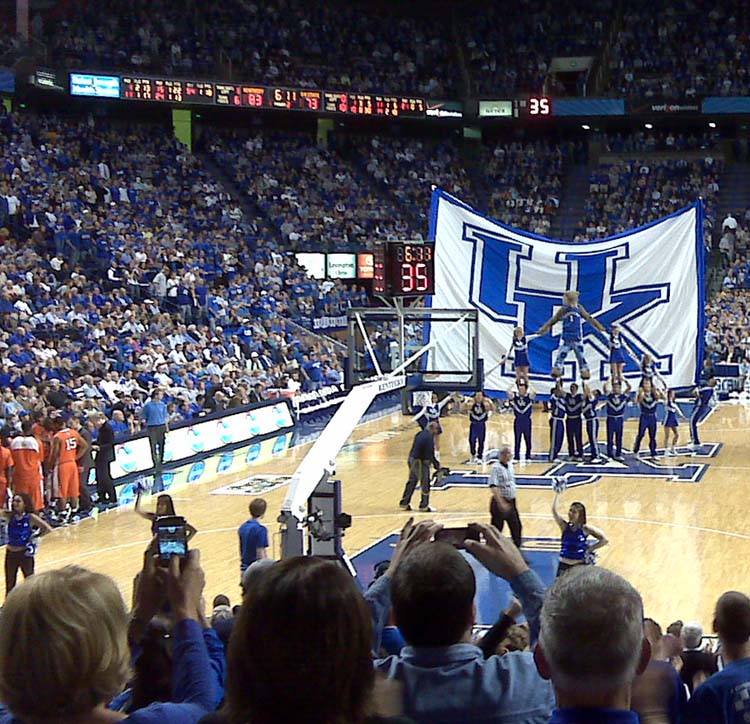
during a late-in-the-game long timeout (usually at about 7 or so minutes left to go), the cheerleaders and the Wildcat mascot bring out the rotating pyramid and the flag backdrop, while everyone in the stands (usually around 24,000) stands to sing, cheer, or applaud in unison while the band plays the UK fight song

… after adding water (it has, indeed, rained several times over the past week or so) … the collection of orange and pink flags grew into a collection of posts:

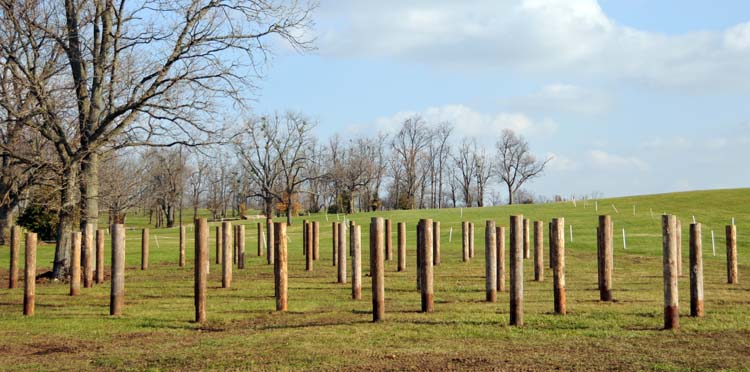
a crop of posts has sprouted at the site of a new WEG marathon obstacle, where before there was a crop of flags (which you can see in the second photo from the Nov. 12 post)

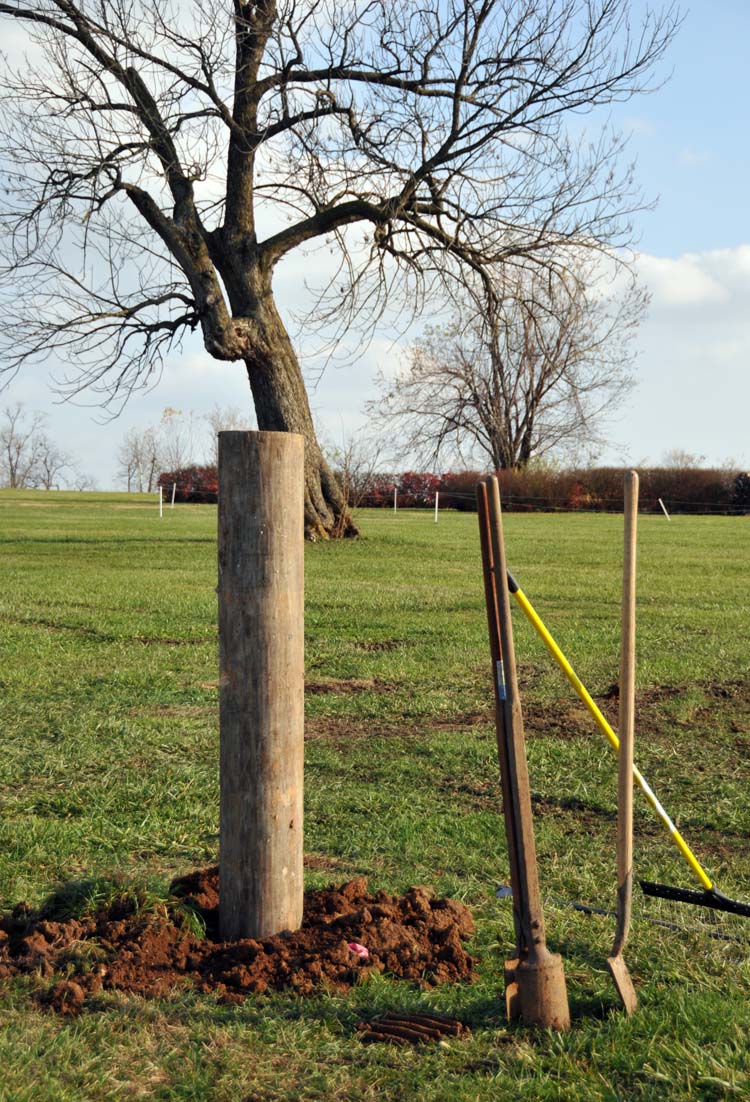
Of course, I’m joking. There’s a whole lot more effort involved in putting all these posts in place. Today, I went out to the site of yet another new WEG marathon obstacle, which I think will be known as “The Hedges.” There, posts were still being wrestled into the ground. And mighty hard work it appears to be, too. As you can see in this photo, some of the posts are firmly in the ground and some aren’t quite yet. While I was there, Aaron, Isaac, and Lenny were hard at work: setting posts in their deep holes (dug by hand with post-hole diggers), making sure they were plumb and level, and laboriously tamping the soft dirt (it has rained, remember) in around them.

some posts at the new “Hedges” obstacle … some are set and some are still being placed

one of the posts, in place but not yet firmly set

Back over at Mick’s Mountain, it appears that the pergola (shown recently while in progress) is now finished:

my, what a pretty pergola

And, finally, here’s one of the sculptural new posts (yes, it’s a former tree) at yet another obstacle:

a beautiful new post, made from a tree, over at … wait, I’m not going to say which obstacle this is … we don’t want to give EVERYTHING away

I haven’t seen it yet, but I hear that the top of Mick’s Mountain’s pergola (which was in the beginning stages of construction in the previous post) is now finished. I would’ve walked out to see it, but we had quite a bit of rain today, so there’s now quite a bit of mud between here and there. And, too, as Mick himself pointed out, you need sunshine (i.e., shadows) to make a pergola really stand out. So I’ll wait, camera at the ready, for the next sunny day.

At one of the new marathon obstacle sites (the one between Mick’s Mountain and the Sunken Road), the orange and pink flags I showed you last Thursday are being replaced by solid wooden posts.

I also heard this afternoon about an intriguing new (well, new to here, no one really knows how old it is) piece of machinery in Mick’s arsenal … this one can apparently be rigged to “polish” entire logs. He promised to call me once it’s in use, and I threatened to bring my little video camera so we can post some action shots!

In other areas of the park, the mysterious new parking lot / road on the other side of the covered arena from the CAA office appears to be nearing completion. It will be interesting to see, once it’s done, how it’s actually laid out … it’s been kind of hard to tell up to this point.

And “Southern Lights” — the Horse Park’s annual drive-through holiday lights show — is set to begin very soon … this weekend, I believe.

Yesterday was a perfect fall day for working outside: sunny but not hot, breezy but not cold, and with a bright blue sky overhead. I was working at my computer, as usual, when Mick (the course builder for the WEG cross-country and marathon courses) called to say they were just starting work on some of the decorative additions to the big hill obstacle — “Mick’s Mountain.” So, naturally, I grabbed my camera and went out into the sunshine to get some photographic evidence of the work being done.

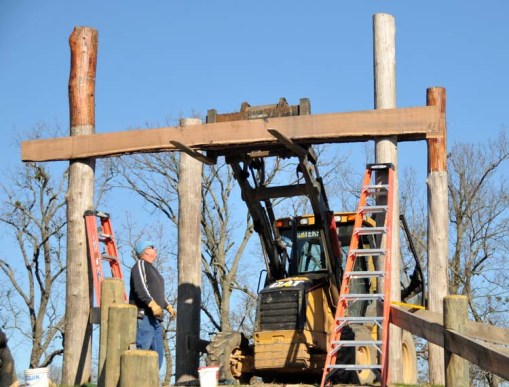
the first two supports being added to either side of the pillars at the top of the hill … these are being held up at the moment by the front-loader’s forks, before they’re actually attached to the pillars

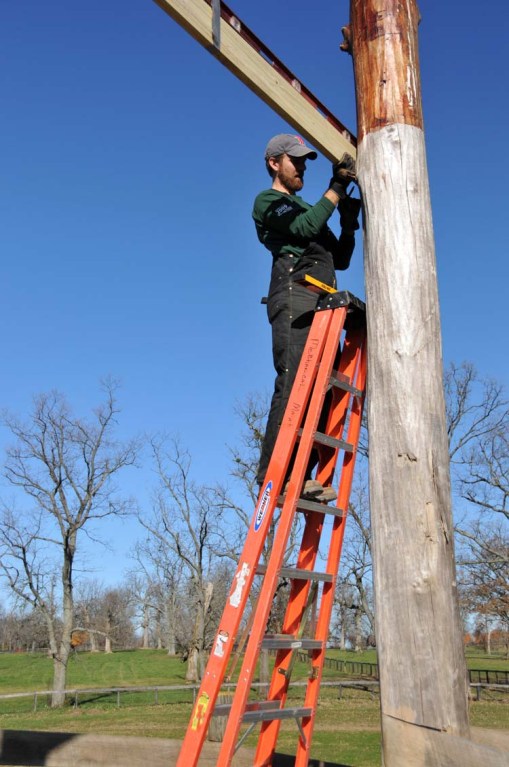
Isaac (on the left) checks whether the boards are level, while Mick (on the right) gets into position to help hold them in place while they’re attached

gathering the boards for the two pillars on the other side of the hilltop

while Mick collects the next set of boards, Isaac marks where they should go

the second set of boards is hoisted up into place

« Previous PageNext Page »