history


On Monday, Jill was looking for something in the CAA library and came across a reprint of an old book of photographs. The second edition of the original book (the edition that’s been reprinted) was published in 1876, so I don’t actually know when the collection was originally published, or when the photos were taken … but it’s safe to say that they’re all from the mid-nineteenth century.

I’ll be sharing most of these wonderful old photos here, and I thought I would start with two of my favorites:

.

.

.

Even though Semana Santa and Easter are behind us, I think we’ll stay in Sevilla for a couple more days.

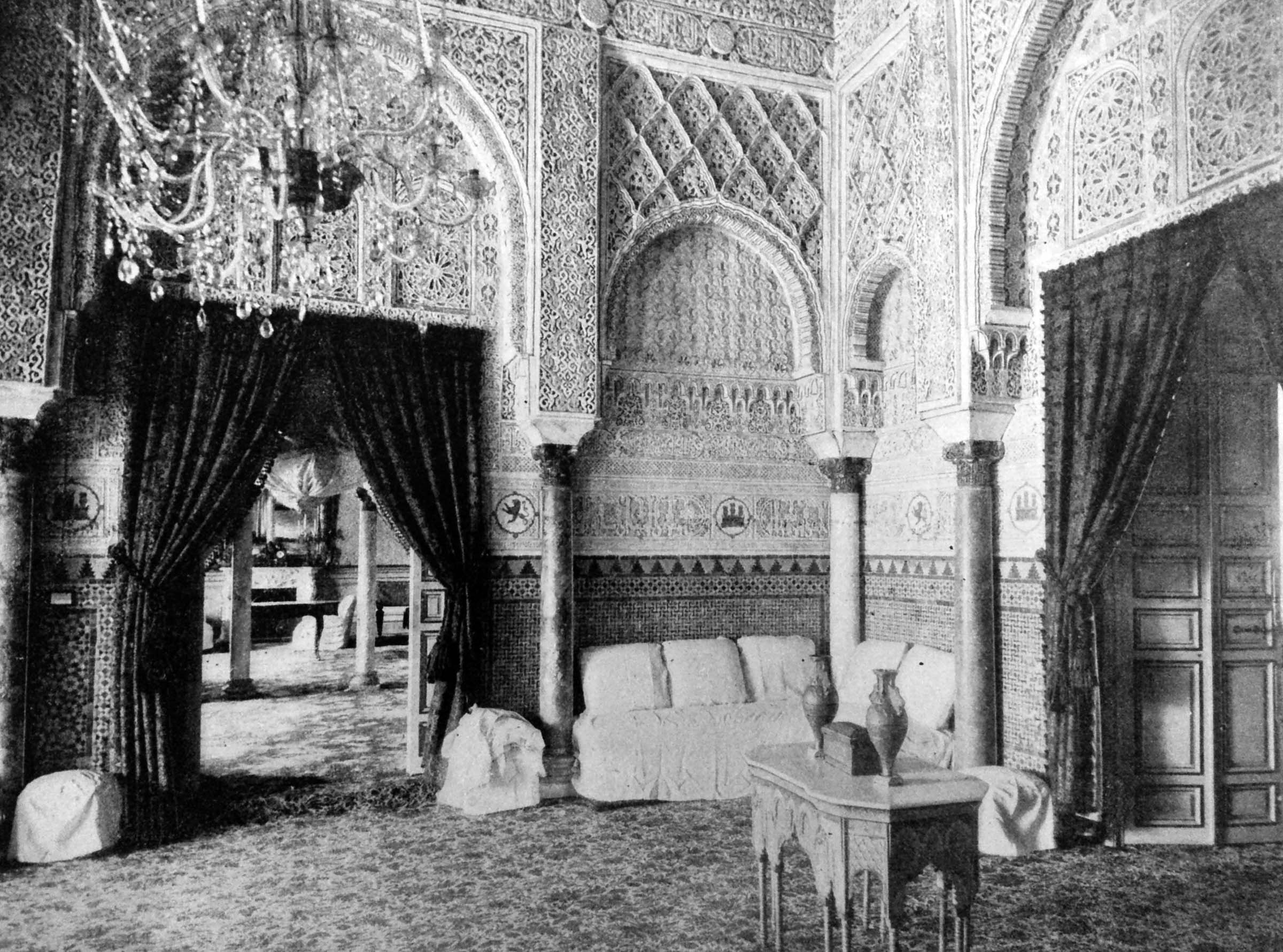
Going back to our Glimpses of the World book, here’s a late-nineteenth-century interior photo of the Real Alcázar … which is remarkable because the rooms are shown furnished.

.

.

The book’s caption for this photo says: “The Alcázar (a name derived from Al Kasr, the “house of Caesar”) is a Moorish palace, begun when Arabian Caliphs ruled in Spain in 1181. It was, however, largely rebuilt by the [fourteenth-century] Christian sovereign, Pedro the Cruel. The room portrayed in this illustration is the boudoir of Maria de Padilla, the beautiful lady whom Pedro loved and secretly married. … The Alcázar of Sevilla is in some respects more beautiful than the Alhambra. At all events its Moorish ornamentation has suffered less from the ravages of Time and Man. Its exquisite tile-work and the stucco tapestry of its walls are like mantles of finely woven lace. Behind this palace are lovely gardens, laid out by Charles V, and abounding in myrtle hedges and orange groves, bright with their glistening leaves and fruit of gold. The windows of this apartment command a view of those gardens, and no doubt the beautiful Maria de Padilla has often looked out upon their charming terraces and breathed their perfume-laden air.”

.

If you were to tour the Real Alcázar today, you could wander through gorgeous — but empty — rooms, and lovely courtyards and gardens.

Here are a few glimpses of the elaborately beautiful walls and doorways in the Real Alcázar, which I took in 2010:

.

.

.

.

.

We (the CAA) received a donation yesterday from one of our former presidents, who sent, among other things, a stack of newspaper and magazine clippings from the 1960s … all related to carriages or driving. If you happen to be reading this, Mr. Pemberton: Thank you!!!

This particular one, which was published in the June 1968 issue of Pony magazine, is so adorable, I wanted to share it with you.

.

Grandmother’s Album … is full of donkeys, whose friendly faces peering out of its pages show that their popularity is perennial

by Margaret Mason

My grandmother was an adept at telling stories. Often they were much embellished and not always suitably! One great amusement for us children when staying with grandmother was to ask her to show us the family photograph album. We never reached the last few pages, because grandmother paused at each photo to recount some anecdote. One that I remember well, concerned an eminent bishop — her cousin. His picture always produced excited giggles in anticipation of the little rhyme, written by The Right Reverend the Lord Bishop himself, so grandmother vowed:

“Half an inch, half an inch, half an inch shorter

“Skirts are the same for mother and daughter.

“When the wind blows — each of them shows

“Half an inch, half an inch more than they aughter.”

Which all goes to prove that the mini-skirt is nothing new. Turning the pages of the album now, I find that neither is the present fashion for donkeys — their friendly faces and long ears peer out from page after page of grandmother’s book. It seems that it was more the rule than the exception for a family to have a donkey grazing in the park or paddock.

Darkie was bought for 20 shillings from some gypsies by my grandmother and remained with our family for years, eventually ending her days with the bishop cousin. Darkie moved strictly in ecclesiastical circles: her early years were spent at the rectory, and when the children there had outgrown her, she took on the bishop’s children. The bishop’s palace was on the outskirts of a large industrial town, and Darkie, being the only donkey for miles around, enjoyed a multitude of small visitors with offerings of bread and sugar. The annual cost of keeping Darkie at the palace ran into many pounds a year in repairs to the iron railings which surrounded her field, and supported the joint weight of visiting parties.

During Darkie’s less exhalted life at the rectory, she was first and foremost a pet. There is a charming photo [below] of her accepting a tidbit from my mother, aged ten months.

.

.

She had several tricks which she would perform for rewards, and there is an excellent picture of her sitting up on her haunches.

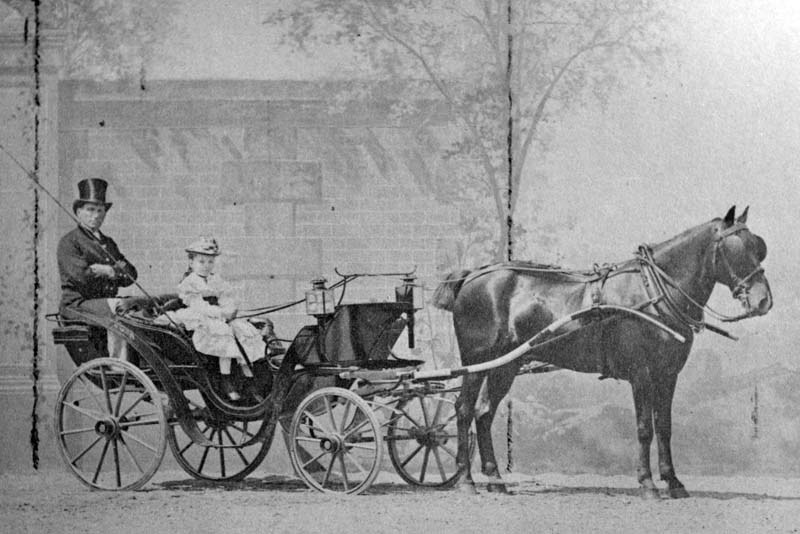
Darkie, however, was not a useless pet. Nannie is seen driving her to a delightful wicker-cart [below], and in it Nannie’s charges were conveyed to dancing class, tea parties, picnics, and the like.

.

.

A pony was also kept and driven to the same cart, but evidently the donkey was considered safer for nursery outings.

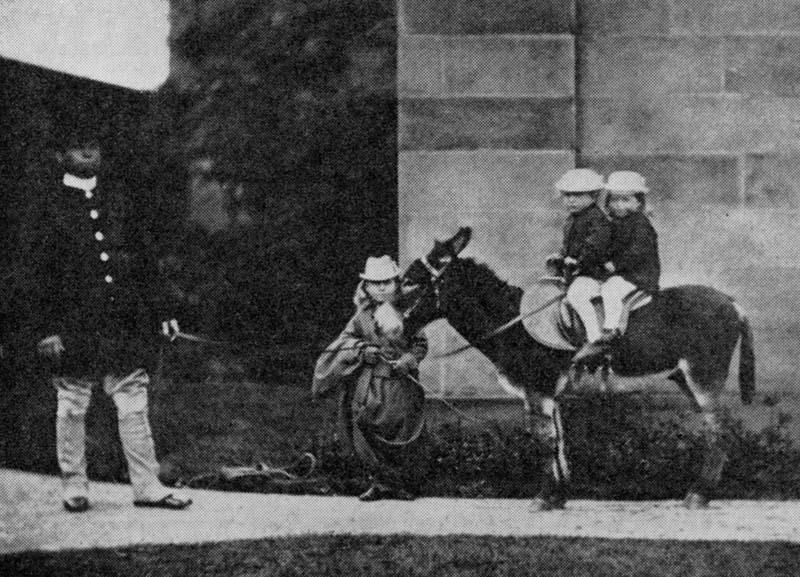
Darkie was not in fact of a dark color but silver gray; she owed her name to a much earlier donkey. Turning back the pages of the album, there is the original Darkie: dark indeed, with a beautiful mealy muzzle — this time [below] led by the coachman resplendent in livery.

.

.

The year was 1890, and a great-great-aunt is seen at the age of five, attired in a full-blown riding habit, complete with gloves and whip. She is unmounted, but two younger great-great-uncles sit one behind the other on the donkey.

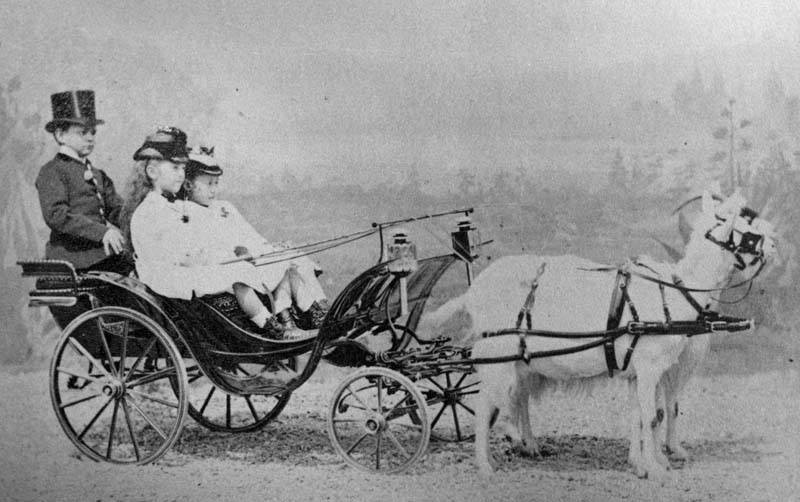
Before the pram was in general use toward the end of the nineteenth century, babies were carried out for an airing in the arms of a nursemaid. As families were frequently large and additions arrived yearly, other modes of transport had to be found. The donkey was ideal. Carrying paniers, he easily and safely conveyed smaller children. As the family graduated from nursery to schoolroom, the governess took over afternoon outings, for which the donkey was used in a cart.

When nannies and governesses vanished, donkeys disappeared as well, only to reappear quite recently as companions, not to the children of the well-to-do, but to lonley horses! They have gained popularity very rapidly over the last five years. Some as rather gimmicky pets of suburban-dwellers, others in pre-first-pony capacity, and many just because they are delightful, gentle, original, and loveable characters to have around.
For today’s installment in our trip through Glimpses of the World, we’re stopping in Vienna.

The book’s caption for this photo is as interesting a look back into both distant history and late-nineteenth-century history as the photo itself:

“One of the oldest and most interesting streets in Vienna is that which we may now in imagination enter, called the Graben. It derives its name from the fact that this was the ancient Grab, or moat surrounded by the fortified wall, which rose where now are yonder buildings containing some of the most luxurious and expensive retail shops in Vienna. One would hardly expect to find within this busy street the solitary survivor of the famous Wiener Wald, the ancient forest bordering the Danube! Yet at one corner of it is a most extraordinary-looking object, protected partly by the wall of the building, and partly by some bands of iron. It is the famous Stock in Eisen, or the Iron stick. It is well-named, for its appearance is precisely that of an iron club. Investigation, however, proves it to be a mass of wood, literally covered with nails, to some of which coins are attached. One of these has the date of 1575. This ancient tree (which apparently could not crumble now if it should try to) was for some cause, now unknown, esteemed especially sacred; and everyone who drove a nail into its precious wood, received a spiritual shield against the devil. How odd it seems to see this strange reminder of the past, standing thus grimly in the very center of the city’s life! Just as some superstition, like a dread of Friday or thirteen at a table, still exists amid the common sense and science of the nineteenth century.”

.

.

Continued from yesterday …

“‘Stranger, I hope you will. If you do succeed, just make a book of your journey.’ ‘I will, and you may get hold of one of them.’ ‘I should like to meet you somewhere down East; I would give more to see you in that Barnum’s big show.’ ‘Well, friend, I must be going on, I have got to tramp every day, and make big days at that before I reach the eastern states.’ ‘Well, stranger, I hope you will get safely through; goodbye.’

“It was about seven o’clock when I left him; I kept the railroad on my left. At eleven o’clock, I came to another station, called Brown’s Station. I made but a short stop at this place, just long enough to water and feed. This is a telegraph station; only two buildings, the depot, and a house. At half-past twelve I left and journeyed with the railroad on my left, and as I travel the desert is left behind me, my course now lying through Humboldt valley, the river of that name being on my right. I intended to reach Lovelock’s, but my trail led me so far to the right that I was obliged to return to the railroad, so made Granite Point instead. This station is nothing but a house for the boss of repairs and a shanty for his Chinamen.

“I took the horse from the carriage and fastened her as usual, with the cow opposite. After feeding, I made my bed and laid down, being only disturbed that night by a passing train.”

« Previous PageNext Page »