Carriage Journal magazine


Copies of the March issue of The Carriage Journal were mailed to all current CAA members on March 1 (Tuesday), so they should be arriving in mailboxes right about now (or very soon).

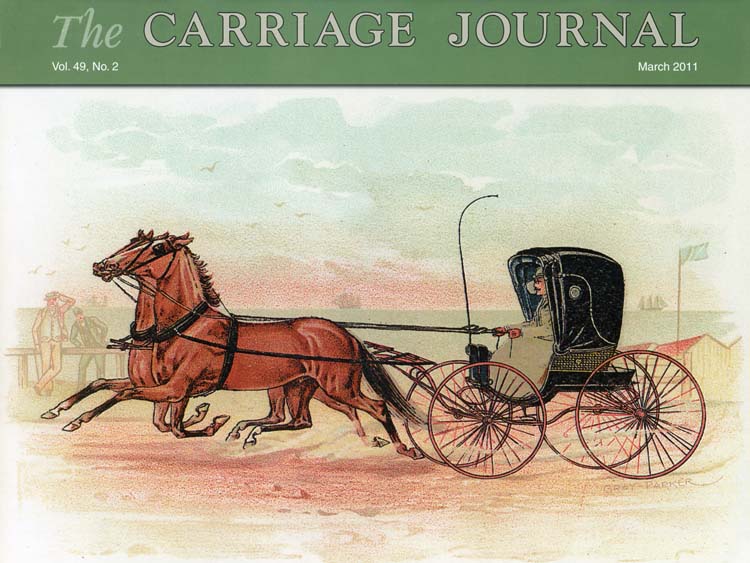
Following the winter scene on the cover of the January issue, we offer this spring-y scene for March. (If you’re not familiar with our magazine, have no fear: it’s only the cover image that is often horizontal; the inside of the magazine follows a traditional, vertical format.)

.

.

In this issue are the usual departments (In the Carriage House, In the Stable, Nuts and Bolts, The Road Behind, and more), plus articles on Oakland Wagons and the late-nineteenth-century New York Tandem Club, and a photo essay from the 2011 CAA Winter Conference.

If you’re interested in learning more about the Carriage Association of America and our publications (including The Carriage Journal), please visit our website: www.caaonline.com.

The cover of the October 2010 issue of The Carriage Journal featured a beautifully restored 1903 Cretors “Model C” popcorn wagon, owned by Richard Scott of Ohio.

You may have read more about it in this previous blog post: https://carriageassociation.wordpress.com/2010/11/16/hot-buttered-popcorn-fresh-roasted-peanuts/

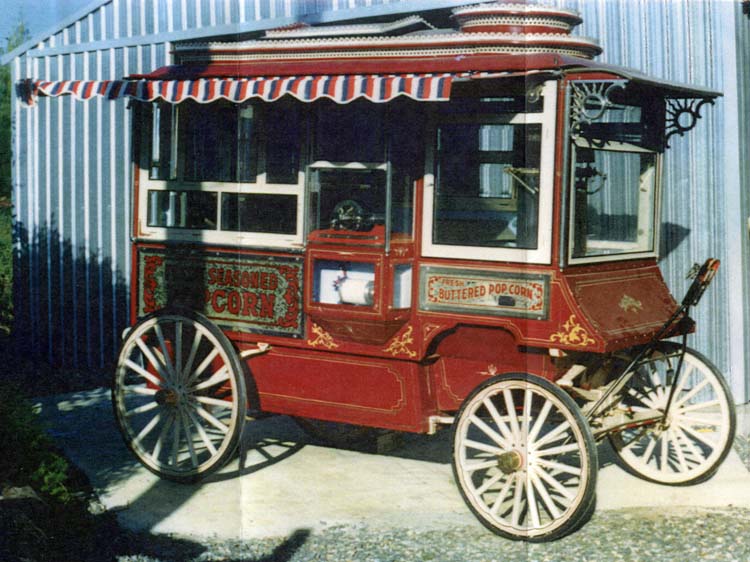
That magazine cover prompted CAA members Robert & Lori Babcock, of California, to send some photos of their own Cretors “Model C” popcorn wagon. The first of these shows the wagon at home; the second is a bit more out of the ordinary.

.

the Babcocks' Model C Cretors popcorn wagon (photo courtesy of Robert & Lori Babcock)

.

... and the same popcorn wagon, with "movie ageing," on the set of Water for Elephants, which is due in theaters in April (photo courtesy of Robert & Lori Babcock)

.

The movie, based on the best-selling book of the same name, stars Robert Pattinson, Reese Witherspoon, and Christoph Waltz. You can watch the trailer here:

.

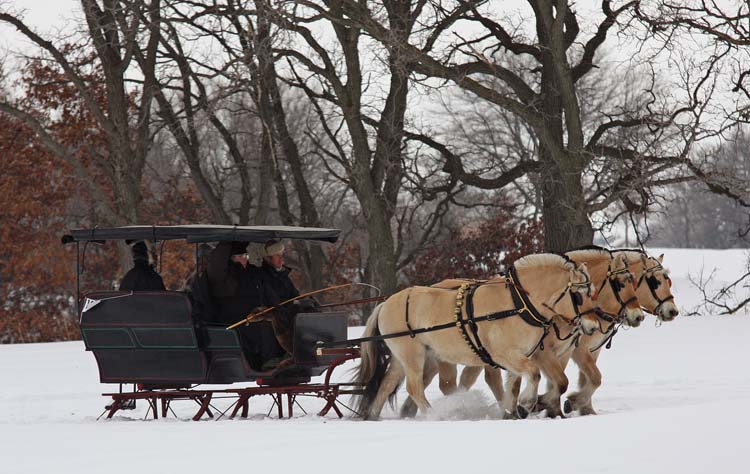
This image …

.

CAA member Ted Swendson drove his Fjords, three abreast, to his antique sleigh at the 2011 CAA Winter Conference in Minnesota (photo by Else Bigton)

.

… is included in our photo essay on the 2011 CAA Winter Conference, in the upcoming (March) issue of The Carriage Journal.

Unfortunately, we didn’t have room in the magazine to give too many details about this lovely old sleigh, so I thought we’d do so here.

Ted Swendson (of Calgary, Alberta, Canada) shared this information about his sleigh: It’s a Wagonette Bob-sleigh that was built around 1900. Ted described it as a “true” Bob-sleigh, meaning that the vehicle’s body was meant to be on wheels but was adapted with bobs for driving in the snow (although he believes that this particular vehicle has always had its bobs). Early in its life, this sleigh was used as a taxi in Ontario.

Ted bought this sleigh from the collection of Jack Pemberton of Ontario, and it was Jack who had it restored. The current colors are the same as they were originally, and the upholstery is all original.

Another interesting note: the Canadian government has declared this piece a “heritage” vehicle, which means that Ted is not allowed to sell it outside of Canada.

In the October 2010 issue of The Carriage Journal, I wrote the entry for “The Last Word” (our personal-opinion column, on the last page of each issue). In it, I declared my love of history, genealogy, old photos and, especially, old photos with ancestors in them.

As I said in the column, old photographs may be beautiful and fascinating on their own, but when they have family members in them, we’re able to look our own personal history right in the eye.

I also put out a call for CAA members to share old family photos with carriages in them. We all may enjoy looking at old images of horse-drawn vehicles, but these become so much more interesting when there’s a story attached.

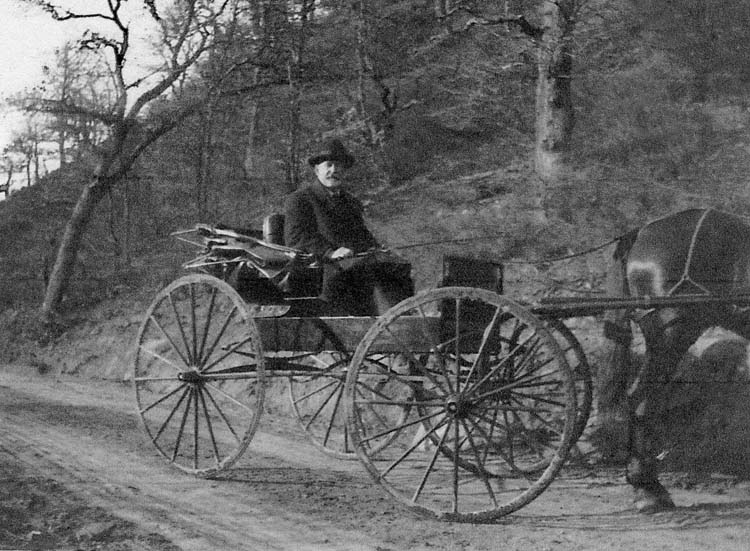
Here’s one I received from Kathy Graves in California:

.

John William Lill (photo courtesy of Kathy Graves)

.

Kathy says:

“This photo is of my maternal great grandfather, John William Lill, just above the town of Hood River, Oregon. It is not known if this was a rented turnout, or if he owned it, using it to travel from his home in Hood River to his couple of acres just outside of town, where he raised chickens. The photo is undated, but it most likely was taken sometime after 1900, but before 1916, when my mother was born.”

Thank you, Kathy, for sharing this wonderful photo!

The January issue of our magazine, The Carriage Journal, includes a fascinating article on horse-drawn travel in Switzerland. The article is adapted from Andres Furger’s lecture at the 2010 CAA / CWF International Carriage Symposium. 

Andres shared the following story with the symposium attendees, and his lively storytelling prompted an awful lot of laughter in the room. Except for the general intro (below), however, this story didn’t make it into the magazine article. So I offer it here:

.

“Over two thousand, five hundred years ago, the area that today is Switzerland lay in the heartland of the Celts. These people, the Helvetii, were excellent craftsmen particularly when it came to building vehicles. During their time the concept of using spoked wheels was introduced into Europe. These were constructed in much the same way as they are today, maybe even better, as the Celts understood the need to make the wheel rim out of a single piece of wood, which they bent using steam.

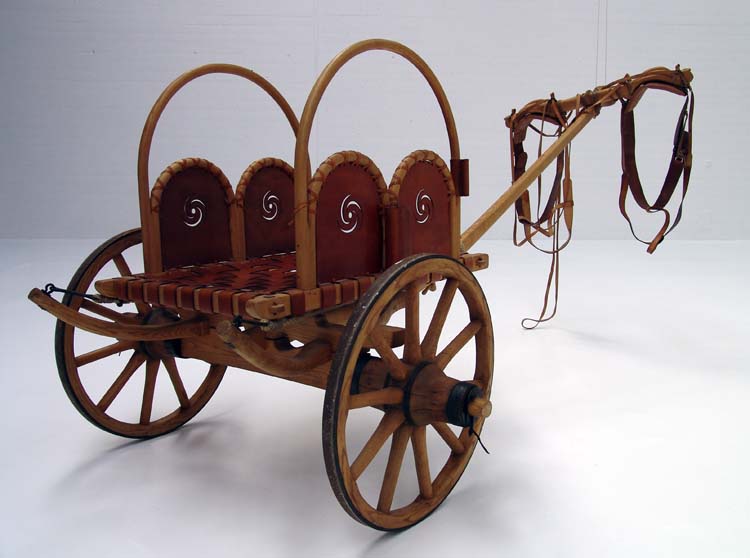
“Using archaeological evidence, I was able to reconstruct a working Celtic war chariot for the Swiss National Museum in 1987.
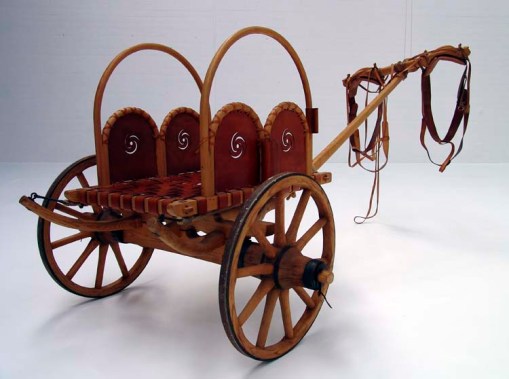
Andres Furger built this reconstruction of a Celtic war chariot in 1987

.

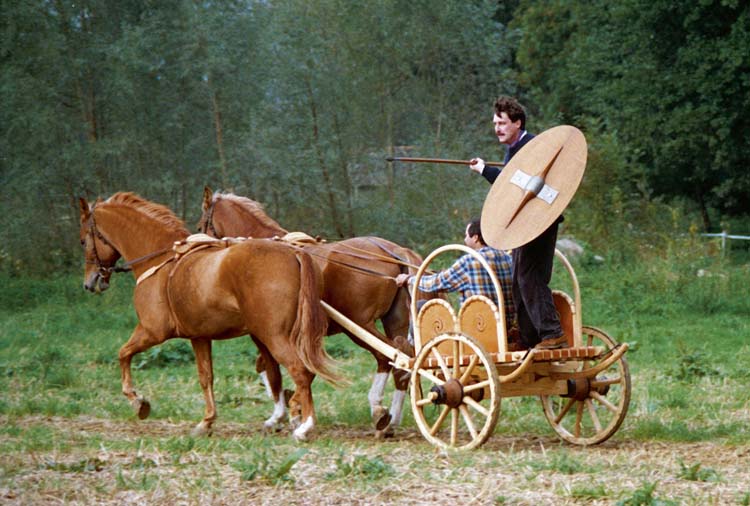
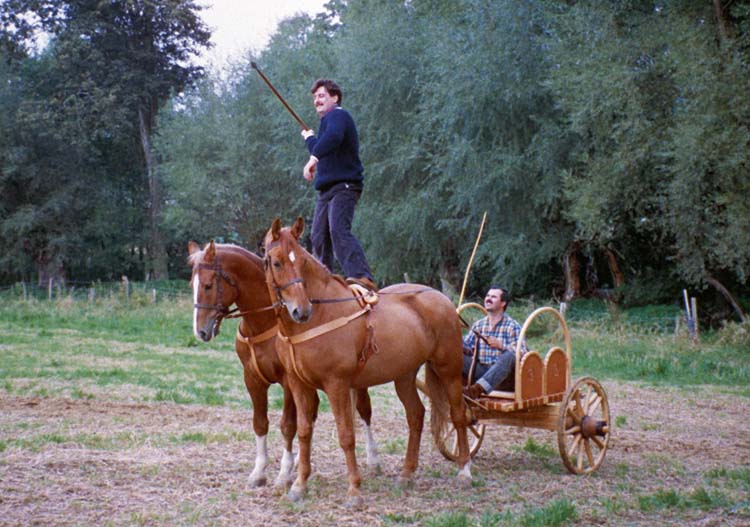
“Unlike the Greeks and Egyptians, the Celtic driver sat while the warrior stood behind him on the back of the chariot, which was suspended even then. I had the opportunity to test this with my good friend Daniel Würgler, today one of the world’s top four-in-hand drivers.
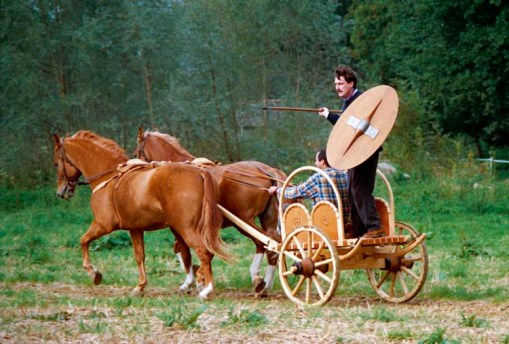
... and he put it to an actual test (that's him, standing at the back), with his friend Daniel Wuergler driving (seated at the front)

.

“The test was going splendidly until I tried my hand at something that Julius Caesar himself had described, which was the “warrior method” of leaping at full gallop from the back of the vehicle onto the pole and up to the yoke to be able to throw the spear down from a great height. This my horses tolerated at the halt. However when I tried it again at speed they shot forward, catapulting me backwards between their hind legs.

Furger's first attempt at the "warrior method" of throwing a spear (here, at the halt) was successful ... the second attempt, not so much

.

“Only some quick thinking and a roll to the left saved me from becoming yet another statistic concerning itself with the rise and fall of the Roman Empire.”
« Previous PageNext Page »