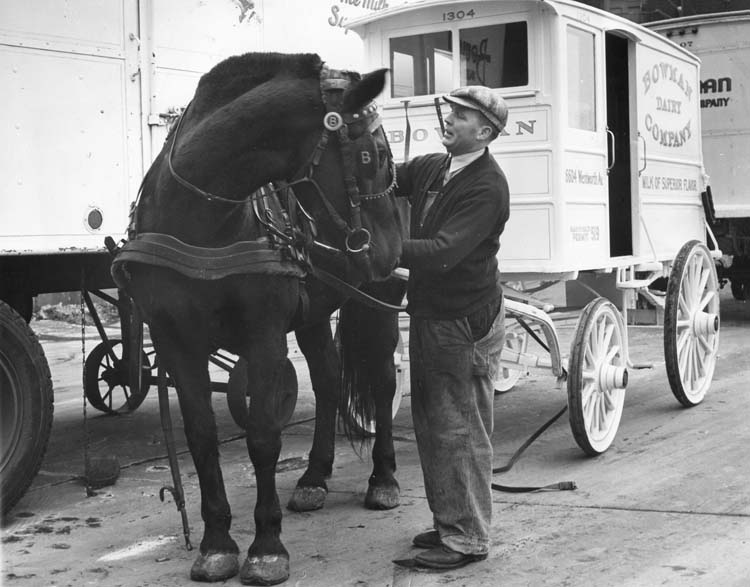
Also from a news service, this photo is dated Feb. 3, 1942.

The caption taped to the back says:

Refitting the Old Milk Wagon

Chicago, Ill. — The horse looks back, and was heard to say: “What’s this thing behind me?” He’s being hitched to one of the Bowman Dairy Company delivery wagons, which has come out of retirement as a result of the tire shortage.

.

(from the Jack & Marge Day collection)

For Friday and the weekend, let’s look at a few more old photos from Jack and Marge Day’s collection, shall we?

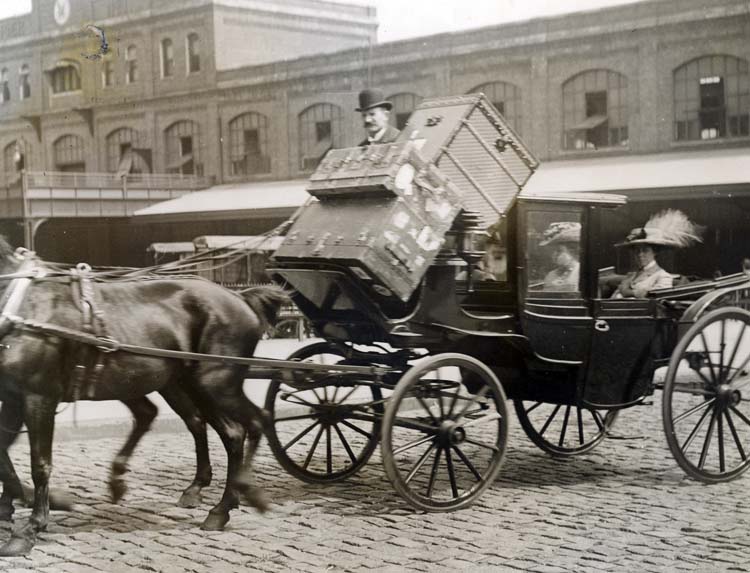
First up: a fabulous, old (but undated) photo of several elegant ladies in a carriage piled high with trunks.

This photo was one of several that the Days acquired from an old news service. On the back is taped the typewriten text that would’ve accompanied the photo in an ad, apparently for travel insurance. The note (dated Nov. 29, 1932) says, “New Ways for Old. In the days when personal baggage was never lost sight of during the journey, the traveler had little cause to worry about his personal effects. Today even with the modern efficiency of man and carriers, loss and damage does occur. Let our Tourist Baggage policy afford you constant financial protection against such loss.”

.

(from the Jack & Marge Day collection)

Last week, I mentioned our upcoming academic symposium on horse-drawn carriages and transportation, which will be held at Colonial Williamsburg (Virginia), January 11-15, 2012.

Well, the brochures arrived today from the printer, and we’ll be getting them out in the mail very soon to all current CAA members. But everyone is welcome to join us at the symposium, member or no!

.

There will be ample free time to explore Colonial Williamsburg, plus these fascinating lectures:

“London and the Cab Trade” – Richard James (England)

“Dressing the State Coach: Comfortable Interiors and Elegant Hammercloths” – Susan Niederberger (Switzerland)

“Royal Coaches and Carriages of Sweden: A Second Look” – Gösta Kylsberg (Sweden)

“Runabouts by the Hundreds: Mifflinburg Becomes ‘Buggy Town’” – Bronwen Anderson-Sanders (USA)

“U.S. Army Transport: The Development of the Great Blue Army Wagon” – Thomas Lindmier (USA)

“The Selective Breeding of Driving Horses, 1500 to the Present Day” – Andres Furger (France)

“American Wagons: Rediscovering the Wheels that Won the West” – David Sneed (USA)

“Between Pomp and Understatement: Carriages of the Holy Roman and Austrian Emperors” – Monica Kurzel-Runtscheiner (Austria)

“Sledge-riding in the Off-road World: English Descriptions of Winter Travel in 16th- and 17th-century Russia” – Alexander Sotin (Russia)

Le Parfait Cocher: A User’s Guide to Driving in Eighteenth-century France” – Mark F. Schneider (USA)

“The Conservation of the Lafayette Coach” – Brian Howard (USA)

“Miss Daisy Goes Driving: Carriages and Gender” – Suzanne Beauvais (Canada)

“Horse-drawn Commercial Vehicles in the American Industrial City” – Thomas Kinney (USA)

“The [British] Royal Mews: Setting the Bar for Correct Ceremonial Turnout” – Colin Henderson (England)

.

For a full-color brochure, with more information on the CAA & CWF’s third International Carriage Symposium, click here. To download a registration form, click here.
It would appear that a bright red, horse-drawn fire-fighting vehicle is one of the first things visitors to the KHP’s International Museum of the Horse will see when they arrive for the museum’s newest blockbuster exhibit, “The Horse: How Nature’s Most Majestic Creature Has Shaped Our World,” which opens this Saturday (Oct. 22) and runs through April 6, 2012.

The museum staff prepared this photo montage / video of the vehicle and its descent to a doorway large enough to accomodate it:

.

.

As usual, if the embedded video won’t work on your computer, click here to go directly to YouTube.

Guest post by Jerry Trapani:

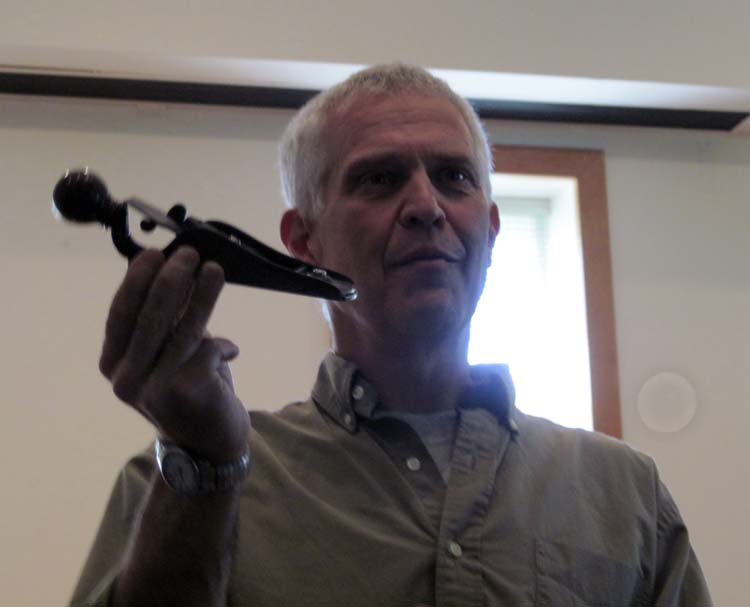
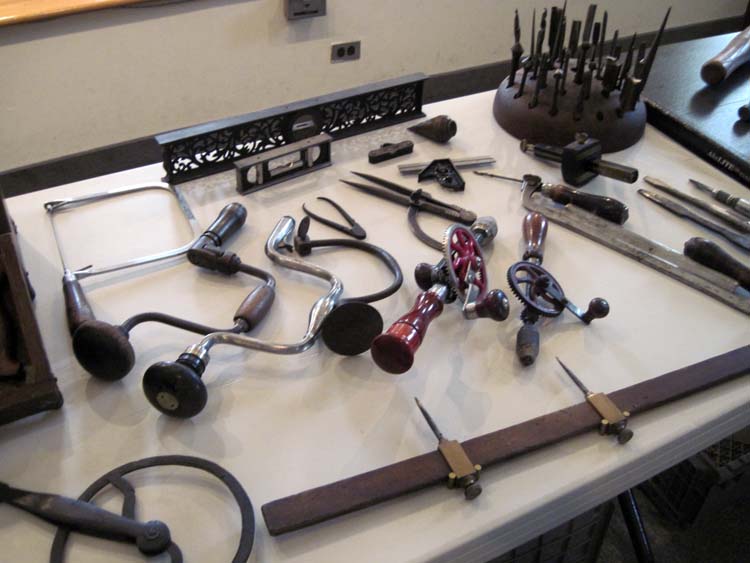
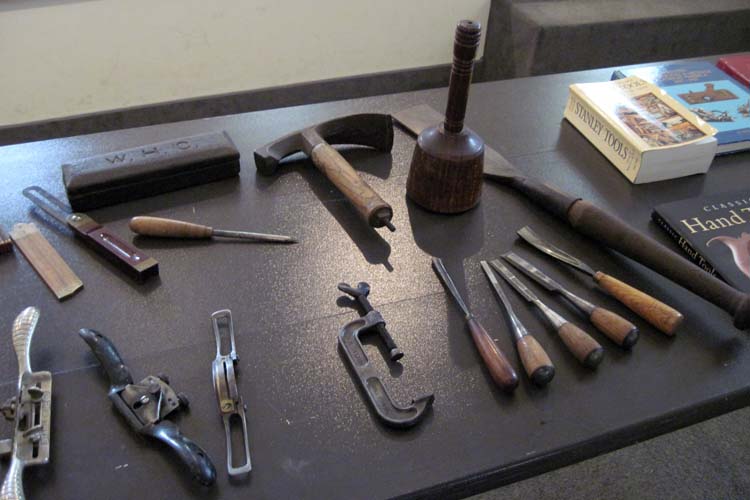
This past Sunday (October 16), the Long Island Museum of Art, History and Carriages at Stony Brook (New York) hosted a lecture by Jamie Swan of Northport. Mr. Swan is a fourth-generation craftsman, and many of the tools in his collection are family heirlooms. He filled four tables, end to end, with all sorts of tools for everything from carriage-building and cabinet-making to ship-building.

.

Jamie Swan speaking about antique woodworking tools (photo by Jerry Trapani)

.

As part of his lecture, Mr. Swan told the story of Leonard Bailey, a plane maker from Rhode Island whose ingenious patents were the best of his era. Unfortunately, though, he was a terrible businessman. Over his lifetime, Mr. Bailey lost his company three times to the large Stanley Tool company.

Mr. Swan also told the story of his grandfather, James Brudenell Swan, who was the building superintendent for the Brewster-Rolls Royce building in Long Island City.

Mr. Swan spoke about the apprenticeships that his ancestors had worked and how they had passed their love of woodwork and their good tools to him. Among the tools he’s inherited are a hand hub borer and several planes used to make joints and decorations. He also has a coachmaker’s brace used for boring holes inside coach bodies.

.

Mr. Swan's father's toolbox (photo by Jerry Trapani)

.

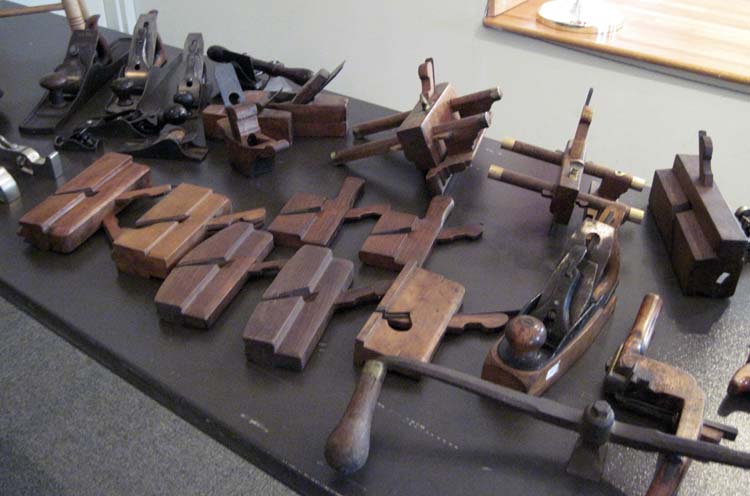
I never realized how many different kinds of planes there were. Moldings, contours, and decorations all had to made by a skilled and steady hand. Each detail had its own tool.

.

a multitude of planes (photo by Jerry Trapani)

.

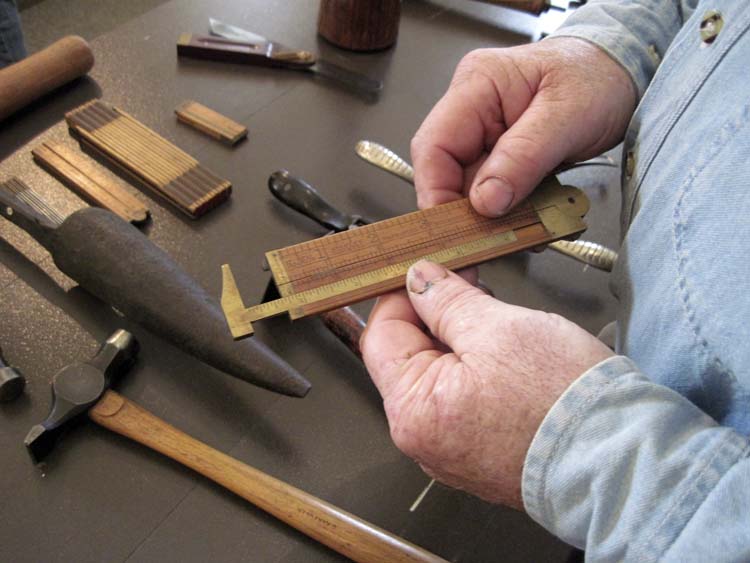
Among the many tools on display were spoke shavers; a “traveler” used to measure the diameter of a carriage wheel in order to know what length to cut the steel tire; and many types of rulers, including several with calipers incorporated to measure a piece of stock or wood.

.

a ruler with a caliper incorporated (photo by Jerry Trapani)

.

tools ... (photo by Jerry Trapani)

.

... tools ... (photo by Jerry Trapani)

.

... and more tools ... (photo by Jerry Trapani)

.

If you’d like to learn more about old hand tools, try these books: Antique and Collectible Stanley Tools by John Walter; Classic Hand Tools by Garret Hack; Restoring Antique Tools by Herbert Kean; A Museum of Early American Tools by Eric Sloane; A Reverence for Wood by Eric Sloane; and Patented Planes in America 1827–1927, Vol. 1–2 by Roger K. Smith.