This first of my new (thank you, Elizabeth!) old English postcards is this undated photo card, which shows a fully loaded coach and four … on a ferry crossing the Windermere.

.
January 22, 2013
This first of my new (thank you, Elizabeth!) old English postcards is this undated photo card, which shows a fully loaded coach and four … on a ferry crossing the Windermere.
.
January 21, 2013
Here’s our next photo (and a wonderful caption) from the 1892 Glimpses of the World book …
.
.
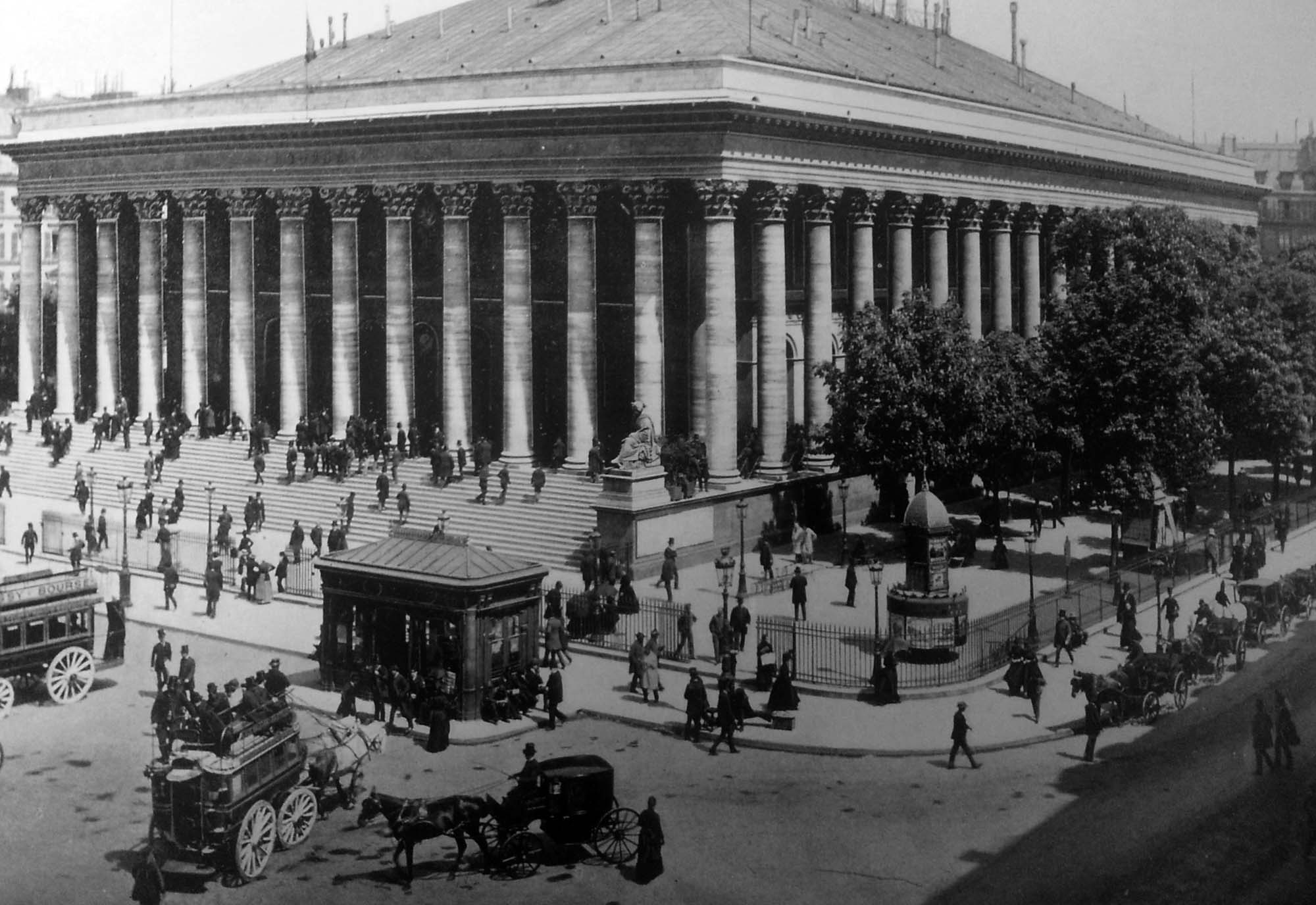
The Bourse (or Exchange), Paris
A handsome structure is this edifice where fortunes are so easily made and lost. Surrounded by sixty-six Corinthian columns this building is not unlike the model of a temple in the Roman Forum. When the traveler has seen the stock exchange of New York or the Board of Trade in Chicago, there is nothing especially new or strange in the transactions of this Paris Bourse. Nevertheless, the tumult and incessant uproar which wake the echoes of these walls from twelve o’clock to three are well worth noting, as an indication of the feverish excitement of the “Bulls and Bears,” whose characteristics do not differ materially, whether the arena where their combats take place be in Wall Street or by Lake Michigan, in the vicinity of the Thames or here in Paris. To stand in the gallery of this Bourse and watch the pandemonium below or merely, as one lingers on these steps, to scrutinize the faces of successful or unfortunate speculators as they leave the building, affords an admirable chance to study interesting phases of human experience. This square, or “Place de la Bourse,” is a great point of arrival and departure of the Parisian omnibuses, the demand for which is usually greater than the supply. But no such crowding is possible here as in our public vehicles in America. Each passenger is entitled to a seat, which he secures by applying for a “number,” at the office in the square. The rule of “first come, first served” is rigidly enforced, and when the seats in the coach are filled, it rolls away, displaying over its door the word “Complet” (full). Who does not recollect the story of the disappointed tourist who exclaimed that the only place in Paris he did not go to was one called “Complet.” “Whenever I see an omnibus going there,” he cried, “it will never stop for me!”
January 19, 2013
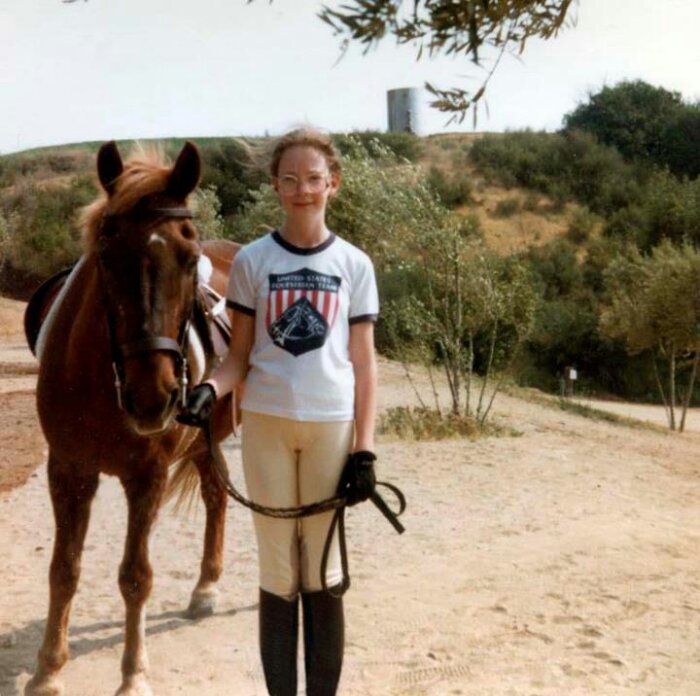
Another thing I found during my office-cleaning rampage project was a little photo album with a few old photos from my early riding-lesson days. For some reason, a lot of my horse- and riding-related memorabilia ends up in my office instead of at home. I guess that’s because my job is horse-related too.
At any rate, here’s a photo of me and a pony whose name I don’t remember, before one of my early riding lessons. This photo was probably taken sometime around 1980.
.
.
I was wearing what was, at the time, my favorite t-shirt, with the U.S. Equestrian Team logo on it. My younger self would never have guessed that I’d now be working in “the business.”
But I still have that t-shirt.
January 18, 2013
I’ve spent part of yesterday, and much of today, cleaning and reorganizing my office. So, once again, I’ve had little time to prepare anything to share with you here.
But I received a fabulous gift today: three old driving-related postcards from England. I’ll be sharing two of them with you next week. The third is a Christmas postcard. And, in the midst of my cleaning and filing today, I found two more old Christmas cards that I’d squirreled away with some other old prints. So I’ll have all three of those ready and waiting in the wings for this year’s Christmas-time look at old cards and postcards.
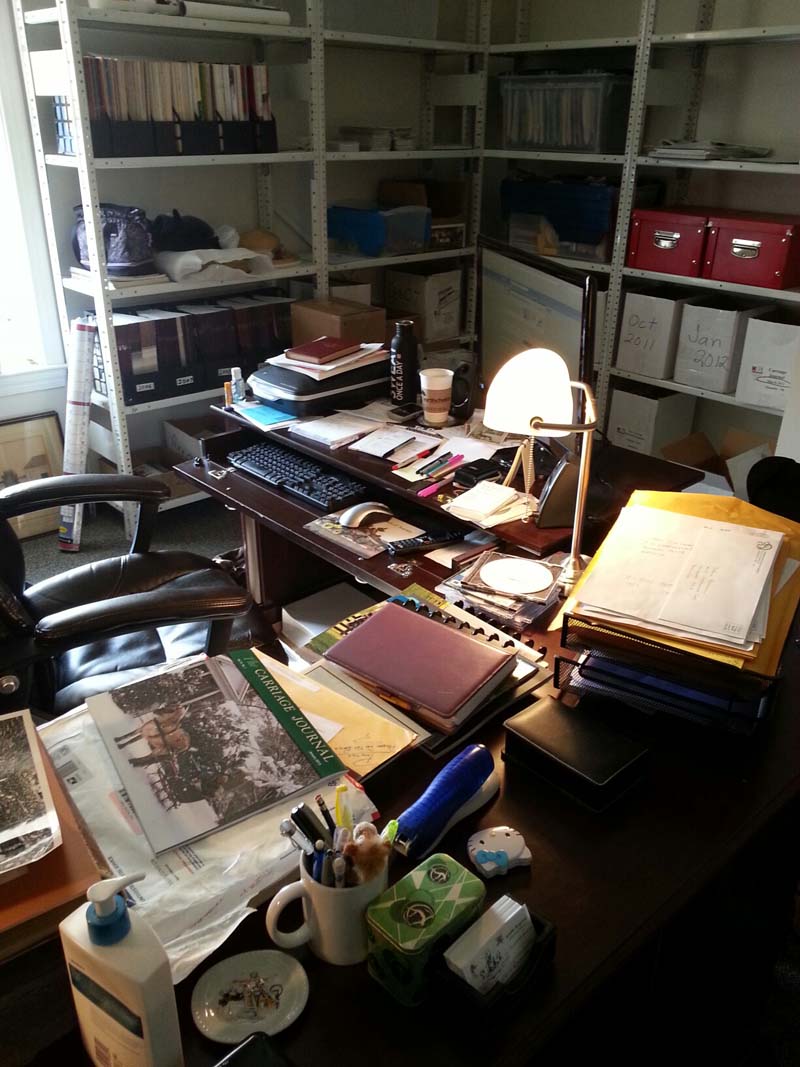
In the meantime, here (although this is a bit embarrassing) is a “before” photo of my office …
.
.
…. aaaaagggghhhhh. Is there even a desk under all that??
I’m excited to report that I’m nearly finished with this project and that I’ll be neatly arranged and organized. I’ll share an “after” photo next week.
January 17, 2013
At the end of yesterday’s post, Mr. Sherwood guessed that perhaps Mr. Johnson didn’t like California, because he was returning to Massachusetts so soon after arriving there. Based on this long, detailed response (probably his longest comment on any particular subject so far in the book), I’d say that Mr. Johnson *really* didn’t like California at all …
“I think this, that there are those who are responsible for the deception that has been sent abroad in regard to California. So much has been said on paper that brought out thousands who are not able to get back, who would if they could. I have heard many say that much. Oh, such a climate, so warm and pleasant, and so beautiful. I will admit that the months of December, January, and February, to Eastern people are most agreeable, that is, in regard to heat and cold. But in April and the summer months, till December, everything is dried up, except what irrigation has kept green. If you are located on the river valleys you are all right, but these are scarce. I have seen the sands blow like our eastern snows. I prefer snow to sand every time, when the wind blows. No rain is expected until the month of December. In the northern sections you may get some rain in November, but seldom.
“After the first rain things change; when the second rain comes, should it prove a good substantial one, say, so many inches, you put in your seeds and in order to get back the value of your seed and labor, you must have so much rain, or so many inches of rainfall in order to warrant a crop. Now during the months of December and January, these two month, the rains come. The best months are the first four.
“In April, things begin to dry up; May is dry, June is very dry, in July you are trying to get your sheep to the mountains. Can wait no longer, and you have to be smart to get them there or they will perish on the way. It is not yet August and don’t expect rain for several months. August, September, October, November; four months, all dried up. Think of it; ten months out of twelve, no rain. You get up in the morning, say five o’clock, the sun is just up, not a cloud to be seen. The day advances; nine o’clock, hot; twelve at noon, very hot, not a cloud to be seen. No, no rain today — no showers to lay the dust — all dried up.
“I prefer living where it is cold, warm, hot, with showers occasionally, to lying down in the hot burning sands, to bring out the rich colors of the shrubbery and make nature grand and sublime. A smart thunderstorm that will burn up the nitrogen and give us in [its] place a healthy oxygen, that is what I admire.”
I can just imagine poor Mr. Sherwood, at the end of this rant, thinking, “Well, ok, then. Off you go, back to Massachusetts.”
 The Slower Road