I was doing some work-related Internet research — looking up some coaching detail or personage, as I recall — and came across this gem …

.

Pig Rides in Cars Just Like a Baby

(The New York Times – April 17, 1911)

If it hadn’t been for a stifled squeal and a very pig-like wriggle the taxicab driver would never have known that one of his fares wasn’t human. In fact, the chauffeur rubbed his eyes several times before it finally dawned on him that Mrs. Marie Watson’s traveling companion was a pig instead of a baby.

The chauffeur wasn’t to blame for being deceived, for several conductors had made the same mistake. They don’t know even now that the bundle Mrs. Watson carried so tenderly in her arms was not a baby at all, in spite of its baby cap and fluffy little coat and the milk bottle which Mrs. Watson produced every now and then on her ride from Newark.

Mrs. Watson, as almost every vaudeville performer knows, is the wife of Sam Watson, who has a barnyard circus. One of the star performers was a wee pig, but it got so fat that Mrs. Watson decided another pig would have to join the show, one that she could hold in her arms without straining her muscles.

After some correspondence she found what she wanted in the pig line on a farm just outside of Newark. The pig’s owner agreed to sell free on board at Newark, but not Manhattan.

Mrs. Watson and her husband went into conference to decide how to get the pig here. “Leave it to me,” said Mrs. Watson. “I’ll just bring the pig on the train.”

Her husband suggested that pigs were not allowed on passenger trains. But Mrs. Watson knew what she was talking about. “Leave it to me,” she repeated, and Mr. Watson did so.

Mrs. Watson made the trip to Newark Friday and met the farmer and his pig. Mrs. Watson whispered a few words of pig language in the little fellow’s ear and proceeded to dress him up in baby attire. The cap was a cute affair of muslin and baby chiffon, with a near-blue ribbon at the tip. The baby coat was also blue, as was a blanket which Mrs. Watson had provided. When the dressing was finished the farmer departed chuckling over the transformation.

With the pig in her arms, Mrs. Watson proceeded to the Newark station of the Pennsylvania Railroad and boarded a train for Jersey City. The pig wasn’t making a sound. Perhaps it was because of those few whispered words of pig language of which Mrs. Watson says she has a smattering. Perhaps it was a bottle of milk which the pig tippled now and then. Anyhow, no one on the train imagined that it was anything else than a very quiet and well-behaved baby that Mrs. Watson was carrying in her arms.

At Jersey City, Mrs. Watson and her charge proceeded to the Hudson Tunnel station. While waiting for a tunnel trail an elderly man suggested to Mrs. Watson that she had better stand well back from the edge of the platform. “You know these drafts are very bad for babies,” said the elderly gentleman. Mrs. Watson smiled and thanked the solicitous old man. Never once during the trip to Manhattan did the pig betray himself.

At Thirty-third Street, Mrs. Watson hailed a taxicab, and in this the last lap of the journey was made. At the theatre Mrs. Watson alighted and paid her fare. The movement of getting into her purse must have disturbed the pig, for there was a sudden squeal and a very vigorous wriggle. The baby cap slipped back, displaying a very piglike face. It was then that the chauffeur began rubbing his eyes and pinching himself.

In a few days the little pig will take the place of the elderly porker in the barnyard scene. He is now undergoing the necessary preliminary training.

.

Naturally, I had to find out more about the Watsons and their farmyard circus, so I did a little more sleuthing and found these two newspaper announcements, both published two years before the article above. And (bonus!) one of them even included a photo of Mr. Watson himself and a little piggy … presumably the very one who, in 1911, was being replaced by the piglet who rode the train dressed as a baby.

.

Variety of Amusements for Summer Evenings 

(The Evening Chronicle – Spokane, Washington – June 26, 1909)

The inhabitants of a well-regulated farmyard appear in the act which heads the bill at the Orpheum theater for the week beginning with the matinee tomorrow afternoon.

“Sam Watson’s Farmyard circus has been described as a treat for children from six to 69, and it is true that everyone finds something appealing in this quaint European novelty,” says the manager.

Watson introduces a donkey, dogs, cats, roosters, and a tiny pink pig in his routine of comedy, and the results obtained by persistent training of presumably brainless creatures, such as roosters, are astonishing.

.

Sam Watson at the Orpheum

(The Deseret Evening News – Salt Lake City, Utah – September 15, 1909)

Sam Watson, who is appearing this week at the Orpheum theater with his Farmyard Circus, is an old-time performer, and his animal act is the cleverest playing over the Orpheum circuit, while his “little pink pig” with which he appears in the above picture, is the provoker of extraordinary interest and merriment at every performance. Many people wonder how it is that Sam has trained some of his animals — to wit, his roosters and cats — to accomplish some of the stunts they perform. Sam avers, and it is easy on looking into his open countenance to believe, that it is all done by kindness, and though he may hold old-fashioned beliefs, he believes that a kind work or a pat of the head does more good than a swish from the whip. He never uses the hammer, either before, during, or after his act, and this is one of the principal reasons that his animals work with such a good will and display such fond affection for their master. Sam’s wife personally bathes all her pets, and they are all spotlessly clean and as white as snow. The animals should amuse many a youngster and grown-up, being all this week at the Orpheum.

In this photo, c. 1901, two ladies are setting out for a drive from The Firs, in New Baltimore, Michigan.

Here’s another view of the house at this one-time summer “resort” … more like a bed & breakfast, really.

.


Mr. Johnson continued his tale from where we left him in yesterday’s post …

“On the morning of the 28th I was up again before it was light enough to travel. I gave my cattle grain, but they would not touch it they were so thirsty. As soon as light came I drove into the trail and moved on. I knew that my cattle must have water, so I drove on as fast as possible; after traveling about eight miles, we came to water, which I tested and found it fair water, so I gave to the cattle as much as they would drink. After which I gave them their grain, and while they were eating had a breakfast of crackers and milk. I did not stop long, but went on and about ten o’clock met a man on horseback, leading a pack-horse. ‘Good morning, stranger,’ I said. ‘Good morning, sir.’ ‘How far have you come this morning?’ I asked.  ‘About ten or twelve miles,’ he said. ‘Did your horses have grass last night?’ I asked. ‘No, not any; I should have stopped at the creek, there was grass there,’ he said. ‘How is the trail on ahead?’ I asked. ‘First best for me; I can go anywhere as I am, you can’t with your wagon.’ ‘Where are you going to?’ I asked. ‘I am going to California,’ he said. ‘California; I am just from there.’ ‘You from California; what, you have not come from California with that outfit?’ he asked. ‘I have; just as I am, and I am going East, to Massachusetts,’ I answered. ‘The devil you are. Well, I will give it up, if you have come so far, I think I ought to do as much; goodbye, stranger.’ ‘Goodbye, sir.’ We parted and went on, I saying, ‘Well, Fanny and Bessie, we must make that creek before night. There is grass; you did not get any last night, tonight you may get some.’

“On we went, a good trail and down grade; we are traveling at the rate of three miles an hour, and about four p.m., I made a stop of about thirty minutes, giving the cattle some grain, after which we went on. Talking to my horse I said, ‘Come, Fanny, do your best, it is a good road, you shall have grass tonight.’ I was crowding along as fast as I could, when looking off to my left, saw smoke, and soon I came to tracks of wagons and was sure there was a camp somewhere near. When the horse saw the tracks she stopped, looking around. I said, ‘Fanny, we will go in here and follow those tracks and see what we can find.’ Traveling around a bluff we came in sight of a camp — a tent and three wagons and eight horses; five men, a boy, two women, and a girl. As I went into the camp I called out, ‘Don’t be afraid, I have come to see who is here!’ ‘Come in, stranger; you are welcome,’ was answered. ‘I am going East and you are going West, I suppose. Can I stop with you tonight; or, in other words, can I go into camp here?’ I asked. ‘Yes, sir; you can,’ was answered.

“I detached the horse from the wagon and unharnessed her, turning her loose and she went rolling about for some time. I gave the cow the same chance, but she went for the grass. It is half-past six and I went to gather fuel for a fire. ‘Stranger, do your cooking by our fire; don’t trouble yourself in making a fire.’ I got my supper, such as coffee, boiled eggs, crackers, and milk. I brought in my cattle for the night, securing and giving them their grain, made up my bed, and went to rest.”

to be continued …

About two months ago, I abandoned Mr. Johnson on the road to Laramie. And several people have asked me to please get back to his story, so …

“The morning of the 27th [of May 1883] found me up before there was any light. I turned the cattle loose for grass, greased my wagon, made a fire, boiled coffee and eggs, and opened a can of salmon. My breakfast being ready I brought in the cattle and gave them some grain, then I sat down to my breakfast to be ready to move onwards together. After breakfast, started onward, and having traveled about a mile came to a house. Here was a man, his wife, and two children. I inquired the name of this canyon. ‘It is called Miller’s canyon, stranger.’ ‘How far is it to Green River city?’ ‘Twenty-five miles, stranger.’ ‘How far to the next house?’ ‘I do not know the distance, but it is a long way; in fact, I never was east of here more than fifty miles, stranger.’ ‘How long have you been here?’ ‘Six years or more, stranger.’

“I left them and ascended the mountain, attaining its summit — traveling three-fourths of a circle in the distance of eight miles. About ten o’clock I passed a trail to my left and on a board nailed to a post I read, ‘To Soda Springs, crossing on Green River without Ferry.’ Went down the mountain and at its base I crossed a deep gulch on snow. A short distance from this gulch I came to a creek of good water. Here we stopped, my cattle took water and grain, myself and dog, bread, cheese, and cold coffee. We go on our road today, so far good, no rivers, creeks, or sloughs.

“The day is fast closing; it is time we should have come to grass. I have traveled all day and seen none; we must go into camp without water or grass. I spoke to my horse, ‘Fanny, we will go no further today; we have no grass or water, you will be obliged to eat your grain without.’ It is hard, plenty of grass and water one day and none the next. I drove into the sage bush, just out of the trail, and stopped. Fed my cattle with grain, spread my blankets on the ground and laid down for the night, but could not go to sleep. I would lay awhile and then get up and talk to my cattle and then lay down again, but could not drop off to sleep. Several times I got up and laid down again, and after a while I dropped off to sleep, not knowing it at the time.”

to be continued …

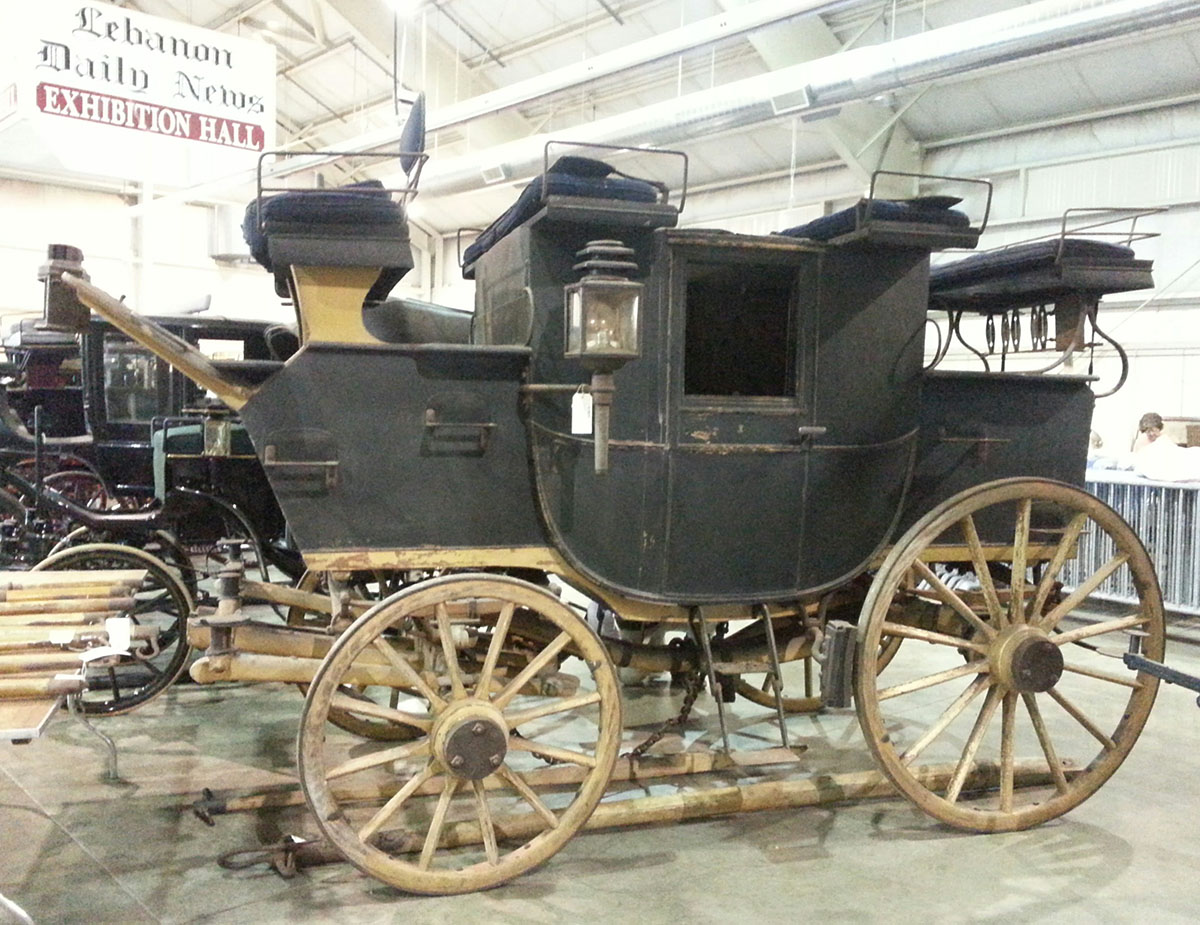
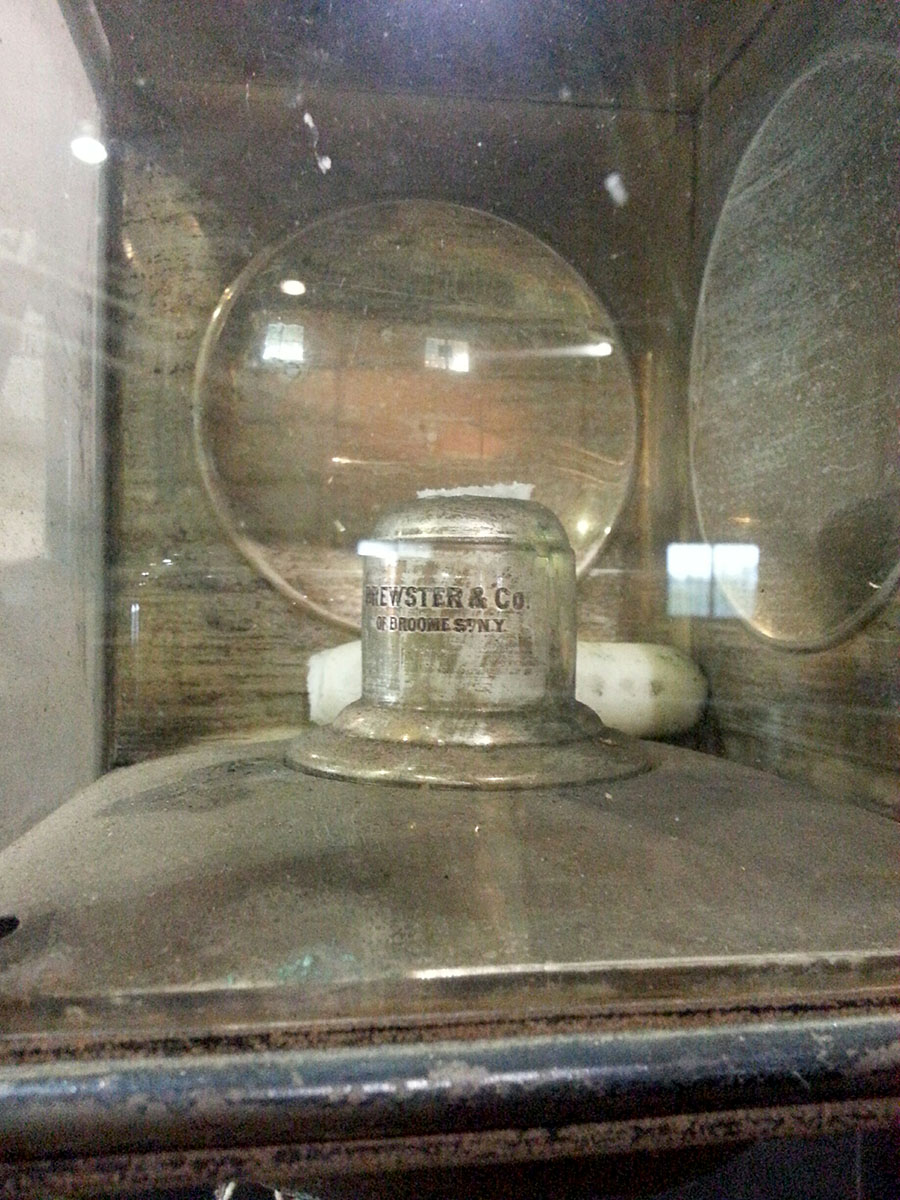
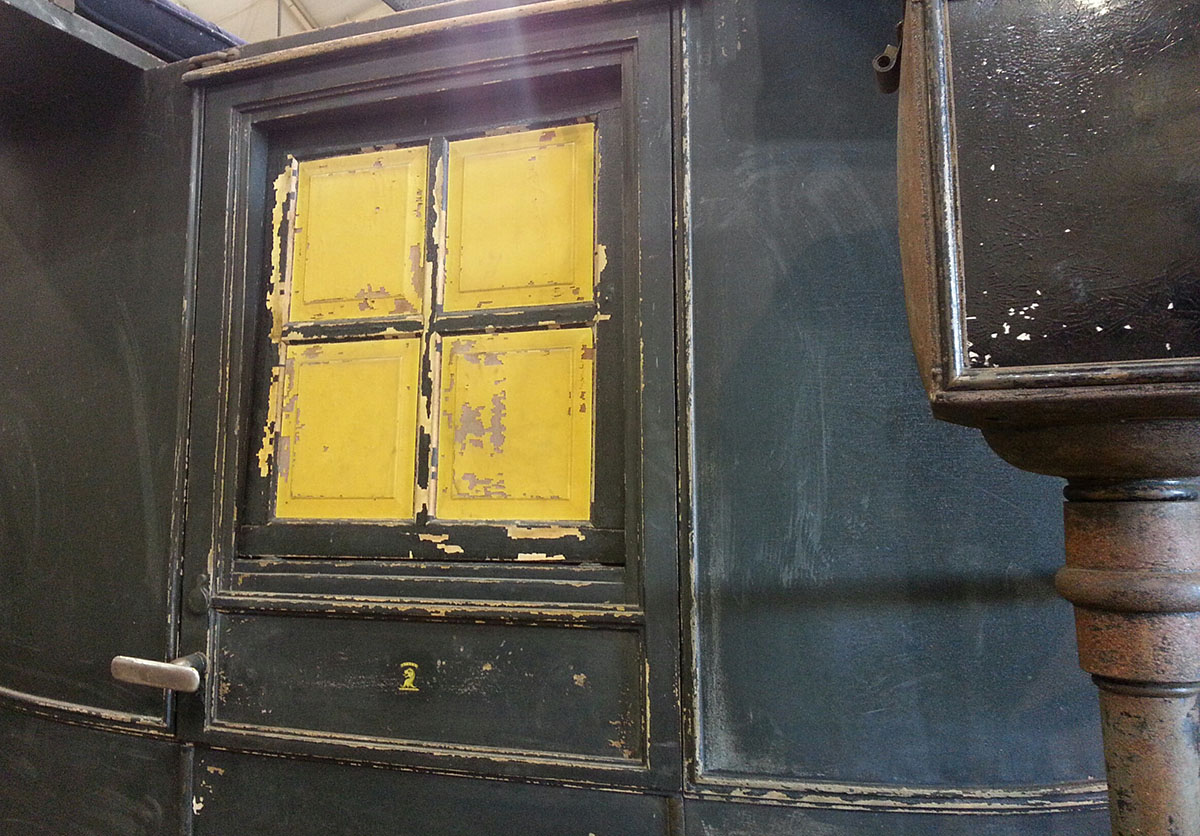
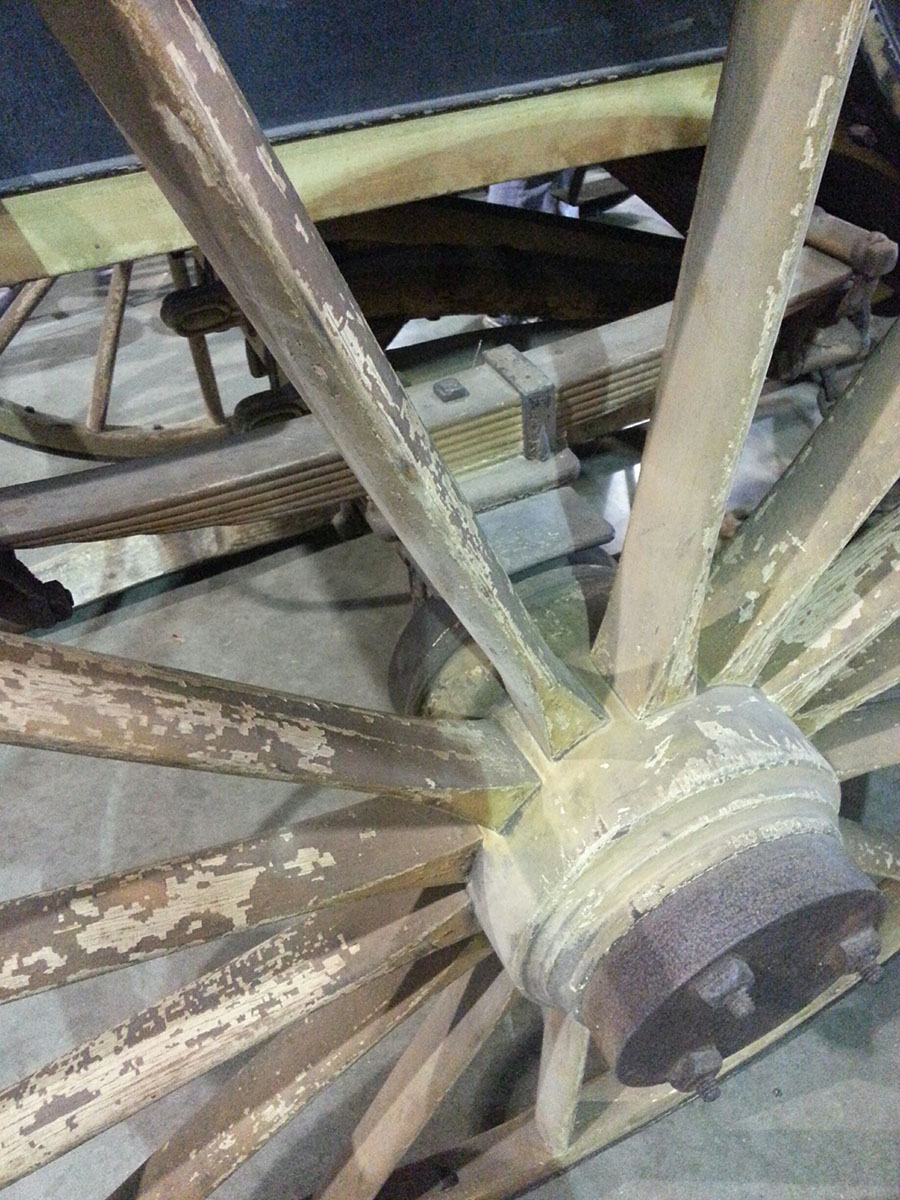
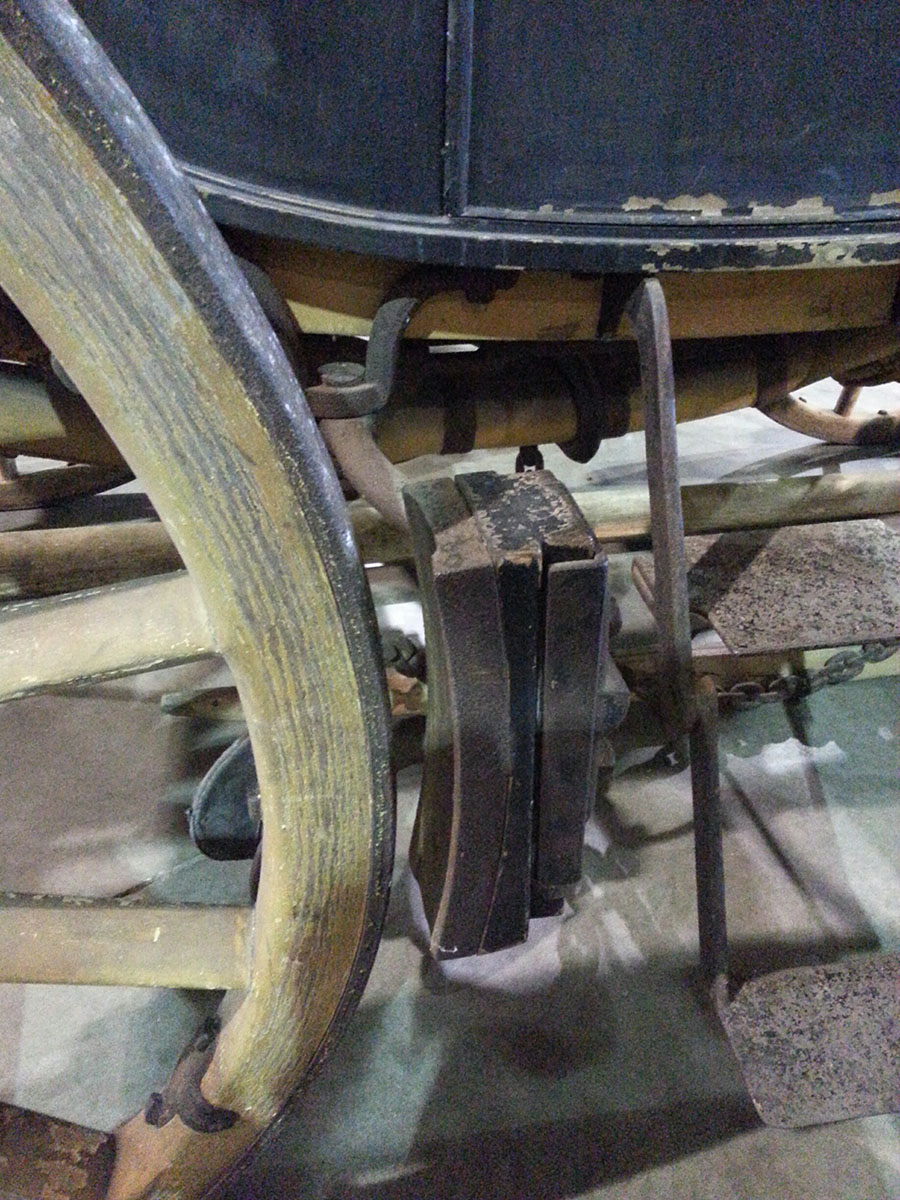
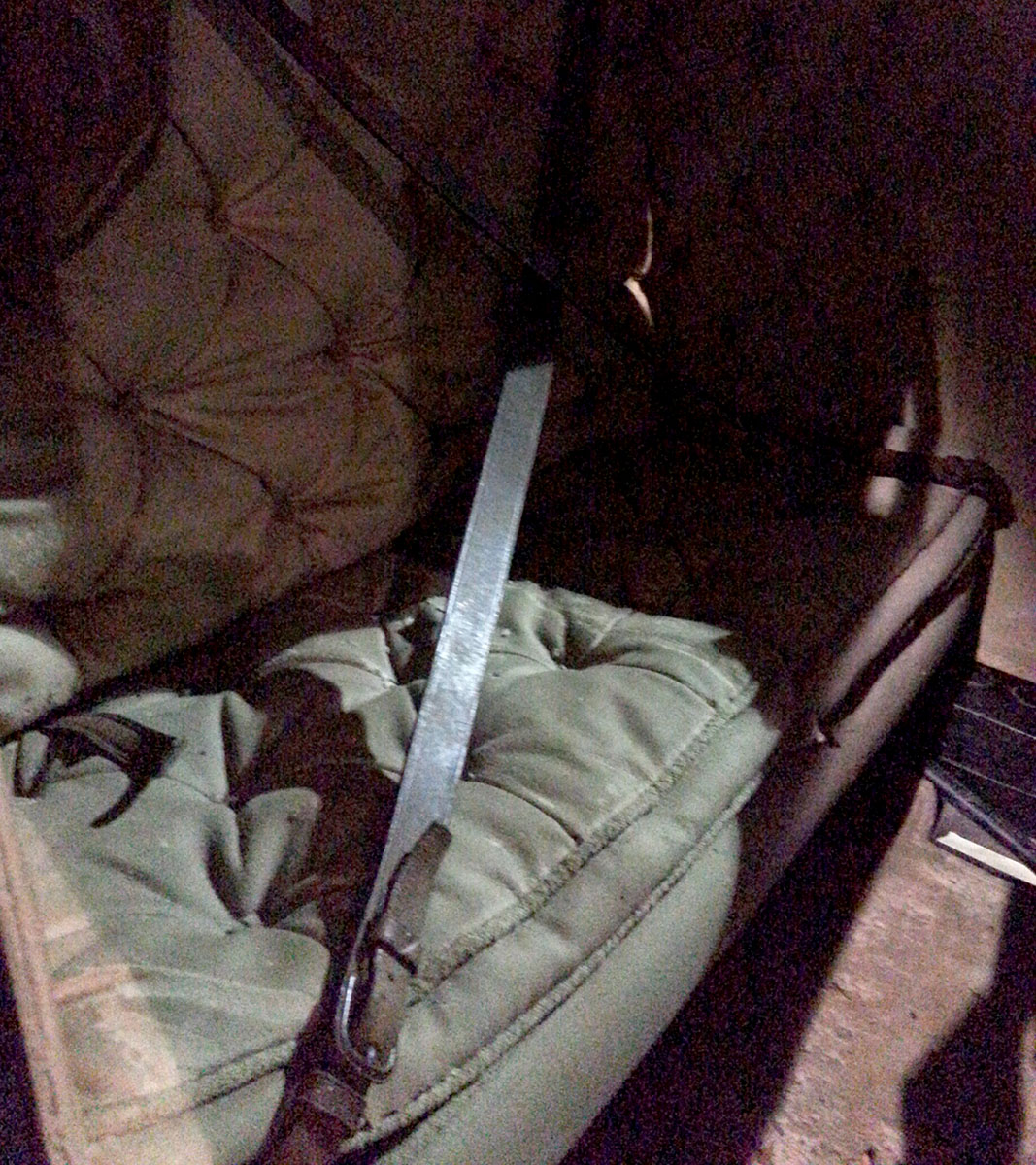
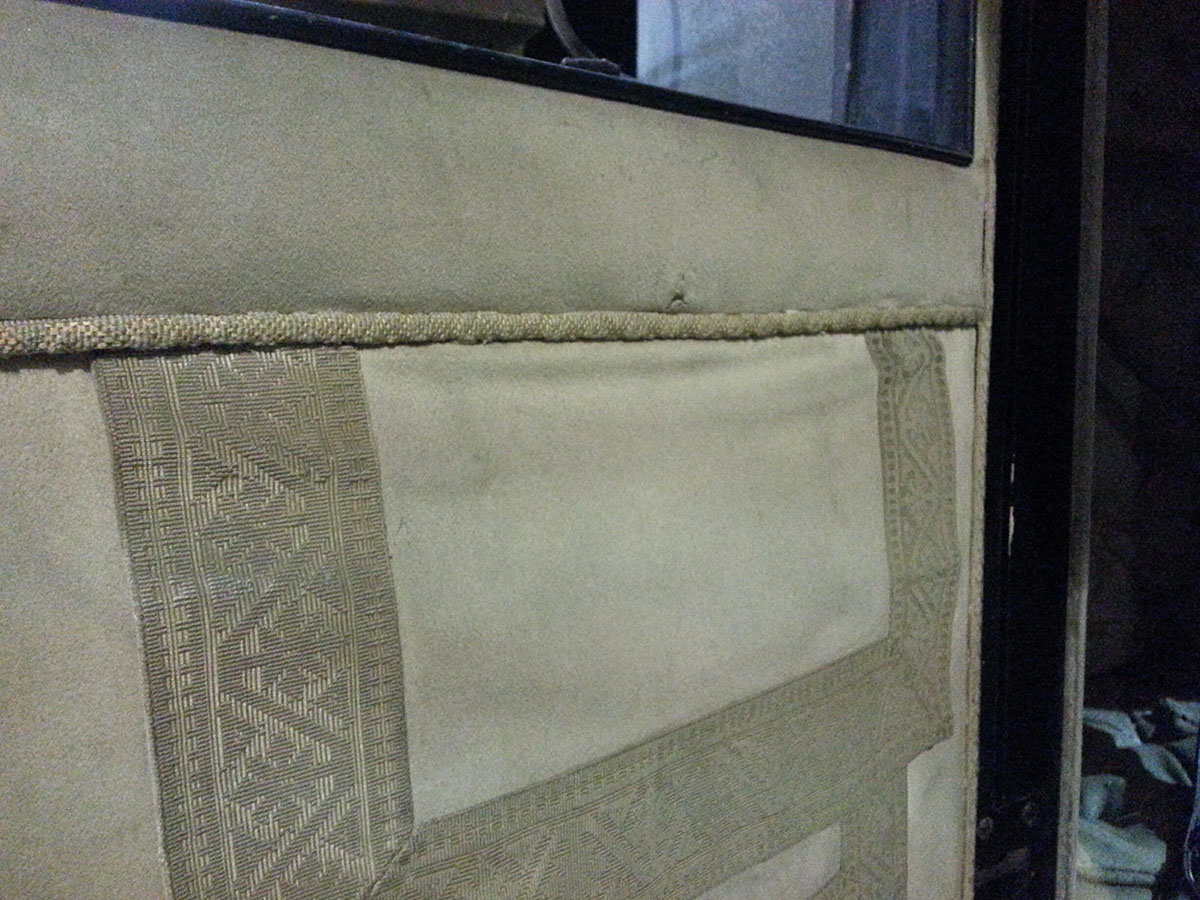
One of the vehicles up for auction at last weekend’s Martin Auctioneers carriage sale was an original-condition Brewster coach. It was described in the catalog as a Park Drag, but it appears to be bigger and heavier and perhaps more akin to a Road Coach … and the boot opens the “wrong” way for a Park Drag (from the side instead of from the top). But, regardless, it was an original-condition thing of beauty.

Here are some photos of the coach (taken with the camera on my phone in less-than-ideal lighting, so please excuse the low quality) …

We have views of the toe-board lamp, a view and a detail of one side lamp, and a bit of the other side lamp with its glass turned around for daytime; both doors, one with the window down and the other with the shutter up; details of a rear wheel and the undercarriage; a (dark!) view of the original upholstery, a look at the coach lace on the door, and the Brewster name plate on the inside of one of the doors.

.

coach1

.

coach2

.

coach1a

.

coach3

.

coach9

.

coach7

.

coach8

.

coach 10

.

coach11

.

coach12

.

coach13

.

coach5

.

coach6

.

coach4

.