For today: another busy street scene from the 1892 Glimpses of the World book.

Here, there seem to be quite a lot of two-wheeled vehicles and of course the horse-drawn trolleys in the foreground.

.

.

Bearing in mind (with regard to the flag atop the statue of Nelson) that Ireland had not yet gained its independence when this was written, here’s what the photo’s caption says:

“The Irish are exceedingly proud of their capital, and well they should be. Its situation on the river Liffey near its entrance into Dublin Bay is beautiful, and many of its public buildings command the traveler’s admiration. Its principal thoroughfare, Sackville Street, has few superiors in Europe. In the center, and dividing it into upper and lower Sackville Street, is a fluted Doric column 134 feet in height, crowned by the statue of Nelson, and reared to commemorate the hero of Trafalgar. The cost of the monument was about $33,000, which was raised by popular subscription. On every anniversary of Nelson’s greatest victories, the Union Jack is displayed from the top of the column. But the Nelson monument is only one of the many striking features of Sackville Street. Here, for example, is the General Post Office, presenting a long and handsome façade adorned with statuary. Here also are several statues of distinguished Irish patriots, and many of the finest business blocks and hotels of the city. Moreover, this is the great promenade of Dublin, and it has been often stated that nowhere can there be seen more beautiful women than one may meet here on a pleasant afternoon. For if a ‘real old Irish gentleman’ is one of the most agreeable of acquaintances and one of the truest and warmest of friends, so Irish ladies are not only charming in form and feature, but remarkably attractive from the rare combination they exhibit of high breeding and dignity together with a quick sympathy and warm-hearted impulsiveness, which no mere covering of conventionality can ever quite conceal.”
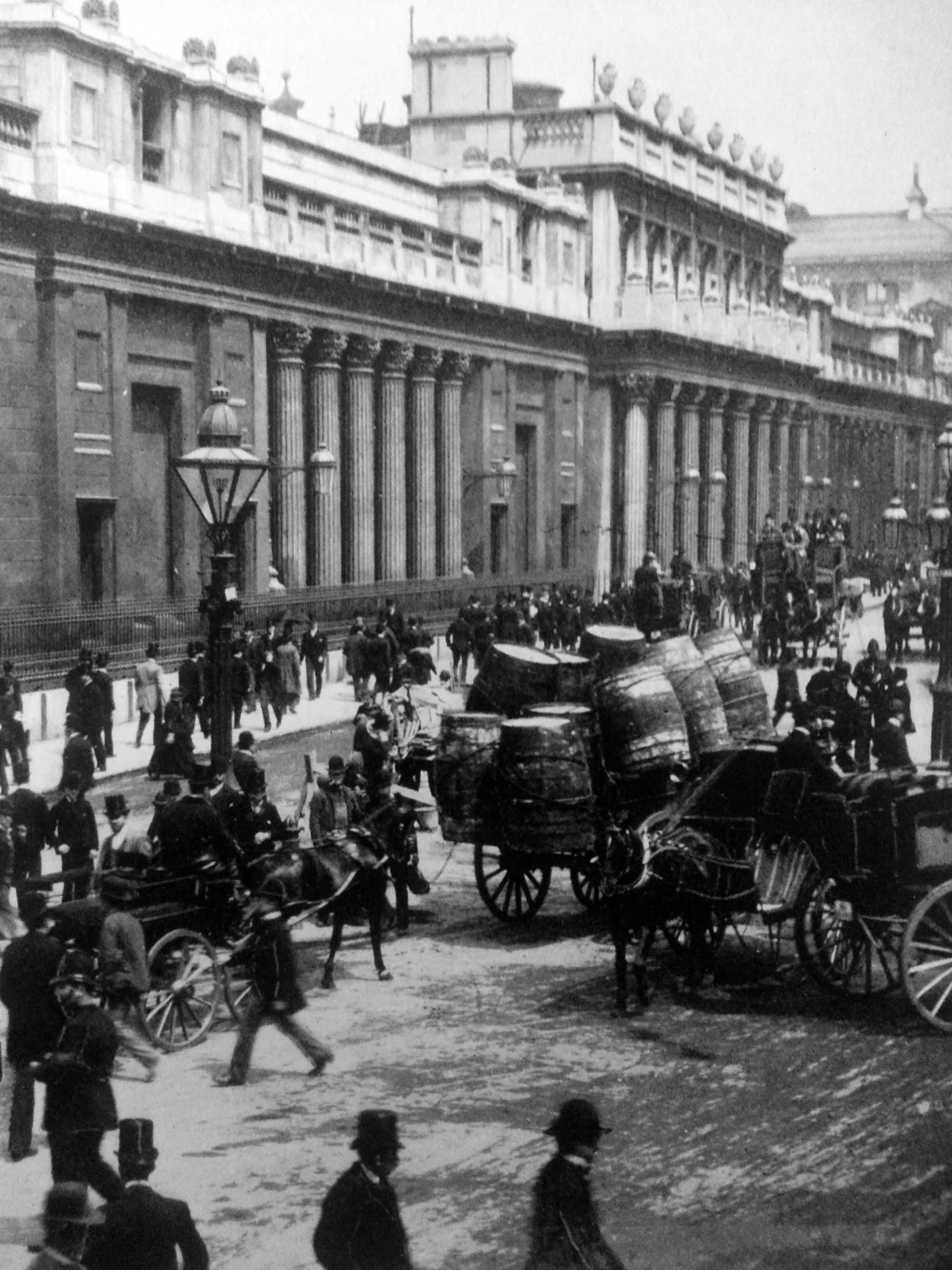
For our next look at a London scene from the 1892 Glimpses of the World book, we have this busy street outside the Bank of England:

.

.

In the street are pedestrians, a wagon loaded with barrels, at least one passenger vehicle, a Hansom Cab, and what appears to be either a coach or an Omnibus with passengers seated on top.

The book’s caption for this photo says, in part:

“In the very heart of the city of London stands a low-browed, massive structure, streaked with soot and without even a window in its outer walls. It is the Bank of England. This absence of windows is supposed to give greater security to its valuable contents, the light within being received from interior courts and skylights. The structure looks therefore like a gigantic strong-box, covering four acres of territory! This establishment, though a national institution, is itself a private corporation. Its capital is about seventy-five million dollars, and its bullion alone is supposed to be at least one hundred and twenty-five million dollars in value. Its affairs are managed by a governor, a deputy governor, twenty-four directors, and nine hundred clerks. Below the surface of the ground there are more rooms in this structure than on the ground floor.”

I just found out yesterday that steeplechase jockey Crompton “Tommy” Smith (b. 1937) passed away last week.

As a young man, he met the Thoroughbred Jay Trump (foaled in 1957). The horse had had a dismal flat-racing career but Tommy discoverd that he loved to jump.

The horse, the jockey, and the son of Jay Trump’s owner began training for steeplechase races. They won their first race in 1962. In 1963, they broke the course record at the famous Maryland Hunt Cup. The next year, they won Maryland’s “Triple Crown” of timber races.

Tommy and Jay Trump’s greatest victory came in 1965, when — despite 100-to-6 odds — Jay Trump became the first American-bred, -owned, and -ridden horse to win England’s Grand National.

In April 1965, Sports Illustrated published a fascinating article on the pair that won that year’s Grand National.

You can watch an original broadcast of the race here. (By the end of the video I was cheering for Jay Trump and Tommy, even though I knew they would win … but remember: neither the sport nor this film of it were for meant for the faint-of-heart.)

After winning the Maryland Hunt Cup for the third time, in 1966, Jay Trump was retired and lived out his remaining years at one of Mrs. Stephenson’s farms. He passed away in 1988, at the ripe old age of thirty-one, and is buried at the finish line of the Kentucky Horse Park’s steeplechase course.

We really did get the beautiful Saturday the weathermen promised: sunny and warm(ish) … perfect for our first “work-day” in the garden in a looong time. And we were finally able to do all the remaining late-winter / early-spring cutting back and cleaning up in our big perennial garden, while our cat lounged in the sun on the porch and “supervised.”

We’re ready for spring!
.

.

One of the sure-fire signs of early spring around here — the Kentucky Horse Park’s annual farm-equipment auction — is this weekend. And the weathermen are promising that tomorrow will finally be both nice (i.e., dry) and warm enough to actually go out and do some yard work / gardening.

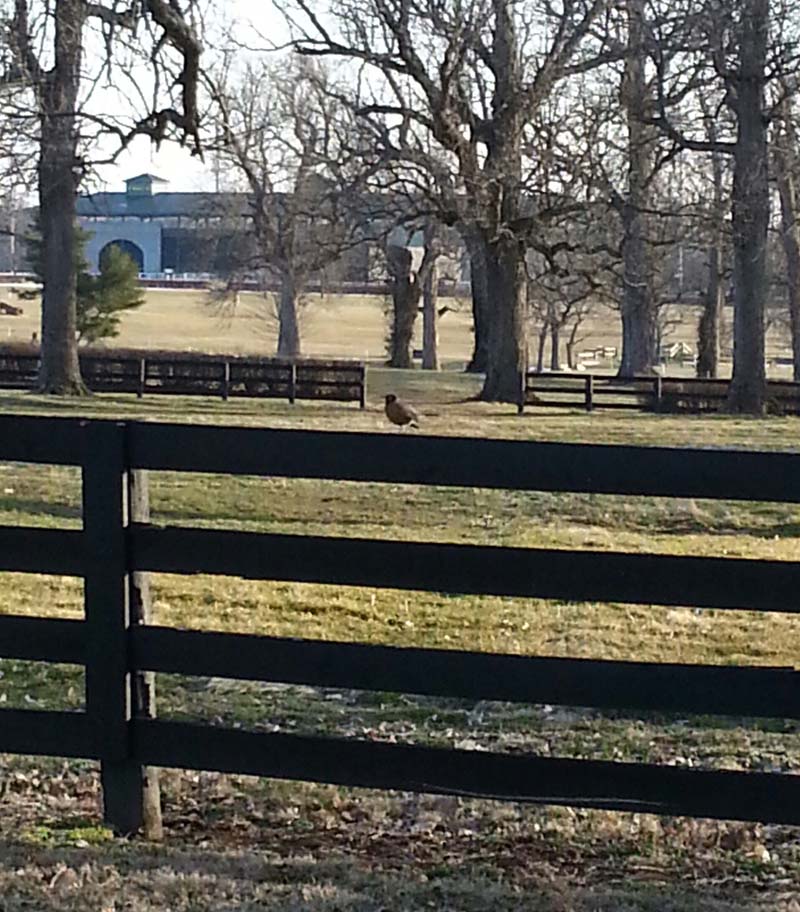
I went for a walk here at the Horse Park this afternoon (in sunshine … hooray) and what must’ve been hundreds of birds, chiefly robins and cardinals, were belting out their pretty springtime songs.

This little guy was one of many singing his heart out. (Can you see him on the fence? I couldn’t get very close before he flew away.)

.

.