I haven’t yet received photos from the CAA group in Windsor (I’m sure they’re too busy having fun to send me any photos!), but I’ll post them here as soon as I do get any. For now we’ll continue with Mr. Johnson’s tale

“I left Beowawe on the morning of the ninth [of September 1882]. I was awakened by a passing train from the west, and on getting up I found it was a little past three o’clock. I fed my cattle and got ready for an onward move; it was four when I started for Carlin. The first part of the road was on the river side, which soon I had to ford, a good gravelly bottom. After journeying about a mile I came to a fine Eastern-built house. A half mile beyond there were many horses feeding by the road. After passing them, they fell in my rear and continued to follow me; I attempted to drive them back, but they took no notice either of me or my dog, whom I set on them. They kept following close behind the cow, which annoyed her.

“I thought it best to turn back to the house, this being the best way to get rid of them. I returned, they following me, and drove up to the house, but could not see anyone around, so I called out loud and strong. This brought a man to the door. I told the man I was traveling East and in passing nearly two hours ago, those horses fell in [behind me]; I tried to drive them back but could not, so I had returned with them as I did not know how far they would go with me, thinking best to get rid of them. ‘Well, stranger, I am sorry they have given you this trouble. How far are you traveling?’ ‘I belong East, in Massachusetts.’ ‘That is my home also.’ ‘What part of Massachusetts is your home?’ I asked. ‘Fall River was my home. Where are you from with this outfit?’ ‘I am from California, more than three hundred miles north of San Francisco.’ ‘You have come a long distance, and led that cow all that way?’ ‘Yes, sir.’ ‘That beats the devil all hollow.’

“[I asked,] ‘How is the road from here to Carlin?’ ‘Most of the way is good — you will find it rough through the canyon. I came through a few days ago on horseback, there is no trouble traveling that way. You have a wagon, it will be hard for you to get through with it. There are some washouts, but you will be able to get over them. Stop and get some breakfast with us, we are late this morning, but it will be ready soon. I will give your horse some oats.’ ‘I will stop for the grain for my cattle as they need it. I think a great deal of the cattle and have to take great care of them, or I shall not be able to get them through this tramp.’ ‘Go in and get a dish of coffee. By the way, will you take something that will help you along?’ ‘Yes, I will, there is nothing better than a good cup of coffee, and I want nothing more. It is just what I need this morning; anything else would be out of place.’

“I had breakfast with them, it was a good one, and with strangers from my own State of Massachusetts. It was seven o’clock as we bade each other goodbye, he hoping that I would get through my journey all right.”

… to be continued …
Jill is leading this year’s CAA trip to the Royal Windsor Horse Show, as she’s done every May for the past twenty or so years.

She sent this report from the group’s first day …

“Tonight the CAA group was joined by several guests at The Christopher Hotel in Eton for a ‘welcome’ reception and dinner. Patti Wolf of Texas (the lucky winner of the CAA trip to Windsor in a contest drawing held last year) was generous enough to host tonight’s champagne reception. We had hoped to be able to enjoy our reception on the outside deck at the hotel, but the weather turned cold on us. So we all got cozy in the hotel’s pub before Grace Yaglou (of Mass.) sounded her coach horn to call us all in to dinner.

“The group was very lively, with our British guests sitting at various tables. We enjoyed a scrumptious meal, washed down with plenty of wine, and three hours later the group reluctantly departed for bed.

“Many of the group went to the show today, and I was pleased to note how many people were in attendance.

“Rumor has it that Jimmy Fairclough of New Jersey is over and has leased a team and a coach for the popular coaching marathon on Friday. Misdee Wrigley Miller (of Kentucky and Florida) is also here for the same event. So there is plenty for us to see and support!

“For the first two days I was here, we had sun and record heat. But now the heat has broken and today was overcast and cooler. I must say, this is more like you would expect, weather-wise.”

… Jill’s hoping to be able to send photos, starting tomorrow, from our guest photo blogger, Finn.

As we sloooowly make our way into spring (even though it’s already May!), we offer this list of suggestions for inspecting a modern horse-drawn carriage before heading into the driving season. This information was provided by one of the CAA’s directors.

1. Wash the carriage completely and thoroughly, but do not use high-pressure water on the hubs.

2. Look for any distortion of the body, or parts being out of square. Do this with a critical eye (pretend you’re looking at the carriage to buy it).

3. Inspect all snap shackles, shaft loops, pole straps, etc. for wear.

4. Check for loose bolts or parts that may be bent or worn, especially singletree mounts, etc.

5. Tighten every bolt on the carriage.

6. Look over all welds, etc. for signs of cracks.

7. Lift each wheel off the ground in turn and make sure they all spin freely.

8. Under normal driving conditions, repack the bearings every three years; every two years under heavy use; and every year if the wheels are submerged in water. Repack these with regular grease, NOT wheel-bearing grease, which is a high-temperature grease and is not appropriate for the low temperatures of carriage wheels.

9. At the same time, check the wheels to see if any are bent or wobbly.

10. On four-wheeled vehicles, make sure that the fifth-wheel system is tight and lubricated (open-chain spray is a good lubricant, but WD-40 is not). Dismantle and clean up this area every six or seven years and, if practical, change the king bolt or its equivalent then as well. Do not reuse any lock nuts.

11. Look at the wheels’ alignment. They should have a little toe-in and a little positive caster when at rest, which will result in a straight-running wheel when underway.

12. Remove the shaft and singletree pivot bolts and inspect these areas. Replace them if they show any wear. On two-wheeled vehicles, check the shafts for signs of cracking or fatigue.

13. On the brake system, check the master cylinder for fluid and top off if necessary. If the fluid levels were low, apply the brakes as hard as you can and recheck the fluid levels. If, after doing this several times, the fluid level is still low, check the brake system for leaks. Make sure you use the correct brake fluid.

14. Inspect the brake discs for wear and clean them with a disc-brake cleaner. Inspect the brake pads, removing the callipers if necessary.

15. Sand off any rust or corrosion and then touch up these areas with paint. Flaking paint can be a sign of a bent or cracked part. Most commercial (not automotive) paint suppliers can match paint to a sample, such as a singletree.

16. Wax the carriage with a good wax.

17. Oil all moving parts, including the brake linkage, seat slides, singletrees, snaps, etc.

18. Remember to conduct this safety inspection each year, ideally in the winter or early spring, which will give you plenty of time to make any necessary repairs before you’ll be wanting to drive the carriage again.

When we last checked in with Mr. Johnson, he was preparing to leave Battle Mountain.

“On the morning of the 8th [of September 1882] I left Battle Mountain, about three o’clock, intending to reach Beowawe the same day, traveling a distance of thirty-three miles. On leaving Battle Mountain I followed the railroad to my right for over a mile, then following the river for some ten miles, when I again came to the right of the railroad to Shoshone station. In making Beowawe I pass two stations, Argenta and Shoshone. I traveled twenty-three miles in nine hours, making only one stop, the road being one of the best. On arriving at Shoshone, twelve miles, I introduced myself to the station agent …”

After the two chatted for a bit, “[the station agent said,] ‘Stranger, take your horse and cow and turn them into the grass, give them their dinner and come in and take dinner with me, and when you get home, you can say that you dined with John Briggs, of Shoshone, formerly of New York City.’ I did not wait for a second invitation. Our dinner consisted of bacon and eggs, bread, butter and coffee; you will remember I have always milk with me. After dinner we talked awhile. I inquired the distance to the next station. He replied, ‘It is ten miles to Beowawe. About a mile from here, take the right trail, leading you over the mountain, it is a less distance, and you will not have to ford the river, which is more mud than water.’

“I left him with good wishes and went on. On coming to the trail I hesitated whether to go over the mountain or ford the river, but concluded to cross the mountain. When about halfway up I stopped. I left my horse and went to the top, came back and said to the horse, ‘Fanny, can you get up this hill with your load? It is a hard pull, but let us try.’ We went about four rods further, then halted, and then made one more pull for the top, which we accomplished. This saved some three miles and we ran no chances in fording the river. The descending was much easier; making the descent we cross the railroad, and from this crossing to the station the road is good. The course of the railroad from Wadsworth to this mountain is north by east. Then turning to the right, making three-quarters of a circle, in reaching Beowawe, a distance of ten miles, where I arrived about six o’clock in the evening.”

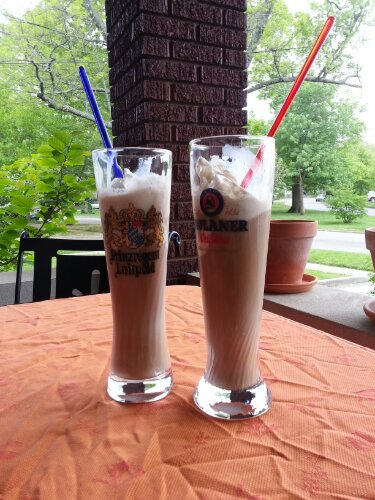
What’s one of the most important things we learned on our trip to Germany last summer? Why, how to make a coffee float, of course! It’s the perfect refreshment for a hot afternoon: iced coffee, ice cream, and (ideally, although we didn’t have any for today’s experiment) whipped cream. And on top of all that, perhaps some chocolate shavings. Yummmm.
.

image

.