I know you’re tired of hearing this by now, but “Wow!”

After having heard about and seen pictures of the feria, I was looking forward to seeing it in person. But I have to say that being there, in the middle of all the color and life and action and the sound of hooves and wheels on cobblestones, was far better than I had imagined.

But I’m getting ahead of myself. In the morning we had a guided tour of the city by bus and on foot. Our first stop was the Spanish Square (Plaza de Espana), where we had been briefly once before. We learned that the beautifully painted tiles around the base of the semicircular building depict a variety of stories from Spain’s history. From here, we went to the Santa Cruz neighborhood (Seville’s old Jewish quarter), which is a maze of extremely narrow, crooked lanes that lead into a series of very small plazas. From the second of the plazas we visited, we followed yet another little alleyway and ended up in a lovely large plaza with the alcazar (the moorish-inspired medieval royal palace) on one side and the cathedral on another. Seville’s cathedral is the third-largest in the world, and it’s quite an imposing, ornate edifice.

In the plazas around the cathedral were a large number of the tourist carriages that we had seen all around town on previous days. These aren’t your typical tourist turnouts, though. Many of the carriages are antiques, and nearly all of them are kept in beautiful condition. The horses look fit, healthy, and lively. Everyone in our group commented on how impressed they were with the apparent good condition and cleanliness of both the horses and the carriages. It’s clear that these drivers (all licensed) take great pride in their work and their turnouts.
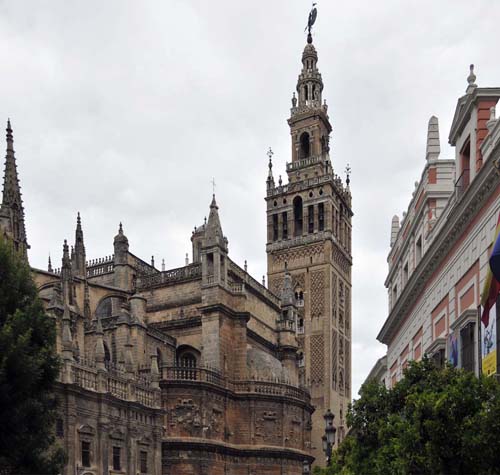
one view of Seville's cathedral

one view of Seville’s cathedral

We went into the cathedral with Raimundo, who had met us along our walk, and our tour guide and what seemed like thousands of other people. It’s a huge space, and it was packed with tourists.

And then it was on to the feria! The day we went was, apparently, also the day that most of the inhabitants of Seville go as well. The first full day of the feria, we were told, is an official holiday in the city so that anyone who wants to can go to the fair.

For anyone unfamiliar with the idea of the feria: the “fairgrounds” are like a village of colorful tents that look like small houses. These are arranged side-by-side on three long cobblestone streets with quite a number of cross streets. Between the tents (casetas) and the streets are packed-dirt sidewalks. In the casetas (almost all of which are invitation-only) are people sitting and eating and drinking and visiting with friends and watching the spectacle. And what is the spectacle, you may be wondering?

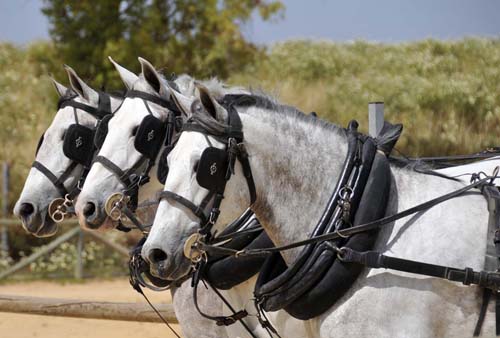
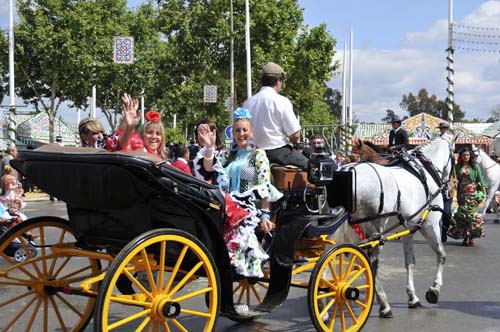
There are horses (nearly all Andalusians, and many stallions) being ridden by men, women, teenagers, and small children, all in traditional Andalusian dress. And there are hundreds of carriages, including many antiques and a couple of coaches, being driven with singles, pairs, fours-in-hand, and fives-in-hand. Many of these are in the traditional Andalusian harness — pom-poms and bells galore. So the riders promenade through the streets of the “town,” stopping for drinks at their own or friends’ casetas along the way. And the carriages, too, promenade through town, stopping in front of their casetas to pick up and drop off passengers, probably family, friends, and clients. And weaving in and around all of this are probably thousands of people — walking on the sidewalks and in the streets. Most of the women are in the fancy, colorful Andalusian dresses, whereas the men all seem to be wearing suits. This is probably the best-dressed fair I’ve ever been to.

Enjoy these photos of the feria, as our group heads home. I’ll be in staying in Spain for a few more days and will continue to post a few thoughts and photos here along the way. Then, starting in May, be sure to check back here for the CAA’s blog from the Royal Windsor Horse Show!

women waiting to cross the street at the feria
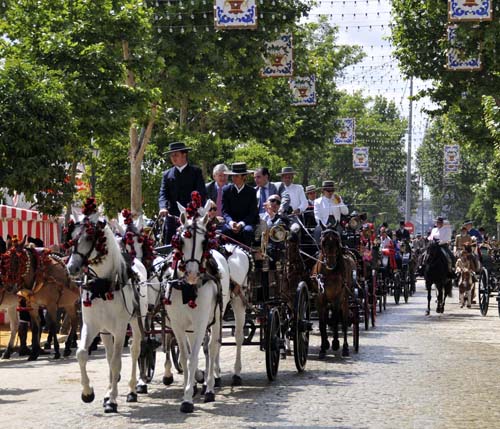
women waiting to cross the street at the feria

a long line of horse-drawn carriages parading down the streets of the feria

a long line of horse-drawn carriages parading down the streets of the feria

hildren on the back of a carriage and a lady sitting on a horse in the traditional style
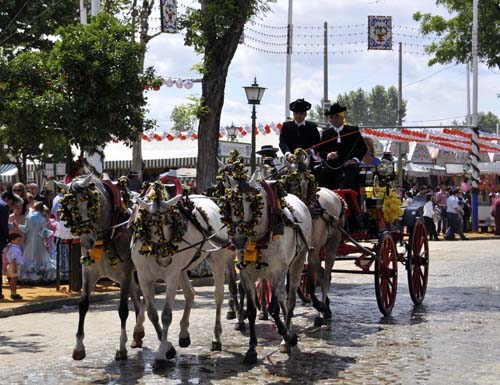
children on the back of a carriage and a lady sitting on a horse in the traditional style

the five-in-hand team and carriage of one of our hosts during our trip

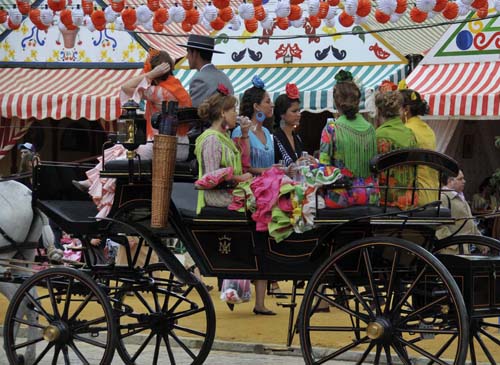
the five-in-hand team and carriage of one of our hosts during our trip

one of the (many!) beautiful Andalusian horses at the feria

with the casetas and the traditional outfits, the feria is wonderfully colorful
with the casetas and the traditional outfits, the feria is wonderfully colorful

goodbye from Seville and the feria!

I don’t know what to say. Today was amazing-, spectacular-, marvelous-, “perfecto” day number three. Wow.

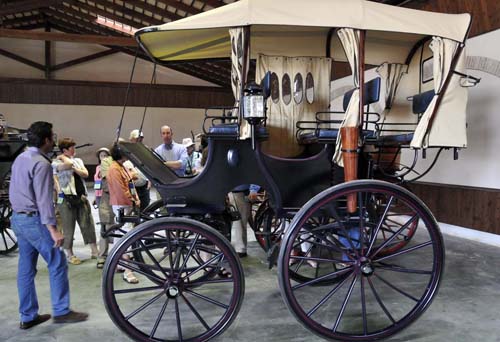
Our first stop was to see the enormous carriage collection of Mr. Aranda. He’s putting the finishing touches on his new (huge!) carriage museum. Because the museum’s not finished, it’s not actually open yet and so it was a treat to be invited to see it.

I’ve been told that the entire collection numbers more than 200 carriages, and just looking at the size of the museum building, I would believe the claim. There were all sorts of vehicles, although as one of our group said, they are not necessarily representative of everyday life of the time. These were unique and high-end vehicles, most of which had been restored in an on-site restoration shop. The carriages were displayed with a lot of space around each one, which made it easy to walk all the way around and look closely at them. The ubiquitous water (usually a bucket of water under each axle to help with the humidity level) was here a whole series of spouting fountains, with one big landscaped fountain in the center of the building.

After a long look through this building, we walked into the beautifully landscaped garden (to the sound of even more fountains) and, surprisingly, into another building with even more carriages. Most of these were large and ornate, and one was being cleaned and polished to be driven in the feria later in the week.

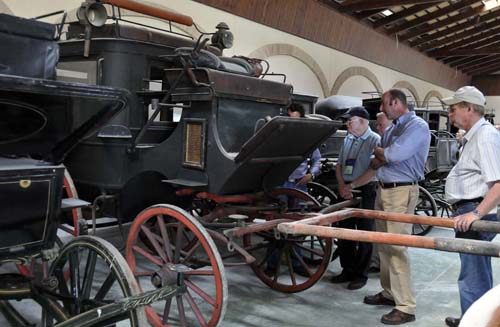
one of the unusual coaches in Mr. Aranda's huge collection

one of the unusual coaches in Mr. Aranda’s huge collection

After exploring this hidden museum building, we were led deeper into the garden and given a view of a paddock with horses. Mr. Aranda also breeds Andalusian horses, but he specializes in black ones, as opposed to the ubiquitous grays. From here, we strolled down a shady lane at the far end of the garden and into a delightful courtyard, which is surrounded by what appear to be the oldest buildings on the farm. Around a corner into another yard, and we were introduced, one by one, to several of the farm’s stallions. Back into the first courtyard, through a doorway and in we went to the harness room. There was yet another courtyard to see, and even a small chapel. And there was a very friendly barn cat who demanded ear scratches and then followed us around for quite a while.

the first of the lovely courtyards in the oldest section of Mr. Aranda's farm

the first of the lovely courtyards in the oldest section of Mr. Aranda’s farm

On the way back to the bus, I heard the story (from Mr. Aranda’s son) of the three-month-old orphaned filly who was bottle-fed (in the house) and now thinks she’s a person. She plays with the family, lies down with them in the grass when they sunbathe, watches TV and, if they’re sitting on the sofa, hangs her head over the back until they scratch her. I would’ve thought he was pulling my leg unless I’d seen the photos of it all on his iPhone.

Our final stop in this marathon of carriage collections was the smallest, but in no way the least. To get there, we drove to the lovely-looking town of Alcala, which stretches up a hillside to the base of an old castle. On the other side of town, we turned and headed out past fields of tall grasses, daisies, red poppies, and more horses. When we arrived at the Olivera farm, we were introduced to “Pepin,” the owner (the original owner’s nephew), and his wife. They and their driver, grooms, and family (even their granddaughter, a toddler) welcomed us with a spread of bread, olives, several kinds of ham, Spanish “tortilla” (potato and egg “pie,” served cold), and more. They were even grilling delicious ham and ribs and sausages in the fireplace/grill corner of the old wash-rack room. They had a table and chairs set out for us in the small courtyard surrounded by the wash-rack room on one side, their house on one side, and the harness/carriage room on a third side. Out the other side of the wash-rack room was yet another courtyard, this one a little larger, with a barn of horse boxes off to the left.

After most of the food was gone, out came a bowl of strawberries. Then, a little later, a pot of coffee, a carafe of hot milk, and a tray of cups and saucers. Needless to say, we were very well taken care of!

When everyone had eaten and visited and relaxed, Pepin and Raimundo gave a tour of the harness/carriage room, which houses several sets of traditional Andalusian harness and both old and new sets of English-style harness. Displayed on chairs are several styles of Andalusian livery from various time periods. And arrayed across the tops of the harness cases, on the walls, and on the tables are the many trophies, ribbons, and awards the family has won for their horses, their carriages, and their driving. On the other side of the room are six carriages: five antiques that have been expertly restored and one 25-year-old reproduction. All are painted in the family’s colors of red and black.

the gorgeous finish on one of the Olivera farm's carriages

the gorgeous finish on one of the Olivera farm’s carriages

After this tour and a close look at the carriages, we met some of the horses and watched a five-in-hand do some work in preparation for driving in the feria tomorrow.

the three leaders in the five-in-hand team

the three leaders in the five-in-hand team

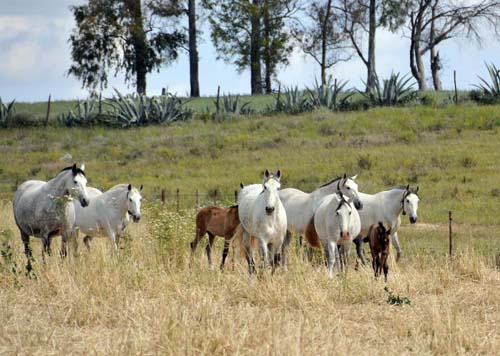
And then, as a final treat, we walked out the back of the yard to a large field, where we went with Pepin to see a herd of his Andalusians. There were 25 or more mares, a number of new foals, and one stallion. When we headed slowly into the field, the older mares went around to arouse the sleeping foals and get everyone moving away from us. So the group of us stopped about mid-way in and waited while Pepin walked slowly toward the herd, talking to the mares. In the end, the mares were mostly curious about us and what we were doing there, and the foals didn’t seem to take any notice at all. The stallion, however, chased any overly curious mares back to the herd. Pepin made his way around to the back while the stallion wasn’t looking and managed to move the lot toward us before the stallion realized what was going on and moved them away again. Watching the interactions among the herd was fascinating. And the horses … well, it goes without saying that they’re beautiful.

curious mares and nonchalant foals

curious mares and nonchalant foals

Who would’ve thought it was possible? We awoke on Sunday to a steady rain, and it had apparently been raining much of the night. It did finally clear up and turn into a lovely day by late morning / early afternoon. But it was still raining quite steadily (and, we found out later, the bullring was full of standing water) around 9:30 / 10:00 a.m., when the antique carriages, the traditionally dressed men and women, and the hundreds and hundreds of horses in their fancy pom-pom-filled harness should have been lining up for the carriage parade. And so, unfortunately, the committee in charge of the event decided to cancel the whole thing.

We are assured that we will see most of the carriages, along with horses and riders, parading through the streets of the feria grounds on Tuesday. But we will just have to come back another year to see the spectacle in the bullring.

So everyone in the group ended up with a free morning to explore whichever portion of Seville suited their fancy.

In the afternoon, we all went to the carriage museum of the Royal Andalusian Carriage Club to see the collection there. The building is another old monastery, and it houses a small but nice collection of carriages, harness, and livery. Because it’s a museum, the displays also describe the carriages and how carriages were used in Seville in earlier times. The collection changes often, depending on which carriages the various members choose to include from their own personal collections.

While here, our Spanish host, Raimundo, presented the CAA with a beautiful book on the history of carriages in Spain, and with a book describing the museum and some of the carriages presented there over the years.

Two of our group missed the visit to the carriage collection, but for a good reason. Roger and Sue Murray had been invited, as official CAA representatives (Roger is an officer of the association) to attend a special lunch for the Royal Andalusian Carriage Club’s directors and special guests (including representatives of other countries’ carriage associations, and a delegation from the Dominican Republic). Of course, “lunch” wasn’t served until 4 p.m.! By all accounts, they had a wonderful time, meeting new people and making connections with counterparts from all over the world.

This is a quote from one of the European participants in the trip. And he was talking about the day we had. “Awesome,” “amazing,” “fantastic,” or (as our Spanish host, Raimundo, is fond of saying) “marvelous” — none of these seem to do it all justice. To quote the old stereotypical postcard: “Having a wonderful time. Wish you were here.”

We started out the day by going to the offices of the municipal water company for a tour of their building (yes, the water company). It’s just across the street from our hotel and, from the outside, doesn’t look like much. The interior, however, is a beautifully restored monastery, with two cloisters, antique furniture, and a monumental sixteenth-century staircase.

the trip participants in the impressive staircase in the old monastery that now houses the water company

the trip participants in the impressive staircase in the old monastery that now houses the water company

Then we all piled on the bus and stopped briefly by the Plaza of Spain (I think is its name), which is across the street from a huge park and whose massive, tiled building, towers, and bridge have been featured in several movies. On the way there, while several people on the bus were discussing the many (more than a hundred) horse-drawn tourist carriages in Seville, we came upon what appeared to be a Dutch Harness Horse being exercised to a marathon vehicle — down the middle of the street in the middle of all the traffic. It was quite an unusual sight, especially when he objected to stopping for the red light and reared up before settling back down to a smart trot once the light turned green.

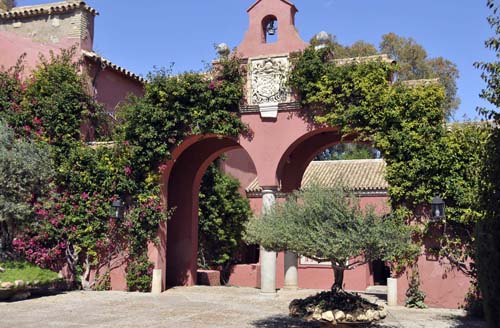
After the obligitory tourist stop at the famous square, it was off to the farm of Mr. Ordas. After making our way through the gate, we drove for at least another mile if not more, past eucalyptus groves, farm fields, pasture, and field upon field of olive trees. My description of the gardens, courtyards, and old and newer building probably wouldn’t do them all justice, so here’s a photo of one of the courtyards:

a portion of one of the courtyards at Mr. Ordas's beautiful farm

a portion of one of the courtyards at Mr. Ordas’s beautiful farm

From here, we went into one of the stables, filled of course with the most exquisite gray Andalusian horses. Then it was back out into the courtyard and into a lovely carriage house with 26 vehicles. Most of the group enjoyed a long, close look at the collection, while a few went back out into the courtyard to watch the many storks in their huge rooftop nests, flying in and out, standing around, and feeding babies. As I understand it, the storks are considered good luck, and so it is considered bad luck to disturb their nests.

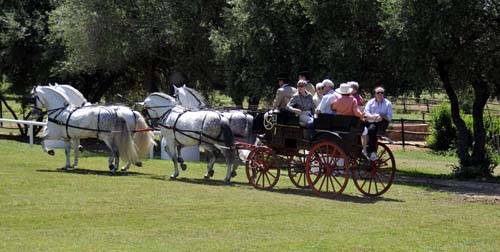
Then it was through the short end of the indoor riding arena on our way to the two-story, round harness room with harness cases around the wall. This room, we were told, had been where the bread was baked in the original buildings on the property. On through yet another little courtyard, and we were out next to the grass riding arena. The setting was impossibly beautiful, with a backdrop of trees, garden, and a large metal and glass greenhouse that looked large enough to hold a fancy party in. Chairs were set up along the short side of the arena, and we were offered homemade lemonade with mint. Eventually, Mr. Ordas arrived, shook everyone’s hand, welcomed us all to his farm, and apologized for his late arrival, but his polo game had just finished. Our group, the polo players, and several other guests were treated to a demonstration of four of Mr. Ordas’s carriages being driven. First, to a background soundtrack of Spanish guitar, came a single, then a pair, then a four-in-hand of Andalusians (at least two of whom were stallions) and, finally, a five-in-hand (three in front and two behind) in the traditional Andalusian-style harness, including all the brightly colored pom-poms and what sounded like hundreds of bells. Each turnout did a bit of a drive around the arena, then at the end they all came in and stood facing us. Mr. Ordas invited our group to go out to take photos or to just look closely at the harness, horses, and carriages. Then he invited anyone who wanted to to climb aboard for a ride.

several of our group enjoying a ride in one of Mr. Ordas's carriages

several of our group enjoying a ride in one of Mr. Ordas’s carriages

As we left this farm, everyone seemed to have a happy sort of glow about them.

And then it was on to yet another fabulous destination: the town of Salteras, in the hills above Seville, and the lovely farm of CAA member, carriage collector, and FEI competitor Miguel A. Gutierrez Camarillo.

Here, we met, in Miguel, a gracious host and an incredibly knowledgeable and passionate collector of carriages. It seems odd to call the building we entered a carriage “barn,” as it clearly doubles as display area and living room (with a big dining table, a full bar, plenty of comfy chairs and sofas around the fireplace and TV, and a pool table). But there are also several very nice vehicles here, including an original mail coach, a five-glass landau, and others. Miguel shared stories on each one — how he found it, why he likes it, and why he bought it. And all this while we all drank small glasses of manzanilla. 

About 30 minutes after we arrived (enough time to cook the rice), we were treated to a delicious lunch of Spanish paella, fresh bread, and red wine (remember the dining table and all the comfy chairs and sofas??).

Then it was around the back of the property (past the beautifully landscaped dressage arena, the view of the valley from the edge of the hillside, and the view down onto the practice marathon hazards and water) to the “under construction” carriage barn, where the rest his 70 carriages are stored. He had separated them into two groups, with the restored carriages on one side of the big barn, and the original-condition vehicles on the other. Here, again, we were treated to fantastic stories, a demonstration of an old fire pumper, and detailed, close looks at many of the vehicles. Miguel found kindred spirits in many of the die-hard carriage researchers in the group, and they found one as well in him. It’s clear that he knows the subject very well and that he’s passionate about it.

Miguel and several members of the group look at an unusual, recently restored American carriage

Miguel and several members of the group look at an unusual, recently restored American carriage

David Freedman and several members of the group discuss one of Miguel's yet-to-be-restored carriages

David Freedman and several members of the group discuss one of Miguel’s yet-to-be-restored carriages

Tomorrow, we go see the carriage exhibition (100 carriages) in the bull ring!

For our first full-day in Seville, we boarded our small bus and set out for a full-day tour.Our first stop: the monument depicting Christopher Columbus, which was a gift from the people of America to the people of Spain in 1929.Our second stop: a tour of the cool (it was quite sunny and hot today!) and lovely monastery where Christopher Columbus met with the abbot and prayed and, apparently, left his only son, before setting sail for unknown lands. Six Franciscan monks still live in the monastery, and the tour takes one through the exquisite chapel, the cloister, and several breezy hallways. Interspersed along the way are a meeting room and a dining room, which are kept as they would’ve looked at the time. And in a separate section of the complex are a few display cases of artifacts and, in the final room, boxes of dirt that Columbus brought back from all the places he visited.

the monastery Columbus visited before setting sail

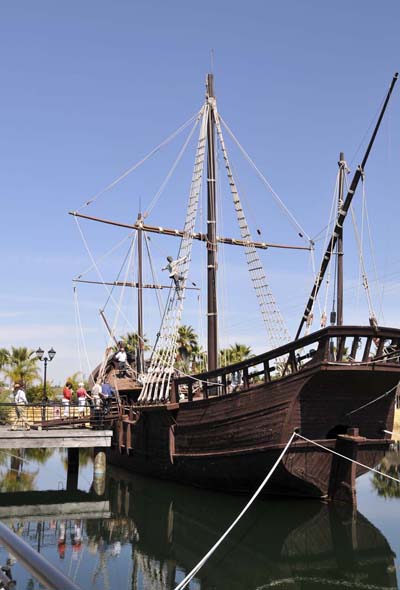
After that, we drove down the road to a museum of sorts set up in the city’s marshy area. (We were along a river and quite close to the Atlantic at this point.) This center had a small museum and recreations of a Spanish village of the era. The star attractions, however, were the life-size replicas of Columbus’s three ships. The tiny Nina is hardly bigger than a modern commercial fishing boat, the Pinta is a bit bigger than that, and the Santa Maria looks like the battle ships of the period that we all imagine. I was told that there were, in order by size, 20, 30, and 40 men on each ship. The real treat was being able to go on board each one and see what the view from the deck might’ve looked like. Or, more accurately, how hard it must’ve been to stand up on the deck! On all three, the deck is taller in the middle and curved down toward the sides. They always look flat in the movies! A few manequins and props and, below deck, speakers broadcasting the sound of water and creaking boards, completed the claustrophic but fascinating picture.

the replica of one of Columbus's ships

the replica of one of Columbus’s ships

 Then it was on to the day’s main attraction: Hacienda Maria. I think we were all a bit confused as the bus driver took us through a huge industrial area of factories and refineries, and then turned into a parking lot beside a warehouse. But once inside, we understood. Our hosts have amassed a stunning collection of close to a hundred carriages, and they are all (except the three being restored) stored here. They’ve implemented an interesting regimen of cleaning and “watering” the floor to keep the carriages clean and as hydrated as possible in this dry climate. In several metal containers (yes, the kind carried on board container ships), all the harness. lamps, and other collections are neatly stored. Before the group wandered off enjoy a close look at all the carriages, the introductions were made, everyone was “officially” welcomed, and we were invited to enjoy a beautiful and bountiful spread of local delicacies and traditional food. There were several special kinds of ham, delicious fresh-cooked pork, omelet (which is mostly potato), cheese, and more. Part way through our visit, a man arrived with the most delicious strawberries — fresh, sweet, and juicy. The area we were in (Huelva) is apparently one of the main growers and suppliers of strawberries for all of Europe.

part of one of the rows of carriages in the Hacienda Maria collection

part of one of the rows of carriages in the Hacienda Maria collection

After a lovely long visit, where everyone had ample opportunity to visit with each other, our hosts, and several of their friends, and to look at all of the many carriages, we headed off for the actual farm. Here, we were introduced to several gorgeous Andalusian stallions and were treated to a ridden dressage demonstration by two more Andalusian horses, one brown and one black. The perfect end to our perfect day came next, when we were all invited to walk out into the mares’ field, which is full of friendly Andalusian mares and, as of now, fourteen, foals. They are awaiting thirteen more. We wandered among the horses, scratching chins and noses, and making more new friends.

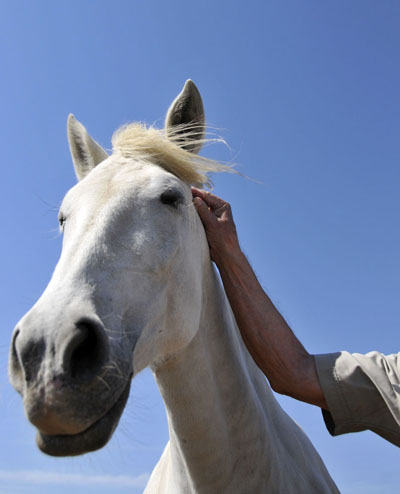
one of Hacienda Maria's friendly mares