… really. I mean it this time!

Tomorrow I fly from Seville (through Lisbon) to London, where I will spend the next week at the Royal Windsor Horse Show. As that is another official CAA trip, I’ll be blogging from there daily again, starting on Tuesday. So check back often for more reports and photos, this time from England!

To finish off my reports from Spain, let’s go back to yesterday’s visit to the private carriage collection.

My parents have a good friend here in Spain who, in turn, has a good friend we met on this visit. She has a cousin (well, 73 cousins, actually!) whose family owns the farm and the carriages we visited.  The farm and carriages belong to the Terry family, which used to own and run the Terry bodega (sherry winery) here in El Puerto, until they sold the bodega (and the brand name) about ten years ago. Our new friend’s cousin is a Terry on his father’s side, and the cousins are related through their mothers. The mothers were two of eleven children (hence the 74 cousins), and they were part of the Osborne family, who are also major sherry producers here in El Puerto. I think the Domecq family (also big sherry producers and horse people) are related to this large extended family as well.

After our visit to the farm, we stopped at a beautiful hotel here in town for a drink and a snack. It’s next to the Terry bodega and was probably once part of the same facility. It boasts exquisite architecture, including an ornate private chapel that was part of the original building (the priest would come from the local church each morning to say mass). The courtyard in the center is now covered but would have, I’m sure, once been open. And there’s a lovely fountain in its center. On one side is a huge garden with pathways between the trees and plantings, and several semicircular stone benches with small fountains at the center of the circles and rosemary bushes growing behind the benches. We understand that the furniture is not the same as it once was, years ago, but the feel of the place (overstuffed sofas, portraits on the walls) is of someone’s home. And, in fact, as you may have guessed, this was someone’s home (the grandparents of our new friend, if you hadn’t already figured that out as well!) before it was turned into a hotel.

But I’m getting ahead of myself.

Our visit to the farm was all the more delightful because the family was so kind in allowing us to even see it, as it’s simply their private getaway. The family’s small collection of carriages (most acquired by our host’s grandfather) are stored in two rooms. Some have been restored and some appear to be in original condition. All but one are driveable, although they are not driven as often anymore because the family’s horses are now mostly ridden.

one of the old carriages in the Terry family's collection -- this one has flower decorations painted on the woodwork

one of the old carriages in the Terry family’s collection — this one has flower decorations painted on the woodwork
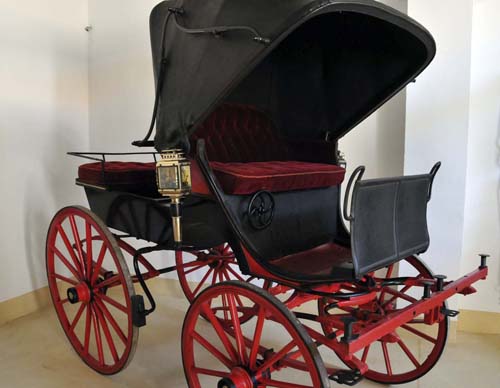
one of the family's carriages in the second storage area

one of the family’s carriages in the second storage area

The harness and tack room is a cosy place, full of old harness, traditional saddles, hunting trophies, and horse-show trophies. There’s even a Breyer horse that was modeled after one of the family’s Andalusian stallions.

part of the harness / tack room

part of the harness / tack room

As I’m learning is the case at most of these Andalusian farms, there was a succession of delightful courtyards, patios, and outdoor “rooms,” both sunny and shady. The ones here were filled with pots of geraniums, rose bushes, palm trees and, in one case, an arbor of grape vines. Off of the grape-vine courtyard were four stalls with horses in them; Andalusians, of course. This one here was quite friendly and didn’t want us to stop scratching his nose.
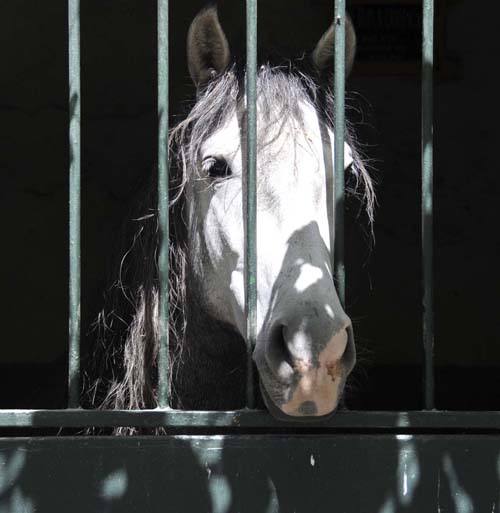
this horse really wanted his nose scratched and his photo taken

this horse really wanted his nose scratched and his photo taken

Later that day, we went to El Puerto’s feria, which is just as colorful as Seville’s but has far fewer horses. One thing this feria has much more of, though, is singing and dancing. It’s a treat to see so many girls and women (and a few men) in their bright, colorful feria dresses (not the men, obviously!), dancing the traditional Sevillana. And everyone so happy! Just as we’ve been for our springtime visit to southern Spain.
Here I am (suddenly, it seems) on the last day of my visit to Spain.

We (my parents, who used to live here, and I) have had a wonderful time during these extra days of our visit to Spain, after the CAA trip. And we continued with the horse theme throughout which, as you may have gathered by now, is quite easy to do here in Spanish horse country.

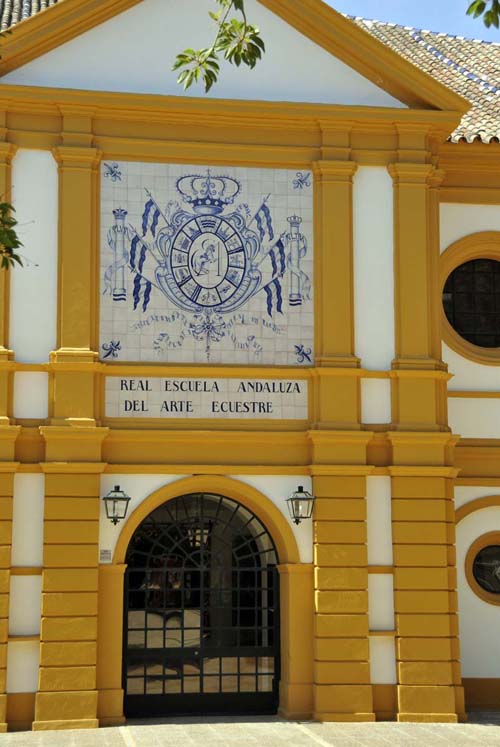
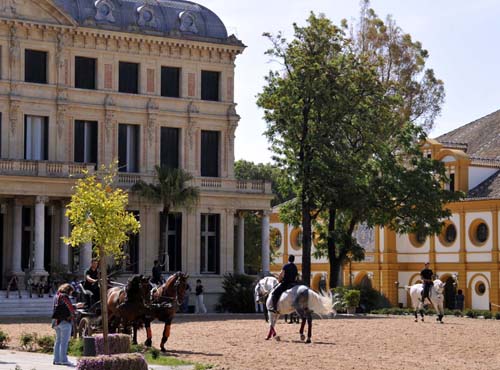
On Monday, we drove the short distance to Jerez de la Frontera to visit the Royal Andalusian School of Equestrian Art. There were no performances that day, but our entrance ticket allowed us to wander through the park-like grounds, see the palace and the riding school’s exhibition building, and watch the riders and horses during their training sessions. We were even able to walk through the saddle shop, where the harness-maker instructors and students make bridles and saddles by hand. There’s a small room off to one side of the building that has examples of the various stages in the construction of a traditional saddle, and there’s a short video that shows the process and explains it in several languages. 

a beautifully decorated entrance to the exhibition hall at the Royal Andalusian School of Equestrian Art in Jerez de la Frontera

a beautifully decorated entrance to the exhibition hall at the Royal Andalusian School of Equestrian Art in Jerez de la Frontera

the back of the palace (the exhibition hall is to the right) and the outdoor practice arena at the riding school

the back of the palace (the exhibition hall is to the right) and the outdoor practice arena at the riding school

Also wonderfully informative and interactive is the riding school’s carriage museum. They have a fairly small collection (I counted ten vehicles), but they represent a variety of types, styles, and makers. Each one has quite a lot of space around it, making them all easy to see, and each one also has a computer screen with information about the particular vehicle in a variety of languages, making it a user-friendly museum for visitors who may know little or nothing about carriages or driving. On larger screens at several locations are videos of the carriages being driven, which is another nice touch that breathes some life into a static museum display.

On Wednesday, we went back to Seville for a short visit. While exploring the narrow streets around the bullring, we found the harness shop of Angel Gonzalez, who is a cousin of our local host for the CAA trip, Raimundo. We had met Angel during one of our farm visits with the group, and he recognized us when we came into the shop to look around. He immediately welcomed us to his shop and asked if we would like to see the workshop as well, so we walked a couple of blocks away to a small space on a side street. Here were Angel’s father (whose father started the business) and their one other harness-maker. The shop was full of leather, bits and pieces of things, tools, forms, and both finished and partly finished projects. Angel explained that they do new work (bridles, harness, and saddles) as well as repair work, mostly on pieces they originally made. All the work is done entirely by hand.

sewing leather by hand at the workshop of Angel Gonzalez

sewing leather by hand at the workshop of Angel Gonzalez

After saying our goodbyes, we wandered through the old part of Seville until we found (a short but disorienting walk away) the impressive cathedral. Here, we saw more of the ubiquitous horse-drawn tourist carriages. The day was quite hot and most of the drivers had kindly parked their waiting carriages so the horses were in the shade.

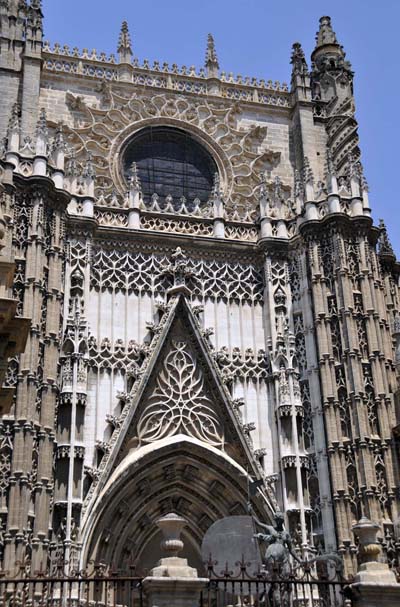
elaborate stonework on one of the entrances to Seville's cathedral

elaborate stonework on one of the entrances to Seville’s cathedral

this driver trotted his lovely horse by the cathedral, executed a one-handed "u"-turn, and parked the carriage so that the horse was standing in the shade of a tree

this driver trotted his lovely horse by the cathedral, executed a one-handed “u”-turn, and parked the carriage so that the horse was standing in the shade of a tree

On Thursday, we visited a lovely private farm and carriage collection in the countryside between Jerez and El Puerto de Santa Maria. This was the visit that had been arranged by a friend of a friend, whose cousin’s family owns the farm and the carriages. I’ll post some photos from that visit in my next report, later today.

Yesterday, we drove out into the countryside to see a show at “Acampo Abierto.” The beautiful property is owned by Alvaro Domecq, whose family is known for breeding and training horses and for breeding and raising toros bravos (literally, “brave bulls”), or as we usually know them: fighting bulls.

The family has put together a two-hour show that they put on three times a week to introduce their horses, their bulls, their beef cattle, and their way of life to visitors. Anything like this is of course a bit touristy because it’s just for show, but this one also appears to be a labor of love borne of goodwill and a desire to educate. It’s also clear that the entire family is involved in each performance. The riders range from small children to someone who is probably their grandfather — perhaps even Mr. Domecq himself. When we were there, the mother of several of the children in the show sat next to me, taking photos. And several other family members drove out to the arena to watch or to help.

Over the course of two hours (with a ten-minute intermission), they bring all the riders into the arena; bring the cows and calves into the arena; bring a herd of mares and foals in; demonstrate the life of the old Spanish drovers (“cowboys”) by bringing in the steers, bringing the cows and calves back in and, with horses and dogs, separating the calves out; and, finally, they bring in a group of fighting bulls. Of course, all of this happens in sequence and not all at once! In between these very active segments of the show (many of the herds are “brought in” to the arena at a full gallop, starting from a quarter of a mile away!) were a few more sedate demonstrations, including classical dressage and traditional Spanish “ranch” dressage. Because everything is explained along the way (in Spanish, French, and English) it was interesting to learn that they breed purebred Andalusian horses for dressage work and, I would imagine, for driving (these they often leave “whole”). But they typically cross their Andalusians with Arabians to obtain the horses they use for working with the cattle and the bulls (these horses they geld).

Here are some photos from the show:

four riders enter the arena, including three young boys (Domecq grandsons, perhaps?)

four riders enter the arena, including three young boys (Domecq grandsons, perhaps?)

preparing to go to work, using the traditional pole with which they tap the cows

preparing to go to work, using the traditional pole with which they tap the cows

a herd of mares and foals running into the arena

a herd of mares and foals running into the arena

bringing the steers in to the arena for the "reenactment" part of the show

bringing the steers in to the arena for the “reenactment” part of the show

the traditional "ranch dressage" is vaguely similar to reining

the traditional “ranch dressage” is vaguely similar to reining

working with the fighting bulls

You can’t really tell from any of these photos, but it’s been really windy here the past couple of days. I understand that we’re in the midst of a “levante” wind, which comes from the east. This time of year, it just makes the wheat fields ripple constantly, but in the summer a levante brings hot air and dust from Africa.

Having grown up in the Santa Ana wind country of southern California, where the warm (sometimes hot) wind comes in from the desert and blows all the smog back out to sea, I’ve always had a bit of a soft spot in my heart for a good strong wind, as long as it doesn’t do any harm.

And, speaking of California, the countryside here in southern Spain continues to remind me of home. Or, at any rate, of the California I wish I could have known, before all the people arrived. In a strange sort of way, this visit to modern, rural Spain is a bit like a time-travel visit to old California. While on our way to and at Campo Abierto, we saw eucalyptus trees, palm trees, oleander, cactus, dry creek beds, and all sorts of delicate wildflowers thriving on all the rain the area received this winter. There are red poppies, and various pink, yellow, purple, and magenta wildflowers. Today, we drove along the coast, past Trafalgar and through a forest of “umbrella” pines and scrubby oak trees.

Tomorrow, we’re going to visit the Royal Andalusian School of Equestrian Art in Jerez de la Frontera (site of the 2002 World Equestrian Games). And on Tuesday, we may be going (through the generous help of a cousin of a friend of a friend) to yet another private carriage collection, this one at a farm on the way to Jerez.


an old fort on a hill, and farmland, near the Domecq property

an old fort on a hill, and farmland, near the Domecq property

In a comment on the previous post was a question about the bridles on the driving horses, in both the photos and the videos seen here. And, if you’ve never before seen what I was taking about, my mention of pom-poms may not have made much sense.

With the traditional style of harness here, the bridles of the driving horses (or mules) are covered in pom-poms that look like they’re made of wool. They typically come in one, two, or three colors per turnout.

So, to help dispel any confusion, here are two photos for you to study: the first is a close-up of the bridles (with pom-poms and bells) on the three leaders of a five-in-hand team at the feria, and the second is a close-up of a single pom-pom.

bridles on three horses at the Seville feria, showing the traditional pom-poms and bells

bridles on three horses at the Seville feria, showing the traditional pom-poms and bells

a close-up look at a single pom-pom, which would be one of about 30 on a bridle

a close-up look at a single pom-pom, which would be one of about 30 on a bridle

While we were at Mr. Ordas’s farm last week, watching the horses in the arena, Sue Murray used her camera’s video feature to film the horses and carriages. This link will take you to six minutes’ worth of Andalusian horses: a four-in-hand team and a five-in-hand. If you have sound on your computer, you can hear the guitar music in the background and the bells on the harness.

http://www.youtube.com/watch?v=sPE-oL6S5pg

And here are links to three videos that Sue shot at the feria:

http://www.youtube.com/watch?v=867EC29dIJg

http://www.youtube.com/watch?v=O9FId9uM0Lk

http://www.youtube.com/watch?v=RZ5lwi1T7cw

Enjoy!