We’re starting a new weekly feature here on the CAA’s blog, where we plan to introduce drivers, collectors, restoration specialists, officials, CAA members, and more … to you and to each other.

The premise is simple enough … we’ve compiled a list of questions (most are driving- or horse-related, some are just for fun), and we hope to get a wide variety of driving-community members to answer our questionnaire. Each Friday, we’ll introduce you to someone new.

We’re starting this series with our own Jill Ryder, the CAA’s executive director …

Where do you live?  Kentucky

For those who don’t know you: How are you involved in the driving world?  I have worked for the Carriage Association for 26 years!

How long have you been involved in the driving world?  Apart from my job, I helped organize a successful one-day cde in New Jersey in 1982 and from there became interested in scoring CDEs and also judging presentation. 

How old were you when you became involved with horses / driving?  I have photos of myself in a carriage and on horseback from the age of 6 months old.

Do you come from a driving/horsy family?  Yes. Many people will be familiar with my father, Tom Ryder, from the Hackney world or the carriage or coaching world.

Are you a CAA member? If so, for how long?  I was a member before being offered the job with the CAA in 1983, and I used to help out at conferences, so I guess you could say I volunteered my way into this job.

Do you compete?  Over the years I have helped groom or navigate for others. I have only ever competed in a pleasure show with a Hackney.

Do/did you ride or participate in other horse sports?  Pony Club when I was young.

What do you like best about driving as a hobby/sport?  The tradition of carriages and driving and the camaraderie.

What is your favorite carriage museum?  This is hard because I have seen so many wonderful carriage museums, but the one that really struck me was at the Schönbrunn Palace in Vienna, as they took us to see many special items in storage.

What is your favorite type of carriage?  I love the lines of the Spider and Mail Phaetons.

If you could go back in time to visit a particular era of horse-drawn transportation, which one would it be?  When the ladies and gentlemen paraded in Hyde Park, London, in all their finest! 

Do you have any other pets?  I just inherited a stray cat! In the past I have always had dogs.

What kind of car do you drive?  VW Jetta

What was your first car?  It was a red Dodge sports car, but I cannot remember the type (that was a long time ago!).

What is your favorite holiday?  Christmas

What spectator sports do you enjoy watching?  Tennis

What is your favorite food/cuisine?  That is hard. I enjoy cooking British food, but also enjoy either Italian or Indian.

What was the last movie you saw?  Julia & Julia – I really enjoyed it.

Do you plan/hope to come to the WEG (as a competitor or spectator)?  With the CAA office/shop right in the middle of the Kentucky Horse Park I will most certainly be there – with our doors wide open to welcome the world!
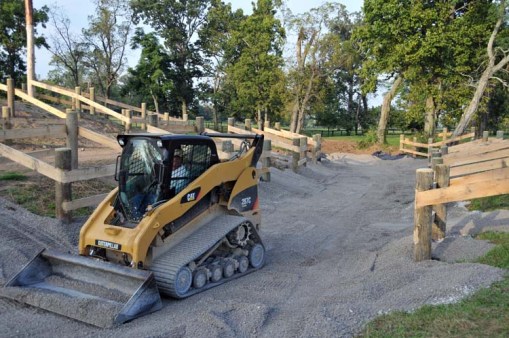
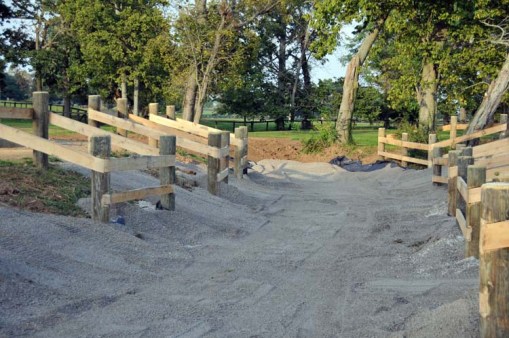
These photos were actually taken later in the same day that the gravel was delivered (see the previous post from Tuesday) … I’m just a bit late in posting them here.

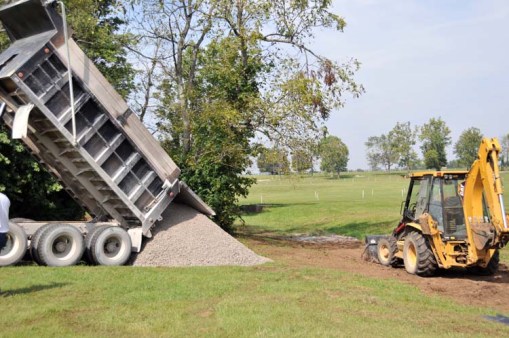
The big pile of nearly 70 tons of gravel became this, which Mick is spreading here with his trusty … whatever this machinery is called …

someone told me that it was difficult to get a sense of scale from these photos, so if you’ll look to the left … there’s the hill

And, voila, a level creek bed and ramps up and down the hillsides leading into and out of the creek.

a lovely, gravel-y creek bed; at the end there (where the pile of dirt is) will be a dam, so this will actually end up as more of a pond than a creek

First, a photo from yesterday …

the “creek bed” at the base of the hill obstacle, scraped and leveled (somewhat) and awaiting more supplies …

Then, all the progress as of about midday today …

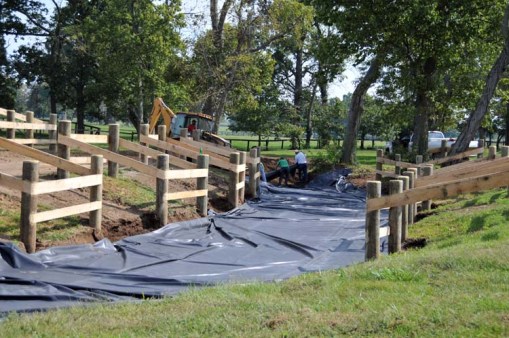
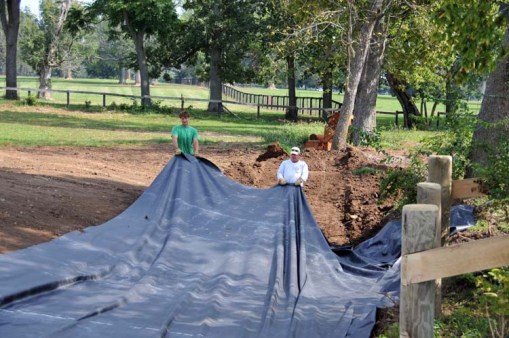
the “creek bed” liner being installed …

… and pulled a bit straighter

… and the view in the other direction

one of several gravel deliveries … 70 tons of the stuff in all

I’ll have more photos of this impressive obstacle as it continues to take shape, in preparation for the driving event that is now mere weeks away!

Over the weekend, I spoke with Richard Nicoll, course designer for the driving portion of the WEG. He was in town to check on the progress of the new marathon obstacles and to work with the course builder, Mick Costello.

Richard said that six of the marathon-obstacle sites being used at this year’s Lexington Combined Driving Classic / WEG test event will also be used in the WEG itself … the sites, that is, but not necessarily the obstacles themselves. This will let the crew test the ground conditions, and work on any “weak” areas they find. This sort of advance testing and tweaking isn’t usually possible at “one-off” events and championships, and Richard’s glad for the chance to be able to work out any difficulties ahead of the WEG. All this advance work will also allow the ground to settle and the grass to grow, so that what will in 2010 essentially be a new marathon course won’t actually look new and raw. It will look like part of the horse park.

The “hill” obstacle, which we featured here back at the end of August, is coming along quite nicely and is one obstacle that will (mostly) remain intact from this year’s event to the WEG. Richard assured me that it won’t look exactly the same, though. He’s very pleased with how it’s turning out … big, sturdy, and solid. There’s no doubt that it will look daunting, impressive, and exciting (depending on your vantage point) at this year’s event. But next year, it will be arranged and decorated to elicit a “WOW” from all who see it. One of Richard’s goals, in fact, is to have the marathon obstacles looking so impressive and beautiful during the cross-country Saturday of WEG that all the eventing fans unfamiliar with driving will be enticed back the following Saturday for the driving marathon.

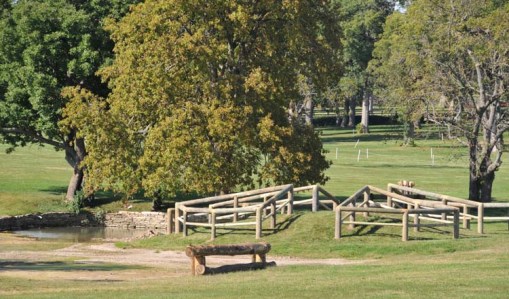
the most recent view of the new “hill” marathon obstacle at the KHP

on the other side of the foreground grass, at the base of the hill, is the ditch where the water will go; the crew is installing a liner here, and we’ll have more on this tomorrow

another look at the “in-field” water splash, from a different direction

Another goal: to position the WEG marathon obstacles in pairs or threesomes so that spectators can easily see two or more from a single vantage point (or at least within a very short walk) and to make several of them so exciting to watch that people will want to wander and see them all. There’s nothing worse than having only one exciting water obstacle on a marathon course and all the spectators crowding around that one so that there’s no fan support at any of the others. To that end, the “tight / technical” obstacles are in some of the less-popular, more out-of-the-way spots, and the “galloping” obstacles, of which there will be several, will help keep the crowds interested and moving.

More work is being done on the “hill” obstacle today, and more work will be done on the course in general after this year’s test event. We’ll keep you updated!

Here (finally!) are the promised notes from my conversation with Michael Freund last Thursday.

Germany’s Michael Freund is a twelve-time German national champion and two-time world champion (in 1994 and 2004) in the sport of four-in-hand driving. He was on the world championship gold-medal team four times (in 1992, 1994, 2000, and 2006). In the relatively new sport of World Cup driving, Michael finished the year in first place in 2001/02, 2002/03, 2003/04, and 2004/05 (he was tied that year with Holland’s Ysbrand Chardon). He (Michael) won the 2007 World Cup Final and was the winner of the FEI Top Driver Award in both 2001 and 2004.

He was hired earlier this year to serve as the coach of the U.S. team for next year’s Alltech FEI World Equestrian Games. Of course, at the moment, there is no team, so he’s keeping an eye on the up-and-coming U.S. drivers working with Germany’s Peter Tischer, who was hired last year as the coach for the developing U.S. drivers.

Michael also continues to work with his individual, longtime clients: Chester Weber, Tucker Johnson, and others here in the U.S. and elsewhere.

He’s had quite a lot of practice in the art and sport of driving, having grown up in a driving family. He says that he’s probably been driving altogether for a total of thirty-five or forty years. He first competed in the four-in-hand division in 1975, having competed before then in the pony, single, and pair divisions. He retired from competition after winning the team gold medal at the 2006 WEG in Aachen.

I asked Michael whether he focuses on training people or horses. He said that after he won his first world championship (team gold in 1992 in Riesenbeck, Germany), people started to ask, “Can you help me?” and so he was more and more in demand as a trainer of people wanting to improve their driving skills. At that point in his career, Michael still had a regular job, and horses (driving, competing, and training) were a hobby. But from 1992 up through 1999, he was asked to do more and more training. In 1999, he made the career switch to make training his full-time profession. He and his brother, Fred, now run a barn/training facility with twenty-seven stalls. Michael explains that he works with people and horses as a driving unit but that he doesn’t start horses. All the horses that come to him are already broke to drive.

Having heard that Michael’s son, Marco, is also in the “family business,” I was curious to know whether his son competes and how well he’s doing. Michael proudly reported that Marco was the youngest driver to have qualified for his local state (Hessen) driving championships, where he competed last month against eighteen other drivers in the open class. Marco started driving when he was five years old and now drives and competes with a pair of Shetlands. Michael assured me that the ponies are “trained just like the big horses.”

I asked Michael what he thinks has been the most influential change in the sport during the time he’s been involved. Almost without hesitation, he said that he believes the indoor World Cup competitions have been a big help in making the sport more public. (If you’re not familiar with World Cup driving, it’s like a combined marathon obstacle and small cones course, held at high speed in an indoor arena.) Michael said that these events bring a lot of publicity to driving, and they’re easy for people to see and understand, which is one way to sell the sport to those who know nothing about horses.

Michal admitted that one of his gripes with the traditional marathon courses is that, while people can stand by the marathon obstacles and see who goes the fastest, they might not understand when the fastest driver doesn’t place well because of penalty points on the walk section, for instance. He says that the marathon walk section makes little sense anymore. “When the marathons were very long, it was a ‘relax’ section but now it only causes stress.” He explained that driving attracts so many different breeds of horses, and many of them simply can’t walk fast enough to make the correct times.

Going back to the World Cup competitions, he said that for many of the shows that hosted World Cup events, those nights were sold out, and attendance at the “regular” driving events (the CAIs) increased as well.

Looking forward to the Lexington Combined Driving Classic (the WEG test event), which will take place here at the KY Horse Park the first weekend in October: Michael will be here to help a few clients and to observe the developing U.S. drivers. He said that he’s not been to either the KHP or this event before, so I hope to catch up with him during or after the event to see what he thinks of the WEG preparations.