For those you who haven’t yet read yesterday’s post, just skip this one … I’ve already fixed the caption. But if you have already read about the first night of feria, you will have seen the photo of me and Pepa with “El Tato.” As several people have pointed out since I posted the photo, I somehow got myself all turned around and was apparently unable to tell my left from my right (and no, it had nothing to do with any possible consumption of manzanilla at the feria the night before … although lack of sleep may have been to blame). At any rate, the caption is now correct and of course should have stated in the first place that the photo shows me on LEFT and Pepa on the RIGHT. Ooops.
April 20, 2010
So I’ve discovered that it’s quite simple really to fly to Spain and not have to worry so much about trying to get over the jet lag if you just go with the Spanish timetable of life: breakfast in the mid-morning, lunch in the mid-afternoon, and dinner around 10:00 or 10:30. Then it’s off to bed around midnight (or 2:00 a.m. if there’s really something going on worth staying up for: a party, for example). I would never be able to stay up this late at home, but it’s not so bad when my internal clock is still set several hours earlier. The key to this, of course, is not having to get up at or before the crack of dawn like so many of us do at home!
At any rate, I spent much of yesterday morning playing with Raimundo and Pepa’s charming 2-year-old daughter. Then, in the early afternoon, I met Raimundo and several of his friends for a drink. This was accompanied by the ubiquitous (delicious!) serrano ham and manchego cheese, at a small bar in the Santa Cruz neighborhood. My guidebook says that the Bar de las Teresas, on one of the busiest crossroads in Santa Cruz, is “surprisingly authentic.” Raimundo said that it’s often very touristy now, but that when he was young, the customers were mostly local Sevillians. I felt like a complete tourist, taking these photos, while standing at the bar with Sevillians in business attire, chatting animatedly in Spanish, but here you go (at least I did this with the little, inconspicuous camera and not the “real” one):
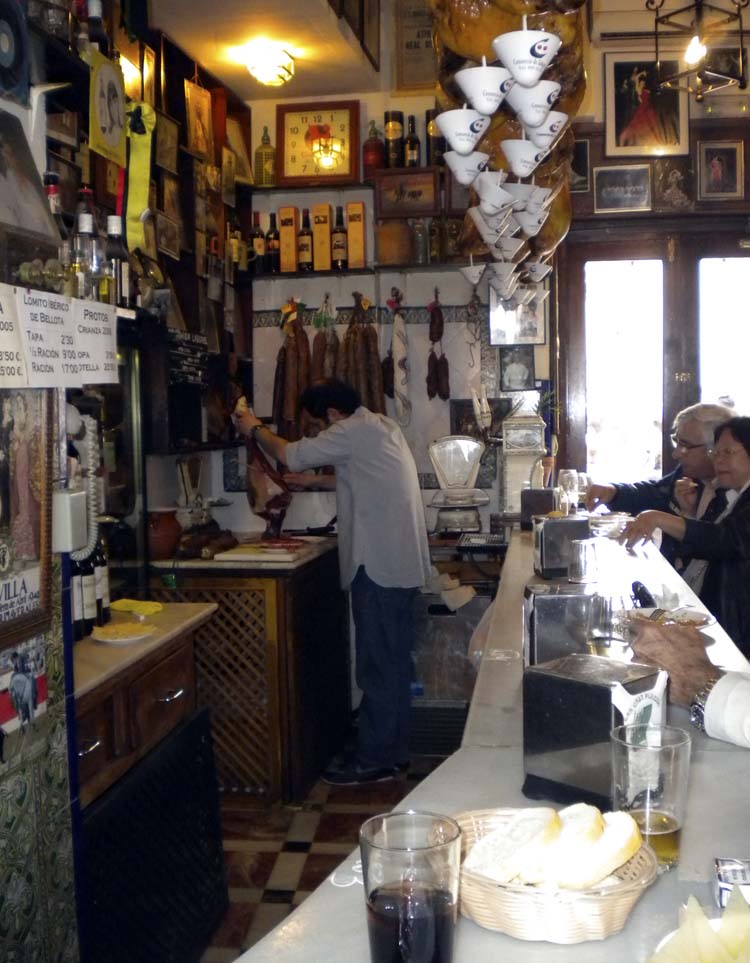
the Bar de las Teresas is on a corner in Santa Cruz, and we were standing just inside the door at the corner of the bar; the man at the end is cutting thin slices of serrano ham
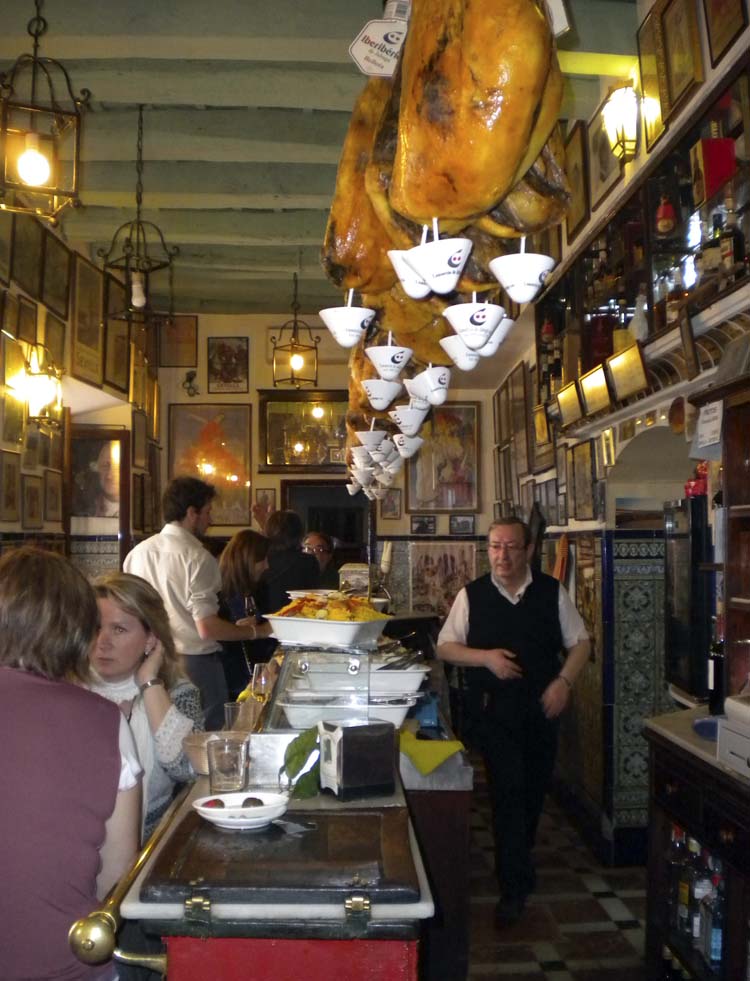
... and the view in the other direction; the walls are covered in tiles to about halfway up, with photos and old posters, etc. above; those are hams hanging from the ceiling
Later in the afternoon/early evening, I walked around to get a few more photos:
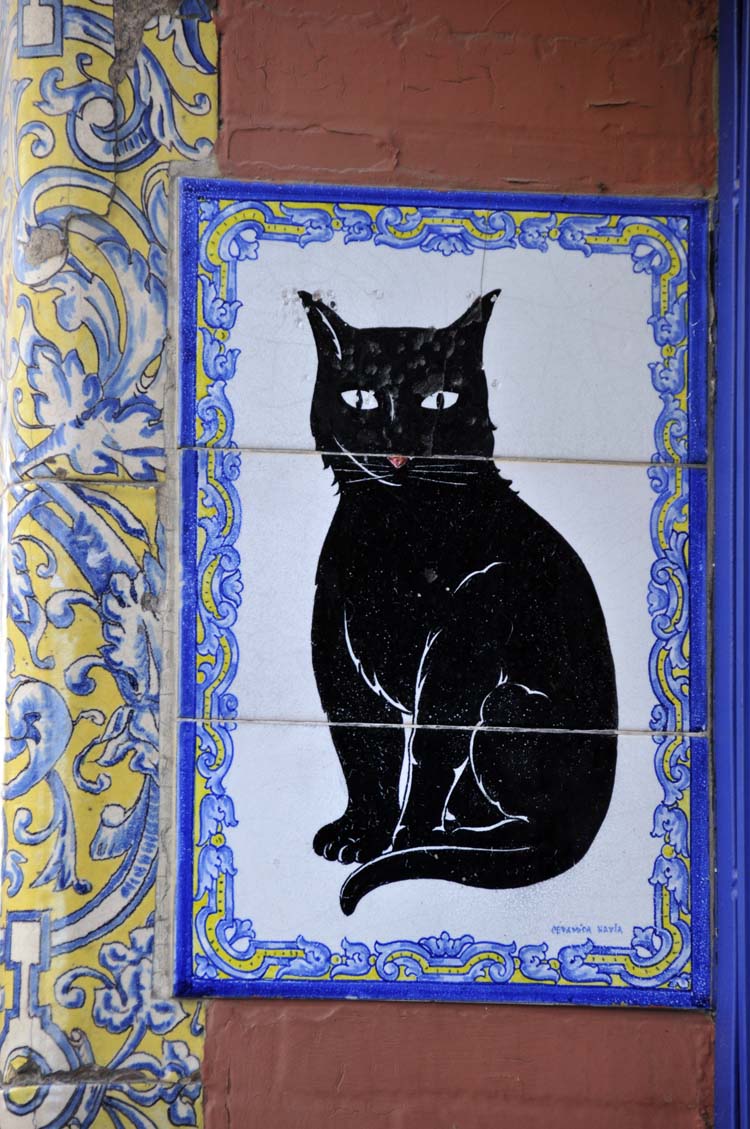
I've mentioned, haven't I, that there are beautiful tiles covering any and all available surfaces? I saw this delightful one on the side of a building
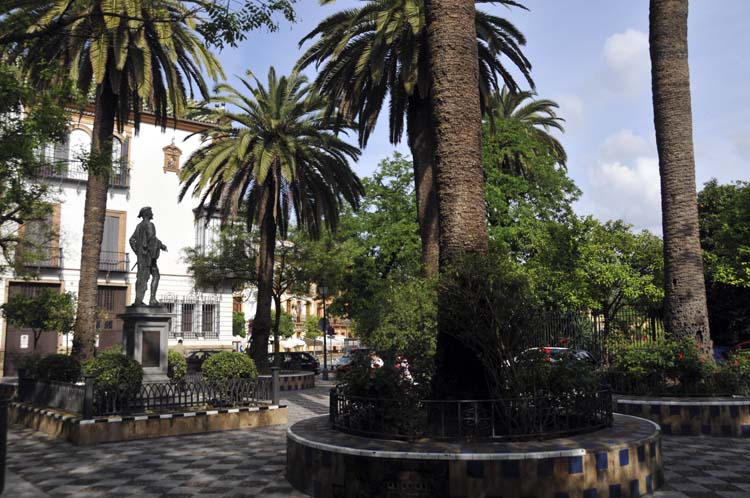
another out-of-the-way plaza, with a statue of Don Juan, who (I hadn't realized this) was from Sevilla
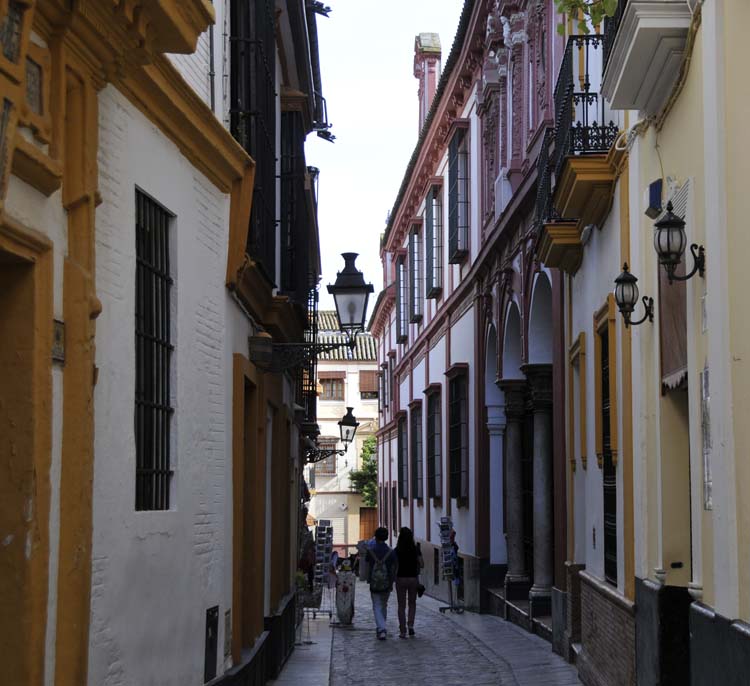
one of the narrow (but not the narrowest!) streets in Santa Cruz; behind the facade halfway down on the right, with the columns, is an amazing baroque church, with colorful paintings covering every available space on the walls and ceiling
Then (you remember the timetable I mentioned earlier, right?), I met Raimundo and Pepa at about 10 p.m., and we walked over to the feria, where I had kindly been invited to have dinner in one of the private casetas. Here, once again, we enjoyed a delicious succession of food and, for feria, manzanilla. At midnight, the lights came on and the feria was officially opened.
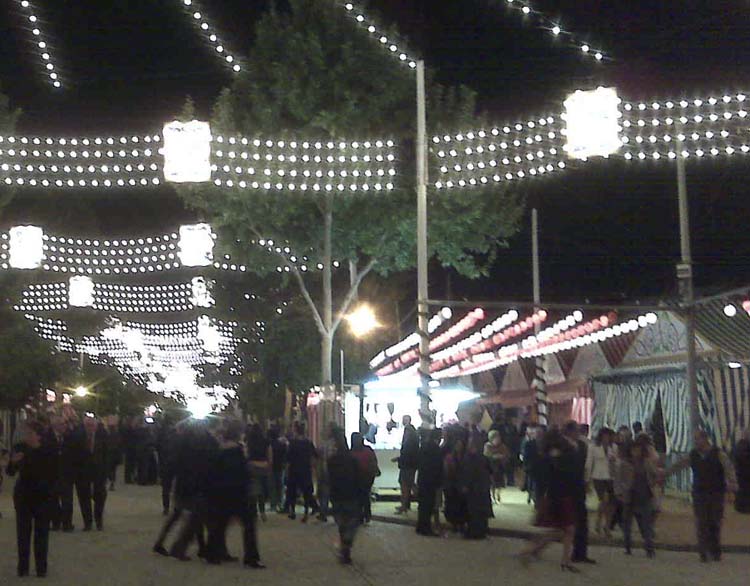
the lights are on and the feria has begun!
Once dinner was over, the tables were cleared away, the musicians set up in a corner, and the singing and dancing began. Watching everyone singing along to the traditional songs, clapping in time, and young and old dancing the flamenco-like Sevillana was great fun.
I don’t think I’ve showed my face on this blog till now, but I couldn’t resist getting my picture taken with the famous matador who came into the caseta to visit with friends (and have his photo taken with the ladies).
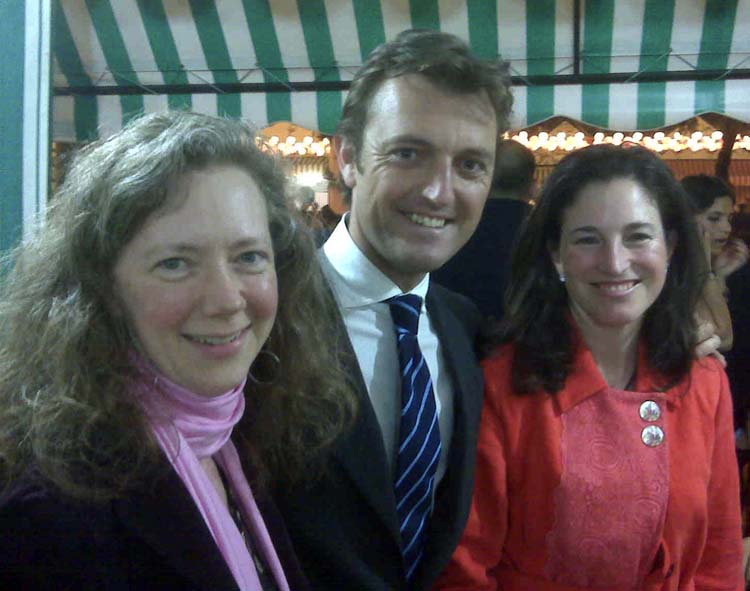
I must admit that I'm not familiar with the roster of famous bullfighters, but this is apparently one of them: that's me on the left and Pepa on the right, with "El Tato"
Today will be our first day at the feria, so stay tuned for photos of horses and carriages and ladies in flamenco dresses!
April 18, 2010
… sadly, this is starting to sound like a refrain.
Last year’s R.C.E.A. (Royal Andalusian Carriage Club) Carriage Exhibition in the bullring was cancelled because of rain, so our CAA group missed it entirely. This year, it was cancelled because of rain again. Although this time, I was standing around on the sidewalk with many of the drivers, owners, and R.C.E.A. members, and so I was able to see the one smartly turned out commercial turnout that trotted through (it would’ve been in the exhibtion but as there was none, kept right on going) and a lovely four-in-hand of mules. They stood in the rain for a while and then turned around and drove away. Then some men cam with a trailer and took away the barriers that had been blocking off the street so the horses and carriages could gather and line up on Calle Adriano (next to the bullring). I understand that the reason these are cancelled if there’s a lot of rain (which there has been these past few days) is not so much because of the rain itself, but because the combination of the rain/mud and the horses and carriages would turn the sand surface of the bullring into a major mess for the evening’s bullfight. Soooo … still no carriage exhibition. We’ll hope that my third try is the charm, and that we’ll actually be able to see it next year.
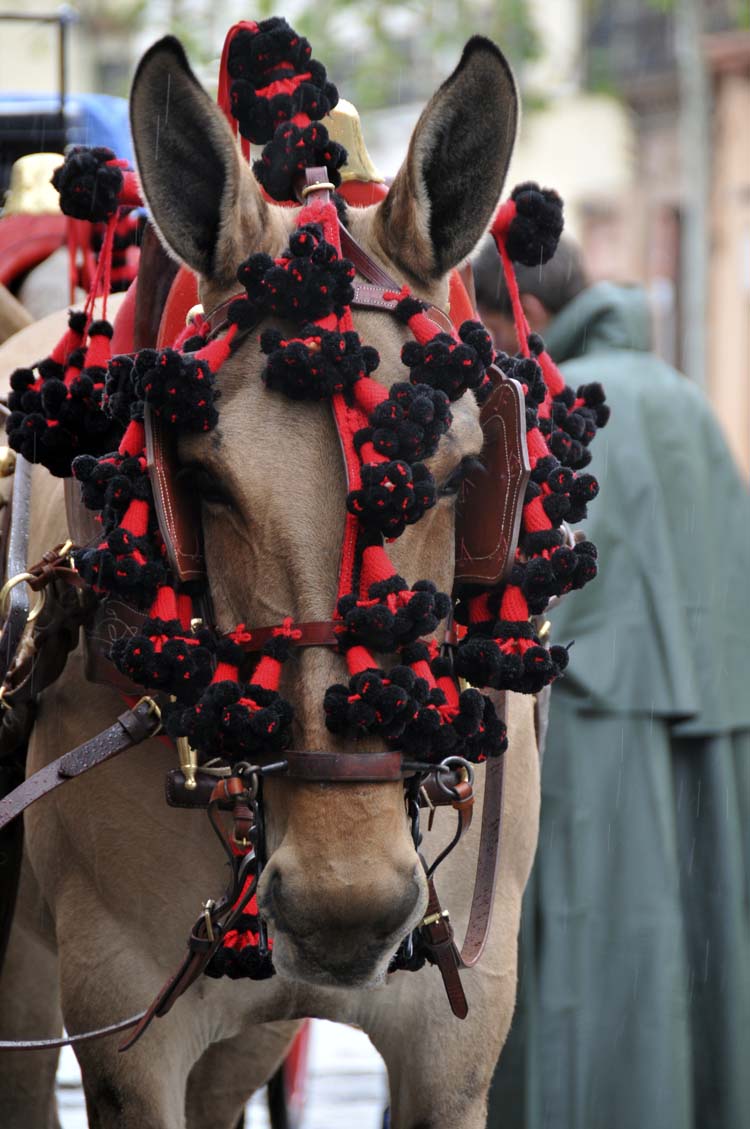
one of the beautiful mules in a four-in-hand that showed up (briefly) for the rained-out carriage exhibition
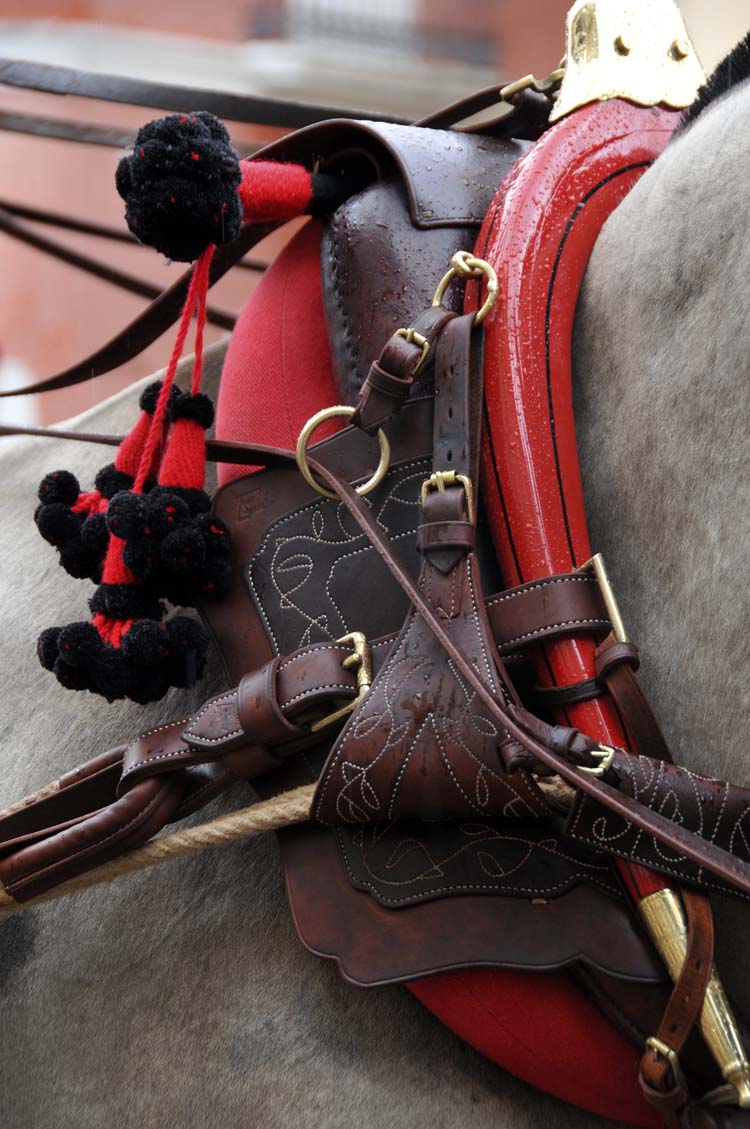
a detail of the (wet) Andalusian-style harness on one of the mules
It turned out to be a good thing that the exhibition was cancelled because, although the skies cleared briefly, the early afternoon featured torrential downpours and thunder. At that point, a group of us (R.C.E.A. members and guests, including myself and the exhibition judges) were safely inside the carriage museum of CAA member Miguel Angel Gutierrez Camarillo, where we had gone to see his beautiful collection of restored and original-condition vehicles. I’ll have more on his collection in an upcoming issue of The Carriage Journal, and at that point, I’ll use whatever photos we can’t fit into the magazine article for a blog post here.
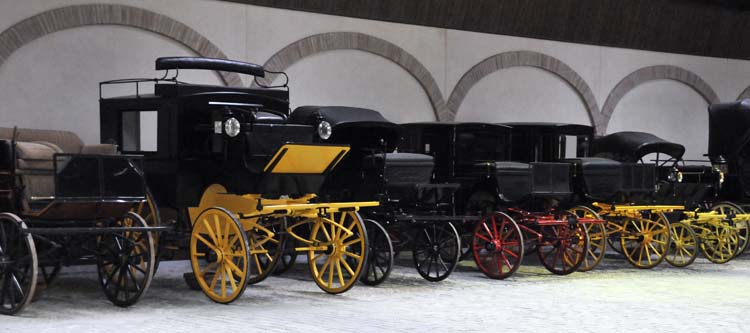
a row of carriages in Miguel Angel's museum; we'll have more on his collection in an upcoming issue of the CJ and in a future blog post
After our visit, we had a nice, loooong lunch. It started, as you can see, with prawns, olives, and bread. The plate behind the bread (which you can’t really see) had tuna with roasted red peppers. Later, out came plates with two kinds of Spanish ham, and then after that: fried fish and fried calamari.
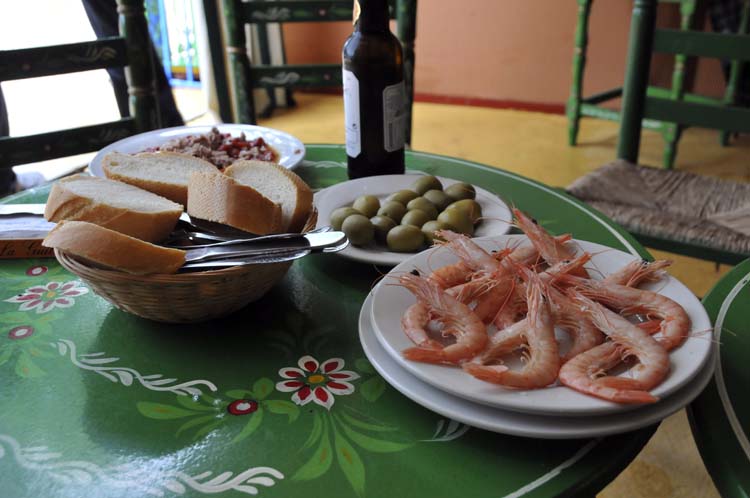
mmmm ... lunch
And, finally, before I sign off for tonight … some scenes from Saturday afternoon/evening’s walk-around:
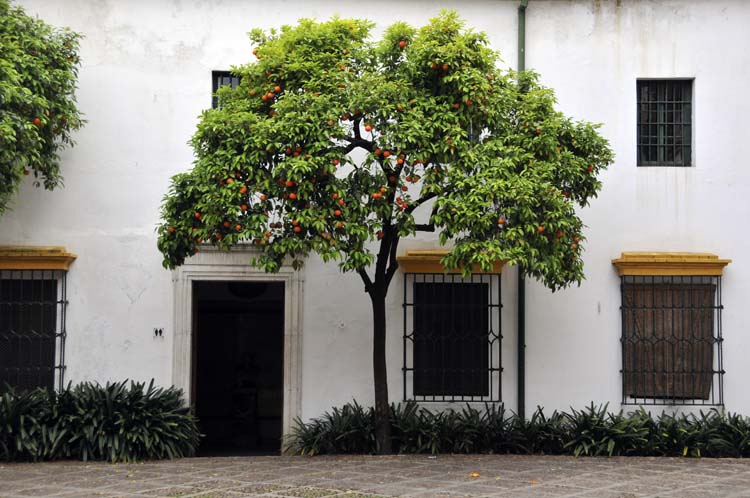
you can see orange trees all over Sevilla
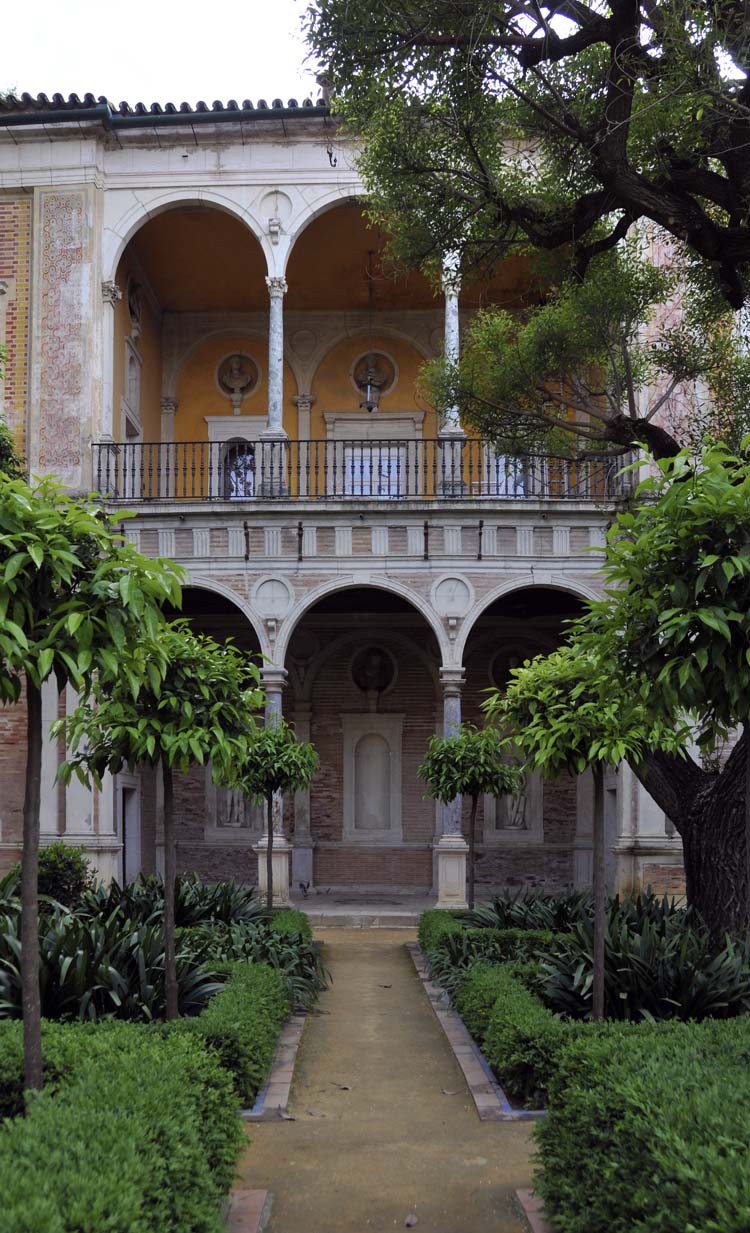
a lovely, peaceful scene, no?
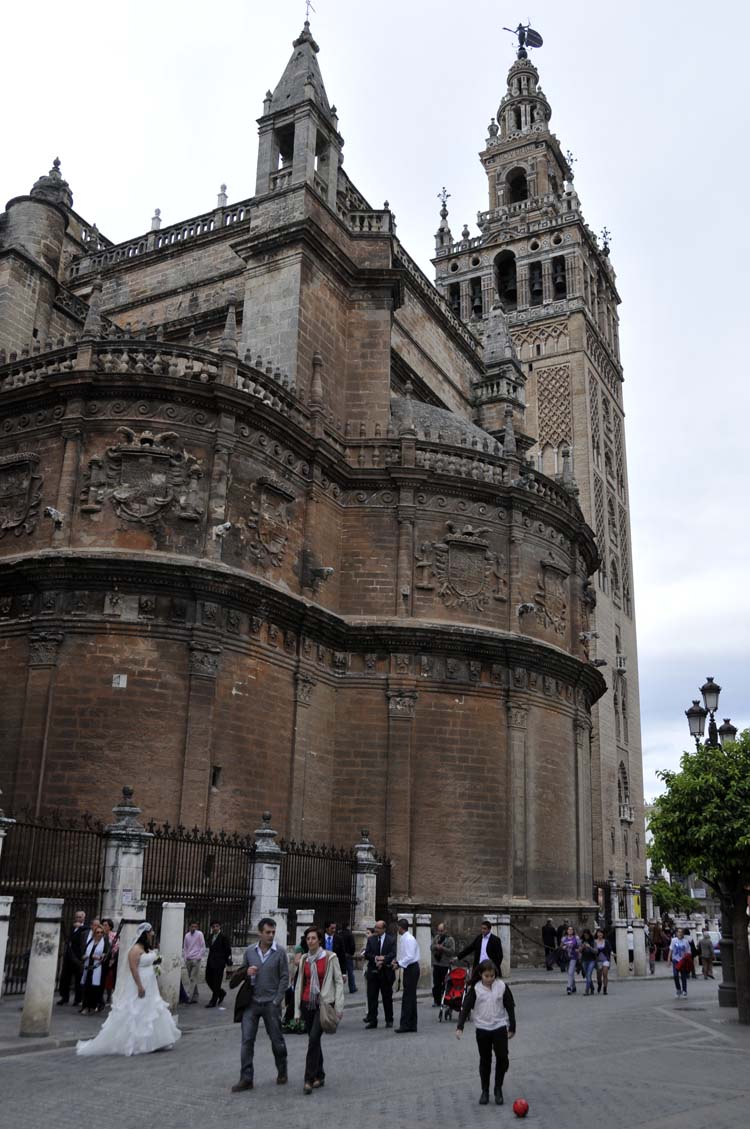
it turns out that around 7 p.m. is a nice time to walk around the cathedral (or pretty much anywhere in the old part of town); the tourist attractions are closed (shops are open), but most of the other tourists are gone for the day - the bride in the lower left was one of five I saw on Saturday
April 17, 2010
We had a fair amount of rain here in Sevilla yesterday (Friday) afternoon. But there are few places more peaceful on a warm-ish, rainy day than the covered edge of an open-air Spanish courtyard while rain falls into the center.
I spent part of yesterday afternoon investigating a few lovely places for next year’s CAA trip … either to suggest that people visit on their own or for perhaps arranging a group visit if they’re more out of the way. If I haven’t mentioned it before (or even if I have) let me state that the narrow, twisting roads here in the old parts of the city are quite confusing unless you’re really good at reading maps (and street signs that don’t exist or that don’t look like street signs) or unless you’re very familiar with the route. Luckily, it doesn’t take too long to start getting familiar with it all.
At any rate, a few courtyards to entice you …
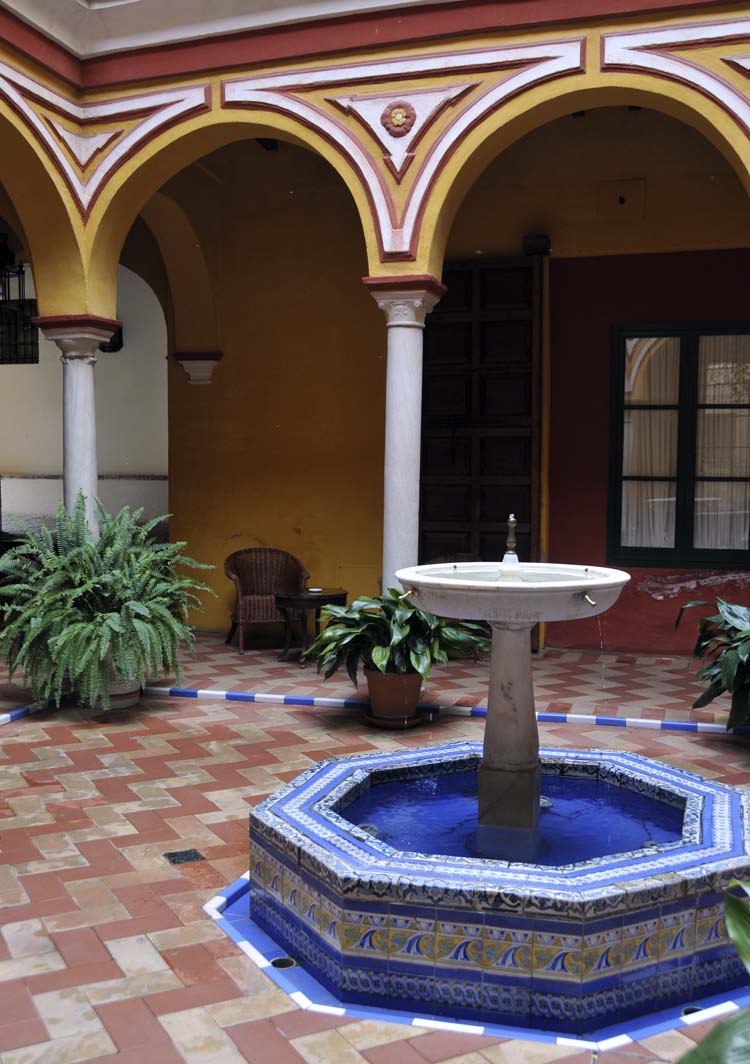
a traditional Andalusian courtyard ...
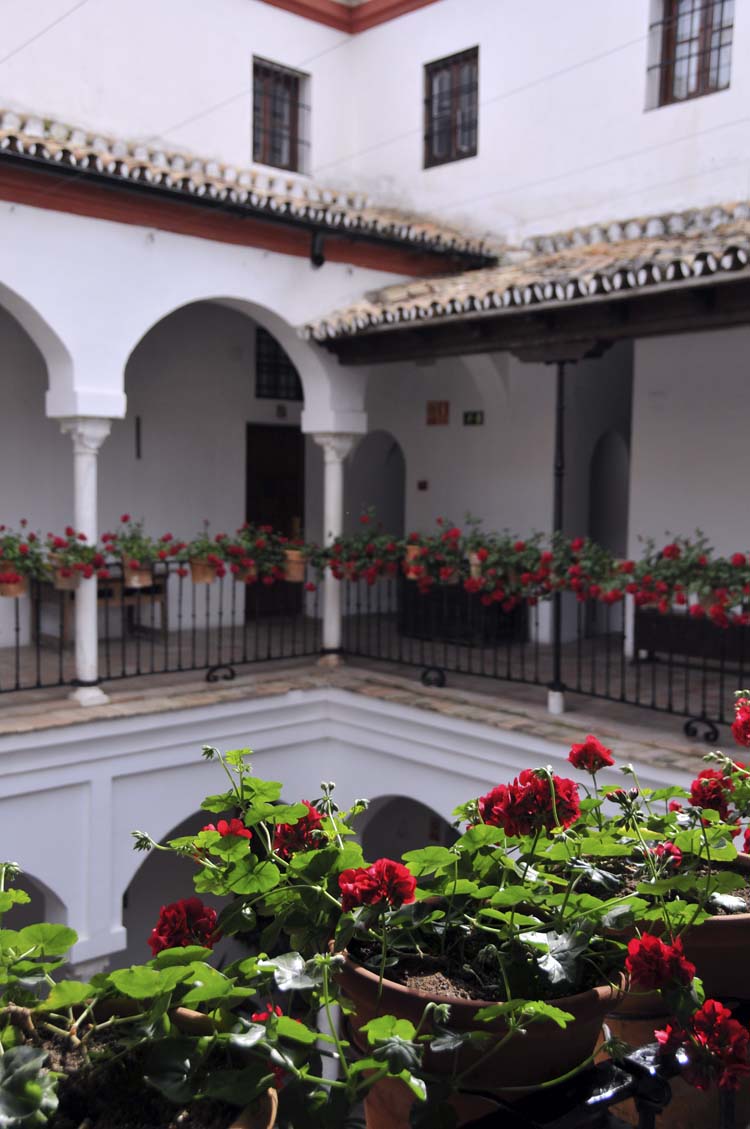
... and another; or the flower-lined balcony at least ...
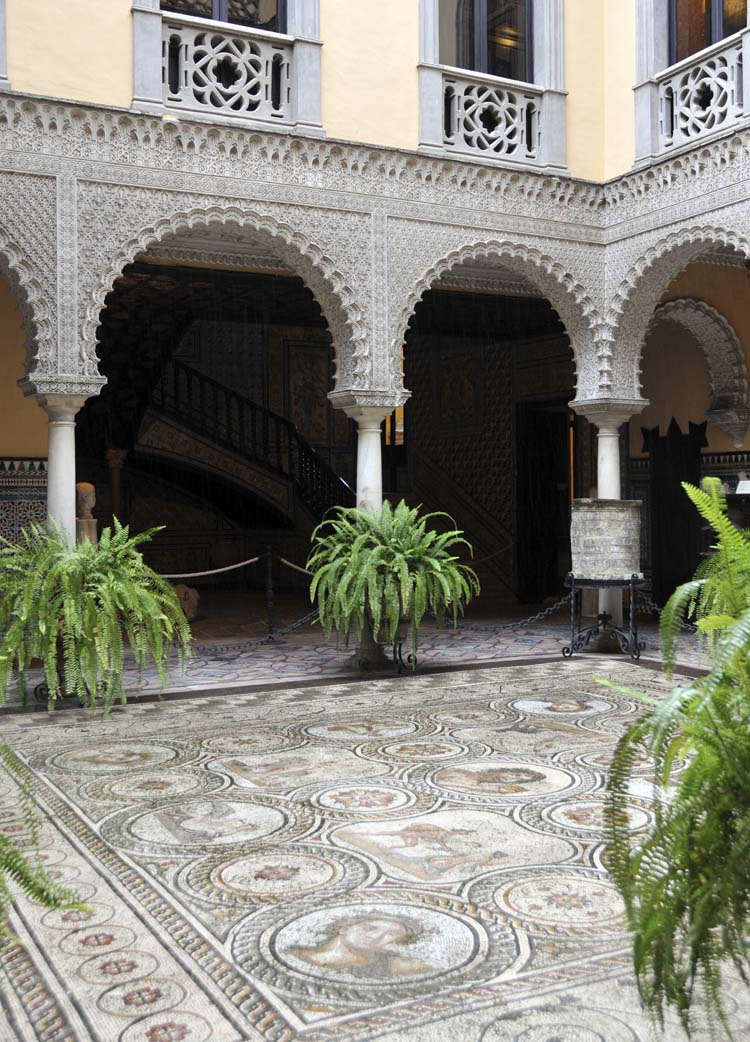
... and a third, although this is admittedly less typical because the floor in the center is an authentic Roman mosaic at the private museum Palacios de Lebrija
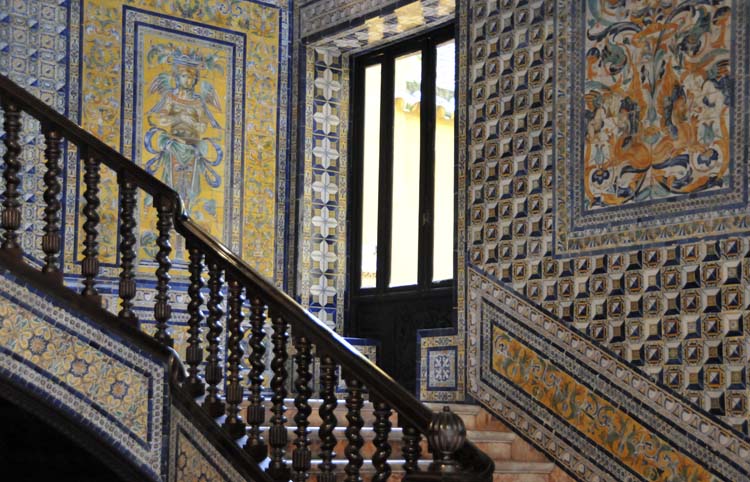
a close-up of the staircase in the background of the photo above, with beautiful old Spanish tiles covering nearly every available surface
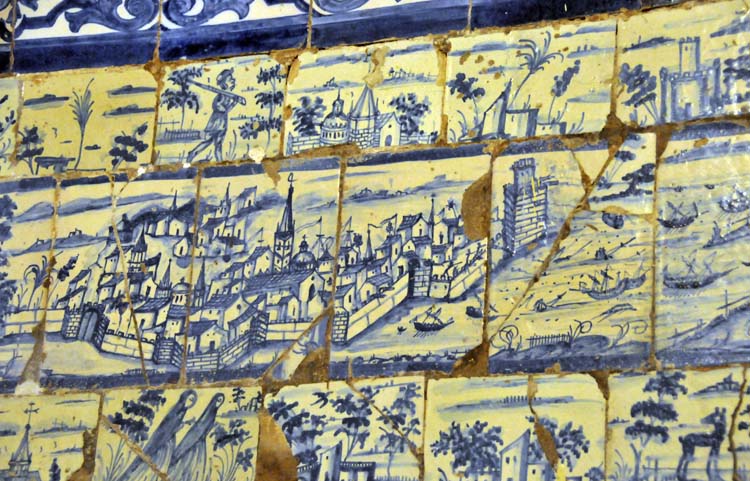
the Palacios de Lebrija was the project of a 19th-century Sevillian aristocratic woman with a passion for archaeology and collecting; she gathered Roman mosaics and all sorts of pottery, including Roman, Moorish, Visigothic, pre-Columbian, Chinese, and even a huge set of English Spode dishes; the walls of one room are lined with very old tiles like these, depicting early views of Sevilla
I also worked with our friend Raimundo on a preliminary list of possible carriage collections to view on our CAA trip next spring. In the evening, we all went to a dinner hosted by the Royal Andalusian Carriage Club (in preparation for their carriage exhibition in the bullring tomorrow – the 25th of these beautiful exhibitions). I was re-acquainted with people I’d met last year and met even more. Everyone is extraordinarily welcoming, and we should have another wonderful group of collectors and collections to visit in 2011.
Tomorrow is the carriage exhibition in the bullring, where I’ll be taking lots of photos, and hoping that the predicted rain doesn’t fall!
April 15, 2010
… finally! My trip here took about 12 hours longer than it was supposed to, but more on that in just a minute.
First, here’s what I missed out on at work on Tuesday:
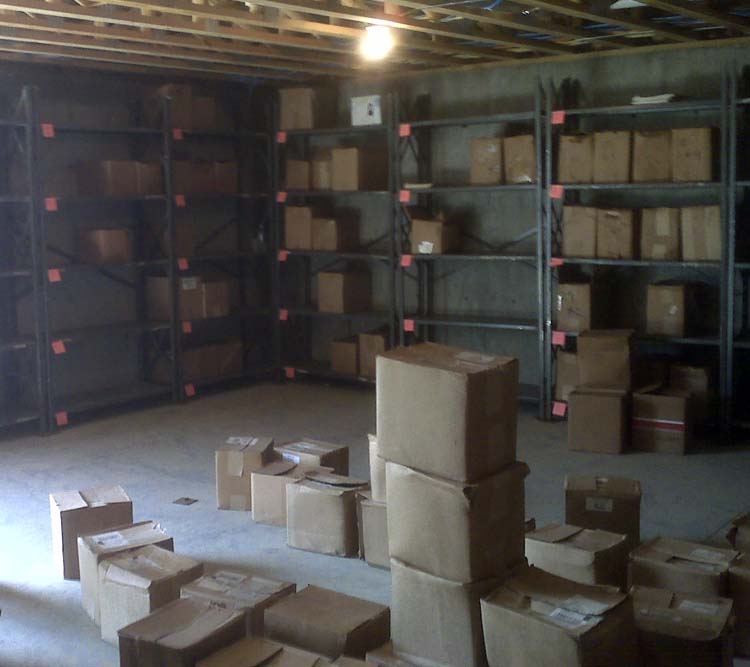
Jill and several volunteers spent hours and hours on Tues. moving thousands of back issues of The Carriage Journal from a rented storage space to new donated storage space
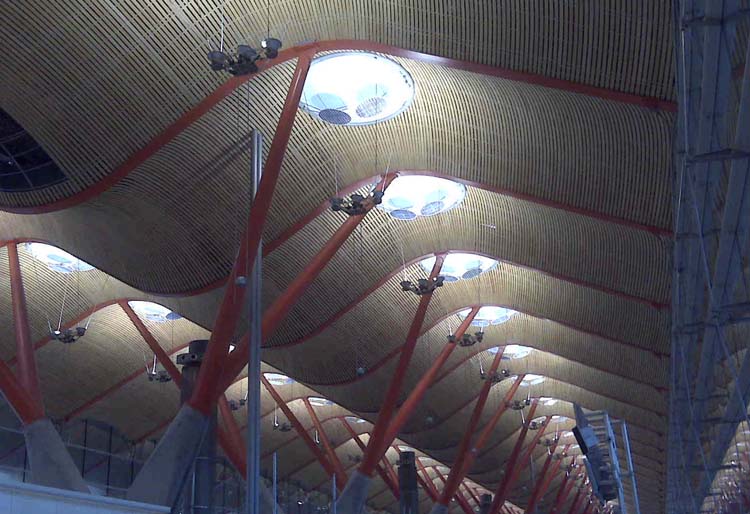
... while I, on the other hand, spent hours and hours gazing at this (the ceiling at the beautiful Terminal 4 at Madrid's airport)
I was scheduled to fly from Cincinnati on Tuesday afternoon, with a layover (not terribly long but sufficient) in Chicago, from there to Madrid and then to Seville, to arrive around 9-ish on Wednesday morning. Instead, the flight out of Cincinnati was delayed, then delayed again. Then they said we would do a “quick turnaround” when our plane arrived. So we boarded … and then we waited and waited and waited some more. By the time we reached Chicago, I had about five minutes to run through the airport (with my backpack o’electronics on my back) for the Madrid flight. When I made it to the gate, I was informed that the flight was closed (although, of course, the plane was still sitting there) and that they had already re-routed me. That entailed waiting several hours, flying to Frankfurt, then flying to Madrid, and then waiting five MORE hours for the flight to Seville. By the time I arrived, it was raining here and 9 o’clock at night instead of 9 o’clock in the morning. Oh well. At least I made it here at all and wasn’t trying to fly in today … I understand that the huge cloud of volcanic ash has massively disrupted air travel all over Europe.
Today, here in Seville, is gorgeous. I’m staying in the very old Barrio de Santa Cruz (a neighborhood near the cathedral) and spent most of the day exploring its ancient streets and alleyways.
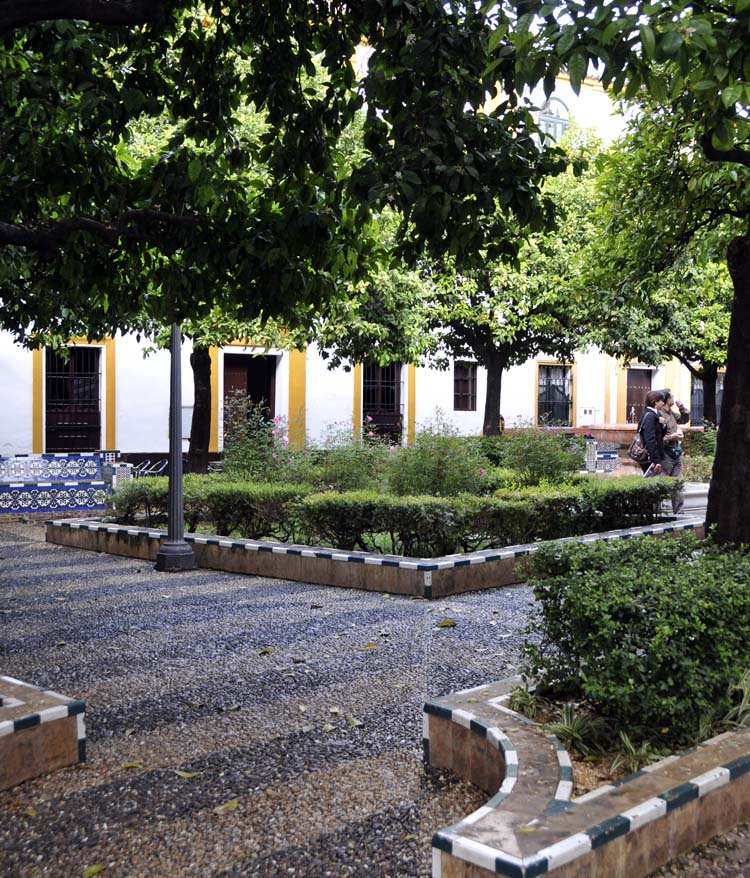
one of the peaceful plazas (surrounded by orange trees) in the Santa Cruz neighborhood
I also toured the inside of the cathedral, with the specific intent of climbing up the famous Giralda tower.
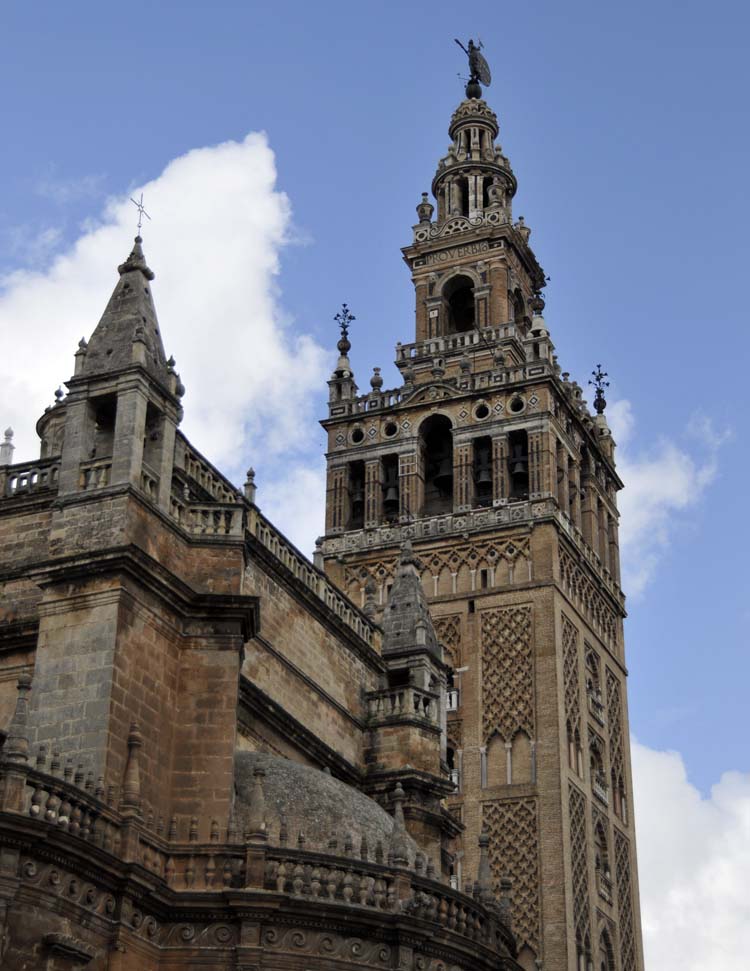
the famous tower on Seville's cathedral; the ramps take one up to the level with the bells
The pathway up the tower is a series of ramps. A travel show on TV that I watched said this was for the purpose of taking donkeys and supplies up to the top. For the first part of the trip up, they’re numbered but then the walkway gets darker and more narrow near the top, so I lost count. The views from the top are quite spectacular, and it’s also quite windy up there.
I took a series of photos (below) from three different levels on the way up:
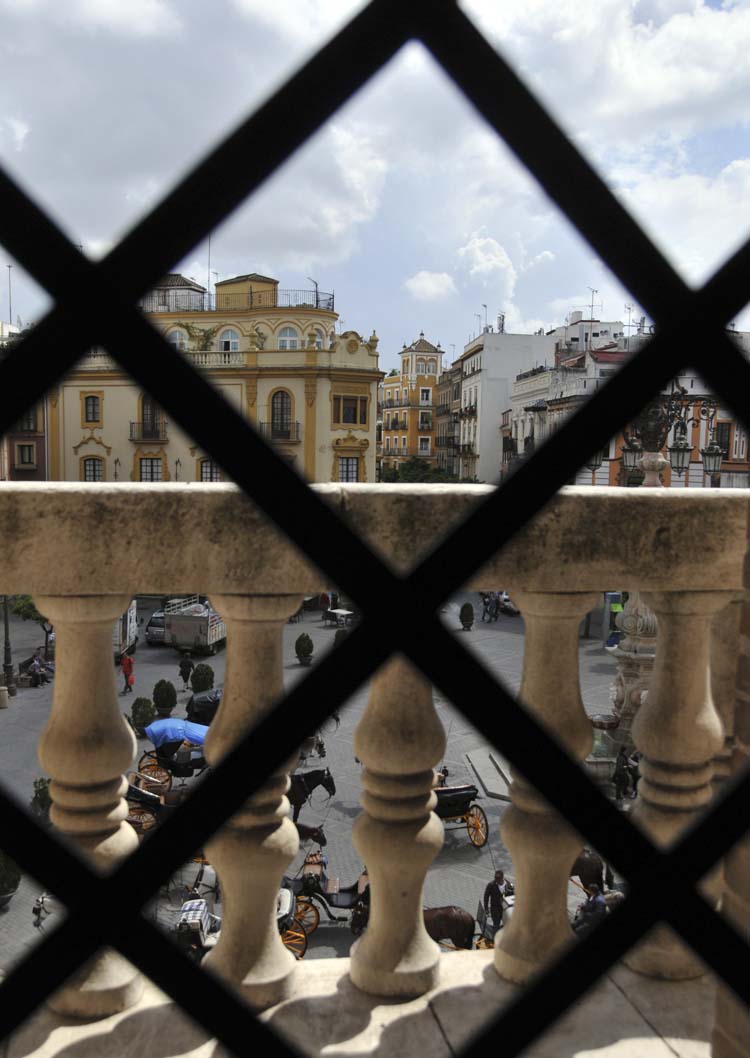
the view from ramp 6
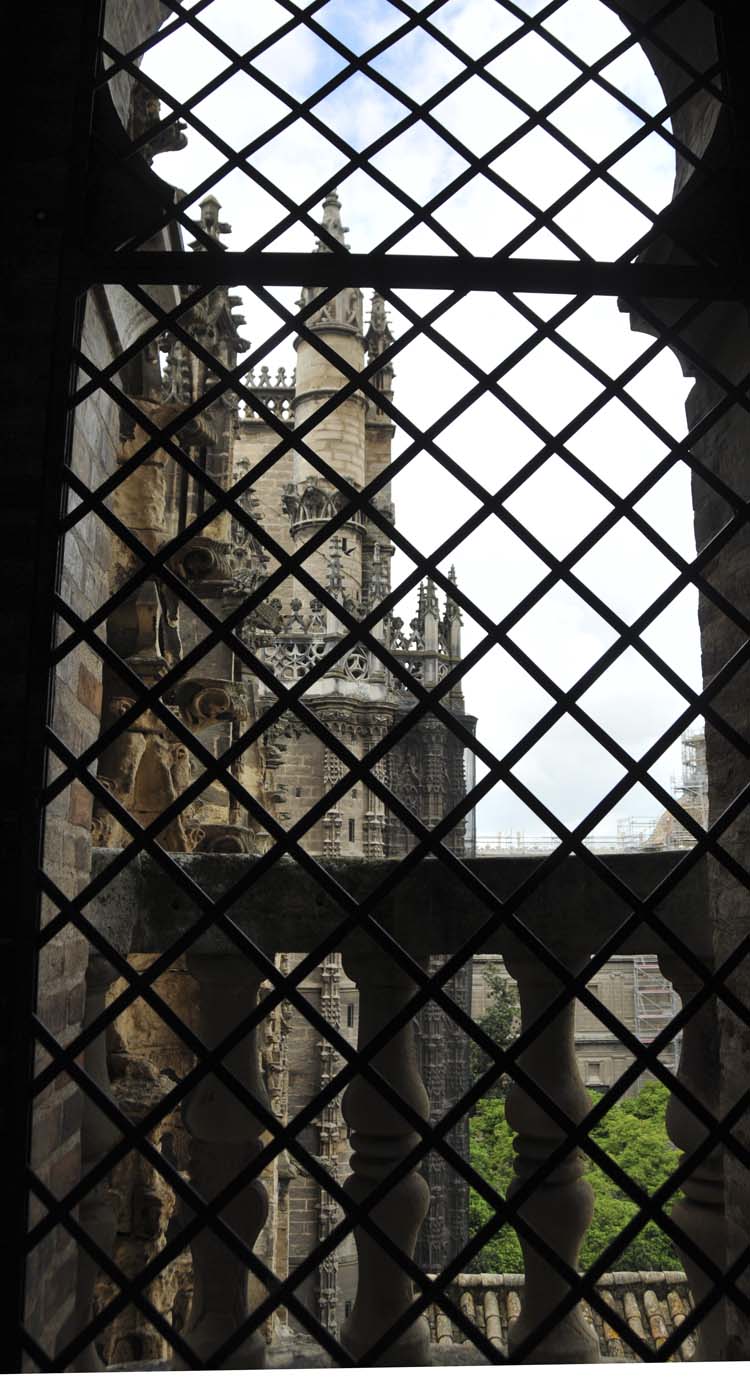
the view from ramp 12
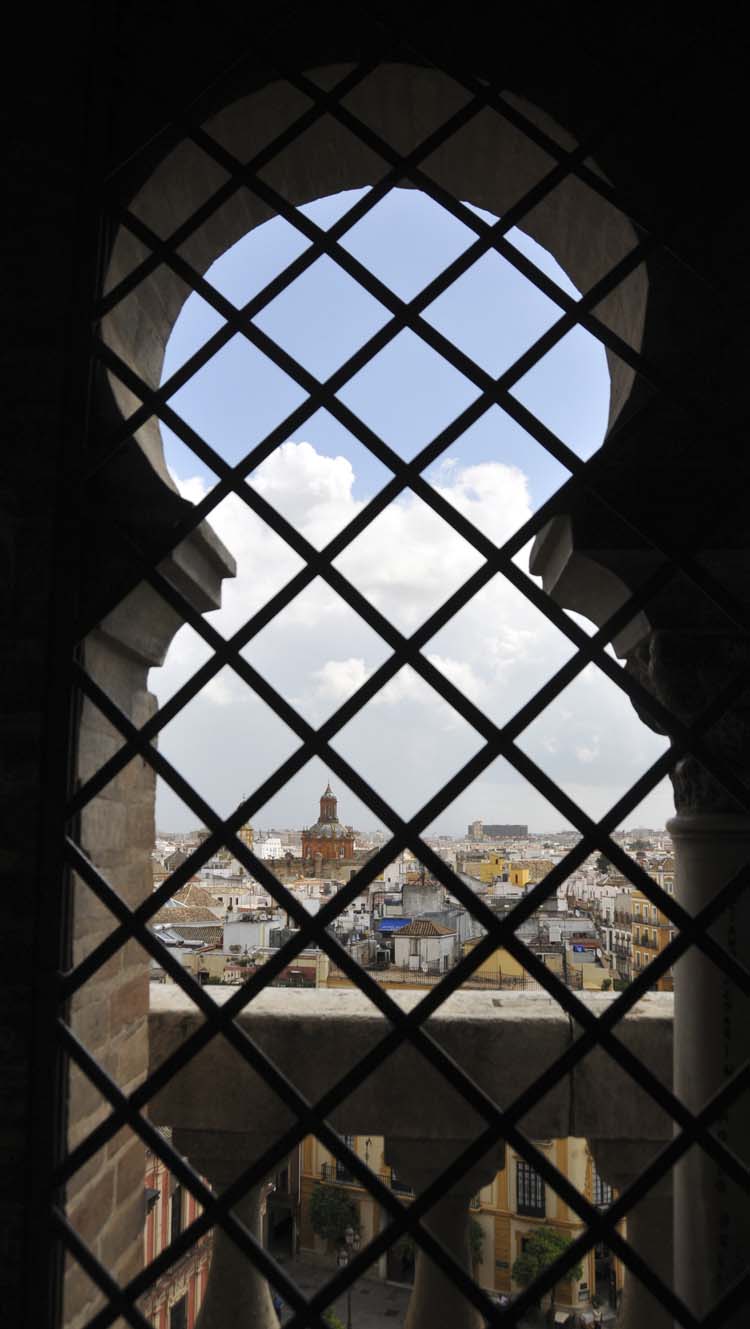
and the view from ramp 18
Once at the top, there’s pretty much a (windy!) panoramic view of the entire city. You can look out from all four sides. And my tall husband will be glad to hear that, although you can’t tell from this photo, there’s a solid stone railing and then heavy heavy iron bars covering the entire opening so no one can fall through.
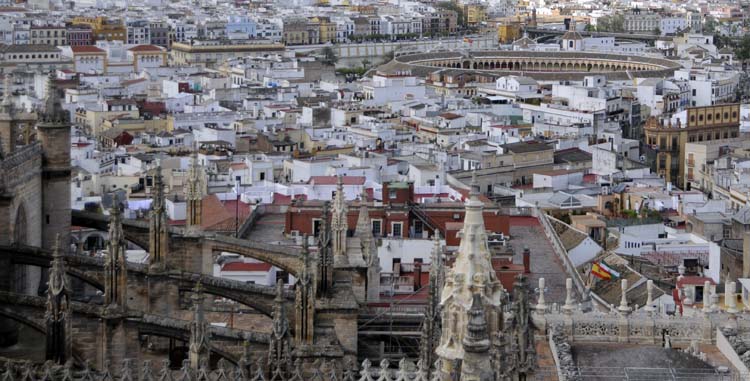
the view (in one direction) from near the top of the Giralda; the bullring (location of the carriage exhibition on Sunday) is near the upper right corner
And, finally a view of one of the quiet little plazas that’s off the main tourist path …
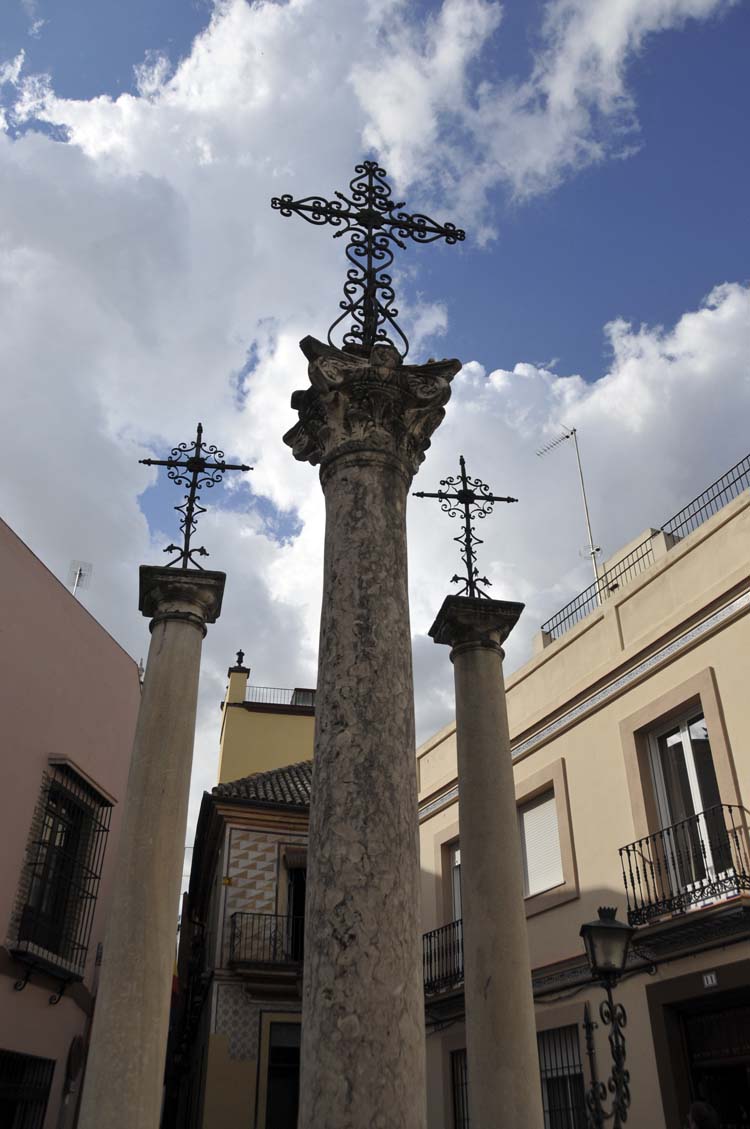
my guidebook says that these three crosses are set on Roman columns

