So I was leaving the KY Horse Park yesterday evening and ran into Mick Costello (course builder for the eventing and driving cross-country courses), who asked whether I’d seen “Isaac’s latest fish.” I hadn’t.

Mick gave me directions to the shady carving area where Isaac’s been working and sent me off to find Isaac and the fish.

Isaac does all of his sculpting with chainsaws, which I find amazing to contemplate when faced with how lifelike these wooden animals end up looking. Unlike most of his recent sculptures, which will populate the eventing cross-country course, this fish is intended for a spot (I’m not telling which spot) in one of the marathon obstacles. 

this largemouth bass is destined for a home in one of the marathon obstacles

While not quite as large as some of Isaac’s other sculpted animals (a huge kingfisher with a bug in its beak, an enormous goose, and a lifelike but massive rainbow trout, just to name a few), this largemouth bass nonetheless stands more than seven feet tall. Isaac also showed me some of his “before” and “in-process” photos of this fish, and it was quite something to witness this huge fish emerging from a hickory log.


Coincidentally, this story appeared in today’s Lexington Herald-Leader newspaper (www.kentucky.com):

Artist with a chain saw carves for WEG

by Mary Meehan

“It’s a little bit of an odd story,” said Isaac Bingham.

That’s a little bit of an understatement.

Because the tale that finds Bingham revving up a chain saw to carve giant squirrels and fish at the Kentucky Horse Park begins in Vermont, winds through Dartmouth and Berea colleges, and takes a detour to study boat building by indigenous peoples in Asia and South America.

“I never imagined I would do anything like this,” said Bingham, “this” being, among other things, carving a Canada goose the size of an RV out of a tree trunk for the Alltech FEI World Equestrian Games.

Carved animal figures have long been used as jumps or beside jumps at equestrian cross-country events, but it wasn’t until January that Bingham tried his hand at the unusual artistic endeavor.

The thirty-two-year-old has a habit of diverting from a path to try new things.

After growing up in Vermont, he went to Dartmouth College to study engineering. A few years of studying left him restless, and he was off to travel the globe, including spending time in Morocco. Because he wanted to get into the arts, he came to Kentucky and Berea College, graduating in 2005. He was then awarded a $25,000 Thomas F. Watson Fellowship to study native boat builders in places like Bolivia, Peru, Vietnam, and Malaysia. Boat-building skills in those countries have evolved over thousands of years.

“I’m always up for a new adventure,” he said.

Bingham had been making jumps at the Horse Park for about three years when Mick Costello, who oversees their building, realized he needed some new duck heads for this year’s Rolex Kentucky Three-Day Event. His previous carver had moved to Australia, so Costello gave Bingham and two other workers a chance to see what they could do.

Bingham had never created art with a chain saw, but he had created art and he had used a chain saw. So he figured he probably could do it.

It turns out he could.

“Isaac is just wonderful. It was quite a surprise” said Costello, who’s been working at the Horse Park for more than twenty years. “He’s the best ever.”

The [eventing] cross-country course was created by world-renowned designer Mike Etherington-Smith, who is based in London, England. He maps the route that horse and rider will take and what sort of critters should inhabit various jumps.

Etherington-Smith dictates the height, width, and depth of the sculptures and the types of animals, say “fish” or “frog,” and then Bingham takes over.

It all starts with the right piece of wood. Costello said local tree services sometimes provide logs, but he also buys tree trunks or uses wood from trees at the Horse Park that need to come down.

Somehow Bingham can see the animal within the log. A burr oak could be a rainbow trout that is seemingly in motion or an orange and brown northern leopard frog that is both native to Kentucky and brightly colored so as not to blend into the grass and cause the horses to hesitate before they jump. (Bingham also paints the animals.)

“You free the animals from it,” he said.

He sometimes uses the traditional sculpture skills he honed at Berea to make clay models for the wood works. But, he said, all the carving on the animals is done with chain saws of various sizes.

“I am never interested in doing that same thing that everyone else is doing,” he said.

Bingham, whose father was a carpenter, said he grew up with sort of a blue-collar work ethic. “Being an artist,” he said, “was never something I could wrap my mind around.”

He’s still a little amazed by his newfound skill and understands what a rare opportunity he has. It’s not every emerging chain-saw artist who has access to the tools, including heavy equipment to lift and move the logs, needed to turn a tree trunk into a trout. But he thinks he’s found his niche, for now.

“Maybe I really am what I can call an artist,” he said.

That, too, is a little bit of an understatement.

Last Thursday evening, A.J. and I walked downtown so I could get photos of a few of Lexington’s Horse Mania horses. That same evening was a “super-sized” edition of our weekly downtown music festival, Thursday Night Live. So instead of a single band, there were three: one in the usual spot (the downtown pedestrian-zone pavilion that houses our Saturday farmers’ market, one a block over on Mill Street (which had been closed to traffic), and one a couple of blocks in the other direction, in the courthouse plaza. In addition, as part of all the road/sidewalk construction we’ve been undergoing all summer, Main Street was down to one lane because of paving … so there was some serious traffic, which is generally unusual for a Thursday evening.

At any rate, without further ado, here are a few Horse Mania horses — in their natural habitat — plus a few other views of the evening:

I think this horse is meant to look like it’s covered in silk scarves … but I’m not really sure; behind it, you can see some remnants of the ongoing sidewalk construction


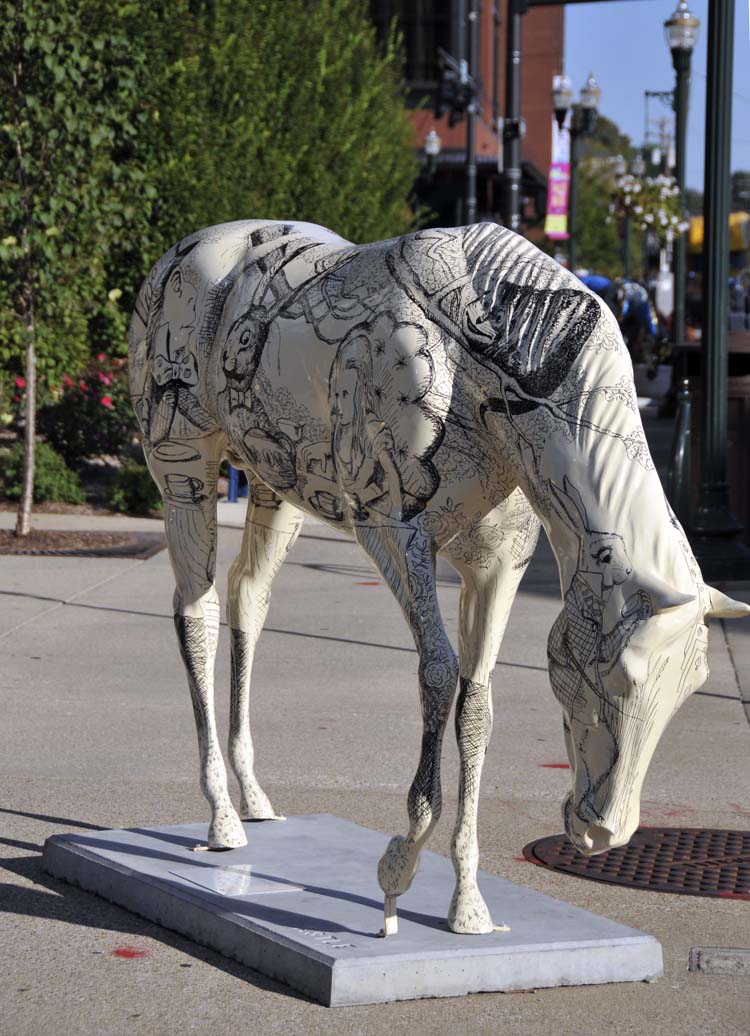
the Alice-in-Wonderland design on this horse was drawn entirely with Sharpie pens


… and a close-up shot of the White Rabbit at the Mad Hatter’s tea party


a horse painted in garden scenes


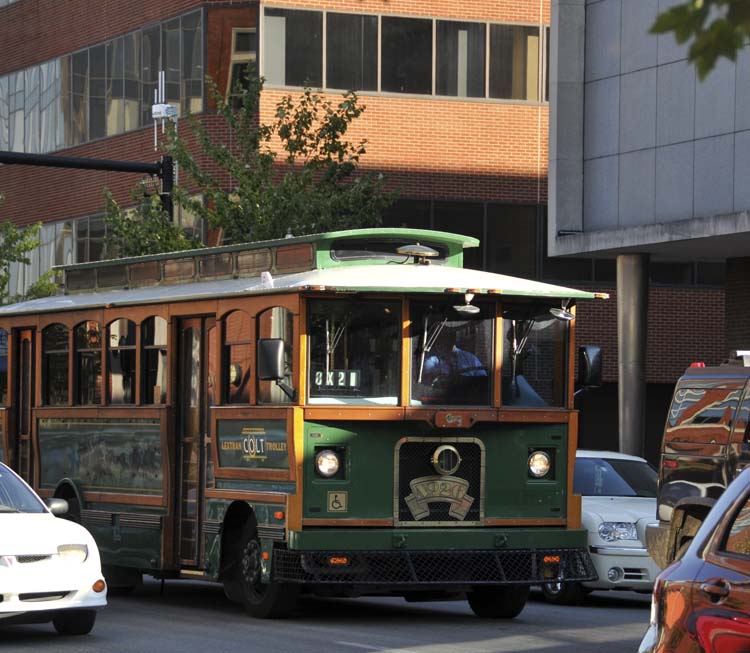
down the street from the “garden” horse, we caught a glimpse of the trolley, which has two basic routes — up and down Main Street and, perpendicular to that, UK to Transy — and, if you want to hop on while you’re in town, it’s FREE


the band that was playing on Mill Street … and, in keeping with our Horse Mania theme, note the little girl in the corner


… and the view (taken a little later) from the other direction


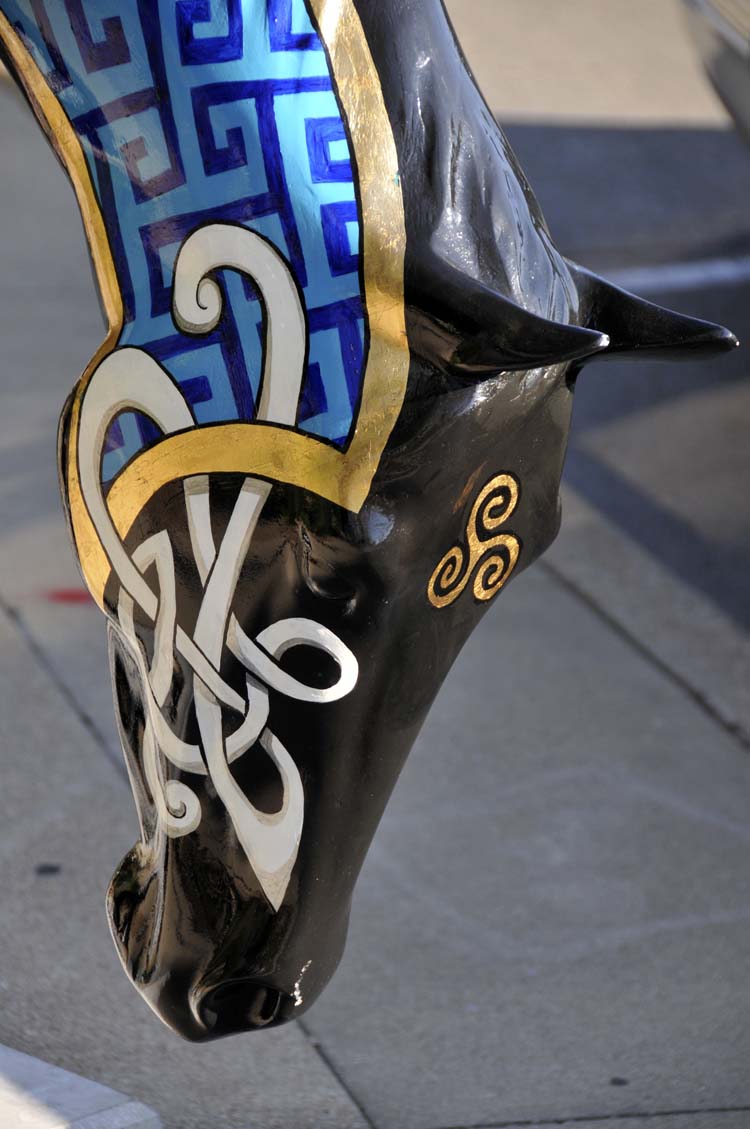
getting back to the horses: one with a beautiful Celtic design


… and a close-up of its head


and, finally (for this Thursday outing) … a mosaic horse


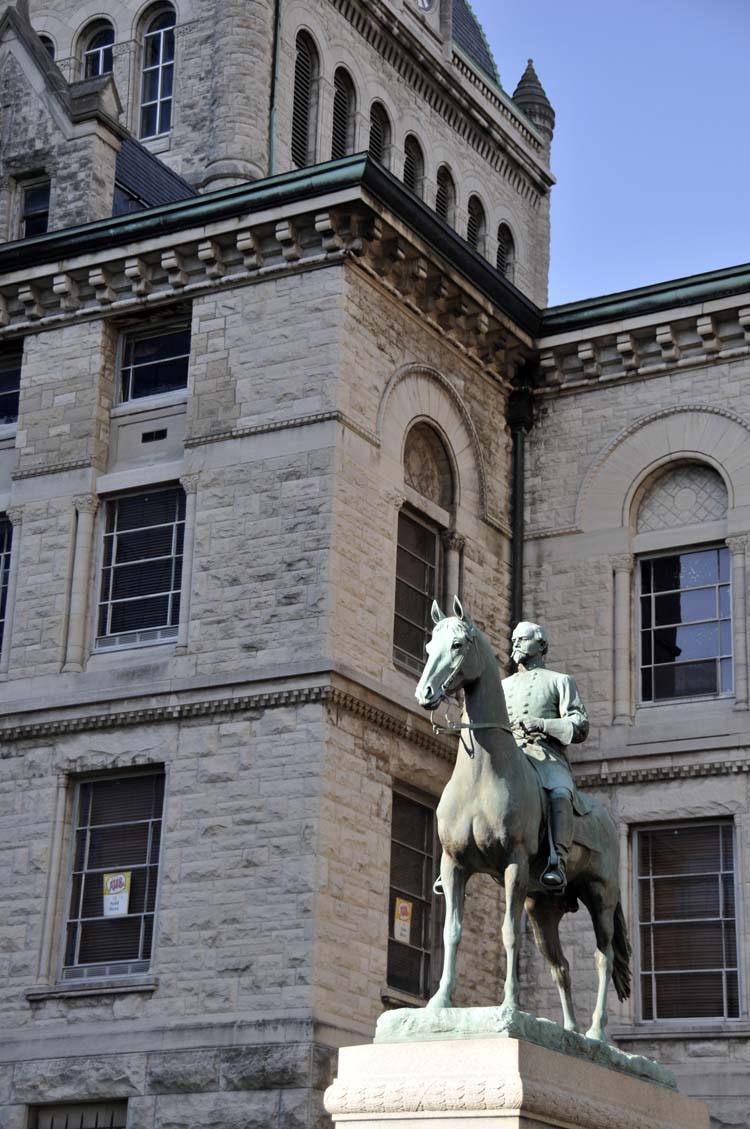
and a permanent horse-statue resident: John Hunt Morgan, in front of the old courthouse (now the Lexington History Museum)


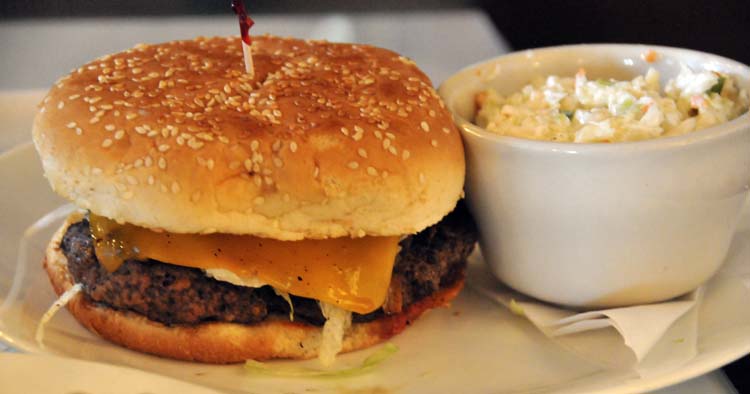
for no particular reason, other than this is where we ate dinner that Thursday, and it’s one of our favorite downtown restaurants, I’ll close with a view of a Wines on Vine cheeseburger, which is one of the best in town

As promised, here are the first photos of Lexington’s Horse Mania horses in their natural habitat.

I have only one horse to start out with (but two photos of it!) and will get the rest off my camera and up here on the blog this week. And I’ll be taking more photos soon, as well. Regardless, I’ll be able to show you only a fraction of the horses here on the blog. If you’re in Lexington anytime soon, you’ll have to seek out these and the remaining ones in person!

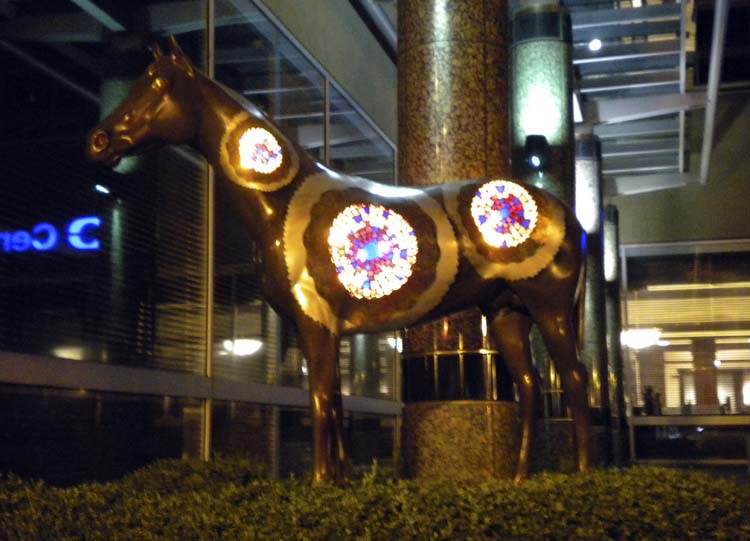
this horse happens to stand in front of the office building that A.J. works in and, as you may be able to see here, it lights up from the inside so that the “stained glass” is illuminated at night

… and here, you can see (in this admittedly bad photo) the effect of the lights inside the horse when it’s dark out

On my way into the office this morning, I drove around the Park a bit and took a few (more) photos of even more tents going up in preparation for WEG.

These first two are next to the outdoor arena, and I have no idea what they’ll be used for.

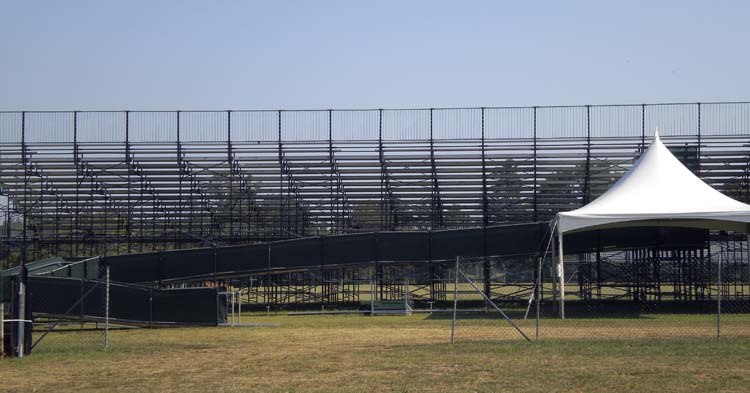
And this is a portion of the back of one section of grandstand seating at the driving arena:

Things are changing around here by the hour, it seems. In the main parking lot, the trade fair is starting to go up, but when I drove by this morning, there wasn’t enough progress to bother with photos. I’m sure there will be plenty there by this afternoon or tomorrow morning, though! So stay tuned.

The most recent “fascinating old photo” I posted here (see the previous entry) has generated some impressive sleuthing efforts among our members. Several people sent me the results of their Internet searches, but one clue turned out to be the most likely of all.

In 1893, the World’s Columbian Exposition was held in Chicago to celebrate the 400th anniversary of Christopher Columbus’s arrival in the New World. The event was also known as the Chicago World’s Fair.

I did some sleuthing myself and found this …

To assist fairgoers, Rand, McNally & Co. published A Week at the Fair, Illustrating the Exhibits and Wonders of the World’s Columbian Exposition, with Special Descriptive Articles … Also Maps, Plans, and Illustrations.

Chapter 2 includes this section on Driving to the Fair:

“The Michigan Avenue boulevard forms a most attractive route to the Fair, and the finest street in the world (as Max O’Rell styled it) is well worth traversing for those who have the time and can afford the carriage-hire. At numerous livery stables, well-appointed carriages can be secured at reasonable rates, and a line of handsome four-horse coaches runs regularly between the city and the Exposition grounds. The boulevard is bordered by the houses of Chicago’s wealthiest citizens, and the route is fully described in the various guides to the city issued by the publishers of this guide. The luxurious route to the Fair is that selected by the Columbia Coach Company, embracing the choicest section of the Chicago boulevard system. Leaving the hotels, the route leads down Michigan Avenue to Oakwood Boulevard, thence by way of Grand and Drexel boulevards to Washington and Jackson parks. The well-sprinkled and dustless roads traversed are devoted entirely to pleasure-driving, and present an ever-changing scene of life, which might be characterized as the holiday side of Chicago. For miles on either side stand the palatial residences of Chicago’s wealthiest citizens, while the magnificent grounds encircling these ideal homes afford a refreshing glimpse of the pleasures of urban life. The coaches designed for this line [our “mystery vehicle” from yesterday; see the engraving below, which was published with this text] combine all the advantages of the modern landau with those of the old-time “Tally Ho,” in supplying each passenger with an outside seat and an unobstructed view. The drivers are old-time whips, who have been historic actors in the principal events of which the history of the West is made up. The overland route to the Pacific has been their stamping ground, and those who have guided their six-in-hands through the tortuous ravines and defiles of the Rockies will have but a vacation in making the trip up and down the boulevards of Chicago. Here are drivers who, to carry out the boasts of these men, scheduled ten miles an hour between the Missouri River and San Francisco, and who can drive a four- or six-horse coach through places where the Eastern driver could not lead the animals by their halters. As nearly as may be in this sybaritic age, the passenger will realize what a trip across “the plains” used to be in the palmy days when old Ben Holliday, of Platte County, Mo., was the autocrat of all first-class travel between ocean and ocean; a journey which may now be made in a gorgeous Pullman car equipped with every luxury. The well-matched coach horses will make the spin in any case in easy time, as relays will lighten the journey. The delights of the journey will far excel any possible written description. The fare has been fixed at an amount which will insure an exclusive and select patronage. Crowding will not be permitted, and the journey either way will be one of comfort — restful at night, exhilarating in the morning.” (A Week at the Fair, 1893)