My recap of the Driving Championship at the 2010 Alltech FEI World Equestrian Games:
When he came out of the dressage arena, having scored only 30.08 penalty points, Boyd Exell was nearly in tears. Rest assured, though—they were tears of joy.
During his test in the 2010 Alltech FEI World Equestrian Games, Exell could barely stop himself from breaking out into a huge smile—his horses were going so well they were practically “doing it on their own,” he said. The fact that his team was feeling so “on” and self-sufficient was, it turned out, helpful in its own right, as he had broken a bone in his left hand the previous week—while practicing his newest hobby: cross-country jumping.
This was Exell’s fifth world championship in a decade of trying to win it all, and he was certainly off to a good start, with a dressage score that set a new record in world-championship competition.
He admitted later that, on each successive morning, he would tell himself that he had driven badly the day before, in order to push himself to do well on the marathon and cones courses.
This strategy seems to have worked. Following a third-place finish in the marathon phase, Exell stood in the lead after the first two phases and entered Sunday’s cones course with a very slight (1.72-point) lead over the reigning World Champion, Ijsbrand Chardon of The Netherlands.
With one ball down (but no time penalties), Chardon simultaneously secured the team gold medal for himself and his fellow Dutch drivers, and increased Exell’s lead by a few points. Taking advantage of the extra cushion afforded him by Chardon’s mistake, Exell was able to drive somewhat conservatively through Richard Nicoll’s complicated course. In the end, he had no course penalties but 3.52 time penalties. With that, he bested Chardon’s overall score by a mere 1.20 penalty points. Knowing that he had just won the individual gold medal, Exell saluted the nearly sold out crowd as he galloped out of the arena.
When asked what he planned to do after accomplishing his nearly-twenty-year goal of winning a world championship, Exell said that he particularly enjoys building teams of horses that work well together. “So we’ll build a new team and see where they go.”
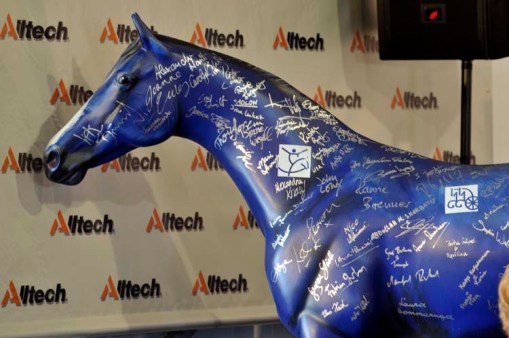
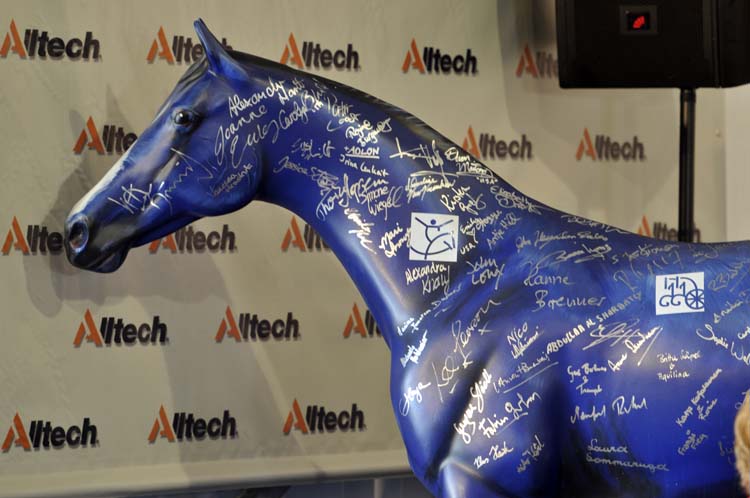
in the spirit of Lexington's "Horse Mania," this blue horse was signed by every WEG medal winner; the horse will remain on display at the KY Horse Park
Medals for the Americans
Following two days of dressage, Chardon was tied for second place with U.S. driver Chester Weber (35.97 points each). Behind them, also tied (with 40.19 points apiece) were Tucker Johnson (USA) and Theo Timmerman of The Netherlands.
And, because each team of three drivers is able to drop one score for each phase and count only the two best scores, the U.S. and Dutch teams were tied for the gold-medal spot after dressage.
The marathon drove well, evidenced by the fact that there were no accidents or serious problems that day. The German team’s chef d’equipe said later that it was a “real championship course.” He wanted to thank Richard Nicoll, he said, “for creating a course that allowed championship drivers to drive like champions and allowed the lesser drivers to finish.”
Among the U.S. team, Johnson had the best drive through the marathon, finishing that phase in seventh place. Throughout the competition, the event announcer had been reminding the spectators and competitors that Johnson planned to retire from competition after this event. So as he exited the final marathon obstacle, he asked his navigator for an update on his time. With a couple of minutes to spare, he stood up and saluted the cheering crowd, which prompted them all to cheer even louder. Johnson said later that he could hear a large cheering section following him on the marathon course. In what must have been a bittersweet moment, he was able to pick out a single voice yelling, “Go, Daddy!” as he entered his final competitive marathon obstacle.
Johnson admitted later that he had found the marathon course to be a difficult one, especially considering the pressure he had placed on himself to have a clean round.
The day was not without problems, though, and the other two American team members didn’t have quite such a good run.
One of Fairclough’s grooms came off the carriage in the third obstacle and, with the resulting ten penalty points, he ended up in fourteenth place in the marathon standings.
In the end, his was not the team’s dropped score for that phase, as Weber accumulated a total of twenty-four penalty points on the course: two for knocking down a collapsible element, ten for a groom dismounting in the fifth obstacle, and then another twelve for a groom dismounting in the seventh obstacle. The result? Weber finished the marathon in nineteenth place out of twenty-five competitors.
Despite the Americans’ bad luck on the marathon, they finished that phase in fourth place among the seven nations vying for team medals.
On Sunday, the drivers faced the lengthy, complicated cones course and a malfunctioning timing clock. The problem with the timer led to several false starts and a delay of about an hour. With the clock fixed, the competition resumed with Weber, who posted the first double-clear round of the day (no balls down and no time penalties). Immediately following Weber, Fairclough tackled the course and claimed the second double-clear round. These two ended up winning first- and second-place ribbons in the cones phase, respectively.
As the competition wound toward its conclusion, the eventual individual medalists each faced the cones course, and each in turn secured their own and their teams’ medals. First of the three to go was Johnson, who had one ball down but no time penalties. Knowing that he had just secured his own individual bronze and the team silver for the U.S., and knowing that he was leaving his final competition, he stood up and saluted the cheering crowd of about five thousand people as he drove out of the arena.
When asked later to describe his feelings on leaving the competition arena for the final time, Johnson said that it “felt good; you don’t always get to end on such a high note.”

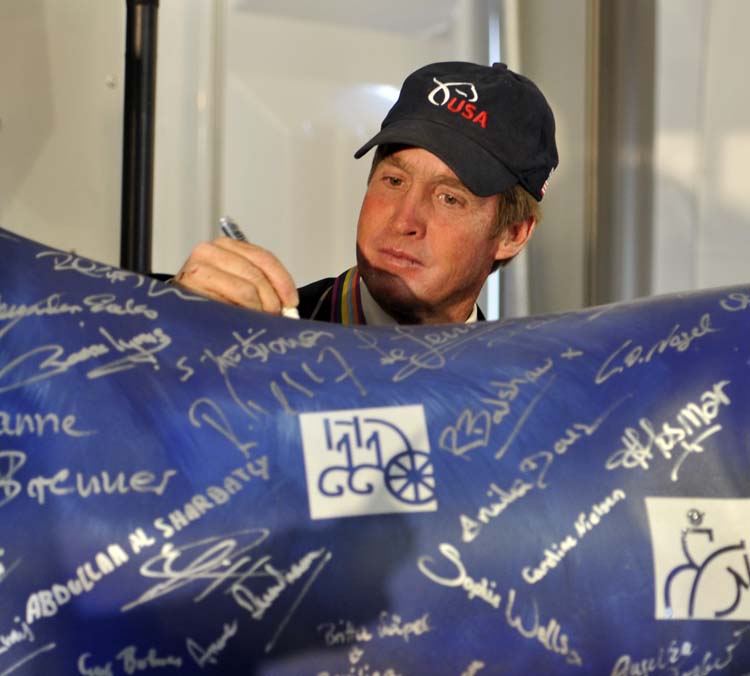
before leaving their final WEG press conference, the silver-medal winners in Driving -- the U.S. team -- each signed the blue horse; here: Tucker Johnson, who also won the individual bronze medal ...
.

- … Jim Fairclough …
.

- … and Chester Weber all added their signatures to the Horse Park’s blue horse as a permanent reminder of their medals won at the 2010 Alltech FEI WEG
ADDENDUM:
The Dutch won the team gold medal, the U.S. won the team silver and, in a surprise finish, the Germans won the team bronze when the second of two drivers representing Sweden (in third place overall going into the cones phase) went off course and was eliminated.
The drivers representing the U.S. as individuals fared as follows. Josh Rector finished in sixteenth place; Gary Stover finished in eighteenth place; Mike McLennan finished in nineteenth place; Cindy O’Reilly finished in twentieth place; and, sadly, both Bill Long and Casey Zubek were eliminated during the marathon. The tenth and final driver chosen to represent the U.S., David Saunders, had two of his four horses refused in the first horse inspection, and he was unable to start the competition.