With tomorrow being the first of December (already?!), I hope you’ll enjoy this video ode to winter.
New York’s Central Park in 1898:
November 30, 2010
With tomorrow being the first of December (already?!), I hope you’ll enjoy this video ode to winter.
New York’s Central Park in 1898:
November 23, 2010
(also from the May 1903 issue of The Carriage Monthly) …
Technical Training
“The carriage builders of the United States are doing more, directly and indirectly, for the development of technical education in their craft than perhaps is being done by any other. Strong pleas are being advanced by leading manufacturers in many industries for the development of technical education in all lines. Prominent among the advocates of such education is Theo. C. Search, the predeccessor of D. M. Parry as president of the National Association of Manufacturers. Mr. Search, in his advocacy of this idea, calls attention to the remarkable development of technical education in Germany. He tells us there are hundreds of manual training schools in Germany supported by city and state governments, by corporations, religious associations and by private individuals, where all manner of technical education is imparted. Among other things, Mr. Search says that American manufacturers have been exceedingly successful in reducing the cost of production to a minimum by the invention of machinery capable of the maximum output with the minimum labor. Machines have been invented by thousands, appliances without number devised, and all sorts of economic plans employed to increase the output and to minimize the number of hands employed. The time has come when we can see the limit of economies in these directions. So far they have enabled us to meet foreign competition by cheapening the product below the foreign price, but the day of reckoning will arrive when the foreigner will have all our economic appliances, all our push and drive, and something else which we have not, namely, trained skill. In running a manufacturing plant the race is the same as in baseball: team work will win against a combination of “stars” who may be brilliant in some directions, but who cannot win a game.” — from the May 1903 Carriage Monthly, courtesy of the CMA Library & Archives
November 22, 2010
… from the editors of the May 1903 issue of The Carriage Monthly, that is.
Progressive Excellence:
“It is no boast to say that American carriages are the best in the world. This statement will be controverted by many English makers. When the refutation is carefully analyzed it will be found that the claims for superiority in English-made vehicles of the better class are lacking in merit from the American standpoint. The foreign exhibits of carriages, made during the past decade, were carefully examined by practical builders, by experts and designers, without learning much from the best foreign work. Superiority in carriage work cannot be determined by simply referring to ornamentation or external finish. There is such a thing as internal finish, and in this respect the American carriage builder excels. This finish is not apparent to the average eye, nor perhaps even to the expert eye, but there is a mechanical finish which represents the highest type of skill, ingenuity and design. Every carriage builder knows that it is possible to vary the cost of a carriage even as much as 50 per cent, and yet to have two carriages representing that difference in cost look so much alike that not one in a hundred purchasers could tell one from the other. This, of course, does not apply to the cheaper grades of vehicles. The trade of making vehicles “in the white” stimulated what might be termed internal finish, for want of a better term. Work in the white enables the buyer or builder to see and know pretty nearly what he is getting. Work in the white is by no means an American system, but it has done very much to develop carriage building to what it is along its higher lines. When we look at work in the white we can see what is wood, what is iron, what is steel; how they are treated, assembled and joined, and how the grain of one piece wood has been laid to secure the greatest possible strength with the maximum lightness. The one feature of American carriage building is the exquisite joining. This joining does not show in the finished vehicle. Joints are the theoretical weak spots in a vehicle. To use material so that there will be practically no joints, but one solid, yet elastic, piece of work is the objective point. A carriage is strained at every point of its surface, so to speak, theoretically at least. These strainings constitute the wearing, yet in a well-made vehicle it is difficult to discover side strains long after the carriage has been built.
“The expert maturing of wood is a very important point, especially with hickory for spokes and felloes and with elm for hubs. In the best carriages this wood is naturally seasoned; in the cheaper vehicles artificial drying is resorted to, which sometimes, and very often, drives the sap out too quickly, the fibres being compressed by heavy weights instead of being compressed by the natural process. This difference in drying, of course, cannot be detected by the eye. The strain in a carriage naturally comes on the body, rockers, springs, spring bolts, king bolt and fifth wheel. The art of the carriage builder lies in so arranging and usng the lumber, iron and steel so as to practically make a unit of all, at the same time giving to the completed work the elastic quality which is inherent in material, and which the structure of a carriage demands.
“American carriage builders are giving to these fine points of construction a great degree of study and attention. They are studying the nature and material more closely. They are getting at the soul of wood to understand how to use it without violating its instincts, as it were, for wood has instincts, and so have iron and steel, as well as human beings.” —from the May 1903 issue of The Carriage Monthly, courtesy of the CMA Library & Archives
.
Tomorrow, I’ll post the editors’ opinions (from that same issue) on the state of “Techincal Training” here in the U.S. and abroad.
November 18, 2010
Ann Miles, of The Carriage Barn in New Hampshire, sent this photo of the furry, adorable Barnum and Bailey. They are Belgian circus ponies that were given to The Carriage Barn’s driving program. Ann said that “someone had the brilliant idea of putting a pole on the front of a dogsled … the trick is to steer and not lose your balance.”
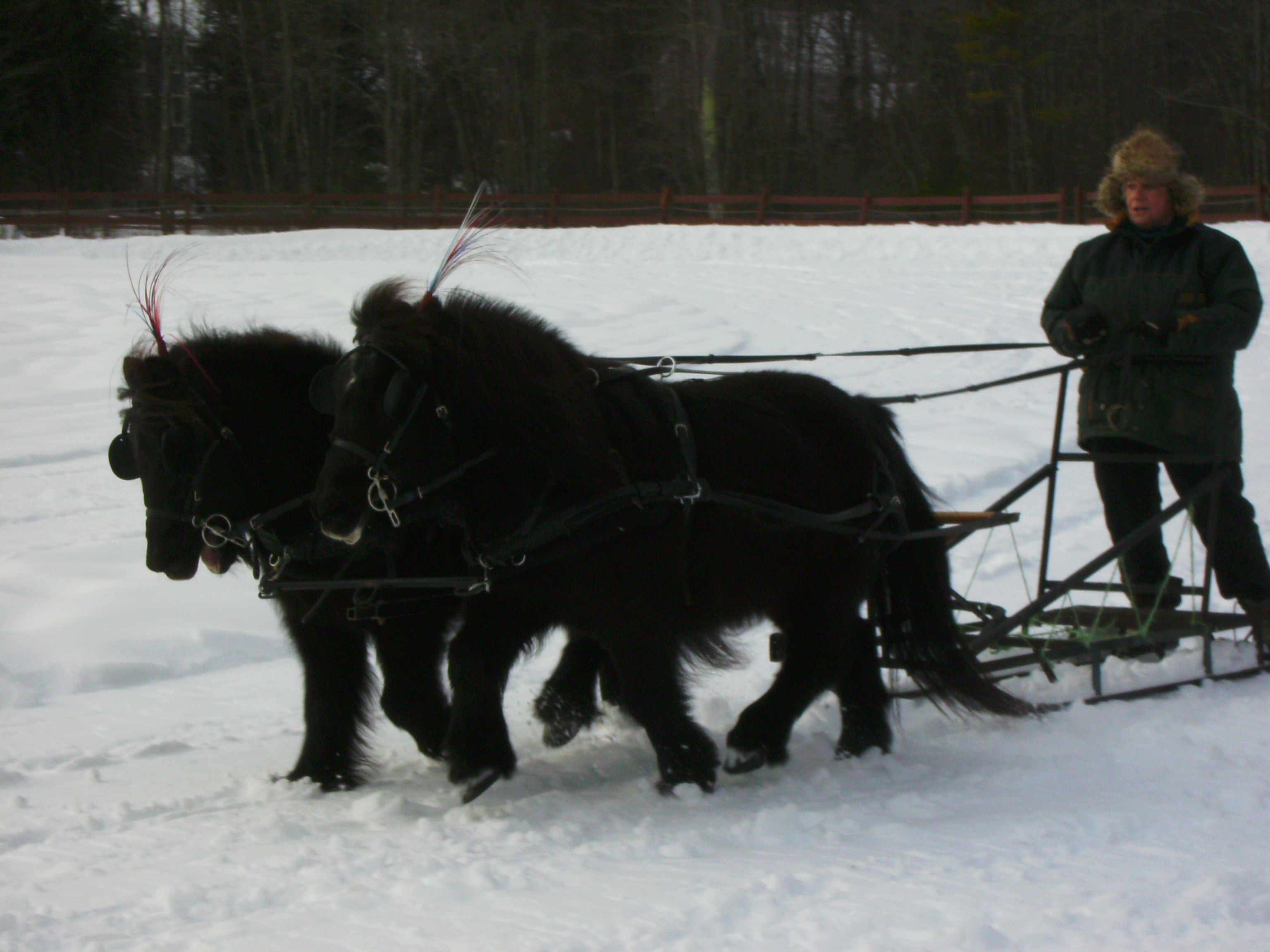
Barnum and Bailey in the snow (photo courtesy of The Carriage Barn)
.
Next, Ann sent this video of the ponies pulling their dog sled.
Do you have any videos or photos to share of your wintertime driving activities? Feel free to send us your favorite, furriest, most beautiful, or most unusual turnouts.
November 16, 2010
Back at the end of August, I took a road trip.
My destination? Sidney, Ohio … a three-hour drive north of Lexington. I timed my departure to avoid morning rush hour in Cincinnati, and in Dayton. There was still the usual big-city and road-construction traffic to deal with, but soon enough I was north of Dayton, admiring the tidy farms along the interstate.
I arrived in Sidney around lunchtime. On the town’s picturesque courthouse square, Richard Scott (owner of the popcorn wagon) and his helpers were putting the wagon in place and setting up all the various props for our photo shoot: the vintage popcorn and peanut boxes, the flags with the correct number of stars to match the era of the wagon, etc.
The biggest photo-shoot prop of all, of course, was Sidney’s courthouse square. On these same streets, a similar wagon sat for nearly fifty years — from the early to the mid-twentieth century — dispensing fresh popcorn. As I and a local newspaper photographer took our photos, more and more people gathered on the square to catch a glimpse of the wagon that resembled a part of Sidney’s history.
Once we were finished, everyone worked to load the wagon back into Richard’s specially made trailer … and we all drove home.
.

Richard Scott's popcorn wagon ... this is one of the photo angles we tried, but not the one that ended up on the cover of the magazine
.

this is closer to the image you've (I hope!) seen on the cover of the October issue ... the wagon in the foreground, with a glimpse of Sidney's beautiful courthouse behind
.
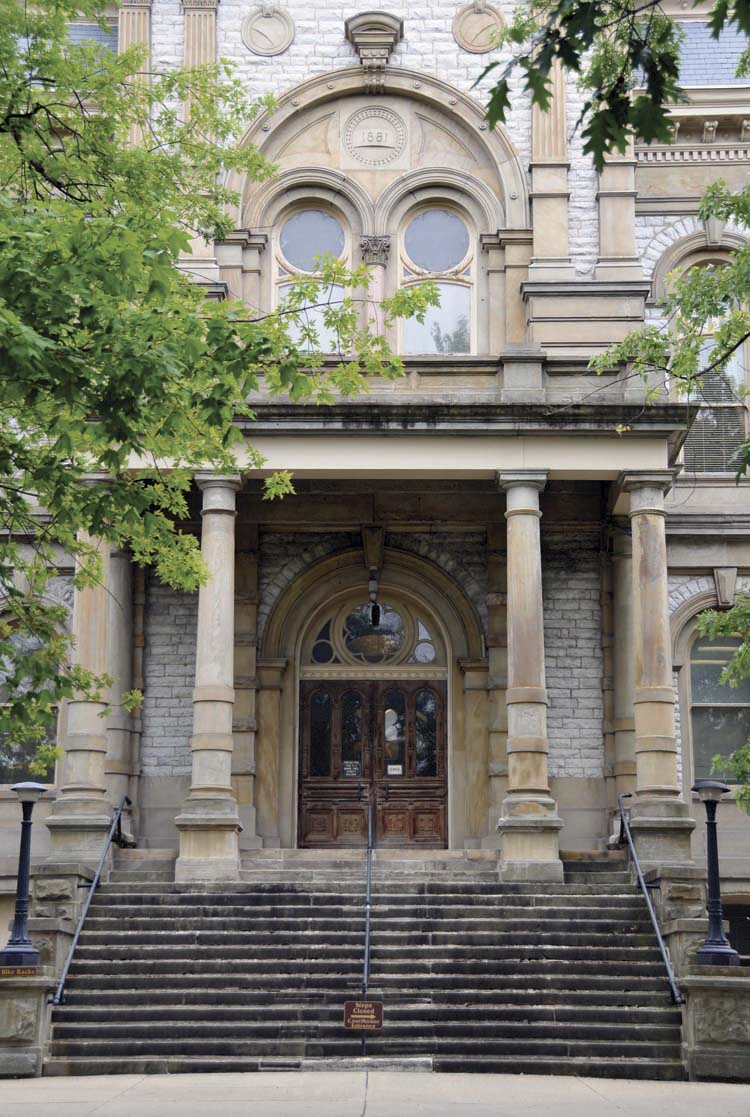
Sidney, Ohio, is a small town of about 20,000 people ... with a remarkably beautiful town square, in the center of which sits this courthouse (here, one of the entrances), built in 1881
.
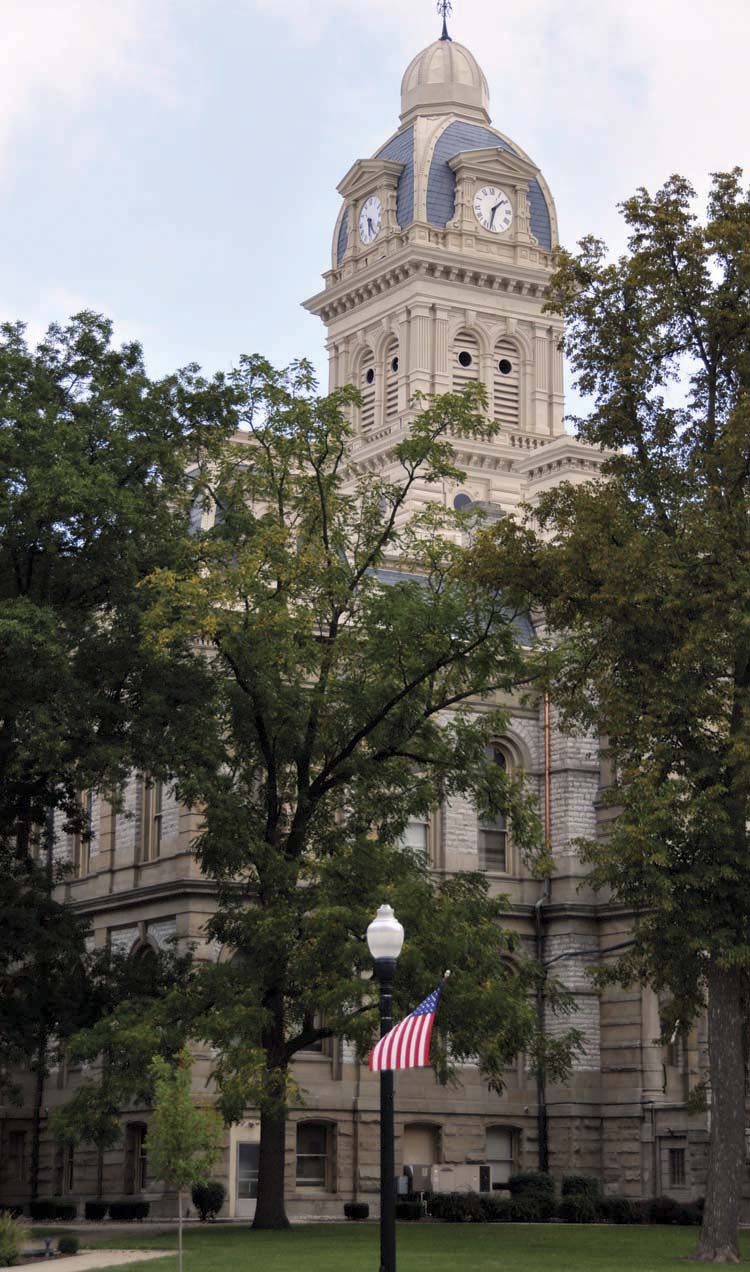
a larger view of the courthouse, including its tall clock tower
.
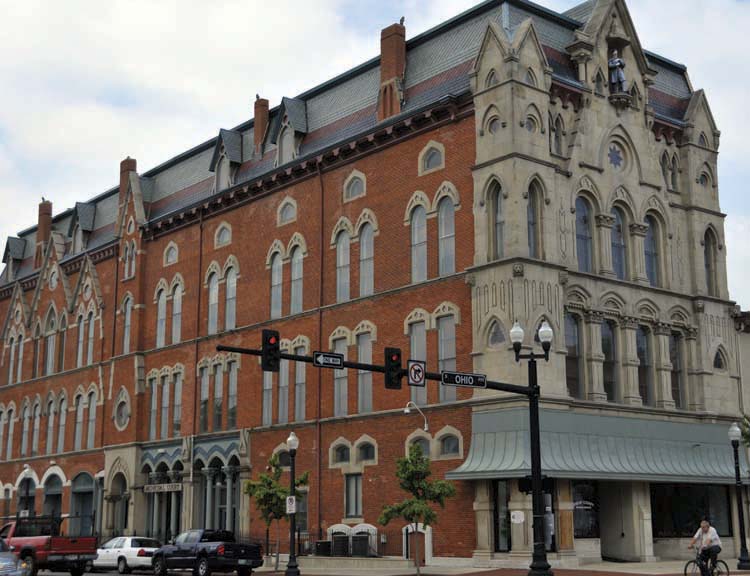
on the corner of the square, the Monumental Building (built in 1877) was dedicated to the county's Civil War casualties; I've heard stories of major events, parties, shows, even circus performances being held in the huge second-floor exhibition space
.

the statue of a Civil War soldier at the top of the Monument Building's facade
.
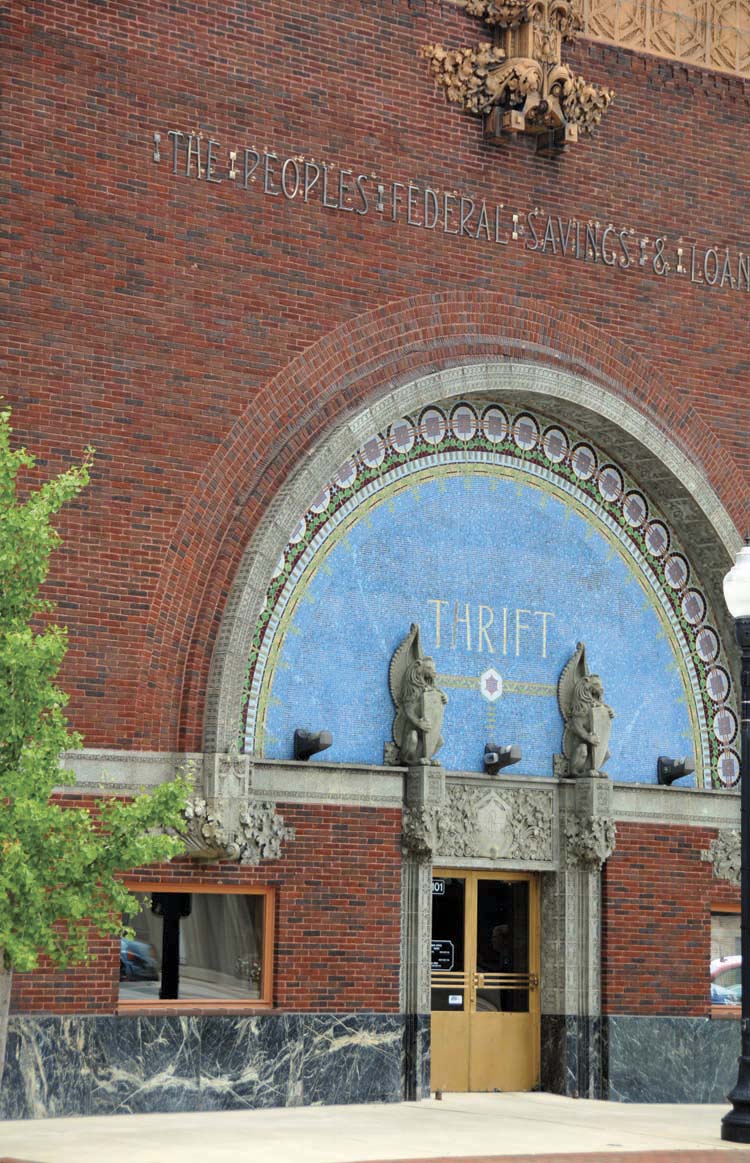
across the street from where we were photographing the popcorn wagon: the 1918 People's Bank, in a building designed by Louis Henri Sullivan
.
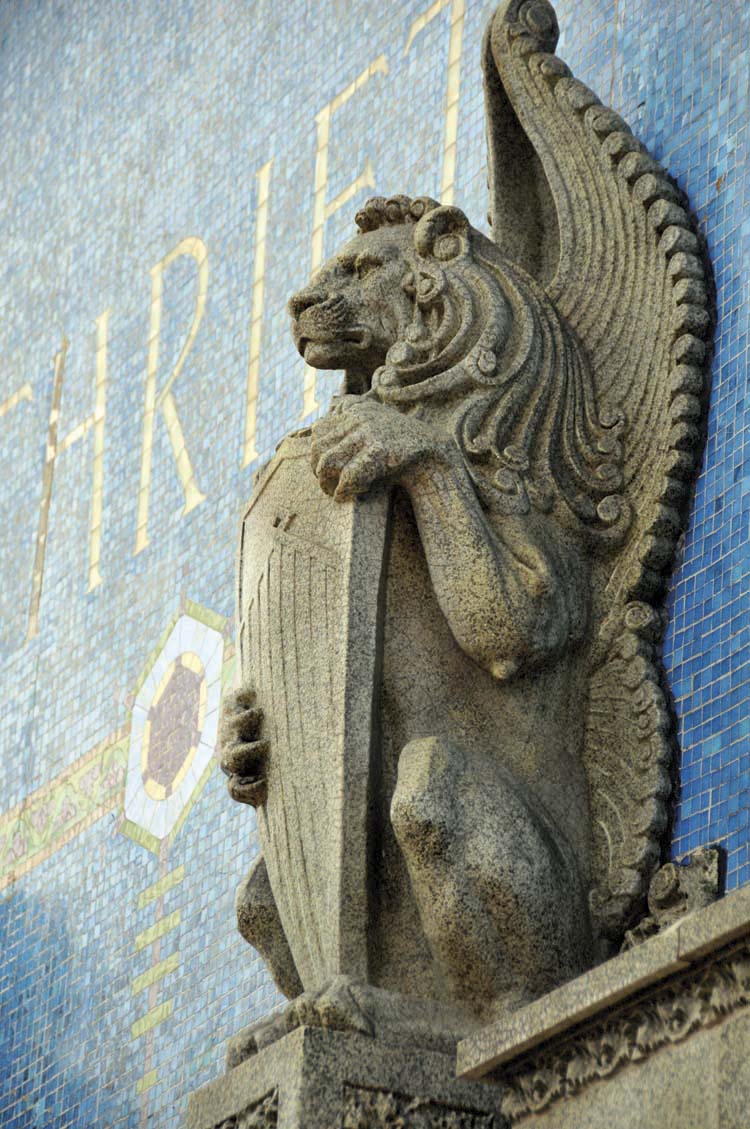
a close-up of one of the creatures over the bank's doors
.
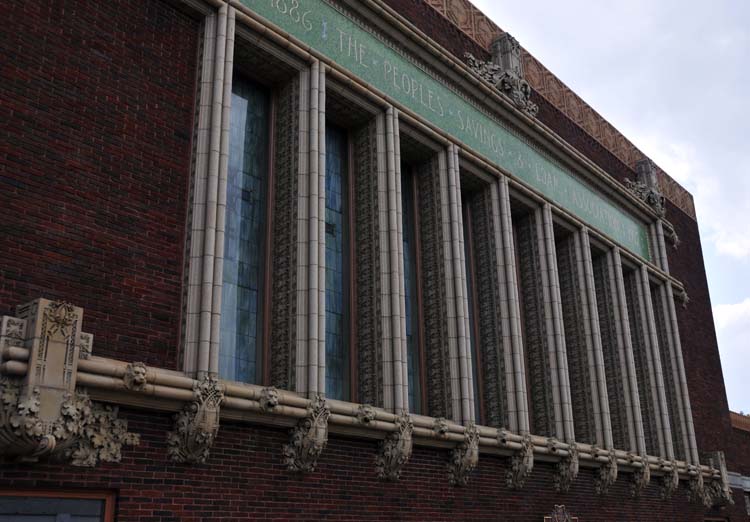
the side of the bank building designed by Sullivan; he is considered the "father of modernism" and his work inspired the Chicago architects who have become known as the Prairie School
.

on the corner, with the Monumental Building across one street, and the bank across the other, is the Spot to Eat, which has been here since 1907; the current building dates from the 1940s
.
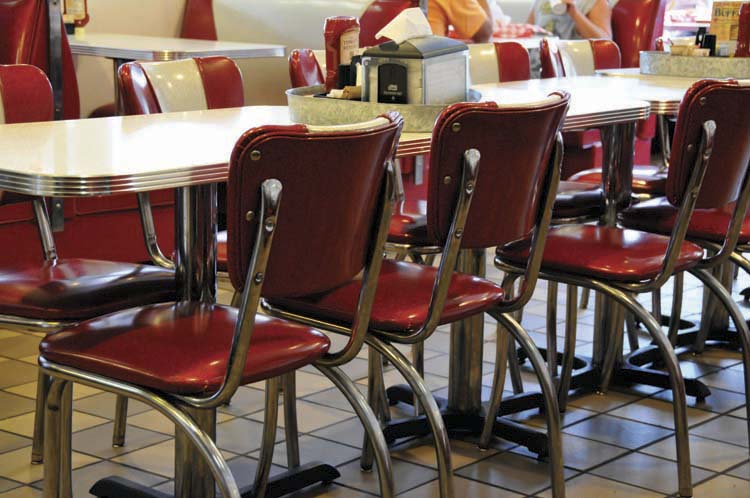
the nostalgic interior of the popular lunch Spot on the corner of the square
.
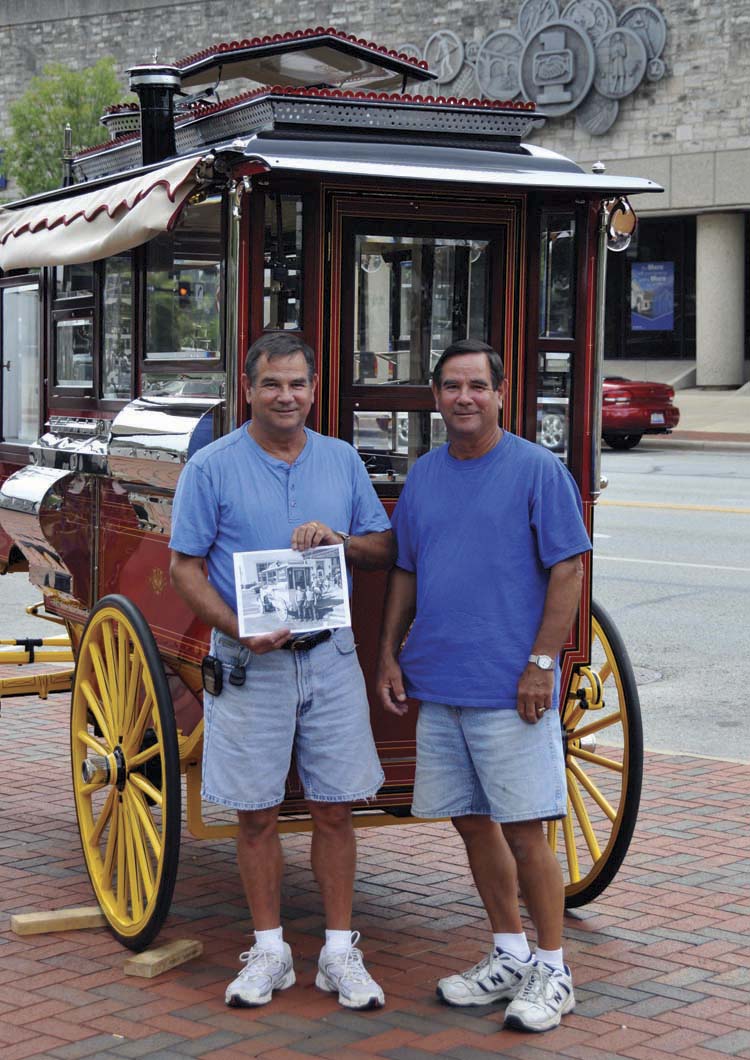
while we were busy photographing the popcorn wagon, twins Larry (on the left) and Garry Leapley brought a photo of themselves from 1955, standing in front of Sidney's early-20th-century popcorn wagon; they later helped load the wagon back on its trailer
.
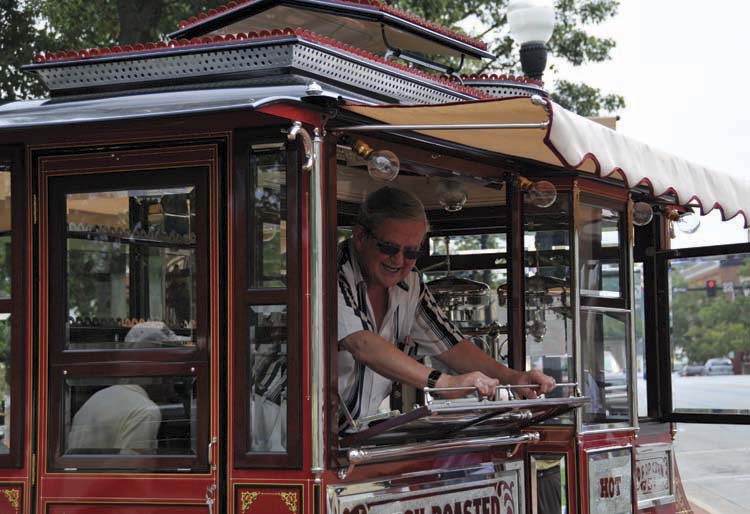
as we finished for the day, Richard closed up the drop-down windows ...
.
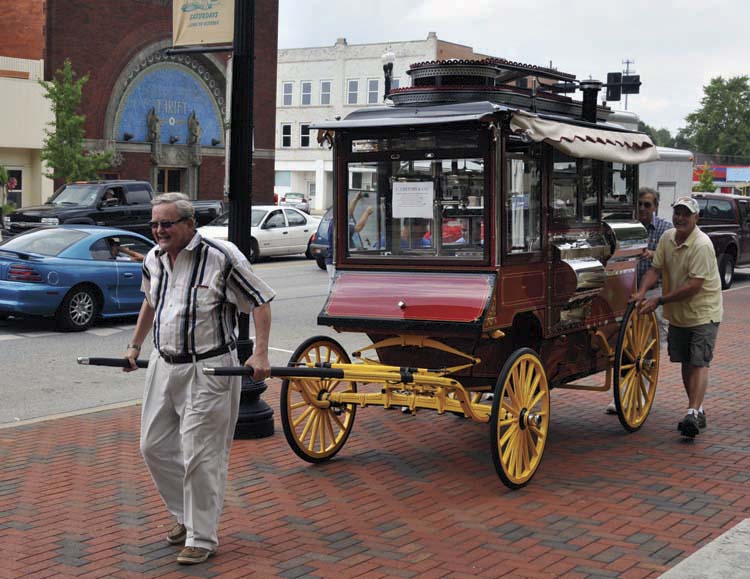
... and trotted down the sidewalk pulling the wagon, to get it into position to ...
.
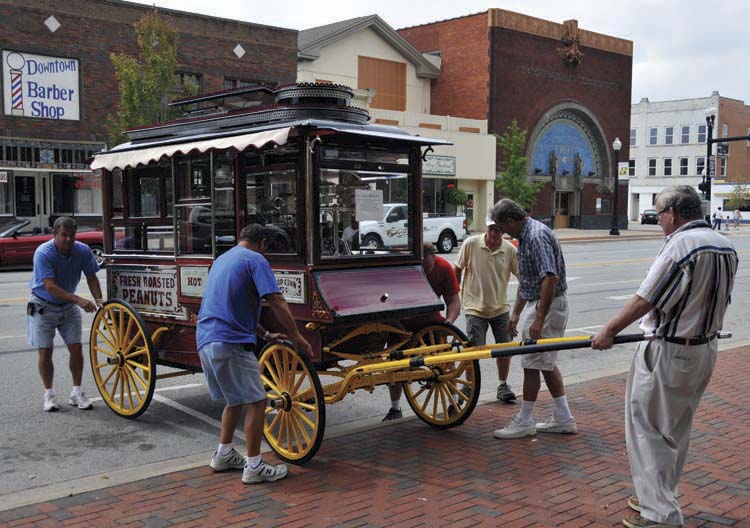
... ease it carefully over the curb and into the lane we had blocked off ...
.
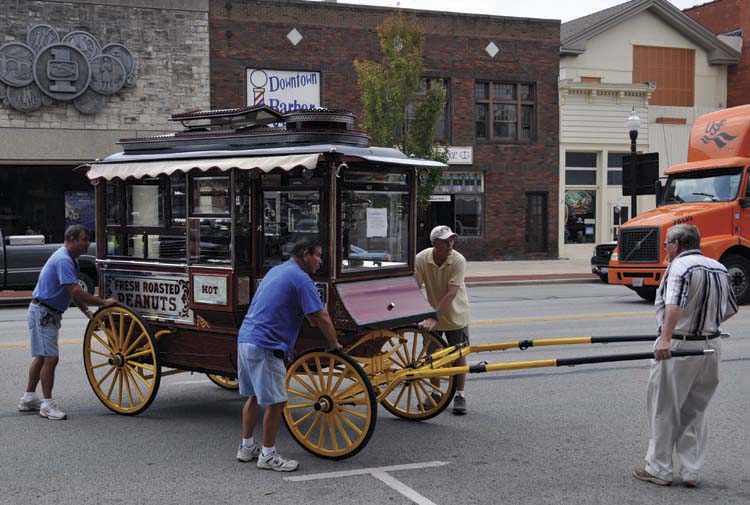
... and turn it to face the trailer ...
.
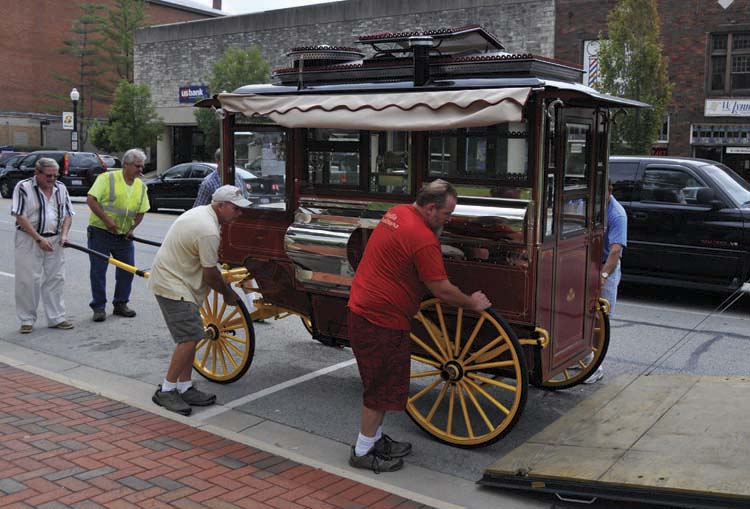
... and get it lined up ...
.
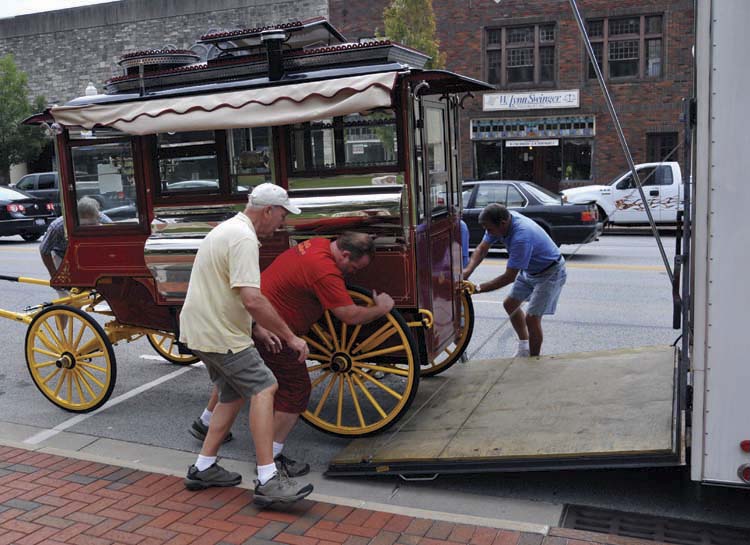
... and up the ramp ...
.
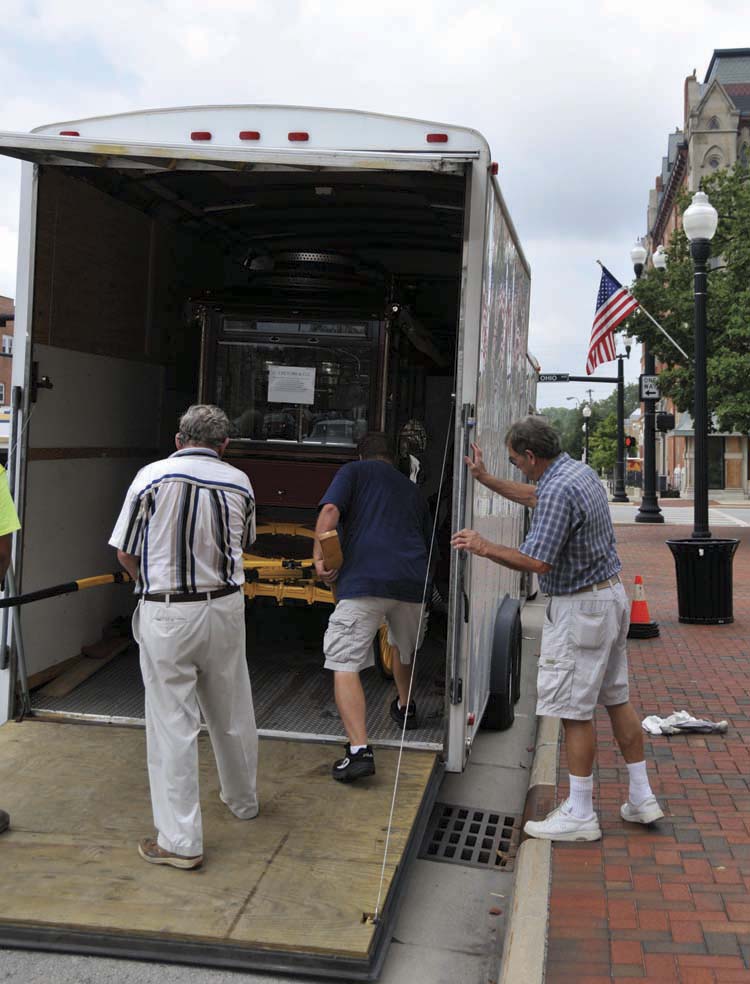
... and into the trailer and on its way home!

