While on our way to a museum in Bardstown, we drove past a sign describing “The Cobblestone Path.” We were intrigued enough to stop (frankly, because, from the road, the slight clearing in the woods on the hillside didn’t look like much).

Remember when I said that little Bardstown boasts a rather stunning amount of regional, state, and national history?

Here’s what the aforementioned sign says:

The Cobblestone Path is one of the oldest paved roads in all Kentucky. By 1785, this was the original entry to Bardstown from the east and part of the legendary “Wilderness Road.” Congress ordered the Pioneer Trace to be improved as a military road after 1792. The cobbled paving of this hill dates to at least c. 1790. It allowed two-way traffic by heavy freight wagons, and for all wheeled vehicles entering and leaving Bardstown. After serving for more than thirty years as the major entry connector to the east end of historic Arch Street, the steep pathway was relegated to light traffic and mounted riders after the improved turnpike was constructed c. 1830. Cut off from the city’s modern streets after 1925, the path’s isolation allowed it to survive, serving only pedestrian traffic after that date.

.

Bardstown's "Cobbled Path" dates from the late eighteenth century

.

... for perspective, here's A.J. standing on the path; this road is so steep and narrow that it's hard to imagine two-way freight-wagon traffic here ... what a job that must've been!

.

... and a close-up of some of the late-eighteenth-century cobblestones

After Madison, Indiana, our next stop was small (but historical) Bardstown, Kentucky.

Bardstown was one of the earliest frontier settlements in what is now Kentucky, and it boasts an awful lot of national, state, and regional history for such a small town … and a lot of lovely old architecture.

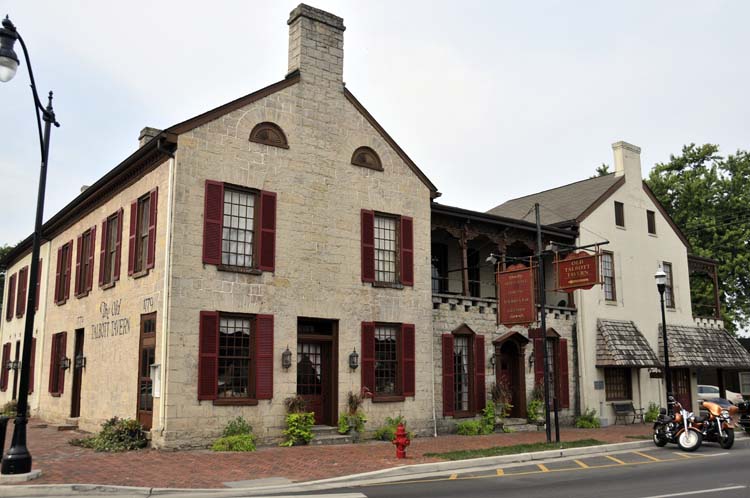
This building is the Old Talbott Tavern. Its original section (on the left) was built in 1779, and it’s still used as a restaurant, tavern, and inn.

.

this eighteenth-century tavern is said to be the country's oldest western stagecoach stop

.

According to both news reports and legend, several notable figures have stayed here, including Abraham Lincoln, when he was a young boy, and his family; Daniel Boone; and the exiled French King Louis Phillipe and his entourage (they even painted murals on the upstairs walls). Jesse James, who had family in Bardstown, is also reported to have stayed here, and he’s believed to be responsible for the bullet holes in the French king’s murals. Sadly, portions of the inn were heavily damaged in a 1998 fire. The murals have not yet been restored, so we weren’t able to see them for ourselves.

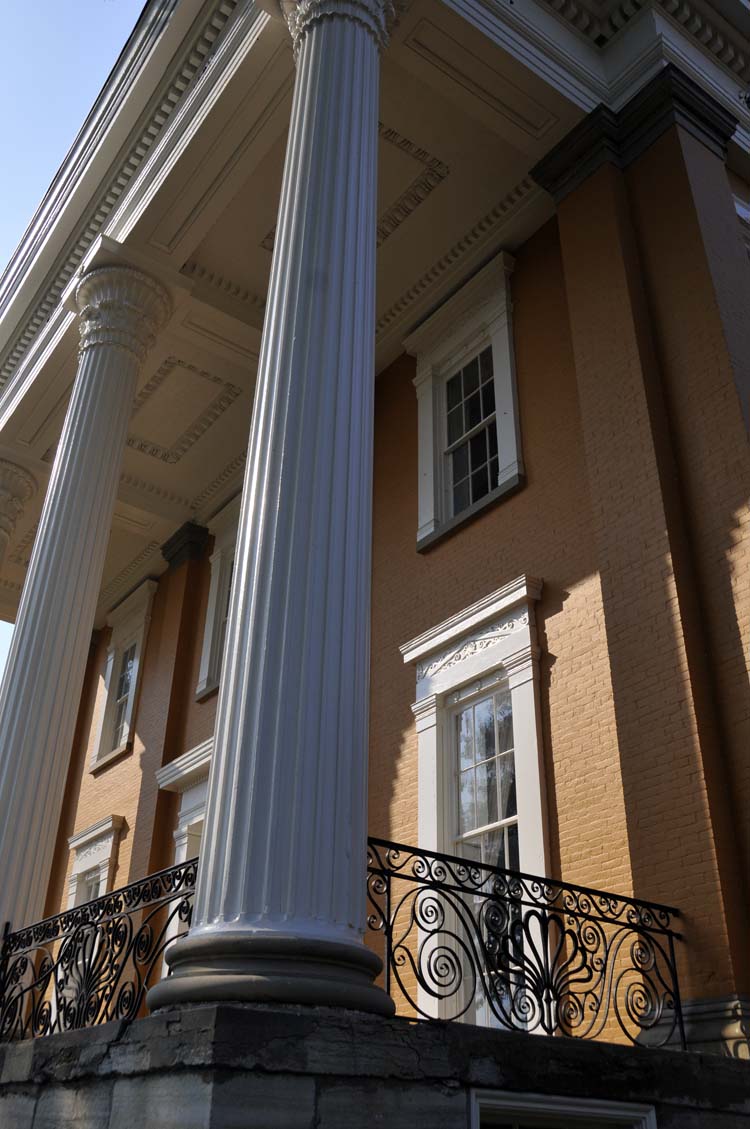
While in Madison, Indiana, we visited a spectacular Greek Revival house built in 1844 for James F. D. Lanier.

.

a portion of the back "patio" of the Lanier Mansion

.

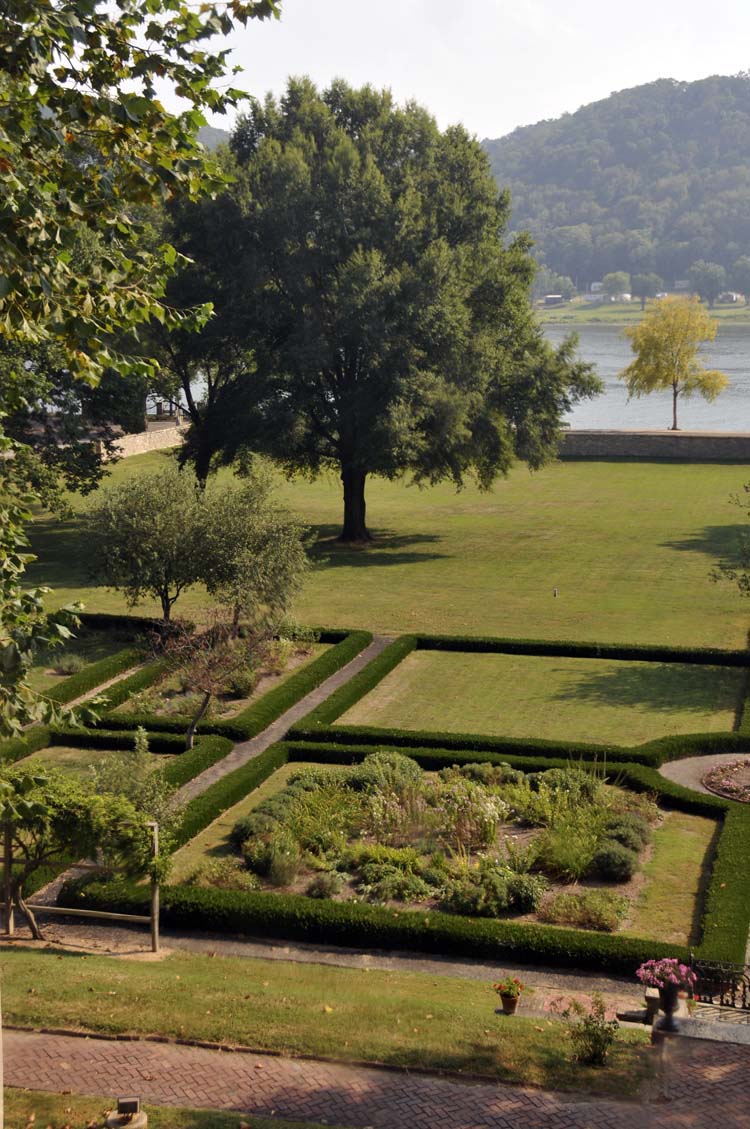
the view from the second-story windows in the previous photo; that's the Ohio River in the distance and Kentucky on the other side of the river

.

Across the street from the back garden is this carriage house:

.

according to a sign on this carriage house, it was "probably built c. 1887 by John Robert Cravens, attorney-at-law, as a carriage house and stable"

.

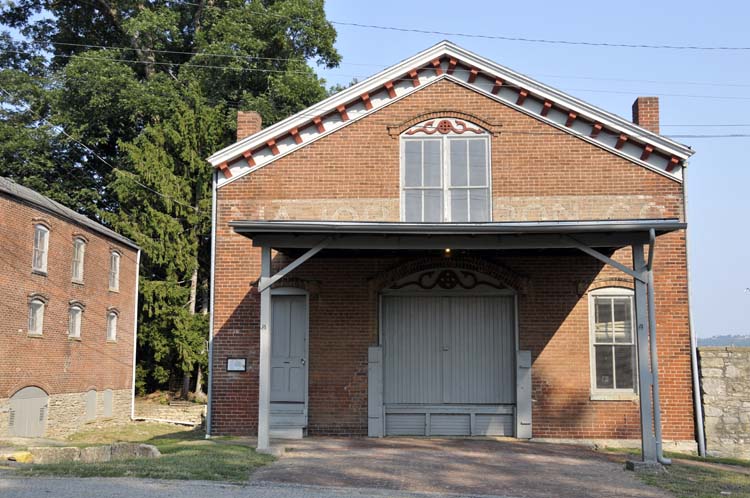
… and, next to it, this carriage house:

.

according to its sign, this carriage house was built by either William Stepp or Alexander C. Lanier (son of James, who built the neighboring mansion) between 1887 and 1892; after the early twentieth century, it was used as a cooperage, a garment factory, and a tobacco prizing house (where tobacco was graded and packed for shipment)

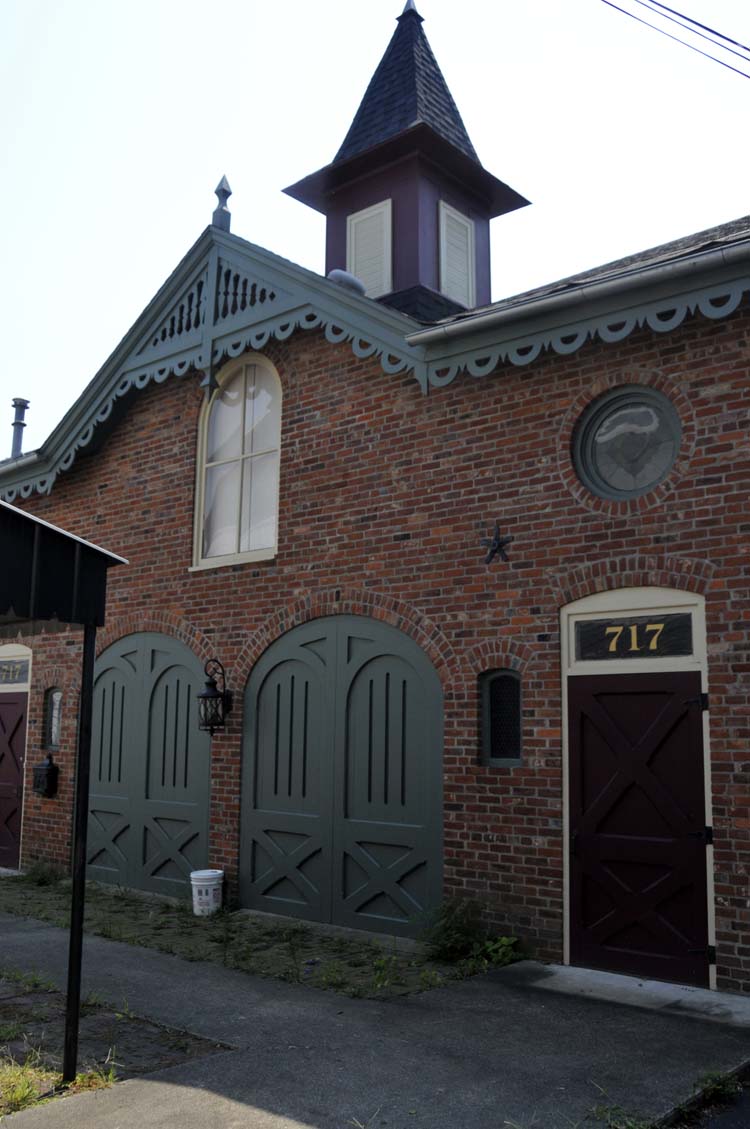
A.J. and I recently went on vacation and toured around some areas not too far from here: Louisville, a couple of small towns here in Kentucky, and a lovely nineteenth-century Ohio River town in Indiana. Both of us are naturally drawn to historic things and places anyway, and there’s no escaping carriage-era history in well-preserved nineteenth-century places, so we had fun gathering information and photos to share here on the blog.

First up is this beautiful Victorian-era coach house at the end of a driveway in Madison, Indiana:

.

CAA member Candy Thomas sent us this report from a special horse-related training day held recently in Virginia:

Horse trailer accidents; horses stuck in mud, fences, or holes; barn fires. Firefighters are the first responders to these sorts of scenes.

They have the necessary equipment to fight fires and take care of emergencies, but have they ever handled a horse?

Even when first responders can handle emergencies, they often have little or no training in large animal behavior and handling. The James River Driving Association (JRDA) recently gave first responders the opportunity to get up close and personal with their horses. Fifteen firefighters representing seven fire houses in central Virginia attended this event, to participate in hands-on training on equine behavior and handling.

Robbin Widmeyer, the JRDA’s secretary and the event organizer, worked with Dr. Shea Porr and JRDA’s own Dr. Tom Newton, DVM, to stage this event. Dr. Porr is an assistant professor at the Virginia Tech M.A.R.E. (Middleburg Agricultural Research and Extension) Center. Her extension program’s focus is on emergency preparedness for large animals, particularly horses. She conducts workshops for emergency responders on horse behavior and handling, holds seminars for horse owners and veterinarians on disaster and emergency preparedness and on how to work with first responders, and coordinates technical large animal emergency rescue training.

The day began with Dr. Porr explaining “Equine Behavior 101,” including such topics as instincts, vision, and body language. She also demonstrated the basic equipment (i.e., halters and lead ropes) and handling considerations. Dr. Newton, DVM, described various veterinary concerns that come into play during an equine emergency. He demonstrated how to check pulse and respiration, and basic first aid needs. The group also discussed a variety of horse trailers and watched demonstrations of how to load and unload horses.

By the end of the day, with assistance from JRDA members and their horses, participants were able to walk into a stall, halter a horse, and lead the horse out of the barn. They learned to walk, halt, turn, and back the horses, and how to approach and halter a loose horse. Participants were also able to practice taking pulses, wrap legs, and lead a horse onto and off of a trailer.

Dr. Porr ended the day’s training by asking the first responders to rate their experience. She later said, “The best indicator of a successful program from this survey is the shift in comfort level. Before we started, several people were uncomfortable. Afterwards, everyone was either somewhat or highly comfortable. It is good to know they feel more comfortable after walking away from the class.”

At the end of the day, each participating fire house was given a halter and lead rope they could keep on hand. Several of the firefighters said they are now planning to take part in large animal emergency rescue training. Mission accomplished!

To learn more about the MARE Center or emergency response training, contact Dr. Shea Porr at 540-687-3521 or cporr@vt.edu.