The following story, by Amy Wilson, appeared today (election day) on www.kentucky.com, the website of our local newspaper, the Lexington Herald Leader:
Go left or right, but no votes to be cast in Decide
They’re mules. Eight beautiful matched, tall, sleek and big-eared sorrel mules, not so patiently awaiting breakfast in the pre-dawn, and they must decide whether to rush Bob Sawyers and his corn bucket or run into one another in the process.
Because they are mules, they do both, even though they live at the entrance of a community that is forever named for its famous crossroads and eternally dubbed in homage to picking and choosing, to the art and imperative that is to decide. As on Election Day.
Except that here it is pronounced DEE-cide.
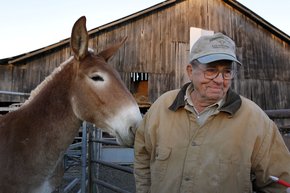
Bob Sawyers — on his farm with one of his prize-winning mules — has lived his whole life in Decide, which is on Ky. 1281, also known as Willis Creek Road (photo by Charles Bertram)
For the record, no one gets to vote in Decide on Tuesday. Instead, they have to go up Ky. 127 for that pleasure.
Still, it is a place where decisions are not unfamiliar territory. Only a few hundred feet up from the glorious mules, where the paved path cleaves in two, it has always been a time for leaning left or right, as there is no other choice.
Stand where the well and the holly tree are planted on Willis Creek Road in Clinton County and know that thousands have stood here as well. Look straight ahead, see where a post office, a grocery store and Col. Crawford Holsapple’s big house with its imposing veranda once demanded that you lean at the fork. Now, it is a brick home, equally insistent.
Before the Civil War, local folks say, if you went left, you and your goods were off to Albany Landing, where the steamboat came to do your bidding. If you went right, you and yours were headed to Nashville via the Cumberland River.
Bob Sawyers’ family did not decide at all, turns out. In Sawyers’ basement is the very chair that his great-great-grandmother sat in while riding in a covered wagon from Virginia. They decided to stay, coming to own, to this day, a large portion of the land that is Decide.
“It wasn’t no town,” Sawyers, 75, insisted, smiling. The post office lasted until the 1960s, but everybody went to Willow Grove School, he said. There wasn’t much organized at this jumping-off point, if you don’t count the occasional bookmobile visit.
There is no vestige of a Decide city hall, because the city part is really more insult here than compliment. Which explains why there’s no fire department. And why, last winter, Sawyers knew there was little he could do when the lightning struck his barn.
“I just watched it burn,” he said.
The mules were safe, which is what’s important in Decide, given that these mules are prize-winning types, and not just for their sorrel beauty. These are bona fide four-hitch champs, having won the Kentucky State Fair title eight times in eight tries, although not in a row because Sawyers had to take a year off in 2007 for cancer treatment. His trophy case includes some awards from Indiana but none from Tennessee, because Tennessee gives money instead, and that Tennessee Mule Championship cash has been spent.
His plaques cover his basement walls; his trophies sit on the two refrigerators in the basement and a separate shelf made for that purpose.
Sawyers cannot remember a time when he, and Decide for that matter, were without mules. They are pretty, but they can plow. They could help put up the new barn if they decided to. They don’t.
So Sawyers goes back to work.
Up at the fork in the road, if you turn right these days, you smell cows. Pure Holsteins, to be exact. And you see the Young family farm up Lawson Cemetery Road where Colonel Holsapple, the leader of the South Cumberland Battalion of the Union Army, has been resting in his grave since the early part of the 20th century.
Funny thing about Holsapple, Paul Young said: He was on the Union side of things, but everyone in Decide knew that the family owned slaves. The slaves clearly provided much- needed help when things were being unloaded at either of the ends of the roads leading away from Decide, and given that the Holsapples were bonded distributors of whiskey when it was legal, that made life in Decide right enjoyable for most. Still, the slave and Union thing didn’t make sense, Young said.
People talked.
Back in those days, the river carried everything to and from this road. Barrels of whiskey used to come in the 600-pound variety, with tobacco bales usually weighing 125 pounds or more, and produce being heavy and unwieldy, Young said.
His son, Steve, said the Young family story is rumored to go back to Brigham Young (who did, indeed, come through Kentucky in 1843), “but we don’t guarantee it.” They’ve tried to trace a note they have that grants a great-great-grandmother in Cumberland County the right to wed a certain son of Brigham Young, but nobody in Salt Lake City is very helpful in confirming anything of that nature, Steve Young said.
Makes no difference. Paul, 78, and Steve, 56, have a stake in these parts, Brigham or not.
Some things do not have to be settled, one way or the other. They just are. And you can wholeheartedly decide to live with how great they turned out right where you are.
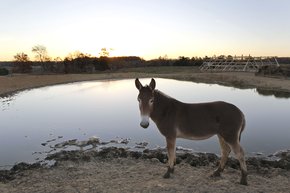
one of Bob Sawyers’ mules stood in front of a pond as the sun rose in the background on Sawyers’ farm in Decide, Ky., on Thursday, October, 21, 2010 (photo by Charles Bertram)

 The Slower Road