horses & driving


… “It was about half-past eight o’clock when I reached Mirage. I took Fanny from the carriage and fastened her to the left rear wheel, the cow opposite and gave them water and grain, made up my bed between them and laid down and was soon asleep. Some time in the night I awoke, my watch having run down I could not tell the time; all around was still. On my left at a long distance, I heard the cry of a coyote. I thought it was morning, still I could not see any signs of the sun having risen.

“I laid down and thought to sleep but could not. I spoke to my horse, ‘Fanny, are you asleep?’ She at once got up and I gave her some grain. This brought up Bessie; she wanted some too, so I gave her some and both were busily eating. Looking eastward, I was sure I saw a light and thought it must be morning and so made ready for moving forward. The light I saw was only about the width of my hand.”

Continuing from Sunday

“I left Wadsworth on the 25th and made Mirage the same day, a distance of twenty-five miles. After leaving Wadsworth, the first six miles was through deep, heavy sand, the wheels sank into it about six inches, which made hard pulling for the horse. I also had a heavier load than usual: there was a sack of barley for the horse, and a sack of bran for the cow, each 100 pounds; ten gallons of water, 85 pounds; in all 285 pounds; besides my common outfit, such as clothing, bedding, provisions, and other things, say about 200 pounds more. My carriage is light, about 300 pounds, making a total of about 800 pounds. Fanny had to haul this through six miles of sand. I had been informed of this heavy road before starting.

“About nine o’clock I reached the desert; just as I was reaching the bottom of the bluff on the desert, the express train from the west passed me. I stopped and gave the horse a can of water, but did not give any to the cow although she wanted some. About two miles farther we came to a second station; I stopped and looked around but saw no one. I looked for the water tank and soon found it below the surface of the ground; I lifted the lid and found there was water; I got a pail and tested it and found it fair. I gave both horse and cow as much as they would drink and filled my empty can and then went on; it was about ten in the forenoon.

“I had not gone much farther, when on looking round saw the freight train from the west approaching. All hands on the trains knew me, as they had bought my milk. At this time I was traveling on the great desert, a better road I never saw; a hard smooth surface, rather too hard for Bessie’s feet. I am now on the left of the railroad, my direction is to the east. In front of me are some buildings, which proved to be salt works. About three o’clock I met the freight train from the east, and at four reached Hot Springs.

“Here I made a stop and introduced myself to the agent, showing him my card in regard to water. He told me that I could have all I wished. I gave the cattle water and grain and refilled my cans, intending to do so at every station. It was fair water, brought from Wadsworth from the Truckee river. ‘Where are the Hot Springs?’ I asked of the depot master. Pointing, he answered, ‘They are yonder. You will see where to turn in at the trail, it is only a short distance to your right.’ I went to see the springs and found a wet, dirty, nasty, mud-hole. The water was warm, not hot as I had supposed. I thought myself sold, as others before had been on this place.

“I traveled farther and about six o’clock met another train from the east, but could not see much express about it, as stops were made at every station, running at the rate of a mile in three minutes.”

Tomorrow: Mr. Johnson reaches Mirage …

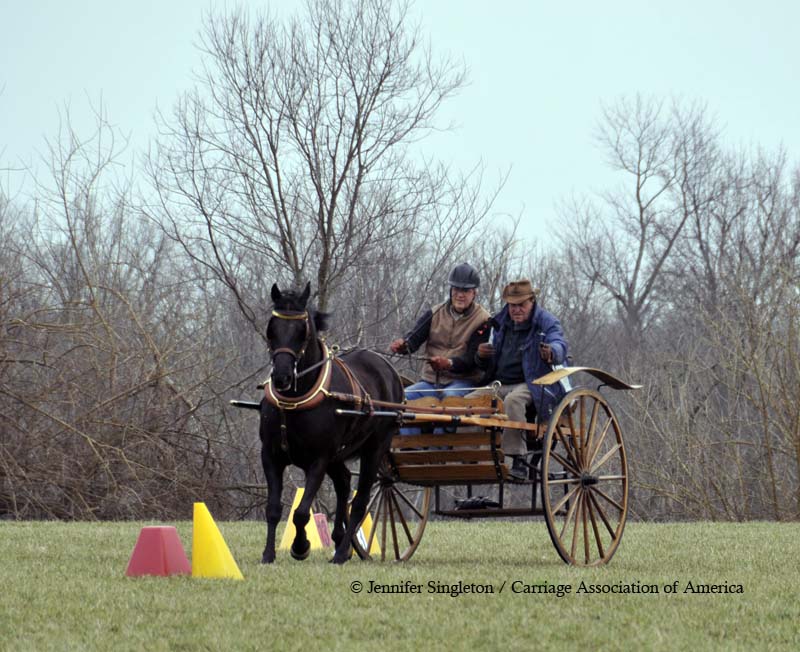
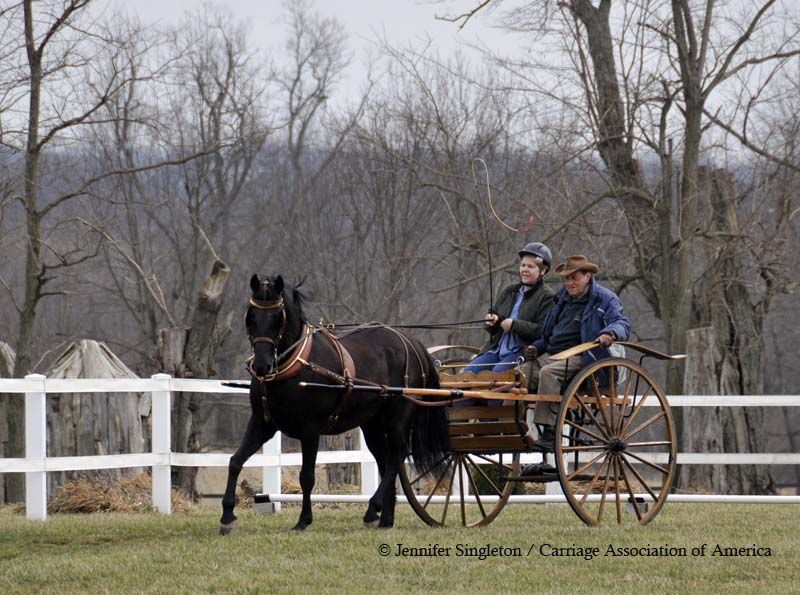
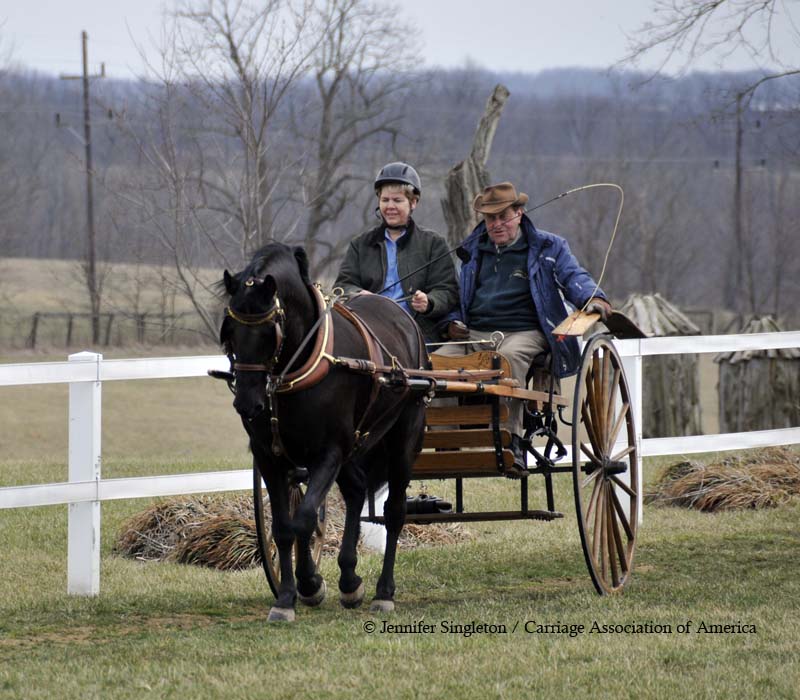
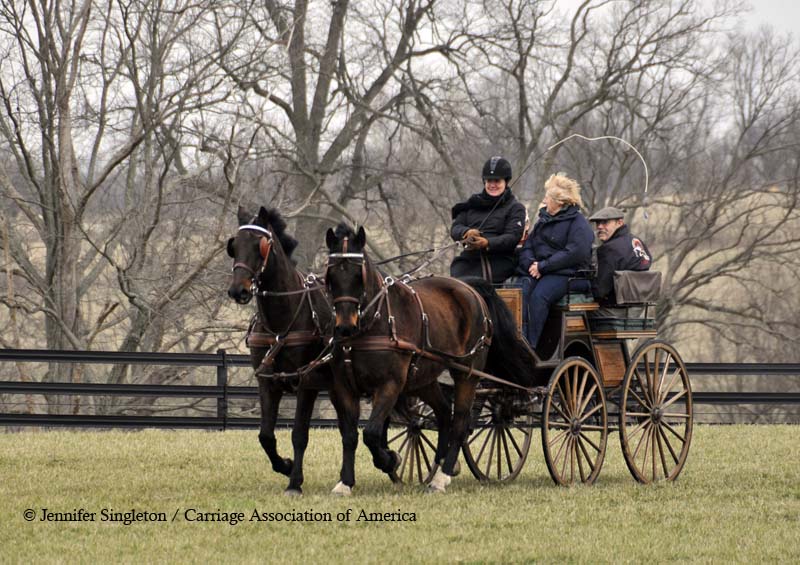
I’ve realized that I haven’t posted anything in quite a while that involves actual, living horses being driven. Of course, it’s difficult to find very many, or any at all, being driven this time of year. But you and I are in luck today! Although our weather here in Lexington is horrible today, and was horrible yesterday, Friday was nice (if a bit windy and chilly) and Saturday was gorgeous. Over the weekend, the CAA hosted a program of driving lessons and Driver Proficiency evaluations at the Gayla Driving Center in nearby Georgetown. The special-guest instructors and evaluators were John Parker and Susan Townsend from England.

I made it out to Gayla for just a little while on Friday afternoon, but here are a few photos of, first, Colonel Davis (the CAA’s immediate past president) and, then, Colonel’s wife, Kathi, taking a lesson with John Parker and their morgan mare, Dixie. Then we’ll see Debbie Banfield taking a Level 3 evaluation with Susan. And in the background of all these photos: the Bluegrass in the early spring …

.

.

.

.

.

.

.

Earlier today, some of the participants in the weekend program (those, especially, who came all the way from California and are staying in the area for a couple of extra days) stopped by the office to visit with John and Susan and to have a cup of tea. I’ve posted a photo of all those folks on the CAA’s Facebook page … which, coincidentally, is easier to find now: just click on the FB link in the upper right corner of this page and it will take you to our FB page, where you can see everything (but not post or comment) without having to either sign in or even have a Facebook account.

Continuing on from yesterday’s post …

“On the morning of the 25th [of August 1882], I broke camp early and traveled until I came to some grass where I stopped and gave the cattle a good feed from it, after which I made for Wadsworth.

“Wadsworth is an old town, and when the emigrants used to come overland through this great American desert, the sight of this place was most cheery after weeks of hard traveling. Since the building of the railroad the town has considerably improved; there is a depot on a large scale and the town has a population of twelve hundred. The railroad corporation has established a machine shop here for the repair of their rolling stock, which gives employment to many hands.

“It has two hotels, several stores, and many saloons; drinking and gambling are very common in this place. In an interview with the superintendent of the railroad about my route, he advised me to buy two ten-gallon cans, fill them with water and carry them with me, also giving me introductions to the station agents on the road, asking for water for my cattle. This was magnanimous; for hundreds of miles, water is transported by the railroad and deposited in tanks at the several stations from Wadsworth to Ogden for drinking and cooking purposes.”

As promised in yesterday’s post: Mr. Johnson’s description of Reno, Nevada:

“Reno is one of the most promising towns in the county. It is situated on a high elevation, on the Central Pacific railroad, in the county of Washoe, State of Nevada. As you enter the town from the west, you pass through a broad street; on your right is the railroad and on your left are many fine houses. In front is the depot, a large fine building, comprising both depot and hotel. About twenty rods from the depot there is a sharp bend in the road to the right, which carries you over the railroad and then it bends again sharply to the left. On the right of this road are two long brick blocks, which contain a number of stores in which all kinds of merchandise can be found for sale — dry goods or wet, hardware or soft, whiskies and lemons, etc. All teams have to pass this point and in passing I stopped, there was plenty of room to give others the right of way.

“Having a time table in my pocket I looked at it, and found that the morning trains had all passed and the trains in the afternoon were late. There are but four trains per day over this road — two from the west and two from the east, one express and one freight each way. You are able to see but a short distance up or down the road, the roads being so winding. The road lies between the railroad and the river mostly, especially in the canyon. In front is a bend in the river, there I am obliged to cross the railroad to my left. I went on but a short distance before I re-crossed — being now between the railroad and river. Going farther, I came to another sharp bend in the river to my left; here I crossed the railroad and my route then lay over the mountain.

“Having crossed over I went into camp and fed my cattle with grain. I made up my bed and lay down to rest but could not sleep as there were too many wild animals around for comfort. I kept a good fire burning all night.”

To be continued …

« Previous PageNext Page »