horses & driving


In checking in again with Mr. Johnson, we find that he has left Granite Point and traveled through Lovelock’s Station, on his way to Rye Patch.

Upon reaching Rye Patch, he stopped at the train station, where he milked Bessie, fed her and his horse, Fanny, and chatted with the depot master, who asked about Mr. Johnson’s journey and his intention to walk across the country.

“[The depot master said,] ‘Well, stranger, I think you are a man of great nerve. It will take all you have got to cover that distance; you surely cannot do it with that outfit. The cow will not go half the distance. It is a fine looking cow, too good and handsome to throw away; you had better sell her at the first chance.’

“[I replied,] ‘Now, friend, let us reason together. Here I am with horse and carriage, cow and dog; both horse and cow are females. You say the horse may go through, but the cow may fail. Sir, my observation is that a mare is worth more than a horse in the market, so what reason can you show that the cow will fail before the horse? She has on iron shoes, so has the cow; both are well shod. The horse has the load to haul, the cow has none; there is the difference in the two. Now, I really think the cow will come out the best of the two; time will tell, however.'”
I’m not sure whether the stuff on the street in this photo is rain or snow … it looks suspiciously like snow, although it could be rain and the “white” we see might actually be sunshine. A summer storm, perhaps? Nevertheless, the somewhat dreary mood I pick up from this photo matches our still-cool, dreary “spring” weather here today.

This photo was taken in Montreal, Canada, c. 1916. There are two work vehicles with teams (pairs) of draft horses; two men driving light, private vehicles to single horses; a couple of motorcars; and streetcars in the background.

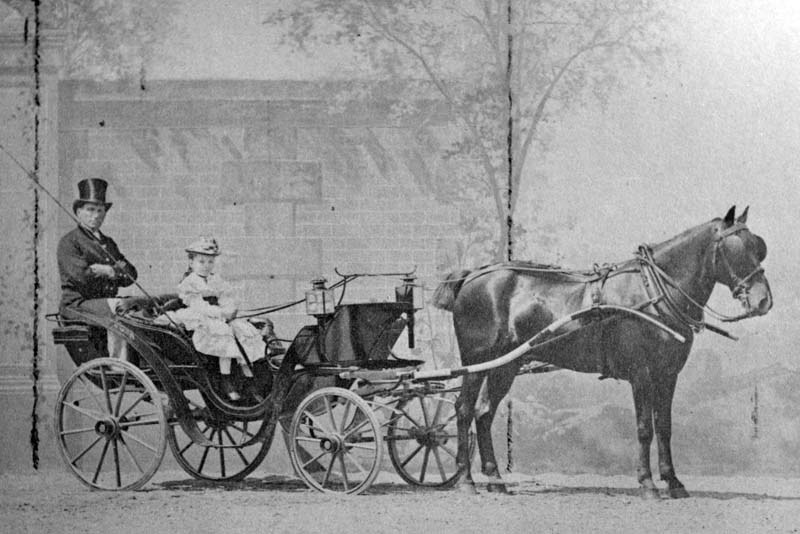
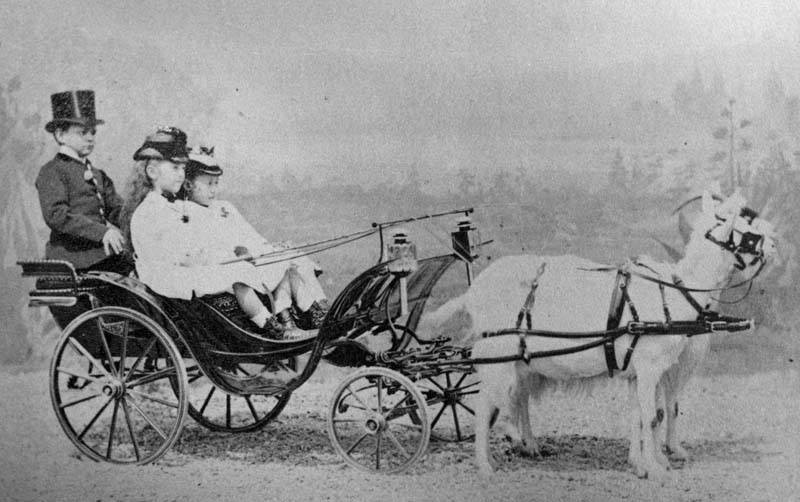
On Monday, Jill was looking for something in the CAA library and came across a reprint of an old book of photographs. The second edition of the original book (the edition that’s been reprinted) was published in 1876, so I don’t actually know when the collection was originally published, or when the photos were taken … but it’s safe to say that they’re all from the mid-nineteenth century.

I’ll be sharing most of these wonderful old photos here, and I thought I would start with two of my favorites:

.

.

.

Continued from yesterday …

“‘Stranger, I hope you will. If you do succeed, just make a book of your journey.’ ‘I will, and you may get hold of one of them.’ ‘I should like to meet you somewhere down East; I would give more to see you in that Barnum’s big show.’ ‘Well, friend, I must be going on, I have got to tramp every day, and make big days at that before I reach the eastern states.’ ‘Well, stranger, I hope you will get safely through; goodbye.’

“It was about seven o’clock when I left him; I kept the railroad on my left. At eleven o’clock, I came to another station, called Brown’s Station. I made but a short stop at this place, just long enough to water and feed. This is a telegraph station; only two buildings, the depot, and a house. At half-past twelve I left and journeyed with the railroad on my left, and as I travel the desert is left behind me, my course now lying through Humboldt valley, the river of that name being on my right. I intended to reach Lovelock’s, but my trail led me so far to the right that I was obliged to return to the railroad, so made Granite Point instead. This station is nothing but a house for the boss of repairs and a shanty for his Chinamen.

“I took the horse from the carriage and fastened her as usual, with the cow opposite. After feeding, I made my bed and laid down, being only disturbed that night by a passing train.”

Continued from yesterday …

Mr. Johnson “left Mirage very early on the 27th [of August 1882] and made Granite Point that day, a distance of twenty-eight miles. It was one of the finest mornings I ever saw, and my road was a good one and I journeyed with good cheer. About half-past six o’clock I saw smoke in our front, and spoke to my horse, saying ‘Fannie, go on, we will soon have breakfast.’

“We shortly came to a station called White Plains. Here was a good house not painted brown like others, but white; there were several men around and as I came up bade them good morning. One of the men answered, ‘Where in hell are you from, and where are you going; you must have come from the East some time?’ ‘Yes, I came from the East.’ ‘But where are you now from?’ ‘I am from California and going East.’ ‘Yes, I know you are traveling East, but where do you intend to haul up?’ ‘In Massachusetts.’ ‘The devil you are, with that outfit; that cow will never see Massachusetts.’

“[I replied,] ‘But where are you from, and what are you doing with that derrick?’ I asked. ‘I am from New York and came here to make an artesian well,’ was answered. ‘I want a pail so that I can milk my cow; you can have the milk. By the way, I don’t suppose that you have any hay that I can get for my cattle?’ ‘Yes, I have some hay, you can have some of it for your cattle. Perhaps they would not eat it, but we will try them.’

“The hay was placed before them and they seemed to relish it very much from the greediness with which they ate it. I got a pail and milked the cow and giving it to the stranger, said ‘Will this pay for the hay?’ He answered, ‘Yes, and more; go into the house and get some breakfast.’ So I partook of breakfast with him. ‘How far have you come this morning?’ he asked. ‘From Mirage,’ I answered. ‘How far did you travel yesterday?’ ‘From Wadsworth, about twenty-five miles.’ ‘Now, stranger, you say you belong in Massachusetts and going home. Do you honestly think you can made that distance with that cow?’ ‘I do. Why not? You see, she has iron shoes* on her feet, and I think she will stand the journey as well as the horse. She has nothing to do but walk; I think she will make the journey.”

To be continued …

* To see a photos of iron shoes for, and the shoeing of, cattle, click here.

« Previous PageNext Page »