history


[continued from yesterday]

“The doctor turned to his visitors and said, ‘Gentlemen, this man is from the northwestern part of the state, Eureka city, and is going to Massachusetts with a horse, carriage, cow, and dog; a long journey.’ ‘Yes, a very long journey; do you think you can make it?’ ‘I do.’ ‘You will never be able to take that cow all that distance; if you do, you will stand on the top ladder of fame.’ ‘Sirs, if I can get the cow shod with iron shoes, I shall succeed; but if not I am afraid I shall not succeed. I have not been able to get her shod as yet. I have had her feet seared four times and they are getting small.’ ‘What do you mean by getting her feet seared?’

“[I explained,] ‘Take a flat piece of hoop iron, heat it red hot, then take up the foot and rub the red hot iron over the bottom of the hoof; that is the way the Spaniards shoe their cattle.’ ‘Now, friend, I will tell you where you will get your cow shod. But a few days ago, when passing a blacksmith’s shop in Reno, I saw the blacksmith shoeing an ox; this I know, for I saw it done. When you get there you can have your cow shod with iron shoes.’ ‘How far is it to Reno?’ ‘It is about forty-five miles.’ ‘It will take me two days to travel thereto; what kind of a road is it?’ ‘It is a good road. When you get to the four corners, take your left and you will have a good road to the valley. Do not keep straight on as that is the old trail; when you get there you will come into the turnpike that leads to Truckee, as you strike this road turn sharp to your left.’

“‘Doctor, are you troubled with wild game at night?’ ‘There are some around, but seldom come near here. If we kept sheep we should have them around continually; the coyote and wolf are terrors for sheep.’ ‘How is the wildcat?’ ‘The wildcat is the smartest animal we have; they will drive the wolf away every time, they are not as heavy but very quick and active; I have seen the wolf and cat fight. The cat will jump on and off the wolf and the wolf does not care to be scratched to pieces by the cat.’ I now left the doctor, went to camp and made ready for the night, securing my cattle, and went to bed.”

When we left Mr. Johnson, he was still in Graniteville, California. He’s since left that town and is on his way toward Reno, Nevada.

“Webber’s Lake — In reaching this place, about midway is an old log cabin, built of handsome timber, the logs of which it is composed are dove-tailed at the corners, making a very strong and durable building. When the stages formerly ran over this road from Virginia City to Marysville, before the Central Pacific Railroad was built, this trail was a good road, but since the building of the railroad this, as well as many another good road, has been neglected, especially the part running through the Sardinian Valley, a distance of seventy miles.

“About two miles distant from this log cabin is the summit of the mountain, which rises from the lake to a height of two thousand feet. The scenery from the summit is lovely, in fact everything around was beautiful, while on my right are the Sierras covered with snow. In traveling along, the lake is on my right going east, on my left were many buildings, one was large, and evidently a hotel, situated directly in front of the lake. The road passed between the lake and the buildings; from the hotel to the water was only about four rods. The length of the lake is one mile; the width about half a mile, many boats were on the shore. On my arrival, I asked for ‘Dr. Webber.’

“A tall man, about seventy-five years of age, answered me, saying, ‘My name is Webber, I answer to Doctor Webber.’ ‘I stopped at a hotel about four miles from Grass Valley, and the proprietor gave me this note to give you on my arrival, here it is.’ The doctor read aloud: ‘This traveler called at my hotel and said that he was from Eureka, with horse, carriage, and cow going East, to Massachusetts. I told him to follow the old Fermis trail to Reno, and on reaching Webber’s Lake, to stop and give this note to Doctor Webber. From, John Clark.’

“‘Stranger, walk into my office; sit down. You are from Eureka and going East, to Massachusetts, your old home, and with that outfit; it will take some grit.’ ‘I am.’ ‘Don’t you like California?’ ‘I like the East much better.’ ‘How long have you been in the state?’ ‘About two years, or a little more.’ ‘Have you been in Eureka all that time?’ ‘I have, sir.’ ‘I do not wonder that you do not like that part of California, where the sands blow like the snows of the East. No wonder you are anxious to get back to old Massachusetts; I know all about this state, having traveled it all over. I think I am situated here the best of any one. Look at my surroundings; look at that beautiful sheet of water; look at the green grass; we do not have to pump water on our lands to keep them from drying up. No, not a bit of it. Look on yonder mountain; see those white caps, they are white by night as well as day; they are white from the first of August to the first of August the next year.’

“[I replied,] ‘Doctor, you have here a delightful situation, I would like to stop with you overnight; here is good grass to which my cattle will testify, I shall soon be where there is none; am I not right?’ ‘You are; when you get into Nevada you will often think of me; what can I do for you?’ ‘I would like to picket my cattle where the grass is short and sweet, not where you intend to cut for hay. I suppose you make hay of that tall grass?’ ‘I do; yonder is a good white clover patch, take your cattle there, turn them loose if you dare do so; they will do no harm. Our tea will soon be ready and come in, perhaps you will find something you do not carry. Do not refuse when one asks you; traveling as you are, accept the invitation, you are right welcome.’

“I went to see that my cattle were all right and having their supper and returned to the hotel for my own. After supper I got a pail and milked the cow, and carried it to the doctor saying, ‘My cow sends this pail of milk to you in return for the grass she has and is now devouring; please accept it.’ We sat in front of the house talking on every subject, when two hacks with four ladies and gentlemen drove up from Reno, who were coming to make a visit of three or four days at this pleasant resort.”

[to be continued tomorrow]

I have one more old postcard to share (this one appeared on my desk this morning).

On the front is a drawing of two ladies in a carriage put to a single horse …

.

.

And on the back, it says … well, I don’t really know what it says, as I don’t read French. It does look like the card was sent, in 1908, to a Miss Mary Oscley.

.

.

In case these young ladies, and the horse, look familiar: you’ve seen them previously on a Happy New Year’s card!

… and my second “new” old English postcard is this lovely, but rather romanticized, view of two harness horses, from a painting by Gilbert Wright.

.

.

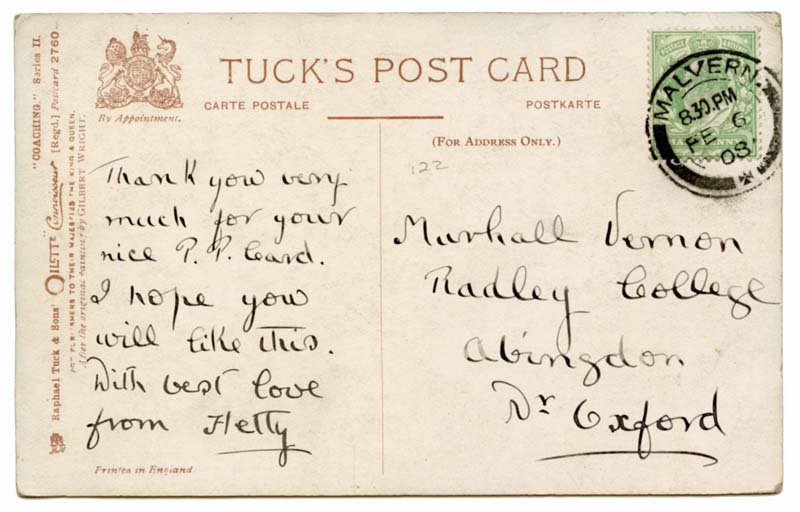
On the back, we see that the postcard was sent to Marshall Vernon at Radley College in Abingdon, Near Oxford. The note says, “Thank you very much for your nice [??] card. I hope you will like this. With best love from Hetty.”

It’s postmarked February 6, 1908.

.

.

This first of my new (thank you, Elizabeth!) old English postcards is this undated photo card, which shows a fully loaded coach and four … on a ferry crossing the Windermere.

.

« Previous PageNext Page »