history


In Tuesday’s post (I missed yesterday, sorry), we caught a glimpse of late-nineteenth-century Frankfurt, Germany, which sits alongside the Main River.

Today, let’s look at late-nineteenth-century views of two other rivers.

This first photo, of Hamburg, Germany (on the Elbe River), doesn’t have any horse-drawn vehicles in it … but the second photo, of London, has LOTS …

.

.

This photo’s caption in the book reads as follows:

“Hamburg is located on the river Elbe at the mouth of one of the tributaries of that stream — the Alster. Its harbor is a very extensive one, but, as it now [in 1892!] exists, it is a modern creation. At first this city was at some distance from the main branch of the Elbe, and the mouth of the Alster served as its port, but owing to vast engineering enterprises, the principal current was diverted to its present course. The quays of Hamburg now cover a distance of about three miles, and beside some of them are pleasant promenades planted with trees. Vessels drawing fourteen feet of water come up to the city itself, and their cargos are distributed by means of barges to the warehouses, which line the numerous canals which intersect the town, and make more than sixty bridges a necessity. This harbor of Hamburg presents, as the illustration before us makes evident, a very animated scene. The river is always covered with a multitude of ships and steamers, some of them close to the shore. There is said to be room here for 400 ocean vessels, and for twice that number of river craft. We can hardly be surprised, therefore, to learn that Hamburg ranks first of all the seats of commerce on the continent, sending its ships and steamers out to every portion of the world. Hamburg is a very ancient city, having been founded probably by Charlemagne in the year 809. In its vicinity are many pretty villages, beautiful promenades, and charming villas.”

.

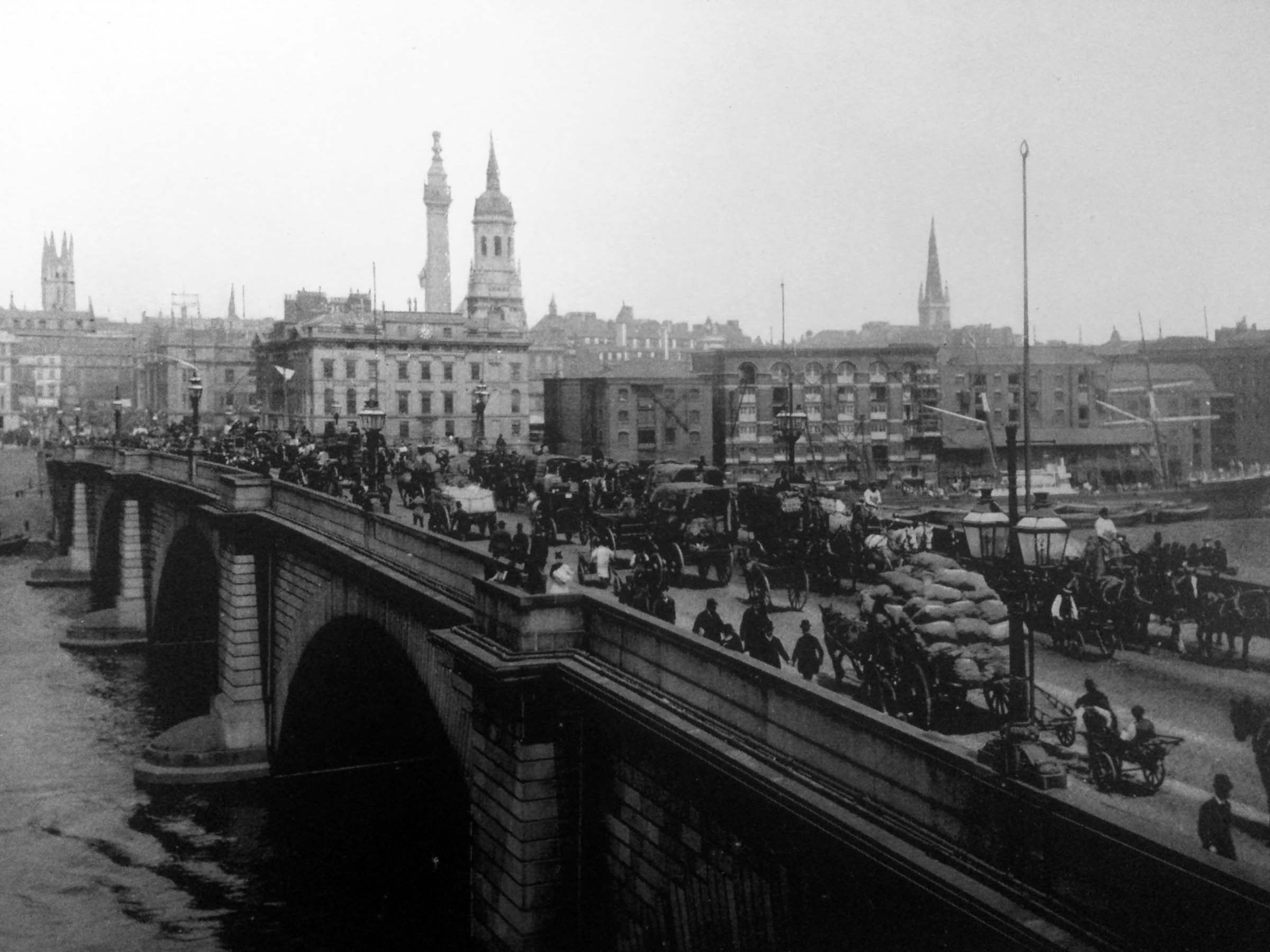
From Germany, and the Elbe River, we head over to England, and the Thames:

.
.

The book’s caption for this photo reads:

“Of all the bridges which cross the Thames within the city limits none is so famous as this which characteristically bears the name of ‘London.’ It was opened to traffic by King William IV in 1831. It is of granite and its cost was about eight millions of dollars. The lamp-posts on its sides are said to have been cast from cannon captured from the French during the Spanish war. It has the distinction of being the last bridge on the Thames or the one nearest to the sea, which is about sixty miles away. The restless tide of human life ebbing and flowing across this granite thoroughfare is a suggestive sight. Dickens was fond of studying here by day and night those widely differing phases of humanity, which can be seen in this world-metropolis better than anywhere else on earth. This bridge is never deserted, and during twenty-four hours it is estimated that 20,000 vehicles and 120,000 pedestrians cross here from one side of London to the other. The roadways are so arranged that those who desire to drive rapidly follow one course, and those whose wishes or whose horses are more moderate must take the other. Standing on this connecting link between the two great sections of the world’s metropolis, one realized the immensity of London. Nearly five millions of people live within its mighty circuit. Twenty-five hundred are born and about two thousand die here every week. One hundred million gallons of water are used here every day, in spite of the multitude of the ‘great unwashed.’ If the people of London were placed in single file, eighteen inches apart, they would extend 1,200 miles, or further than from Boston to Chicago. There are in London more Roman Catholics than in Rome, more Scots than in Edinburgh, more Irishmen than in Dublin. The poverty and wretchedness in certain quarters of the city are as extreme in one direction as the magnificent display and wealth of the West End are in the other. Yet no great city in the world is better paved or better governed.”
It’s been a while since we’ve delved into the photos in my old Glimpses of the World book.

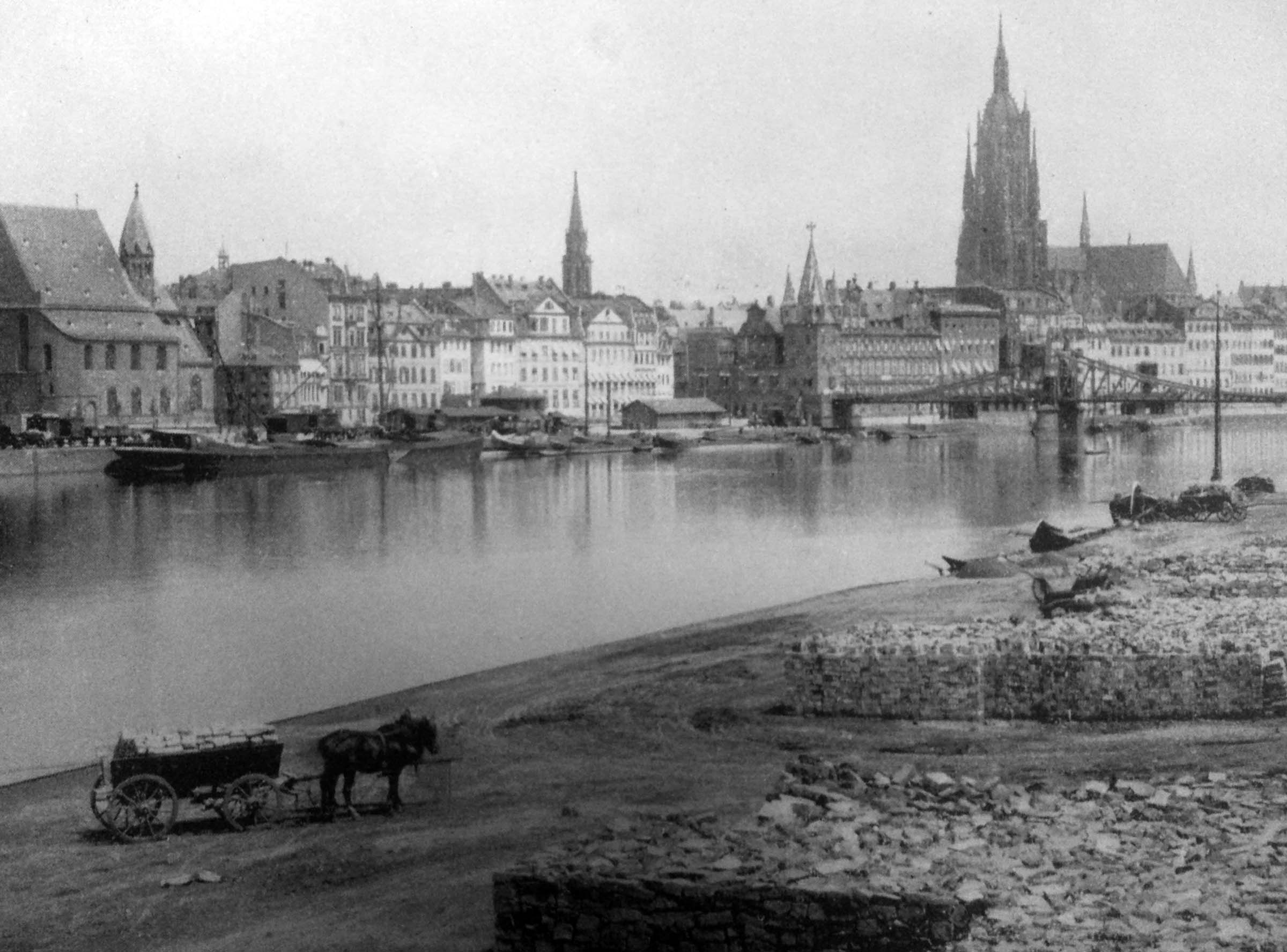
So here’s a late-nineteenth-century photo of Frankfurt am Main, Germany …

.

.

The book’s caption for this image (written in 1892) reads as follows:

“Frankfurt am Main is one of those cities which combine the characteristics of medieval and modern Germany. Some of its streets are as winding and as narrow as they were six centuries ago, and others bear the stamp of the New Empire, broad, well-paved, and adorned with handsome structures. It has many interesting relics of the past. Here is the Council House where the German emperors were elected and entertained in the Kaisersaal, the walls of which are covered with their portraits. In its cathedral, whose spire rises far above the town, the German emperors were crowned. [Actually, German kings and Holy Roman Emperors were crowned in Cologne for several hundred years, after Charlemagne was first crowned there in 800. German kings were also crowned in Frankfurt from the middle of the sixteenth century through the end of the eighteenth.]

“Here may be seen the house in which originated the famous family of the Rothschilds. Its highest literary distinction is the fact that here the poet Goethe was born in 1749, at No. 23 Hirschgraben. In 1863 the house was purchased for 56,000 florins, by a German society designed to promote art, science, and general culture. Thus Goethe’s birthplace was made forever the common property of all German people. Its various rooms are kept as a little museum of Geothe literature and art. Near this river Main is a spot known as ‘Goethe’s Rest,’ because he is said to have there admired the situation and beauty of his native city. One square of Frankfurt is also called Goethe Platz, and is adorned with a fine bronze statue of the illustrious author of Faust. This is a city of immense wealth, and offers a good market for American securities. [Frankfurt, traditionally and still today, is of course a major banking center.]

“Its name is said to be derived from an episode in the life of Charlemagne, when he, together with his army of Franks, found here a ford across the river.”

… “About 6 p.m., there were a large number of the citizens of the town around, asking me many questions, all appeared anxious about our journey. One said, ‘Friend traveler, when do you leave us?’ ‘I propose to leave tomorrow morning, early.’ ‘Since your arrival, and knowing your intentions, being obliged to remain here on account of your cow, you have given us something to think and talk about when you have gone. This is a new and wonderful undertaking; a man of your age, journeying from ocean to ocean, from California to Massachusetts, with a horse, carriage, cow in the rear, and dog jumping in and out of the carriage at pleasure, and yourself a man of sixty-five years, or thereabouts. I repeat, it is a wonderful undertaking. I, for one, will daily look in the papers to learn of your whereabouts; I hope and pray that you may be safely carried through; you will need a strong arm of protection, and hope you will be protected night and day. Stranger, you appear to be a man of strong nerve; if you falter in the least you certainly will fail in this undertaking.’

“A man in the crowd sang out, ‘Three cheers for the man from California going east to Massachusetts,’ which were given with a will. ‘Strangers to me you all were, but now friends. On my arrival I at once made for a blacksmith’s shop, so anxious was I to get shoes on the feet of my cow. On my way I had tried to get her shod, but could not. I was told at Webber’s Lake that here I could get her shod. Therefore, I was anxious to reach this place. Now she has iron shoes on all her feet, and I hope she will be able to wear them out. Tomorrow morning I intend to leave you. Ladies and gentlemen, I believe your sympathies are with me. I believe this, for you have been kind to me and befriended me in many ways. To you, stranger, in particular I feel grateful, and I am sure my cattle are, for the grass you so kindly offered me for them. There is another person to whom I wish to express my gratitude, but I do not see him here, I mean the depot master, for allowing me to sell my milk to passengers on the passing trains, to him I give my thanks. And thanks also to you all, farewell.”

… “The three next days were a repetition of the two first. The incidents were, the meeting of the trains, selling the milk, and the care and exercise of the cow, [plus] the overhauling of my wagon and seeing that everything was ready for a move. While here, the people were kind to me.

“I wanted the blacksmith to reset my wheels, but on examination he advised me not to have them touched. I had him make me several bolts as my whiffle-tree and transient-pin were well worn, so that I should have others when they gave out.

“While I was here, I was interviewed by the local reporter who said, ‘Stranger, I wish to ask you a few questions, if you have no objections?’ ‘I have no objections; go on, sir,’ I replied.

“‘Where are you from with this outfit: horse, carriage, cow, and dog?’ asked the reporter. ‘I am from Eureka city, Humboldt county, California.’ ‘About how many miles have you traveled?’ ‘About seven hundred and fifty, to reach this place. From Eureka to San Francisco, is three hundred and eighteen miles; from San Francisco to San Jose, is forty-seven miles, and from there through Stockton, Sacramento, Gold Run, back to Colfax, Grass Valley, Nevada city, Graniteville, Webber’s Lake to this place.’ ‘But you have been nearly three months in getting here,’ said the reporter. ‘Yes, but I have not traveled half the time, I have stayed over more days than I have traveled.’ ‘About how long will it take you to accomplish this great undertaking?’ asked the reporter. ‘About six months.’

[“The reporter replied,] ‘You think you can make this long journey, do you?’ ‘I do, sir; and time will tell.’ ‘You are the man to do it, if any one can,’ said the reporter. ‘How soon will you leave this place?’ ‘I intend to leave tomorrow morning, early.’ ‘Will your cow be able to travel so soon?’ ‘Well, I am going to try it; if I see that it is too much for her, I shall rest again. From here to Wadsworth is about thirty-four miles and I will take two days to travel there.’ ‘I suppose you have your road marked out before you?’ said the reporter.

[“I replied,] ‘I have. I intend to follow the Central Pacific Railroad to Ogden. I do not intend to leave it any distance, in case any serious accident should occur to me, I shall have the railroad to fall back upon.’ ‘Well, stranger, I hope you will succeed, if you do, you will stand on the top ladder of fame. Goodbye,’ said the reporter. ‘Goodbye, sir,’ I replied.

“I returned to my camp, fed my cattle, got my dinner ready and ate it. I put the wagon together, tried the bolts, and found everything in good order, ready for my start next day. In the evening I allowed the cattle their liberty, but they did not wander far, and kept their eyes on the picture; by which, I mean my wagon.” …

… “On the morning of the 21st [of August, 1882], I felt very anxious about Bessie’s feet, as they were very hot and feverish, and thought there must be some inflammation or they would not be so hot. I mowed down some grass and gave the cow a large quantity, throwing water on it so that it would be cold for her to stand on. This morning, there were two trains from the west — an emigrant at half-past five and an express train at seven.

“My camp is but a short distance from the railroad track, less than five rods, and about thirty rods from the depot. I was milking at half-past six, when the emigrant train came along, due here at half-past five. Being late, it had to stop until the express had passed, due at seven o’clock. Many of the passengers came where I was milking, and bought the fluid as fast as I got it from the cow; this time I did not have to take it to the depot. It was all gone before the other train arrived. I got ten cents a cup, a little more than a pint; for this milking I got one dollar and five cents.

“My milk being disposed of, my breakfast also, and the cattle well cared for, I went into the town and called on the blacksmith and told what I had and was doing. He said I was doing the right thing, he was afraid that I would take off the shoes. [He said,] ‘You must make her travel and get used to them,’ and that she would soon be all right.

“About twelve o’clock, I went back to my camp and found all right and gaven them their midday meal. At three o’clock, I took the cow by the halter, leading her around where it was soft, that she might walk as comfortable as possible. I noticed that there was improvement so took her downtown to the blacksmith and said, ‘How is this for high?’ ‘Ah, friend, I see you understand things. Keep on doing as you have and you will soon leave us.’

“I have adopted a new plan: that is, while the cow is in camp she stands on grass well wet with cold water, this softens up her hard hooves. I returned to my camp and prepared to meet the train so as to sell my milk. I sold fourteen cups, which brought me one dollar and forty cents.” …

« Previous PageNext Page »