history


As you may (or may not) know, Long Island has a long history of carriage driving and coaching. And, these days, it has two enthusiastic “keepers” of that history: CAA members Jerry & Rita Trapani, who live on Long Island and are justifiably proud of their area’s past.

Jerry sent me a link to Howard Kroplick’s website (www.vanderbiltcupraces.com) and blog, where he has posted (and continues to post) all sorts of information, photos, and videos pertaining to the Vanderbilt Cup Races — which, according to his home page, were “held on Long Island from 1904 to 1910 [and] were the greatest sporting events of their day. These exciting and dangerous races were the first international automobile road races held in the United States, drawing huge crowds from 25,000 to over 250,000 spectators. The races had a far-reaching impact on the development of American automobiles and parkways and are a testament to the early racing spirit and drama. VanderbiltCupRaces.com provides comprehensive information on the Vanderbilt Cup Races, the Long Island Motor Parkway, and current Long Island automotive events, car shows, and news.”

I hope you enjoy Howard’s website and blog as much as I did. If you’d like to read about the American Mercedes, be sure to click on the link for his blog post from Jan. 15. From there, you can download a PDF of the full article, which appeared in The Star. (Note, too, under the “Specifications of the American Mercedes” on page 5, that the upholstery, painting, trim work, and detailing were all done by Brewster & Co.!)

Also …

As much as I love horse-drawn vehicles, I must admit that I do love old cars … and race cars … and road races. Which is one of the reasons that I’m fascinated with a recent discovery of  information about Speedways: those old race tracks for carriages. (You may have noticed a couple of references to them here on the blog and in the January issue of The Carriage Journal.) I’m still doing my research and will post a report here on the blog as soon as I have it finished.

And so … I found this reference on Howard’s website of particular interest:

Following a spectator death during the 1906 Vanderbilt Cup Race, William K. Vanderbilt, Jr. and the race sponsors determined that the huge crowds and risks to the spectators precluded [running] the race on public roads. Two days after the race, the concept for a privately owned speedway on Long Island was developed by Vanderbilt and his associates—the first highway built exclusively for the automobile. Vanderbilt’s dream was to build a safe, smooth, police-free road without speed limits and a place where he could conduct his beloved automobile race, the Vanderbilt Cup Race, without spectators running onto the course. After twenty months of obtaining the road’s right of way, construction of the first section of the Long Island Motor Parkway was begun in June 1908.
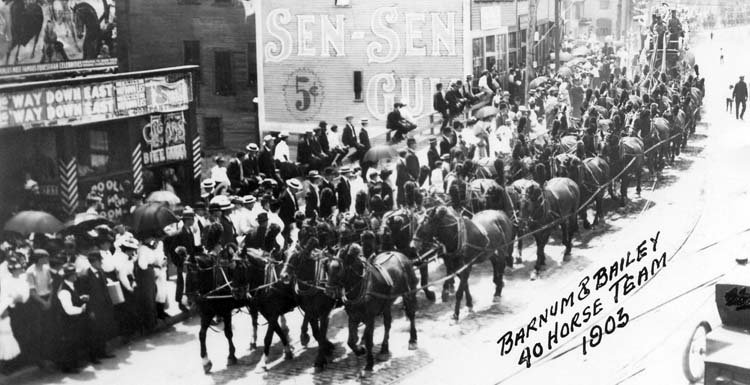
On Saturday, A.J. and I went to a local antiques show that’s held once a month in an old elementary school. Down in a corner of the old gym was a vendor with piles of old postcards and photos, from whom I purchased an old Christmas card with a horse-drawn coach on it (I have a verrry small collection of these). In another corner of the old school, we found a vendor with another pile of old photos, including this one:

.

a forty-horse (!!!) hitch in 1903

Borrowed from the January 1904 issue of The Carriage Monthly:

The fashion plate illustration [below] represents the Duncan & Fraser’s Carriage Works and Motor-Car Factory, Franklin Street, Adelaide, South Australia, one of the largest of the kind in Australasia. They cover nearly an acre of land, and are just now adding additional premises close by their present works to overtake the pressure of business.

Forty years ago [i.e., 1864] the works were started by James Duncan and James Fraser. Mr. Fraser died fifteen years ago, Mr. Duncan carrying on the business and eventually taking his four sons into partnership. Nearly every kind of vehicle that goes on wheels has been made by the firm. Forty years ago the English style of carriages were almost exclusively in use in Australia. The advantages of a new country for American wagons and buggies revolutionized the trade, while the high-class English carriages are still used to a considerable extent by well-to-do people.

Duncan & Fraser introduced the rubber tire for carriages and buggies into Australia, and have put on some hundreds of sets, with very gratifying results.

Twenty years ago [i.e., 1884] the firm constructed the first of the American pattern railway carriages that were used on the government railways, and a great deal of rolling stock, comprising carriages, goods, stock, timber, and other carriages were made, until the government department undertook the construction of its own rolling stock.

They have made some hundreds of tram cars on John Stevenson’s well-known pattern, and supplied a great many for the suburbs of Melbourne and all the rolling stock for Ballarat (Victoria) Tramway System. They have just finished a contract for first installment of the Bendigo (Victoria) Electric Tramways.

Under the supervision of R. A. Duncan, an electric business has been conducted for a number of years.

The motor-car department, which is growing to very satisfactory proportions, is under his supervision. They look to this department becoming a big thing.

They have had gratifying success in their introduction of the Oldsmobiles, and have a number of orders for cars to arrive.

They have also secured the agency for the Orient Motor Buckboard. The senior partner of this firm (James Duncan) has visited the United States twice within the past six years, on which tours he visited all the larger carriage factories and automobile plants. He took occasion to closely study our methods, machinery and appliances, and has introduced many changes in his home factory as a result of his investigations. Mr. Duncan has also visited Canada and England, and is regarded at home and abroad as one of the most advanced carriage builders in the world.

.

"Duncan & Fraser's Carriage Works and Motor-Car Factory, Franklin St., Adelaide, South Australia" (from the Jan. 1904 issue of The Carriage Monthly)

And, finally, a view of the tourists at Morcambe beach in 1901:

.

And another “phantom” tram ride … this one in Belfast, shot in 1901:

.

« Previous PageNext Page »