WEG 2010


I had the opportunity yesterday to watch the proceedings (and listen to stories and ask questions) while Doug and Holly Hansen put together the several wagons they’d brought from South Dakota. These three, plus one other they’d delivered earlier, will be featured in one of the marathon obstacles. Each will sit inside its own specially constructed “box,” where it can be seen but not crashed into. Which is a good thing, because these are gorgeous wagons.

Let’s start with the ultra-pleasing lines of the Prairie Schooner:
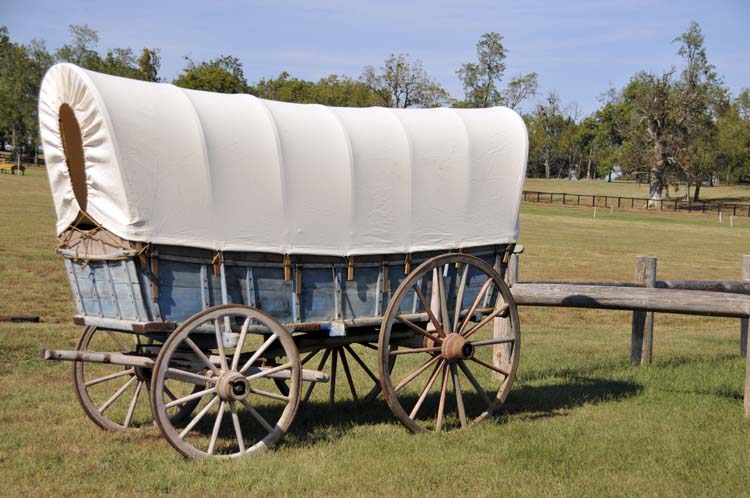
a mostly original 1840s-era Prairie Schooner

Doug said that this particular vehicle is a bit larger than the typical wagons of its type that would’ve crossed the prairies on the various trails heading westward. Be that as it may, it still seems rather smaller than the wagons most of us have fixed in our minds from history books and movies. In the next photo, the gate to the “box” holding this wagon is being hoisted back into place, and you can get a better sense of its size in relation to the people. Can you imagine packing all your wordly possessions in this and walking across the country??

closing the “box” on the Prairie Schooner

Next, let’s take a look at this Mud Wagon, which was used on the Fort Pierre-to-Deadwood Trail in South Dakota in the late nineteenth century:

a close-up of Doug Hansen’s beautiful Mud Wagon; he drives this with four mules

Doug told us a story about just how sturdy this little wagon is. During a 250-mile reenactment drive, it overturned in a river crossing. The tongue broke (and a bit of the canvas top was torn), but the broken tongue was fixed, and the wagon continued on the trail … for another hundred miles! Doug said he’s read plenty of contemporary accounts of Stagecoaches tipping over on the trail, and the occupants being obliged to climb out and help right the wagon before getting back in and on their way.

Isaac (left) and Doug (right) moving the Mud Wagon to its marathon “box”


a close-up of the off side of the Mud Wagon; the tent in the background is the VIP tent that overlooks this and at least one other marathon obstacle


Next, the fabulous Chuck Wagon, which features an original gear and a rebuilt box:

Doug (with Holly helping him on the ground) is putting the first of the bows in place for the Chuck Wagon’s canvas cover
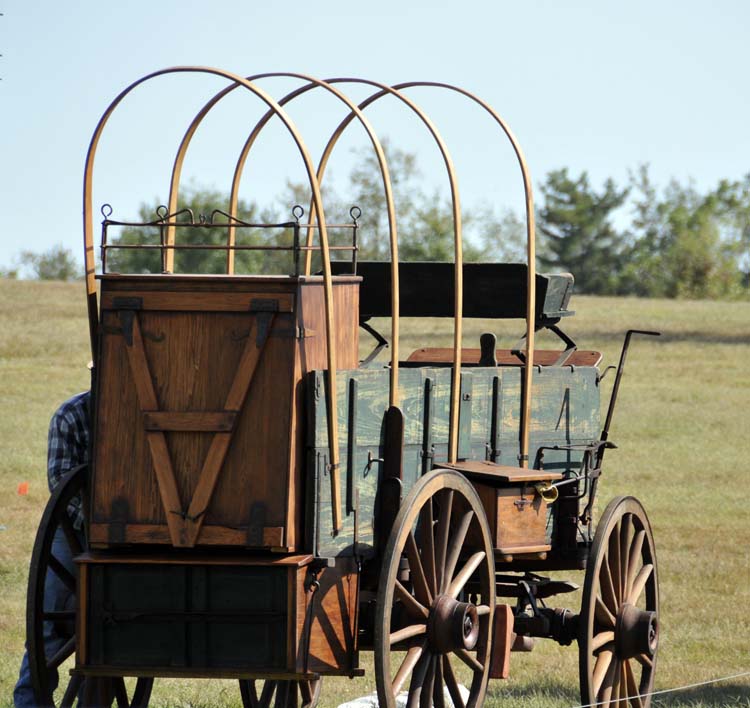
 

… and with all its bows in place


this barrel held water and would be topped up at every fresh-water stop along the drive


before any of Mick’s crew came back to help, Doug and Holly pushed the Chuck Wagon into its box (don’t worry, I helped as soon as I’d taken this photo!)
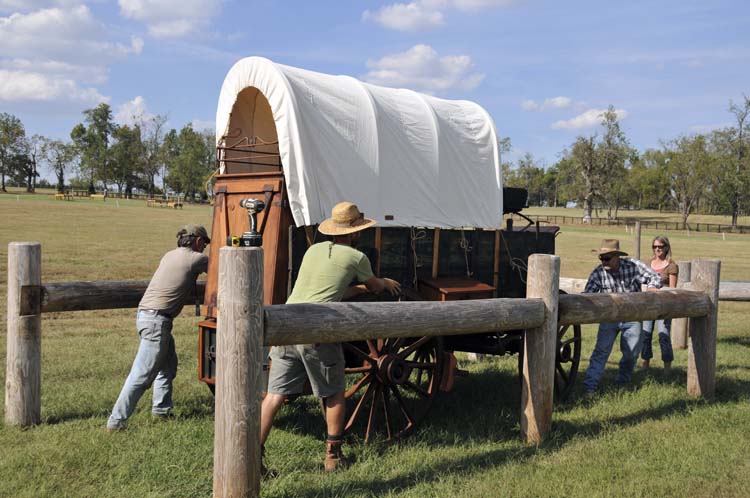
 

… the Chuck Wagon being put in position
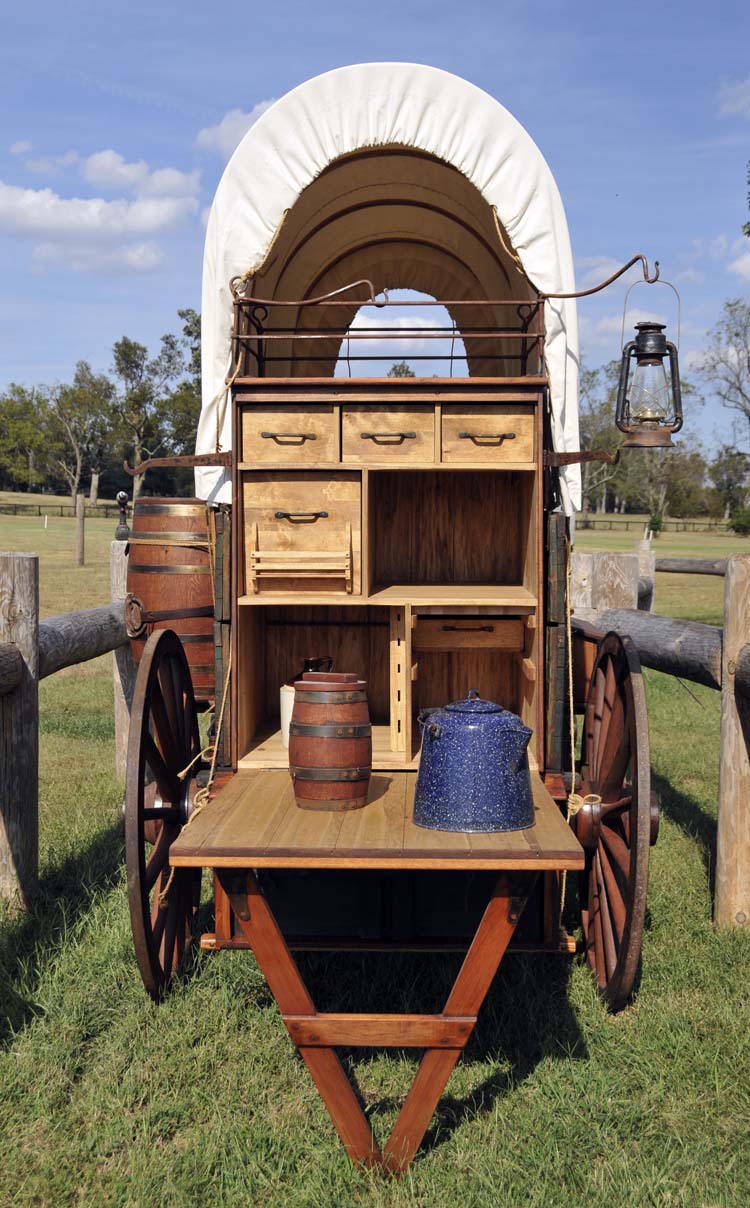
 

… and with the back down … Who’s ready for some lunch?

And, finally, the Freight Wagon, which doesn’t look terribly large but can carry an astounding five tons!
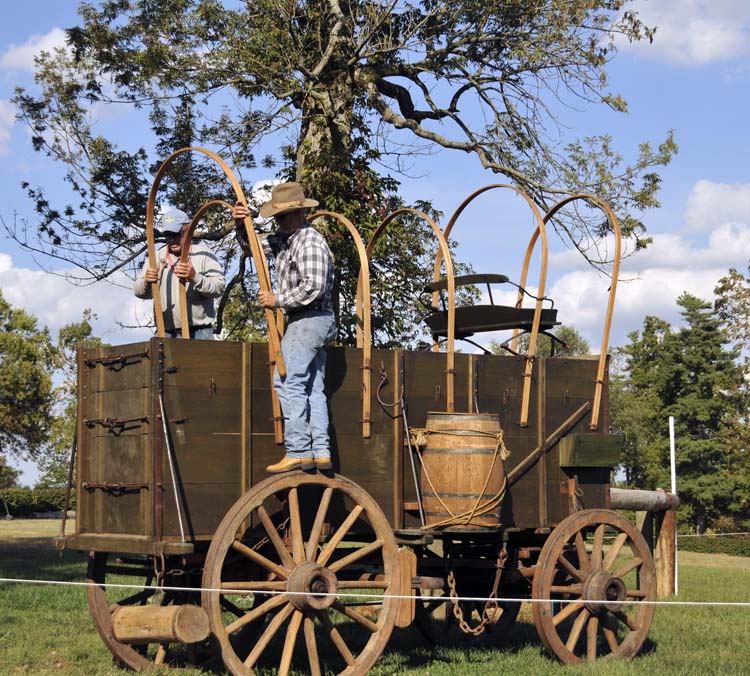
Mick (left) helping Doug (right) put the bows in place on the tall Freight Wagon


Doug and Holly had to go back to their trailer to get the canvas top for this vehicle (and I had to get back to work), so I’ll have to take (and post) a photo of the completed Freight Wagon later this week. Right now, this wagon is sitting next to an eventing cross-country jump, but it will be moved to join the other (marathon obstacle) wagons on the evening of October 2.

One last look for today, of two of the wagons in their marathon “boxes”:

Doug Hansen stands next to his Chuck Wagon, with his Prairie Schooner to the right

Yesterday here at the (almost) WEG, we had a full day walking, photographing, rehearsing, and … well … some regular work thrown in too.

We all started the day by parking — with the rest of the KHP and Horse Center staff — waaayyy over in the Horse Park campground and walking to our office. It’s not a bad walk, really. On the way to work I got to see lots of final WEG prep work along the main road through the park, and on the way back out in the evening, I had a nice stroll in the shade along the “Promenade” that’s been constructed beside our little lake. But … you do have to plan on an extra twenty or so minutes to get to work, or to your car, depending on which way you’re going.

In the morning, Katharine had a couple of men here installing frames to hold the HUGE banners that will grace the front of our building during the festivities.

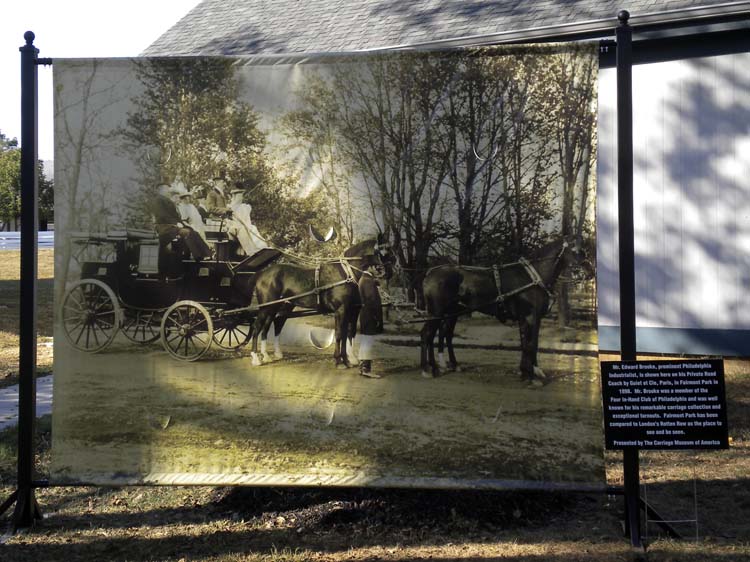
one of the two CMA banners in front of the CAA building …

… they both feature wonderful old photographs, with descriptions on yard signs

the front of the building, covered in flowers for WEG

In the early afternoon, Jill met with the various people in charge of the horse part of the WEG opening ceremony and with the four CAA members who are driving a variety of carriages into the ceremony to deliver VIPs. They all went over their route, the timing, plans, etc.

four CAA members will drive carriages into the WEG opening ceremony to deliver VIPs; l. to r.: Todd Draheim, Misdee Miller, Tom Burgess, Marilyn Macfarlane, and Jill Ryder

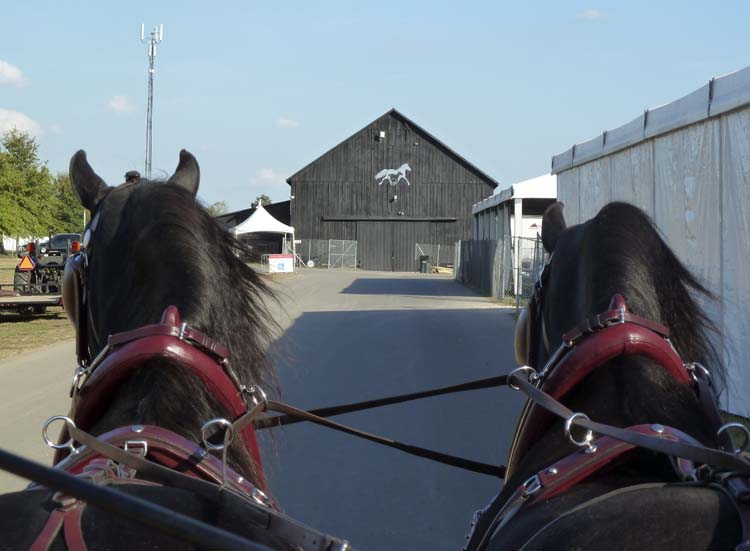
Tom Burgess driving his pair of Friesians toward the KHP’s steeplechase barn

Later in the afternoon, I went out to photograph the arrival of several “Old West” wagons that will be featured in one of the marathon obstacles. The next post here will be about those, so check back!

We’re working on finishing up the last few pre-WEG projects (getting ready for having the shop open for sixteen days and welcoming nearly 250 people to town, on our CAA trip) …

Horses continue to arrive on the KHP grounds … for the WEG competitions, for the Equine Village, and for the opening ceremony …

And today’s the last day we can park our cars anywhere on the KHP grounds, because the “security bubble” comes crashing down is put in place tomorrow. I’ll be wearing my walkin’ shoes from here on out!

our first WEG visitors to the CAA headquarters came by this morning: Carole Mercer (second from left, in the fabulous hat) with a few friends; Carole will be performing with her “Dancing Morgans” in the Equine Village during the first week of the WEG

As a companion to yesterday’s post:

This article was written by Janet Patton, and I’ve borrowed it from the Lexington Herald-Leader’s website, www.kentucky.com.  

.

When the horses from Europe and the Middle East begin arriving Thursday at the Cincinnati/Northern Kentucky International Airport, they probably won’t feel like they are in Kentucky for the Alltech FEI World Equestrian Games.

They might feel as if they are in limbo.

Technically, they are. They will be in quarantine, isolated from U.S. air, water, soil, and other animals until the U.S. Department of Agriculture and the Kentucky Department of Agriculture have determined they are free of a set of rare diseases with deceptively benign-sounding names (like glanders or dourine) that are generally incurable and often fatal.

Rusty Ford, the liaison for the Kentucky agriculture department, which is operating the facility, said that after roughly nine years of preparation, the level of concern about horses bringing infectious diseases to Kentucky is pretty low.

“This is what we do — preserve and protect the health of the Kentucky equine industry,” he said.

Beginning Thursday morning with the first of twelve flights, about 500 horses will come off the specially chartered Federal Express jets in giant metal crates. Their hooves won’t touch any grass, let alone bluegrass, until they get to the Kentucky Horse Park.

The horses, still in crates, will be moved by trailer 1.3 miles directly from the runway to the new private quarantine facility, paid for by the WEG Foundation, in a secure location in the airport employee parking lot.

After they are unloaded, their attendants will settle them in one of five tents, where they will spend forty-two to forty-eight hours.

“The next time they see daylight, they will have been deemed to be free of disease,” Ford said.

The horses won’t leave the tent, which is actually a biosecure barn of up to fifty-two stalls, with filtered air, disinfectant footing at the entry vestibule, and insect-proof walls positioned so that runoff from rain will not drain into any other barn.

That’s on top of regular security, such as the double-fenced perimeter, twenty-four-hour guards, lights, and electronic surveillance.

Inside the barns, vets will take temperatures, assess the horses’ overall state of health (are they eating, drinking, peeing, and pooping?), and … watch and wait.

“The whole point of quarantine is to mitigate the opportunity of diseases being introduced,” Ford said. “During their time here, the horses will be given great veterinary scrutiny to see that everything’s working like it’s supposed to be working.”

Just in case, he has four isolation stalls in separate tents.

Most importantly, the World Equestrian Games vets, under the supervision of the USDA and state veterinarians, will draw blood samples. They will be sent by UPS to the National Veterinary Services Laboratory in Ames, Iowa, for testing for four diseases — dourine, glanders, equine infectious anemia, and equine piroplasmosis.

Should a horse test positive for any of the first three, and the result is confirmed, it will be denied entry to the United States.

But the USDA has granted an exemption for WEG for piroplasmosis-positive horses because it is a tick-borne disease. Games officials have gone to great lengths to show that, with the ticks dormant at this time of year, the risk can be contained.

Piroplasmosis-positive horses will be quartered in separate stalls at the Horse Park, grazed in separate areas under regulatory supervision, and checked for ticks each time they come and go.

And to further limit the possibility of transmission, tick carriers (dogs) are banned from the Horse Park for the duration. A horse cannot transmit the disease to another horse unless a tick is involved.

“All the horses coming are in exceptional shape and health status,” Ford said. And WEG, the USDA, and Kentucky intend to keep them that way. “I don’t think there will be a safer place in the world for a horse.”

The horses flying into Northern Kentucky have been gathering from Europe and the Middle East at Liege, Belgium, a major European cargo and transport hub. They have been checked out by vets on that end. (No team wants to send a sick horse that can’t compete.)

Each flight is timed so horses will arrive nine to ten days before their competition.

After their nine-and-a-half-hour flights from Liege, the horses may stretch their legs by walking around the inside track of the quarantine barn in scheduled rotations.

“These are fit athletes. We want to maintain their condition as best we can,” Ford said.

Their grooms, who will all pass through their own Customs trailer, will be permitted in each day in Tyvek overalls and boot covers to feed, water, and tend the horses. Each horse may bring its own packaged feed, but only for the duration of the quarantine. Anything not eaten on the grounds will be destroyed.

Stall bedding is being provided. Equipment that comes in with the horses will be disinfected. Everything that comes off the plane — even the travel crates — will be cleaned before going back.

At peaks, with two flights a day arriving, there might be as many as 150 horses in the quarantine facility at a time. All those horses will be making a lot of manure. It will be collected in double-sealed plastic bags until the USDA has declared the horses disease-free, when it will go, along with the bedding, to a landfill.

Horses will begin the return trip as early as Sept. 28, two days after the endurance competition. And they will pass back through the Cincinnati quarantine facility, where they might be tested for mosquito-borne West Nile virus and other diseases before being shipped back out.

All horse owners were strongly encouraged to have their animals vaccinated before WEG for West Nile, which pops up most years in Kentucky now.

Ford, like animal health officials worldwide, is on the lookout for any problems on the global radar.

“We’re maintaining the same surveillance we always do,” he said. “We have sick horses every day everywhere.”

Today’s local newspaper, the Lexington Herald-Leader (www.kentucky.com), had not one but two really interesting articles on how the WEG horses are arriving in the U.S.

Being right up against a magazine deadline, however, I shall give you one of the articles today and one tomorrow.

This first one is titled “Horses Fly to WEG in Wide-bodied, Expensive Comfort” and is by Amy Wilson.

The international equine athletes coming to Kentucky for the Alltech FEI World Equestrian Games are, for the most part, used to traveling, used to comfort and, safe to assume, oblivious to price.

With 500 to 600 horses flying non-stop from as far away as Buenos Aires or Hong Kong in specially built in-plane stalls at a cost of as much as $50,000 per horse, it’s easy to see why some are saying the first appearance of the Games in the United States is making it enormously costly. Yet few are willing to inconvenience their horses in protest.

The logistics are as daunting as the math.

Wide-bodied Fed Ex jets each holding fifty horses from European and Middle Eastern countries will take off from Belgium’s Liege Airport for the Cincinnati/Northern Kentucky International Airport on Thursday. South American horses will go through Miami, and Pan-Asian horses through California first, before moving on to the Bluegrass.

The great migration already has begun. Some horses from Chile and Guatemala have passed their quarantine and are at the Kentucky Horse Park. Many more are arriving, beginning Thursday, in Northern Kentucky to begin their quarantine before being trucked to Lexington for their star turn. At some point, all will go home again.

Each plane employed in their multiple moves is a study in comfort.

Take the plane that brought twenty-one horses from Australia and Japan to Ontario, Calif., on Monday. Twelve people, known as flying grooms, accompanied the horses. Each of the grooms — three with the Japanese team, four from Australia, and five from Peden Bloodstock, the official transport agent for the games — sat next to the horses so they could hydrate, feed, destress, and generally administer to their charges throughout the fourteen-hour flight.

All rode in a fuselage cooled to the mid-50s. “The horses love it,” says Greg Otteson, sales manager for Tex Sutton, the transport agent for the firm that brought the horses to Kentucky after their forty-eight-hour quarantine in Southern California. “Horses put out a lot of body heat, and the coolness keeps the bacterial count down.”

Dawn Strickler, shipping agent for Horse America Inc., said most horses are calm throughout the trip. “They can be sedated. But most don’t need it, and the grooms generally don’t like to do it,” she said.

Each horse, per its owner’s instruction, can be flown first class, business or coach. That determines how much room each horse needs in the stall, determined by his or her size, breed and temperament. A first-class stall would be seven feet wide; a business class stall would be a two-horse stall, allowing each about three feet, eight inches of movement; coach class would be a three-horse stall, with about two-and-a-half feet of room per horse.

Peden reserves the right to refuse to send a horse in a stall that might not be large enough or safe enough.

Each move is also a study in speed, said Martin Atock, managing director of Peden, which has handled equestrian transport for the past four Summer Olympics and all of the World Equestrian Games since their inception in 1990.

“We are expediting the process so that the horses are not waiting to load or unload,” Atock said. “The authorities in Cincinnati have been great. We are set to go from touchdown directly to the ramps to the Bob Hubbard trucks to the parking lots where the horses will be held for quarantine.”

Not every competitor in the Games brought his or her own horse, despite the advertised speed and comfort of the process. The Australian vaulting team opted to come to Tennessee on Sept. 2 and train on the horses they will use for the Games instead of paying to bring their five Percheron/Thoroughbred mixes with them.

Bronwen Lowe, international vaulting coordinator for the Australian vaulting team, said the U.S. games are “enormously expensive, easily four times as expensive as any WEG we’ve been to.” Lowe also said that because her team receives no support from the Australian government, as many European teams do for the pre-Olympic event, the cost of bringing the horses was prohibitive.

Lowe also noted that U.S. vaulters have lost horses who died in transit. Horses, she said, “are psychological beings, too,” and the long trip and the stress put on them was part of the decision not to bring them.

Joanie Morris, director of communications for the United States Equestrian Federation, said vaulting and para-dressage are the only two disciplines that may use horses in competition on which riders did not qualify. “Due to rules of the other disciplines, horse and rider combinations qualify together,” said Morris. “It’s the partnership that earns the certification.”

Peden’s Atock defended the cost of the shipping, saying it is well understood by the competitors for whom, he suspects, this is not their greatest expense. There is insurance on their well-trained horses, there is training, and there are veterinary costs.

“With horses at this level, the money, where does it start?” asks Atock. “Where does it end?”

« Previous PageNext Page »