competitions


In preparation for next year’s World Equestrian Games, construction of several new marathon obstacles is underway here at the Kentucky Horse Park. This one (below, from several angles) has a large hill at one end and will have a ditch filled with water at the base of the hill. According to the course designer, Richard Nicoll, the “splash” will make this particular obstacle one of three (!) with water.

Five of the marathon obstacles being used for this October’s Lexington Combined Driving Classic & WEG Test Event will be used again next year for the World Equestrian Games. Two of these (the “head of the lake” and the “hollow”) will be used jointly by the driving and eventing competitors, for their respective marathon and cross-country phases.

one of the three water obstacles planned for the WEG driving marathon, currently under construction at the Kentucky Horse Park

one of the three water obstacles planned for the WEG driving marathon, currently under construction at the Kentucky Horse Park

at the lower left, you can see the ditch that will be filled with water to give this obstacle a "splash"

at the lower left is the ditch that will be filled with water to give this obstacle a “splash”

a close up of the hill at the new marathon obstacle

a close up of the hill at the new marathon obstacle

the polo field where the driving dressage and cones arena will be situated for this year's Lexington Combined Driving Classic and next year's World Equestrian Games

the polo field where the driving dressage and cones arena will be situated for this year’s Lexington Combined Driving Classic and next year’s World Equestrian Games

The course designer is not only planning for the competitors but is also considering the spectators’ needs. Several of the marathon obstacles are (or will be) situated in low areas of the horse park’s rolling fields. With higher ground near the obstacles, spectators will be able to stand or sit to watch one or more from a bit of distance, for a good view of all the action.

We’ll have more photos … of more new obstacles during their various phases of construction and as the horse park prepares for the WEG test event and the WEG itself.

As you might imagine, the Kentucky Horse Park is (and has been for quite some time now!) in the midst of a flurry of activity in preparation for next year’s FEI Alltech World Equestrian Games. The beautiful new indoor arena is finished, and attached stabling is now under construction. The arena itself was inaugurated with this summer’s WEG test events in the sports of reining and vaulting.

The new outdoor arena was formally inaugurated earlier this year and has been used for the dressage and jumping phases of the Rolex KY Three-Day Event in April, the FEI North American Junior / Young Riders Championships this summer, and more.

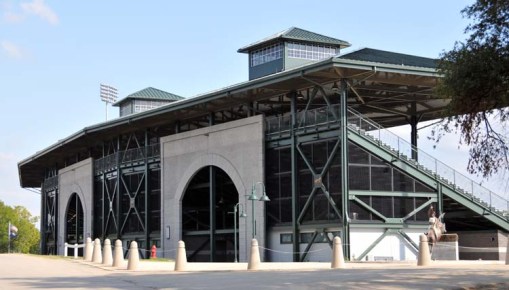
the grandstand structure of the KHP's new outdoor arena, as seen from the "people entrance" on Nina Bonnie Blvd

the grandstand structure of the KHP’s new outdoor arena, seen from Nina Bonnie Blvd

The roads into and around the park are continually under construction, being widened, improved, and beautified. Nearly every week that we attempt to drive in to work, there’s a different road closed, re-done, or re-routed.

And … here’s the most exciting part as far as we’re concerned … construction has begun on the new marathon obstacles for the driving portion of the WEG. I’ll post photos of one amazing-looking structure tomorrow. Stay tuned!

To wrap up our coverage of last week’s FEI World Pony Driving Championships, let’s time-travel back to Sunday’s awards and medals ceremonies and watch the celebrations.

First were the awards ceremonies for the overall ribbon winners in each division. Each of these award ceremonies followed each division’s cones competition. This led to some confusion about the nature and the number of award ceremonies, but for the medal winners, it allowed for multiple celebrations. 

Melanie Becker, the 17-year-old Dutch driver competing as an individual, was ecstatic with her overall first-place finish in the single-pony division; the Dutch fans were rightly proud of her as well

Melanie Becker, the 17-year-old Dutch driver competing in the championships as an individual, was ecstatic with her overall first-place finish in the single-pony division; the Dutch fans were rightly proud of her as well

after finishing his cones course, Germany's Daniel Schneiders (competing in the championships as an individual) knew he had won the gold medal in the pairs division; after the ribbon ceremony, he participated in a radio interview and then was greeted by a number of fans who wanted to shake his hand and by a pack of giggling teenage girls (photo by A.J.)

after finishing his cones course, Germany’s Daniel Schneiders (competing in the championships as an individual) knew he had won the gold medal in the pairs division; after the ribbon ceremony, he participated in a radio interview and then was greeted by a number of fans who wanted to shake his hand and by a pack of giggling teenage girls

Germany's Steffan Brauchle finished in second place (winning the silver medal) in the four-in-hand division; both he and the gold-medal winner (Germany's Tobias Buecker) were enormously popular with the home crowd; Brauchle himself appeared to revel in the attention

Germany’s Steffan Brauchle finished in second place in the four-in-hand division; both he and the gold-medal winner (Germany’s Tobias Buecker) were enormously popular with the home crowd and Brauchle appeared to revel in the attention

After the cones competitions and all of their various awards ceremonies were over, the preparations for the medal ceremonies began. While the crowd waited along the long side of the arena, facing the medal podium, we photographers were herded between the side of the arena and small plastic barriers erected to keep the old cars and the ponies and carriages from running us over. And then the procession began. First came the party bus, with the red-sequined band from the competitors party on top, playing big band music, which blared from speakers on the bus.

the double-decker party bus

the double-decker party bus

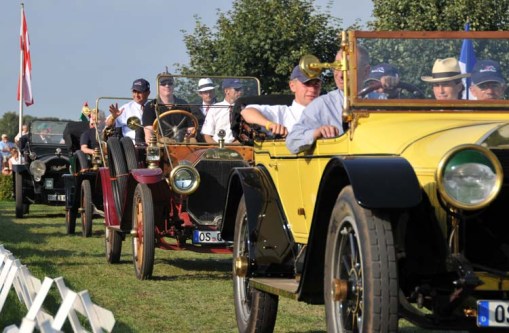
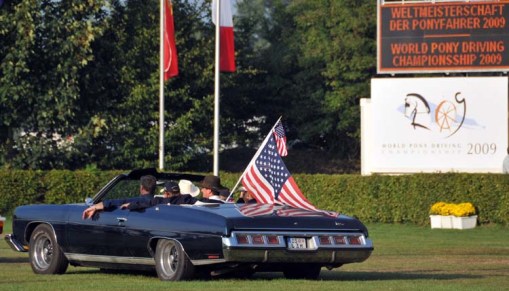
And then came the officials and the teams’ chefs d’equipe, coaches, vets, etc. in a parade of old cars. At least one person in every car was carrying a flag, of course.

old cars 1

four of the antique cars in the medal-ceremony parade

a few more of the antique cars

a few more of the antique cars

The cars then all lined up on either side of the podium, facing the crowd, and in came the ponies and carriages of the drivers who had won both individual and team medals. The rest of each nation’s contingent came in on foot and gathered around their drivers or their cars.

The medal ceremonies for the individual winners were held first.

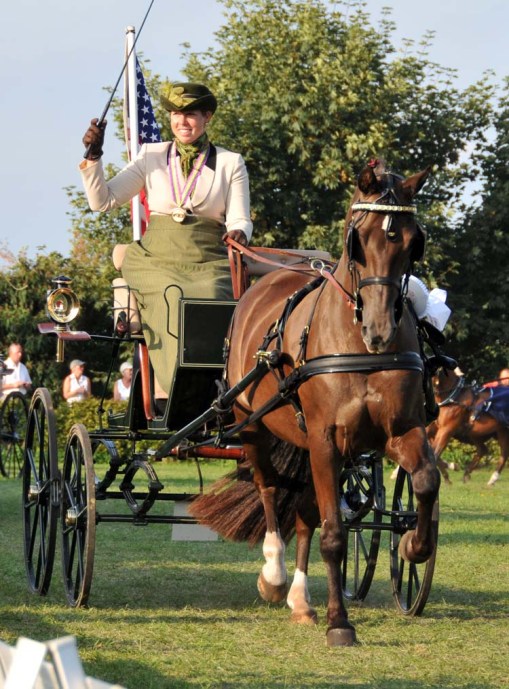
Suzy Stafford has wears her individual bronze medal and watches as Melanie Becker receives her gold medal

Suzy Stafford had received her individual bronze medal and watched as Melanie Becker receives her gold medal

the German fans were shouting and singing in anticipation of the medal ceremony for the pairs division, which was swept by German drivers; those same fans were ecstatic with the enormous flag the organizers produced for their gold-medal winner

the German fans were shouting and singing in anticipation of the medal ceremony for the pairs division, which was swept by German drivers; those same fans were ecstatic with the enormous flag the organizers produced for their gold-medal winner

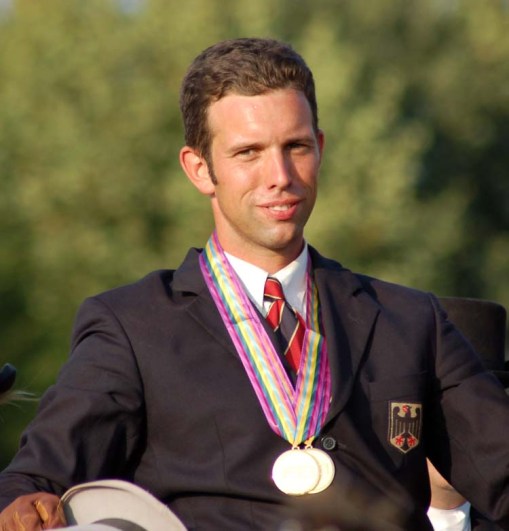
the Germany gold-medal winner in the four-in-hand division, Tobias Buecker

Germany’s gold-medal winner (four-in-hands), Tobias Buecker

 And then, as you might imagine, the crowd was pleased with the awarding of the team medals:

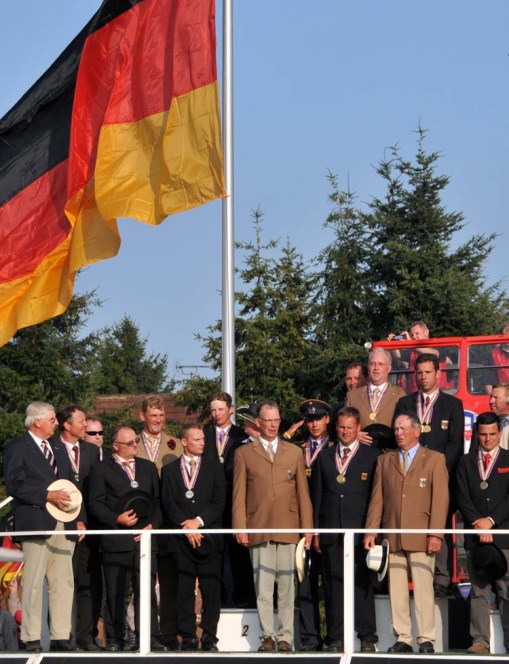
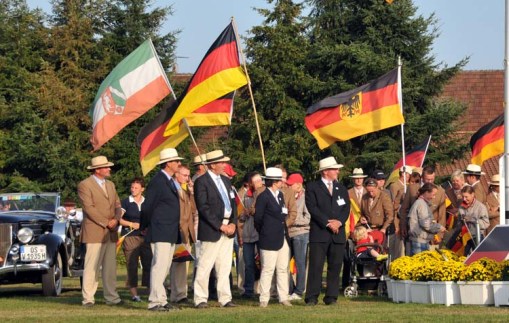
the German team members (and the fans) all sang along to the German national anthem as the huge flag was raised over the podium

the German team members (and the fans) all sang along to the German national anthem as the huge flag was raised over the podium

"hats off!"

“hats off!”

more of the German team members, grooms, families, etc. ... standing next to the podium and watching the proceedings

more of the German team members, grooms, families, etc. … standing next to the podium and watching the proceedings (the judges are the ones in the front with hats on)

And then, finally, was yet one more lap of honor and a final parade of cars. And then it was time for all of us to say goodbye.Suzy Stafford on the lap of honor for all the medalists

leaving the 2009 FEI World Pony Driving Championships ...

Here (finally!) are video clips of each of the U.S. drivers in one of the eight marathon obstacles at the World Pony Driving Championships. Several of these were shot at the same obstacle (number 2), so you can see the different paths that each driver chose). In the background, you can hear the cheers, applause, and whistles of spectators at the obstacle being filmed and at other nearby obstacles; the announcer; and even a few snippets of the eighties-era music that blared from the loudspeakers all day. Enjoy!

If you scroll down to the Aug. 14 post (“dressage awards parades — in motion”), I’ve added the video clips of the pair and four-in-hand laps of honor after the dressage awards presentations.

After this current post, we’ll have at least one more post featuring the final (overall) awards and medal ceremonies, so keep checking in with us each day!

[Guest post by Jennifer’s husband, A.J., written on Tuesday, Aug. 17.]

A.J. here. We’re on the flight back from Amsterdam, having taken the train yesterday from Münster. Jennifer will be posting additional blog entries and photos from the competition and the CAA’s trip to the 2009 World Pony Championships throughout the week, so tune in later for those. But how could I pass up the opportunity to share with you my German “driving” experiences with the infamous “Green Machine”? (Remembering the primary audience for this blog – we’re talking automobile – I myself am not a carriage driver – I have taken a class in it; but for the most part – I’m “carriage by marriage.”)

With only a smallish CAA group attending the World Pony Championships, Jill and Jennifer had asked if I would mind “driving” the group. It would give us more flexibility and at a smaller cost; besides, for me, it would be my first opportunity to drive outside the United States or Canada. After agreeing, I was then told what I would be driving …

The picture below is not what I was driving. Mine was far less sporty … no, this was the red Ferrari being test-driven at Vischering Castle, which Jennifer and I visited before we picked up the CAA group at the Münster Hauptbahnhof (main train station). Not enough seats for the whole group … I guess I could have traded up and simply made plenty of (fast … very fast) trips back and forth between the hotel and the competition site – though luggage space would have been a problem.…
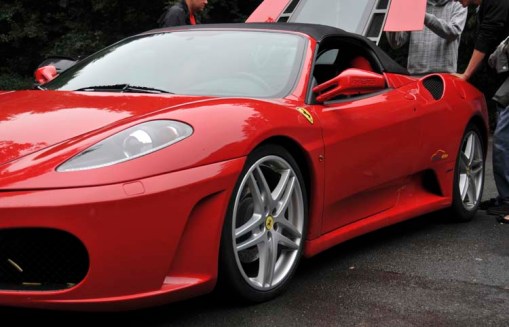
the fabulous-looking Ferrari that A.J. wanted to trade for the mini-bus; the hood in back is open as potential test-drivers admire the engine

the fabulous-looking Ferrari that A.J. wanted to trade for the mini-bus; the hood in back is open as potential test-drivers admire the engine

And the picture below is also not what I was driving. Mine was far less classic … no, this classic Ford roadster was at the competition site. This was reminiscent of the various classic cars used by the teams in the medal ceremony. Jennifer’s certain to show you some photos of those later in the week. But as for this Ford, no luggage room either – more seats though less speed than the Ferrari … but far more stylish than the “Green Machine.”….
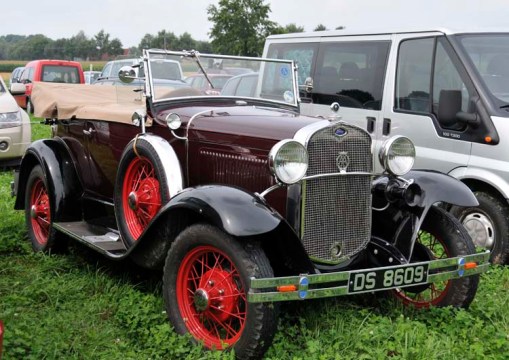
a beautiful old Ford roadster, standing with all the other, "regular" cars in the championship's parking lot

a beautiful old Ford roadster, standing with all the other, “regular” cars in the championship’s parking lot

No … after all that build up of raw European sports-car power and classic American car style, THIS … is what I was driving … my Mercedes mini-bus. Diesel, six-speed manual transmission, with a sliding passenger door. Seats for nine. Sporty – no. Stylish – no. Utilitarian – most definitely.
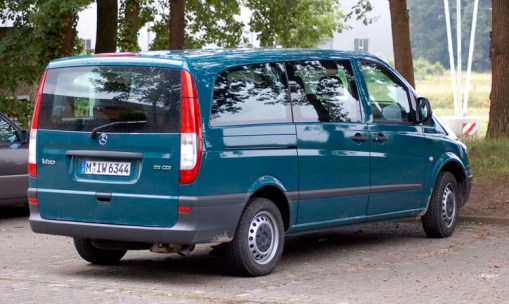
this is the mini-bus affectionately dubbed the "Green Machine" (photo by A.J.)

this is the mini-bus affectionately dubbed the “Green Machine”

Now, I don’t want to be disrespectful to the “Green Machine.” Like a good hound dog, it was dependable and loyal. It got us … all of us … everywhere we wanted to go. After a half day of bonding, it and I became one … without hesitation, we were successfully navigating the tight streets of downtown Münster and the glorious country lanes of Westphalian horse-country. We conquered narrow parking garages and numerous traffic circles like we were coasting penalty-free through a cones course. Together, in Münster rush-hour traffic, we courageously rescued the incoming CAA crew from the Münster train station to whisk them away to the safety of Saerbeck. (Bear with me, it’s hard to be surrounded by such historic churches and castles and not envision a more chivalrous time than our own.)

German traffic signs and driving rules took a little getting used to, but not much.  The speed limit signs were easily understood and, quite simply, made sense.  I also liked the way the stop lights worked.. Sitting at the red light, you wait until the light goes both red and yellow.  This lets you know that “green is coming.”  And with traffic circles, you simply yield to the cars in the circle … and always yield to pedestrians (and bicycles, especially in Münster and the surrounding environs … they are EVERYWHERE).

The “Green Machine” and I also knew our limits. We did not venture onto the famous Autobahn. I’d seen the speeds at which even the “smartest” of cars drove on the Autobahn. I had no doubt that once the “Machine” got up to speed, it would have no problem at least keeping pace in the right-hand lane; however, I also knew that you could clock us going 0 to 60 with a sundial. You see, it was the “getting up to speed” – first and second gear – that caused me pause. And so, we wrote a haiku by which to remember the experience:

Six gears and nine seats.
Do I dare try the Autobahn?
The hamsters say no.

And yes, I did pass a couple of vehicles … plenty of bicycles (this is Germany’s bicycle capital … it was inevitable); a couple of service vehicles and fellow mini-buses; and mopeds were no match for the power of the “Machine.”

But what looked to be our greatest triumph quickly became our worst defeat. On Friday of the competition, two of us had to sprint back to the hotel for a change of clothes for the dressage awards ceremony. Time was short and we were (relatively speaking) booking it. On the return trip, we were at a stop light – first in line on the left. To my right, a service vehicle. Behind it, another mini-bus. Red light turned to red and yellow. Clutch in. First gear. Red and yellow to green. Clutch out, gas down. Away we sped, easily besting both the service vehicle and the mini-bus. It was time to finish off the two. Looking back to make sure I was clear, I started to edge over.

Then I saw her in my rear view mirror. She was silver. She was fast – very fast. New Porsche 911. No sooner had I spotted her, than with a VROOOMMMHHHH, she smoked past me in flash. And before I knew it, she was gone. I was going about 100 km/hr at the time. I can only guess she was easily going about 160 km/hr. Even now, I don’t know what was more impressive – the sight of something moving that fast or the sound it made when it smoked past.

« Previous PageNext Page »