Today we begin with the first part of Mr. Dale’s chapter on tandem driving, published in 1899:

The tandem is the poor man’s team, and is somewhat neglected by many who might obtain a great deal of amusement from it. But driving tandem is not only an amusement, for it is an excellent and economical method of traversing bad roads for long distances. On this point I may claim to speak with some certainty, having driven a tandem for something like eighteen hundred to two thousand miles in a year, for three consecutive years, over some of the worst roads on our Indian frontier. In fact, for the whole of the cold weather and a considerable portion of the hot season too, I was always driving. It is needless to say that this was excellent practice. In fact it is in my opinion impossible to learn to drive well until you have had some experience of driving journeys.

In the old days, the coaching books tell us, those who had a taste for coaching, qualified in the art by driving the stage-coaches, and no doubt this was an incomparable school for coachmen. Roads of all sorts, horses of all kinds and seldom of the best, with loads of varying weight, and time to keep, taught them to be thorough coachmen, judges of pace, strong with a weak team, and gentle with a strong one, so as to get the most work with the least expenditure of the horses’ strength.

When in 1881 I was appointed to the frontier, I found that part of my duties would consist in driving from one end of the frontier to the other, from Bannu to Rajanpore. My immediate predecessor had done the journey on a camel, but I have no taste for camel riding. The ordinary riding-camel is dull work, and the trotting-camels from Bhowalpur are expensive, and carry little or nothing besides the rider. The journey might be ridden on horseback, but there was the question of baggage. Why not drive tandem? “Oh,” said everybody, “that is impossible. The roads are so bad, no cart would stand them, and you would not get twenty miles.”

I am afraid I am not very good at taking advice, and experience has told me that not one man in a hundred knows anything about a road over which he may have traveled often enough. So I took my own course, bought four ponies, and had a bamboo cart built for me. I had the seat placed rather high and on it a box, literally a box—which I found most useful, for it carried my books and pipes—from which to drive. The net underneath carried the baggage, and the whole was drawn by two ponies tandem fashion. The road was rough and in places very heavy, but it was nowhere impracticable, and I drove over the whole of it for three years without a serious accident. The low center of gravity of a bamboo cart makes the danger of upsetting small…

We’ll continue with Mr. Dale’s tandem-driving tales next Saturday!
 

The CAA just received a wonderful donation of books from a member in Canada, and I admit that I (and several others) spent a good hour or so looking through the boxes when they arrived earlier this week.

One of the books is from a series called The Sports Library. This particular one: Riding, Driving, and Kindred Sports by T. F. Dale.

The book was published in London in 1899, and the Introduction says, “In preparing the Sports Library for the younger generation of sportsmen, the Publisher and the Editor had the following ideas in view:

“They intended that the books should be written by sportsmen of the younger generation in thorough sympathy with the needs of younger athletes and twentieth-century ideas. They hoped where necessary and practicable to deal with the cost of each sport, and also to show the public that many sports which are considered beyond the means of the ordinary man, are quite within the reach of all who are really interested. … Last, but not least, it was intended that the series should be a kind of cheap Badminton Library to the thousands of sportsmen who cannot command the price of that series.

“It is natural, perhaps, that the book on Riding, Driving, Hunting, &c., should come first. In no country is the interest in horses more widely felt than in England; it extends from the coster who drives his Russian pony to the Derby, and the City clerk on his hired hack enjoying Saturday afternoon, to the Earl of Lonsdale and the Duke of Westminster. It is anticipated that the motor cars and bicycles will so reduce the price of horses that the splendid exercise of riding will come within the reach of many who have hitherto regarded it as prohibitive.

“Mr. Dale needs no introduction to lovers of horse-flesh. Land and Water, the Field, and the Badminton Magazine have published his articles for many years, while he is well known as the author of Polo, editor of the book on Polo in the Badminton Library, “The History of the Belvoir Hunt,” &c., &c. Mr. Dale is, perhaps, the greatest authority on Polo in the United Kingdom; while in hunting and racing there are few other men who have seen so much sport at such a small expenditure of cash.

“The second volume of the Sports Library is a thoroughly up-to-date work on Football — Association and Rugby — Hockey and Lacrosse. …

“The Editor hopes to include in the third volume of this Library treatises on boxing, fencing, gymnastics, wrestling, and physical culture — each sport to be described by well-known men. Volume IV will include running, athletics, swimming, and water polo. … It is hoped that its readers, the younger generation of sportsmen, will show their appreciation of these efforts by encouraging the Publisher and Editor to produce a library of ten volumes covering every known sport.”

Mr. Dale may have been an expert on polo, but his book includes chapters on horsemanship, riding to hounds, ladies on horseback, polo (naturally), sport and health, dress and equipment, driving, tandem driving, four-in-hand driving, hog hunting, racing, and more.

Starting tomorrow, and continuing for several Saturdays, we’ll take a look at his amusing chapter on tandem driving. Stay tuned!

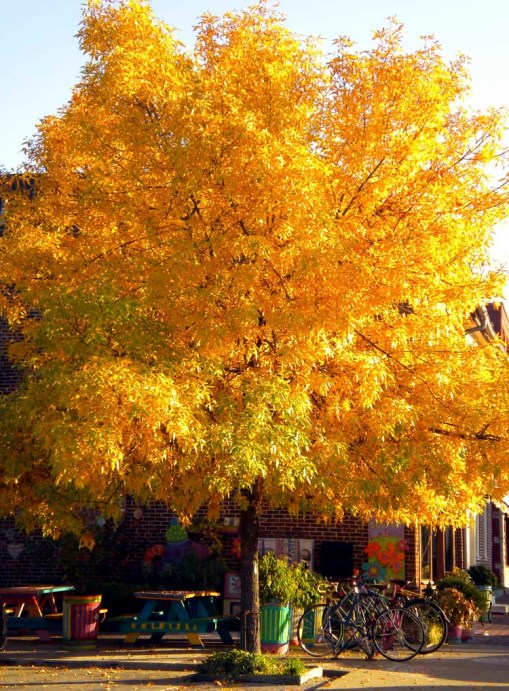
After several days of wind and heavy rain, most of the leaves have now fallen off Lexington’s trees. But we did enjoy one of our more colorful autums this year.

There was brilliant early color, mixed in with still-green trees. Then, one day, it seemed like all the late-changing trees had suddenly turned bright orange, red, or yellow. And we were even fortunate enough to have day after day of bright sunshine and blue skies — which can really make sugar maples and ginkgos shine. Then came the wind, and there were deep piles of fallen leaves to kick through, and still there was color on some of the trees.

Somehow, I managed to get photos only of yellow trees and missed the red ones and the orange ones, but I hope you enjoy this last little bit of fall color anyway.

.

.

Jill had said that the report in yesterday’s post would be her final one from Argentina, but then another — and more great photos — arrived in my inbox.

So here is the (really, truly) final report on the CAA group’s wonderful visit to Argentina:

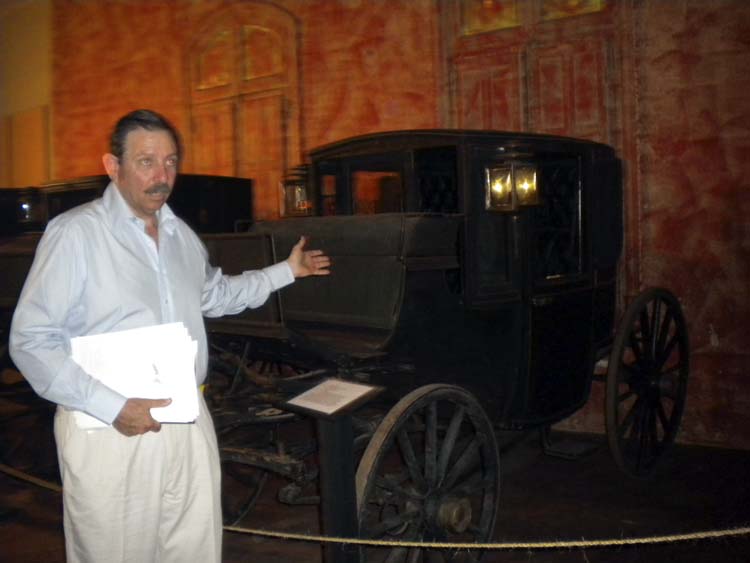
“Monday was our last day of the trip. We departed at 9:00 a.m. from the Estancia El Rosario (our home for the previous three nights) and drove an hour to the town of Lujan, where we were met by CAA member Raul Aquerretta, who had kindly agreed to take us around the carriage museum (open especially for us on Monday, their normal day of closing). As we were all greeting each other, out of the museum door came Andreas Furger of Switzerland (he’s one of the speakers at the 2012 CAA / CWF International Carriage Symposium). ‘What are you doing here?’ I asked, and was told that he had come to buy a Hackney horse from Raul. He was delighted with his horse and was very excited to now be driving a Hackney.

.

the final group dinner for this trip, at Estancia El Rosario

.

a typical Argentine wagon, at the carriage museum in Lujan (photo by Jill Ryder)

.

Raul describes one of the vehicles in the museum's collection (photo by Jill Ryder)

.

Lujan cathedral (photo by Jill Ryder)

.

“After our wonderful visit to the fascinating museum, we had a quick look around the church and drove on to Escobar for our final visit. Many of our local hosts had gathered at the Gibellis’ weekend home to greet us again, enjoy lunch, and look at the carriages and hundreds of appointments that Dr. Gibelli has collected over the years.

.

some of the Gibellis' collection in Escobar (photo by Jill Ryder)

.

... and more of the Gibelli collection (photo by Jill Ryder)

.

... and some harness on display (photo by Jill Ryder)

.

Dr. Gibelli discusses some of his vehicles with the group (photo by Jill Ryder)

.

everyone enjoyed lunch outside at the Gibellis' weekend home (photo by Jill Ryder)

.

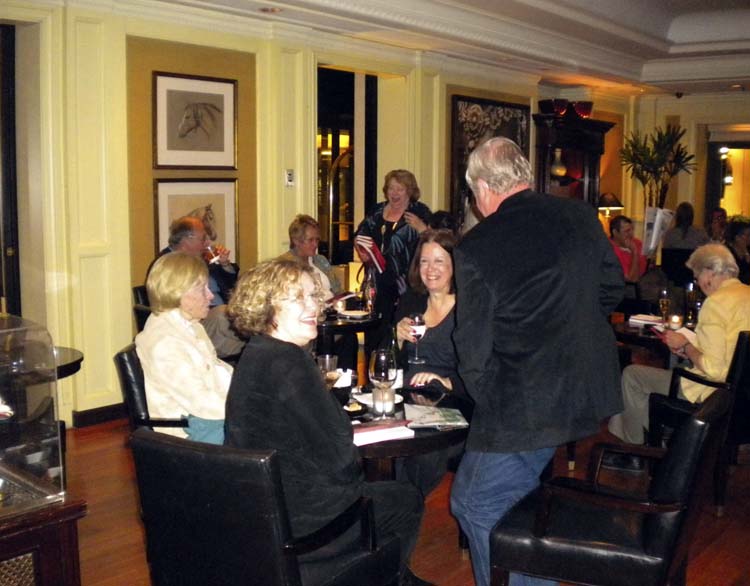
“Then it was back into Buenos Aires to stay at the Sofitel Hotel. We all met in the bar at 8 p.m. and were joined by Milagro Molina de Lattuada, who signed copies of her book on Hackney horses (recently translated into English) — a gift from the CAA. And so ends another outstanding trip to Argentina.”

.

Milagro de Lattuada joined the group at their B.A. hotel, to sign her book on Hackney horses (photo by Jill Ryder)

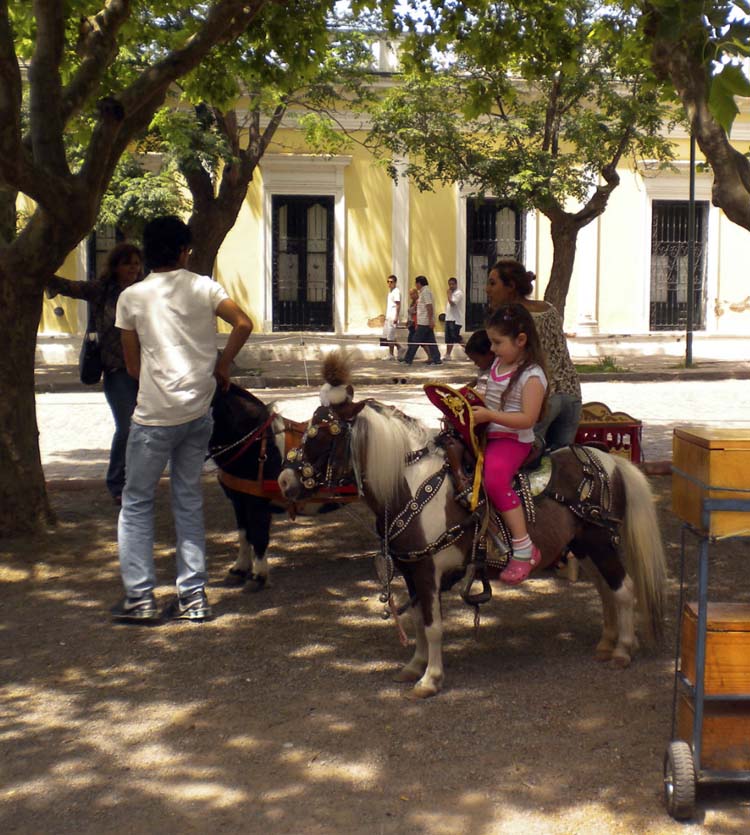
Jill’s final report and photos from Argentina (all from Sunday):

“After breakfast, we received a telephone call telling us, ‘hurry, hurry, the horses are ready!’

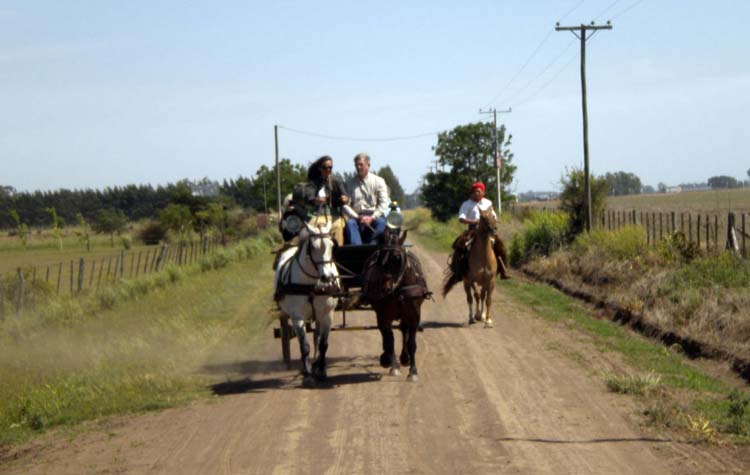
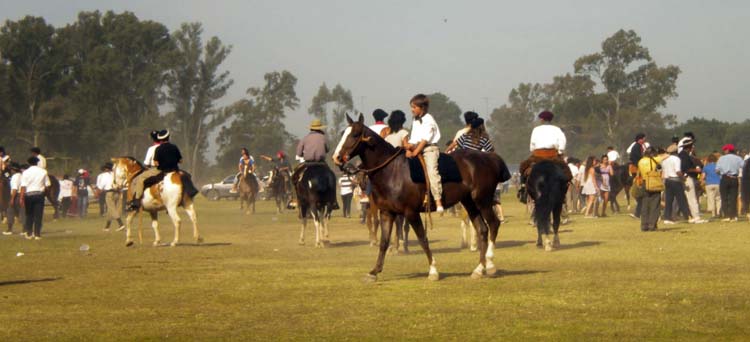
“We drove out of town and were greeted by Juan Gibelli and two pairs of horses. We loaded the vehicles and drove into town. As we approached the town, there were hundreds of horses gathering for the start of the parade, and we drove right through them! Quite a sight and almost too hard to describe. We alighted and hot-footed it through town to our reserved seating outside on the sidewalk. As soon as we arrived, we were served drinks and empanadas and the parade started.

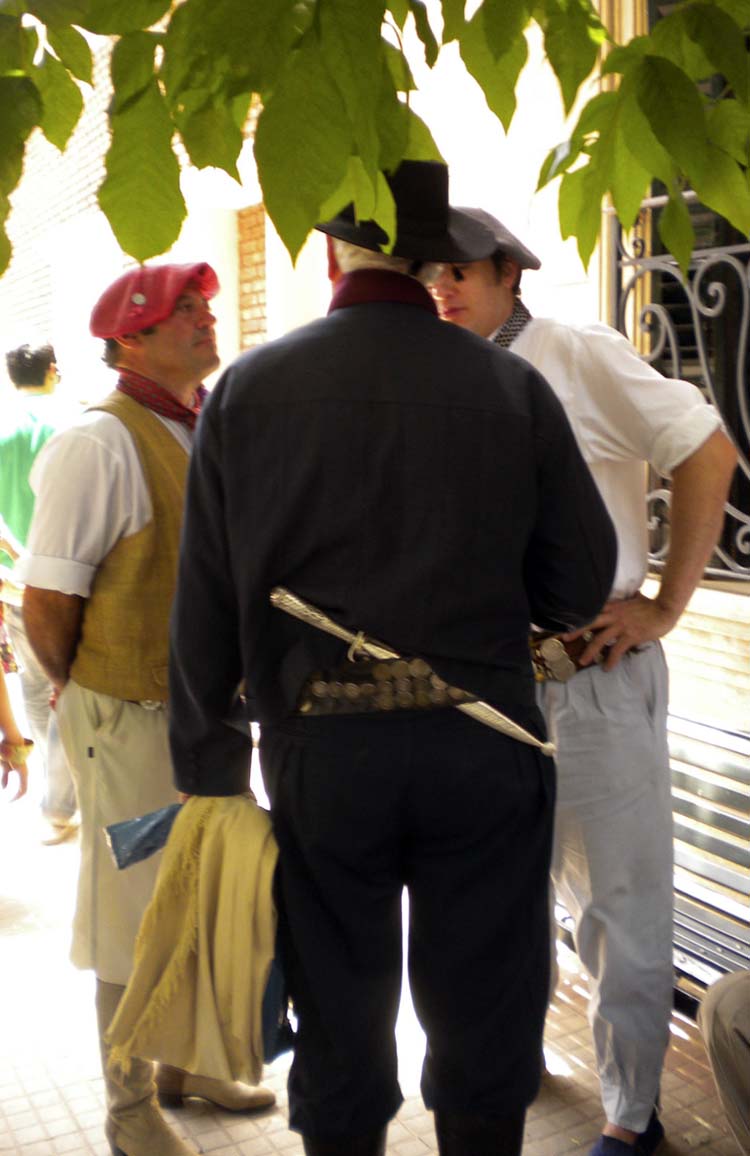
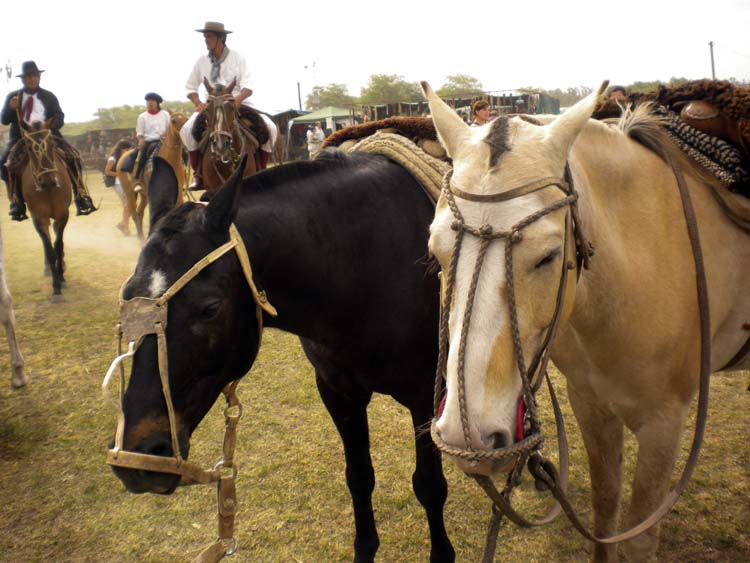
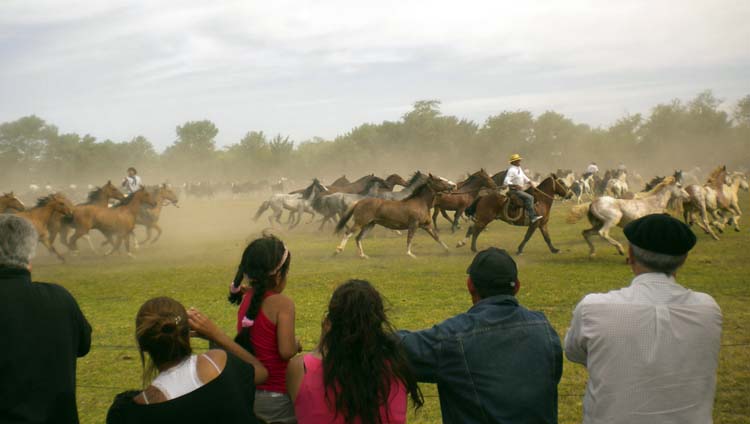
“We watched hundreds (perhaps thousands) of horses being led be a rider or loose, as most of them were in trapillos (a bell-mare group). A guacho rides his horse, leading a mare with a bell around her neck, and then the rest of the horses (having been brought up like this) are loose and stay right with the bell mare. Where else in the world could you see such a thing: people sitting and standing on the side of the streets with hundreds and hundreds of loose horses in the street! Incredible.

“Then it was off to lunch and then back to the arena to see the big festival with ALL the trapillos in the ring at the same time!

“We watched for two hours and were on overload, and so we returned to the estancia and recounted the fantastic day.”

.

(photo by Jill Ryder)

 .

(photo by Jill Ryder)

.

(photo by Jill Ryder)

.

(photo by Jill Ryder)

.

(photo by Jill Ryder)

.

(photo by Jill Ryder)

.

(photo by Jill Ryder)

.

(photo by Jill Ryder)

.

(photo by Jill Ryder)

.

(photo by Jill Ryder)

.

(photo by Jill Ryder)

.

(photo by Jill Ryder)

.

(photo by Jill Ryder)

.

(photo by Jill Ryder)