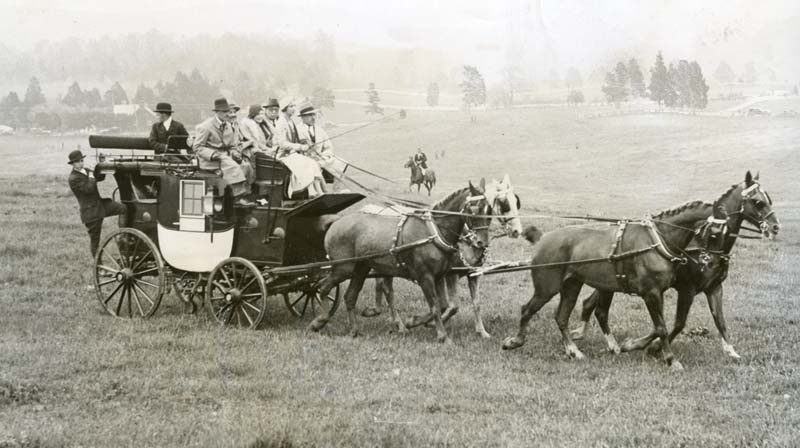
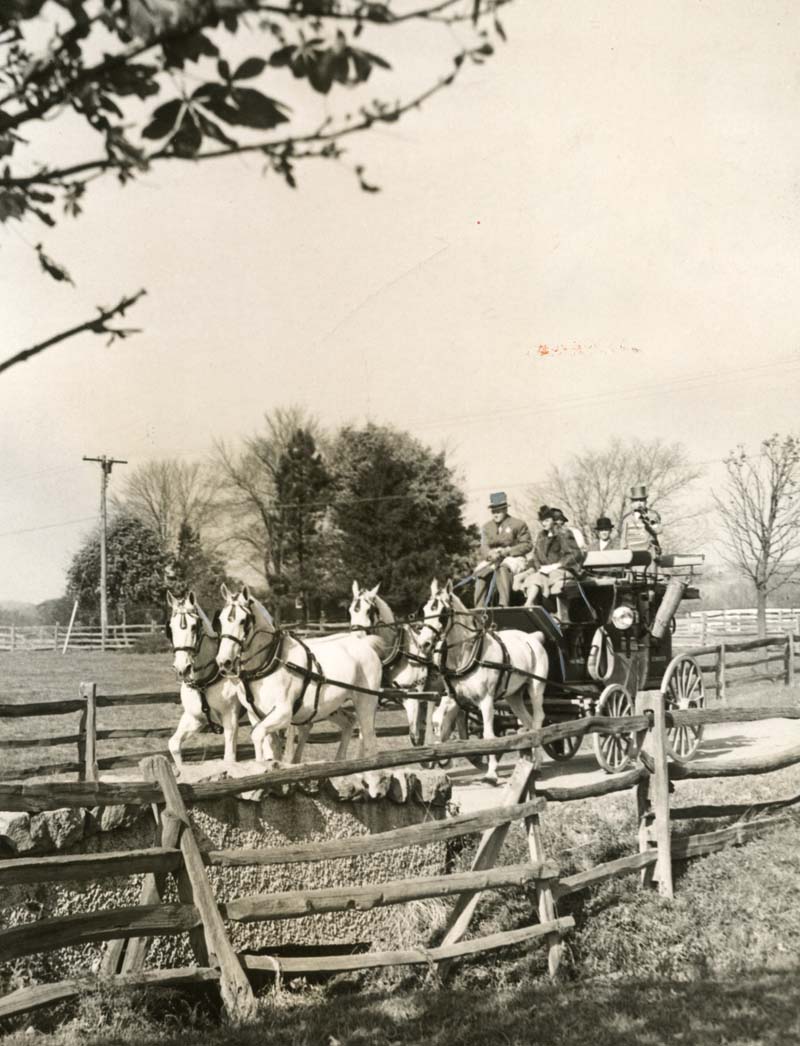
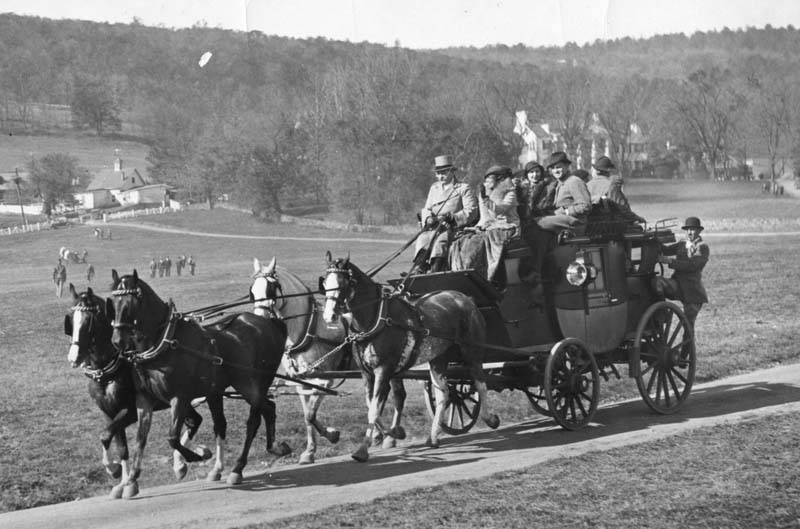
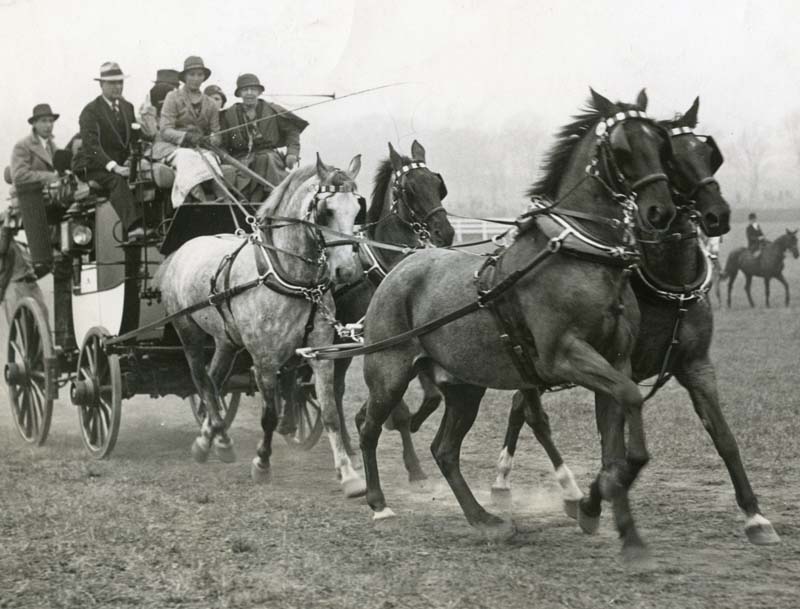
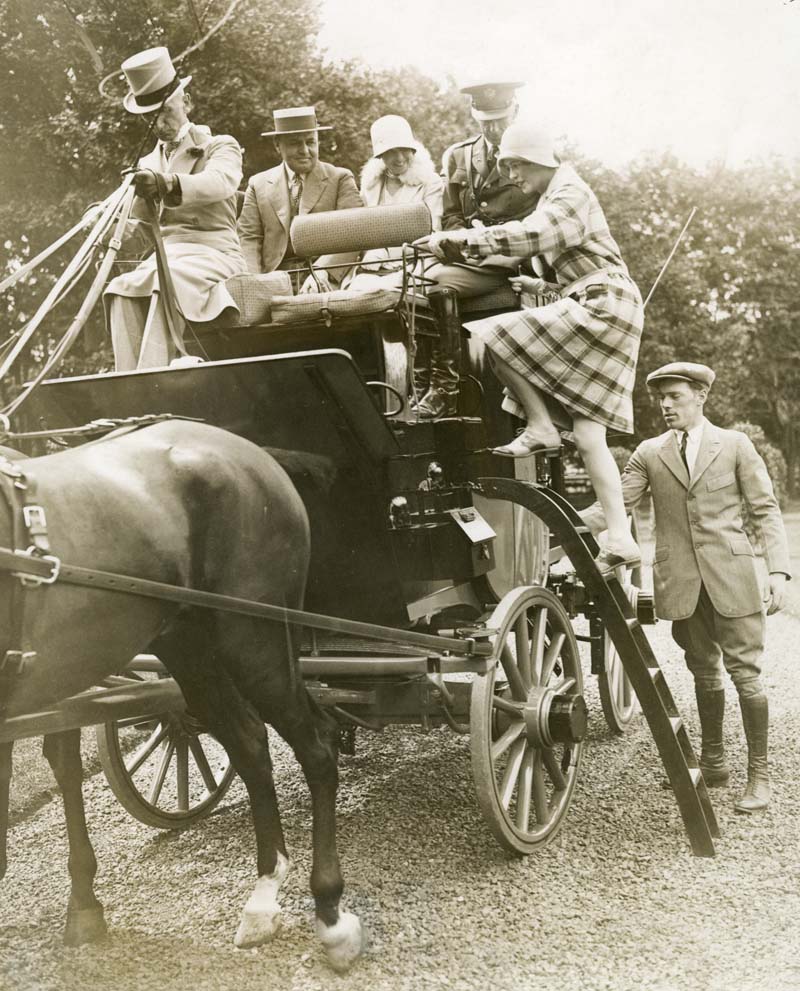
Today, we’ll take a look, over several years, at a coach known as the Tally-Ho. Or are these, in fact, several coaches all known as the Tally-Ho??

First: “Mrs. Frederick Cameron Church, Jr., the former Muriel Vanderbilt, climbing up on her Tally-Ho coach as members of the society colony took a ride over the roads in the coach at Newport, Rhode Island.” This photo is dated August 13, 1929.

.

from the Jack & Marge Day collection

.

Next: “The Tally-Ho, driven by Mrs. Virginia Winmill of  Warrenton, Virginia, arrives for the annual Gold Cup Hunt Meet Race at Warrenton, Va., on May 6, 1933.”

.

from the Jack & Marge Day collection

.

And, finally: “The Tally-Ho arrives with exciting fanfare at the 23rd annual Essex Fox Hounds Race Meet on October 16, 1938. It is driven by Dean Bedford. In front is Mrs. Richard V. N. Gambrill, and in back is Mrs. Dean Bedford.”

.

from the Jack & Marge Day collection

Today and tomorrow, let’s enjoy a few more old photos, shall we? This time, we’ll take a look at some coaches and coaching scenes from years (well, decades) gone by.

Today, we’ll visit two meets of the Piedmont (Virginia) Fox Hounds.

The news-service caption on the back of this first photos says, “W. P. Hulbert driving his coach onto the race course during the third annual meeting of the Piedmont Fox Hounds at Llangollen Farm, near Upperville, Virginia, November 4th, through the courtesy of Mr. and Mrs. John Hay Whitney.” The photo is dated Noveber 4, 1933.

.

from the Jack & Marge Day collection

.

Next: “Mrs. John Hay Whitney is seen driving her four-in-hand during the [first!] Piedmont Fox Hounds meet on her husband’s estate in Upperville, Virginia, on November 17th, 1931.”

.

from the Jack & Marge Day collection

Here in Lexington, it started raining on Sunday. It rained off and on all day and then steadily throughout the night. And it’s been raining all day today (Monday), and it’s supposed to continue raining through at least tomorrow, if not tomorrow night. Then, on Wednesday, we might get a little, um, snow.

I took these two photos back in February of this year, and you may have already seen them here on the blog. But the low spot where the KY Horse Park’s (normally dry) creekbed runs between several paddocks has a tendency to turn into a lake after heavy rain … and it looked just like this again earlier today.

.

.

.

Everything here at the Horse Park that wasn’t already a wide, flowing creek or a lake by this morning was MUD. I can only imagine what it’ll all look like by tomorrow!

We sure do wish we could send some of this rain to our many CAA friends who haven’t had enough of it lately.

Last Saturday, we started with a “reading” of the chapter on tandem driving in the first volume of  The Sports Library (by Mr. T. F. Dale), published in 1899. You can read part of the book’s introduction (and the introduction to our look back at this nineteenth-century book) here.

Today, we have the second part:

… But it may be gathered that during the three years I drove up and down the frontier, I learned something of tandem-driving from a practical point of view.

For example, I learned that breast harness is not nearly so good as collars on rough roads, and that horses that will draw well in a collar will hang back and sometimes take to jibbing altogether in breast harness. In very rough and stiff ground where I wanted all the draft power I could get, I used to unhook the leader’s traces from the usual place and put them on to rings put for that purpose at the end of the shafts. This gave a more direct pull on the load, and certainly made more effectual use of the horse power.

As a rule, however, I drove with the ordinary long traces. This works well enough with a fairly good or willing horse, but with an awkward leader they add greatly to the difficulties of driving, for if the leader hangs back obstinately the wheeler may get its leg over the traces. Of course, when driving fresh-caught Indian country-breds of various sorts, an awkward leader was not uncommon, and many very good travelers were a bit nasty at starting, especially until they got used to it. I may say truly that I have had my leader in every possible and impossible position in relation to the cart. I have had him riding on the step, of course, but that is a commonplace of tandem-driving. I have had him with his head under the shafts behind the wheeler’s tail. I have had him on his back under the cart. I have had him rolled up into a kind of tangle so that he had to be cut out of his harness. But I always got to my journey’s end.

Yet much of my trouble might have been saved me if I had begun as I ended, by driving with bars. To my mind these have simplified tandem-driving immensely, have reduced the danger, if there ever was any, and added greatly to the pleasure. With long traces a certain space was always required to turn in, but with bars a tandem can easily be turned in its own length, and the leader is much more easily put to or detached. …

We’ll continue with Mr. Dale’s tandem-driving tales next Saturday!
If you’re on the West Coast this winter — in or near San Francisco, to be precise — you may want to check out the new exhibit at San Francisco’s Asian Art Museum.

“Maharaja: The Splendor of India’s Royal Courts” opened last month and continues through April 8, 2012. It looks like a sumptuous, splendid, be-jewelled trip through history. And it includes a highly decorated silver carriage, which was built in 1915.

You can see highlights of the entire exhibit here …

.

.

… and a video of the installation of the carriage itself here:

.

.

(As usual, if the embedded videos won’t work on your computer, you can access them directly on YouTube here and here.)