Here (today and continuing through the weekend) is what I was researching yesterday, when I came across Mr. Parkinson and his information on the costs of waggons and carts.

All of this is information I found in a book called the Maryland Geological Survey, which was published in 1899.

In this first part, we read about the earliest days of horse-drawn travel in Maryland:

At the time of the French and Indian War [1754–1763], Governor Sharpe’s* coach-and-four was out of place upon any other than the main road through the province. In fact, before the Revolution carriages were few in number, and rarely used except in the finest weather. First-rate saddle-horses were much in demand, as the newspapers of the time plainly show. Fox-hunting and horse-racing were among the principal diversions, and the raising and importing of blooded horses received much attention. Members of the Assembly, lawyers, actors, and parsons, and indeed all to whom time was important and speed a necessity, preferred the activity of a Thoroughbred to the lumbering “chariot” of these early times.

In Annapolis the use of coaches grew apace. The family coach, with its trappings and outriders, was a matter of pride in which the society of Annapolis turned out to every horse-race, or drove to Marlboro to see the latest company of players. “They have light and elegant carriages which are drawn by fine horses,” is the comment of the Abbé Robin ** on this phase of Annapolitan life, while Eddis writes just before the Revolution: “Our races, just concluded, continued four days, … and surprising as it may appear, I assure you there are few meetings in England better attended or where more capital horses are exhibited.” ***

* Horatio Sharpe (1718–1790) was Maryland’s colonial governor from 1753 until 1769.

** Robin’s Nouveau Voyage dans l’Amerique Septentrionale was published in Philadelphia in 1782.

*** William Eddis’s Letters from America: Historical and Descriptive: Comprising Occurrences from 1769 to 1777 Inclusive was published in London in 1792.
Once again, I was doing research for one project and found other interesting things along the way.

At the end of the eighteenth century, an Englishman named Richard Parkinson lived near Baltimore, Maryland, for three years. He took detailed notes on his travels, American farming practices, the costs of things, and more. His findings were published (in 1805) in a book titled A Tour in America in 1798, 1799 and 1800: exhibiting Sketches of Society and Manners, and a Particular Account of the American System of Agriculture, with its Recent Improvements.

In Section XXVII, he gave an “Account of Waggons, Carts, Ploughs, Harrows: the Price, &c.”

Here’s the part that’s pertinent to our interest in the history of animal-drawn vehicles:

“The price of a waggon in America is one hundred dollars. It is nearly as light made as a coach, and particularly the wheels; for which reason the iron work is not heavy or expensive. The body is generally high on the sides, upright, tilted with bows all over it, and covered with white linen cloth, as they are chiefly intended for marketing [i.e., taking items to market]. The cover keeps the sun off in summer, the frost out in winter, and furnishes the farmer with a place of abode during the time he is on his journey to market; or, when in town, to breakfast, dine, sup, and sleep in. There are generally pumps for water, near to the place where the stands of waggons are; and as the farmer and his horses both drink and sleep in the streets, it is a very necessary duty for the mayor of a town to place pumps for their accommodation. The horses draw double, by a pole, in the same manner as the stage-coaches are drawn in England. There is a trough fixed behind the waggon when travelling; when in the cities it is put on the pole, which is held up like the pole of a curricle, and two horses are placed on each side, to feed. The waggon, being covered with a cloth extended by hoops, is set so as to form a shelter for the horses, as they remain in the streets day and night, during the most severe weather. The driver rides on the near-side hind horse, and has lines to the two leaders. I much approve both of the waggons, and the management of the horses, as the driver has good opportunity to keep every horse to his work. It is as common to see the driver ride on an ox as on a horse. A one-horse cart costs from thirty-four to forty dollars: it is made light, and tilted in the same manner as the waggon. The driver sits in the cart to drive. A two-horse cart costs from fifty-four to sixty dollars.”

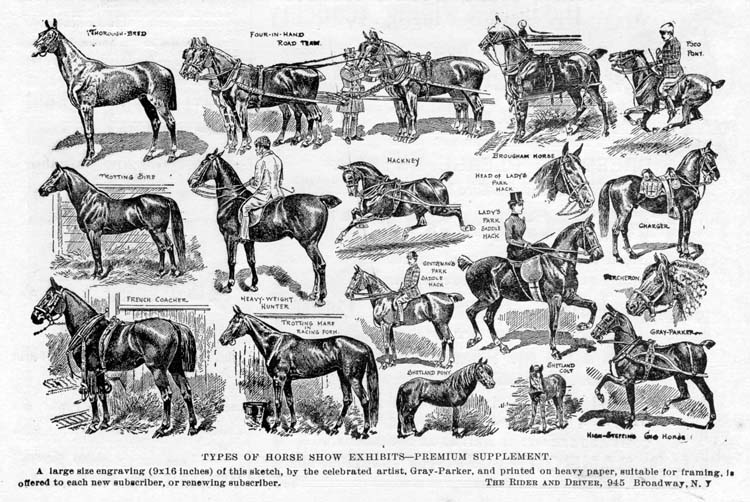
For today’s entertainment / history lesson, I found the following poster, which was being given away (in 1898) as a large (9 x 16 inches) engraving, to all new and renewing subscribers to Rider & Driver magazine. The artist was the same C. Gray-Parker whose drawing of a Goddard Buggy graces the cover of the March issue of The Carriage Journal: http://bit.ly/eHqNdj.

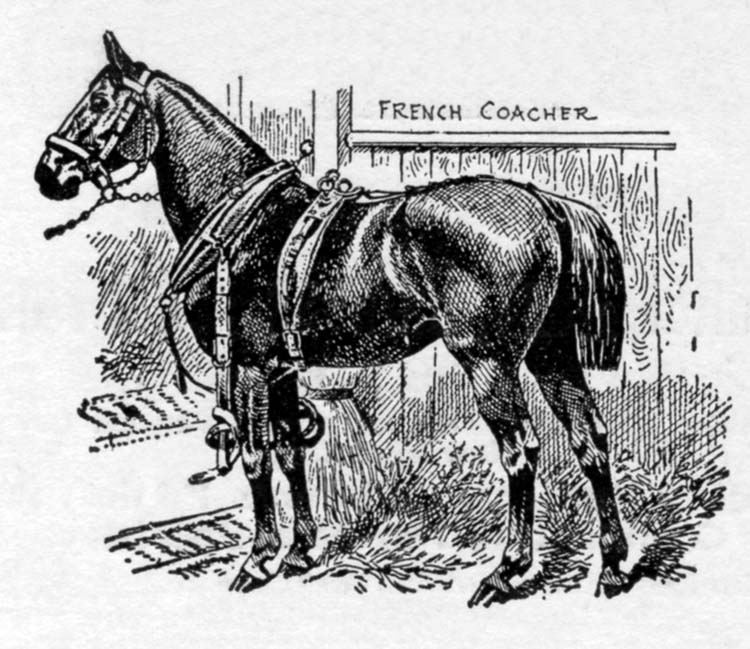
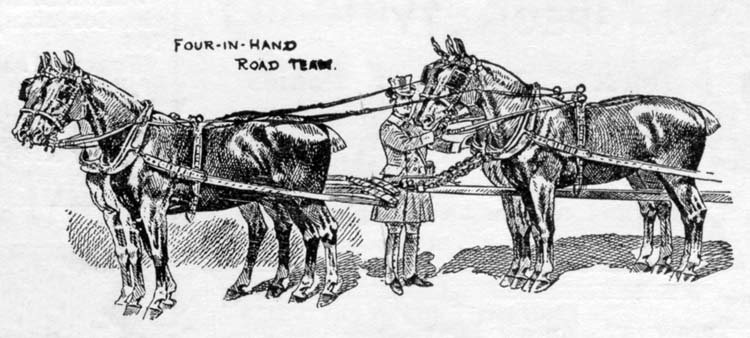
This collage of “Types of Horse Show Exhibits” features a Thoroughbred, a four-in-hand road team, a Brougham horse, a polo pony, a trotting sire, a heavy-weight hunter, a Hackney, a gentleman’s park saddle hack, a lady’s park saddle hack, a charger, a Percheron, a French “coacher” (coach horse), a trotting mare in racing form, a Shetland pony, a Shetland foal, and a high-stepping Gig horse.

You can see them all here, and then, below this first image, I’ve extracted and enlarged all the harness horses so you can see the differences between the various harness and the horses themselves.

.

"types of horse show exhibits" (from the April 30, 1898, issue of Rider & Driver)

.

.

.

.

.

Today’s fascinating old video features a glimpse of daily life on a London street in 1930:

.

… today we take a look at some “horseless” carriages.

This video shows a 1930s-era gathering in Brighton, England, to celebrate the 1896 law that repealed the “Red Flag Laws.” These had required that all motorized vehicles be preceded on the road — for safety’s sake — by a pedestrian carrying a lantern or waving a red flag.

The video’s narrator says that the same 1896 law also raised the speed limit from a “comparatively safe two miles per hour to a reckless twelve.”

.