One of our members sent this link to an online collection of old photos of the Western U.S.
The first six or so, especially, plus a few near the end of the collection, are wonderful images of late-nineteenth-century vehicles, horses, and oxen.
March 31, 2011
One of our members sent this link to an online collection of old photos of the Western U.S.
The first six or so, especially, plus a few near the end of the collection, are wonderful images of late-nineteenth-century vehicles, horses, and oxen.
March 30, 2011
If you’ve read some of the recent posts in the “history” and “early roads” categories, you may remember a description of Stagecoach travel in the eighteenth-century America.
And then, late last week, I posted two stories of Stagecoach travel in New York in 1898 (the first part is here, and the second part here).
You’ve probably already guessed that these two types and styles of “coaching” — about a hundred years apart — were not the same.
From the earliest days of long-distance horse-drawn travel (around the middle of the seventeenth century in Europe, and about a century later than that here in the U.S.), Stagecoaches were a primary means of transporting mail, parcels, and travelers.
With the advent of railroads in the early nineteenth century, however, Stagecoaches started to become obsolete as a basic method of (long-distance) transportation in some parts of Great Britain and the United States.
By the late nineteenth century — in England, especially, and on the east coast of the United States — the art of driving a four-in-hand team to a coach had been handed down from the earlier generation of professional coachmen to a new set of wealthy sportsmen. So the two posts about coaching in 1898 were from this later era — known as the “coaching revival.” During these years, horsemen began driving Stagecoaches as sport. Their routes were not entirely practical; instead, they had “social” destinations such as parks, casinos, country clubs, and the like. Sometimes, the fares they collected were given to charities.
.
In a book titled The railway journey: The industrialization of time and space in the 19th century (Munich: 1977), Wolfgang Schivelbusch wrote:
As the new technology terminated the original relationship between the pre-industrial traveler and his vehicle and its journey, the old technology was seen, nostalgically, as having more “soul.”
W.B. Adams’ Pleasure Carriages, published in 1837, was the precursor of a literature of leisure and sports whose ever-increasing growth the century was to witness.* In this book, the use of horse-power was no longer treated nostalgically, but from a point of view that regarded the use of steam as merely unsportsmanlike: “Steam is a mere labourer –- a drudge who performs his work without speech or sign, with dogged perseverance but without emotion. … He may be personified when speaking of him; but no one pats his neck or speaks to him in a voice of encouragement. It is not so with a horse or horses.”
* In the manual on the art of driving published by the president of the Four-in-Hand Driving and Coaching Club, which was revived in 1870 by the Duke of Beaufort, there is a chapter titled “The coaching revival” that deals exclusively with the club members’ new practice of driving coaches on busy routes (e.g., to Brighton, Dover, Tunbridge Wells) and racing the railway trains to those destinations; this activity made the long-abandoned inns of the coaching era come alive again with the neighing of horses and the cracking of whips.” (P. D. Fischer, Betrachtungen eines in Deutschland reisenden Deutschen[Berlin, 1895], pp. 43-44. Fischer also mentions the following coaching titles published in the 1880s: Stanley Harris, Old Coaching Days; W. Ourtram Tristram, Coaching Days and Coaching Ways.)
March 29, 2011
I had never heard of the Priefert Percherons until I was sent a copy of this promo video for “Texas Thunder”:
.
Impressive, eh?
Intrigued, I did a little reasearch and found the following information on the group’s website:
Under the guidance of talented horseman and experienced driver Jason Goodman, the Priefert Percherons have emerged as one of the premier draft horse exhibition attractions in the nation. This amazing team travels coast to coast, bringing their Texas Thunder and Roman Riding performances to arenas and expo centers all across North America. Jason, his wife, and their talented staff travel the country with eight massive Percheron draft horses, performing live for over six million people a year.
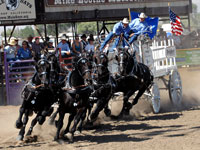
The ground rumbles with Texas Thunder when Priefert’s award-winning six-horse hitch enters the arena. Jason guides the horses through a series of impressive maneuvers. This exhibition includes a simulated “docking” of the freight wagon, a skill that was once necessary for the loading and unloading of freight. The performance also includes the team’s signature “spin the top,” with the horses emerging from the spin at a full gallop known as the stagecoach run. Jason also performs a thrilling Roman Riding act in which he rides standing on the backs of two horses, driving four more in front of him.
The Priefert Percherons have appeared at the Wrangler National Finals Rodeo, the San Antonio Stock Show, the Calgary Stampede, the Denver National Western Stock Show and Rodeo, Cheyenne Frontier Days, Bishop Mule Days, and many other major horse fairs, parades, and PRCA rodeos.
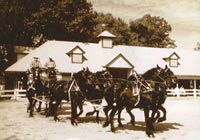
The Priefert family acquired their original team of six Percheron draft horses in 2002. Since that time, Jason and the hitch have been booked with a full schedule. Among the original six horses purchased by Priefert was a horse named Goliath. He went on to hold the Guinness World Record for Tallest Living Horse in 2005 at 19 hands, 1 inch. Today’s hitch horses stand, on average, over 18 hands, 2 inches high, with an average weight of 2,200 pounds each. The Priefert freight wagon is an authentic freight wagon, with the undercarriage, or running gear, of the wagon dating to the late 1800s, when it was used to haul freight in downtown Denver. The box, or upper portion, of the wagon was rebuilt in the early 1990s, by master wagon builder Bob Olson. Together, the Priefert Percherons and their beautiful freight wagon are a spectacle that shouldn’t be missed!
Their upcoming appearances: Equine Affaire in Columbus, Ohio, April 7; the Midwest Horse Fair in Madison, Wisconsin, April 15; Ranch Outlet in Lafayette, Louisiana, May 28; the Mount Pleasant Rodeo in Mount Pleasant, Texas, June 2; the Reno Rodeo in Reno, Nevada, June 16; the Dinosaur Roundup Rodeo in Vernal, Utah, July 7; Cheyenne Frontier Days in Cheyenne, Wyoming, July 22; the Indiana State Fair in Indianapolis, Indiana, August 5, the Oklahoma State Fair in OK City, Oklahoma, September 15; and the Tulsa Fair in Tulsa, Oklahoma, September 29.
March 28, 2011
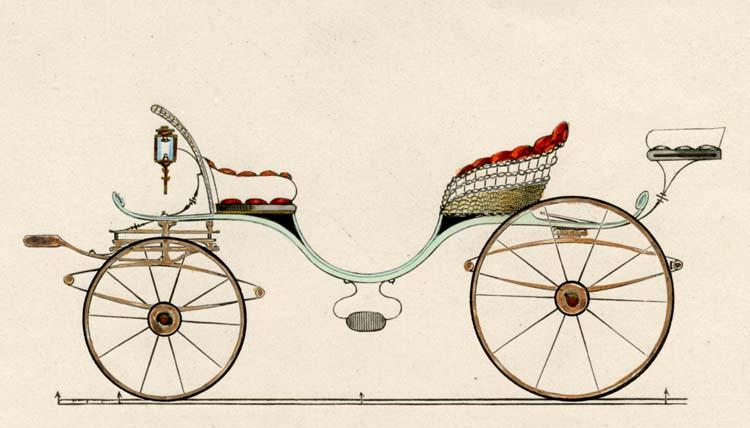
For today: a beautiful (undated) French drawing of a design for a Vis-a-Vis du Prince Imperial.
.
.
UPDATED to say that according to one of our CAA members in the Netherlands, this drawing is probably from about 1860 to 1865 (see Bart’s note in the comments).
March 27, 2011
 The Slower Road