found in the April 17, 1897, issue of The Rider and Driver:
Hackney – French Coach Cross
In talking with the representative of the Chicago Horseman regarding his recent purchase of French coach mares to breed to his great Hackney stallions Langton Performer and Clifton II, Mr. Frederick C. Stevens strongly refutes the inference that he is dissatisfied with the results obtained from his Hackney stock. Mr. Stevens, in replying to a direct question as to this, says:
“Not in the least. It proves that, in my opinion, a Hackney cross will improve anything. Ever since I purchased Maplewood, some seventeen years ago, I have conducted a sort of private experiment station for my own amusement and benefit. The last thing that I determined to experiment with was the production of heavy* harness horses. Before taking my first step I thoroughly investigated both in this country and Europe, the merits of the several breeds which could be used as a foundation. It would be unnecessary for me to discuss the comparative merits of the several breeds, only to say that the Hackney, from my standpoint, met the requirements. I am crossing my Hackney stallions on Standardbred mares (but these are selected with great care for their conformation and round action). Thoroughbred mares and Welsh pony mares are being experimented with. Now, as you say, I have purchased six French coach mares of Mr. Dunham, and they will be bred to Langton Performer and Clifton II. It is an experiment pure and simple.”
(* = “heavy” harness horses were those used with Broughams, Park Drags, Road Coaches, etc., as opposed to the “light” harness horses used with Buggies, Road Wagons, etc.)
Question from The Rider and Driver: “The object you have in view is to produce horses for heavy harness, having the best conformation and great action, regardless of how crosses are made?”
Mr. Stevens’ answer: “That is nearly my idea. I am not prejudiced in favor or against any particular breed or strain. My idea is to determine how the highest type of cob, Brougham, and heavy carriage horse can be produced with a degree of certainty, and then follows the experiment which proves a success. It may be that the best dam will be a half-bred Standardbred / Thoroughbred. If so, we must first take time to breed our dams. It is all a question of great interest, not only to the few breeders now engaged in the business, but to the farmer generally. He can just as well breed a horse that is worth from $300 to $600, or more, as to breed one which is not worth what it has cost to raise him.”
Q: “Now, may I ask you what you hope the result of the cross between the Hackney and French coach horse will be?”
A: “Certainly: a horse 16.25 to 16.75 hands, taking size, and fineness of head and length of neck from the breed of the dam, but having Hackney action, a modified Hackney conformation, and better bone than the dam. I may be greatly disappointed, but it is an experiment worth trying. I have no fault to find with the Hackney crossed any other way. It is a success.”
.
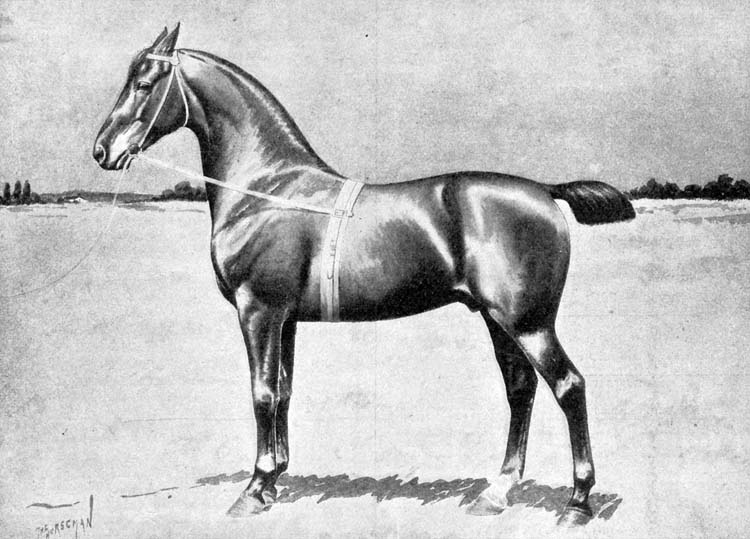
Partisian, 3 years old. Bred at Oaklawn. Got by Perfection (sire of some of the mares purchased by Mr. F. C. Stevens, for Maplewood stud, to cross with his famous Hackneys) out of imported Tranquille. Winner of first prize in the three-year-old class at the New York Horse Show, 1896 (from the April 17, 1897, Rider and Driver)

 The Slower Road