Those of you who (like me) love beautiful old cars just as much as beautiful old carriages will enjoy the story and photos sent by CAA member Randy Solle:

Last weekend, our Solid Axle Corvette Club (1953–1962 Corvettes) went up to Oxnard, California, which is about an hour up the coast from Los Angeles. There, one of our stops was the Mullin Automotive Museum, which contains mainly Art Deco era French automobiles.

.
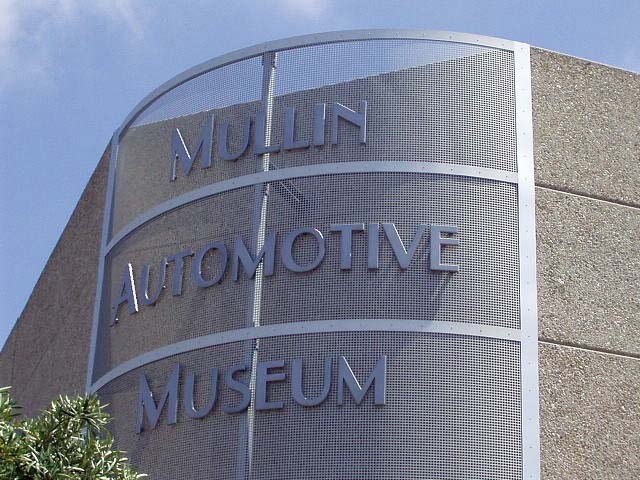
photo by Randy Solle

.

Among the beautiful collection of vehicles is this $40,000,000 (no, that’s not a misprint) Bugatti:

.
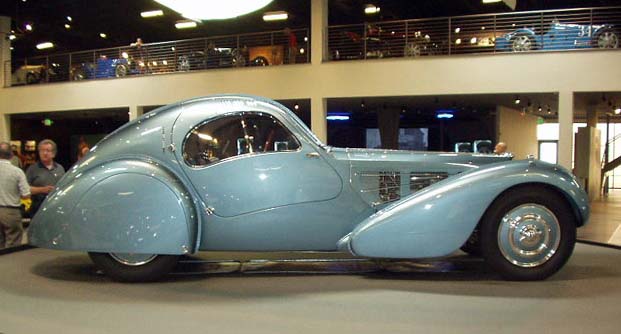
photo by Randy Solle

.

I was surprised to find that they still used the term Shooting Break for some of their vehicles:

.
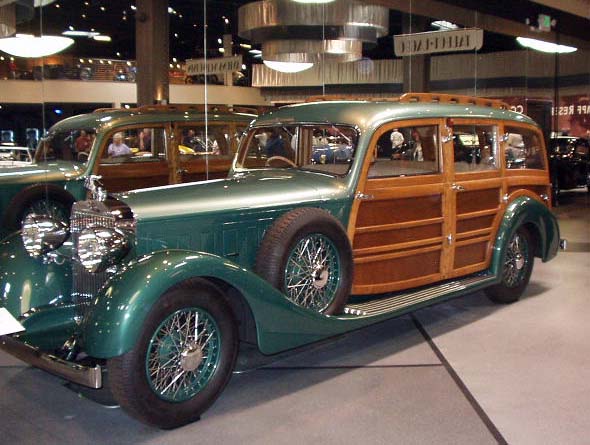
from the museum label for this 1937 Hispano Suiza K6 Shooting Break: the body type is called a "shooting break," a term used to describe a cross between a two-door sports coupe and an estate car; it was designed for the well-heeled to carry large amounts of cargo, such as dogs and hunting guns for grouse shooting; it is also described as a "woody" due to the wooden exterior paneling; the car also has natural buffalo upholstery and seagrass floor mats (photo by Randy Solle)

.

I did manage to find a horse-drawn vehicle in the collection. This is one of the three vehicles that were built for Ettore Bugatti by his family’s automobile company. I would guess that this was one of the vehicles that came from the Kluge Collection.

.
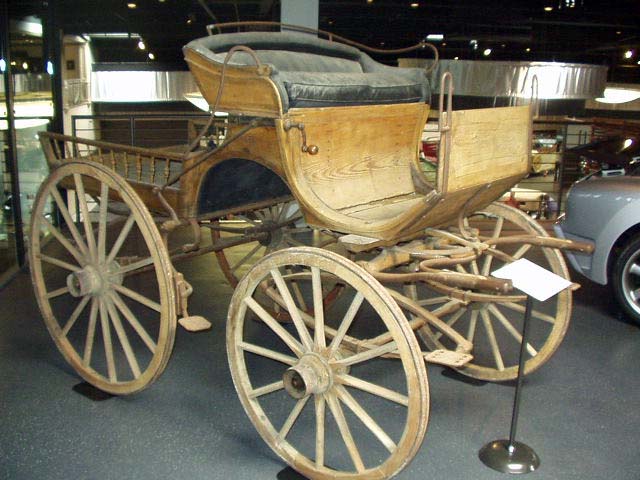
according to the museum label, this vehicle was built in the 1930s by the Bugatti company for Ettore Bugatti, who was an avid horseman; this and two others were intended to be used on the family estate and for short trips (photo by Randy Solle)

.

I thought that the rear spring angle was rather unusual on this vehicle. In the second (detail) picture of the springs, you can see a wedge that has been inserted under the spring – by the looks of it, some time ago.

.
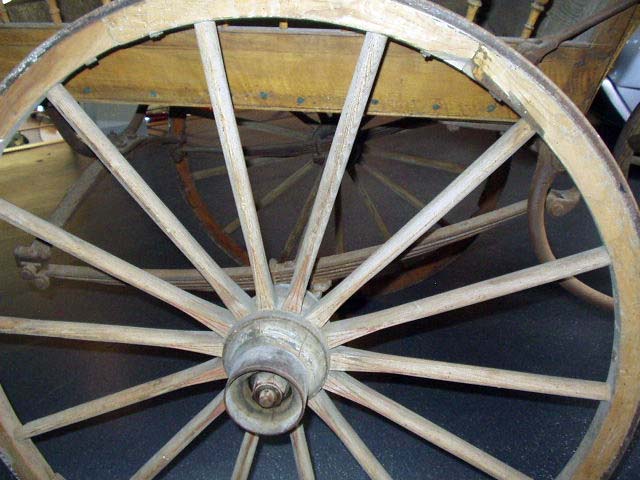
photo by Randy Solle

.
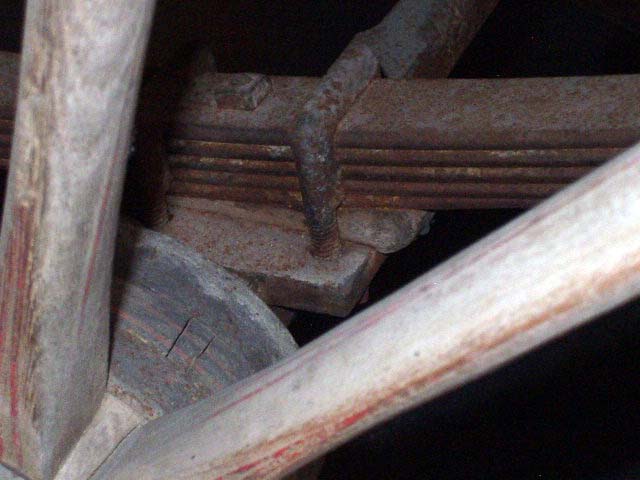
photo by Randy Solle

.

Carlo Bugatti was also very interested in building furniture, which seems to have something of an Asian influence:

.
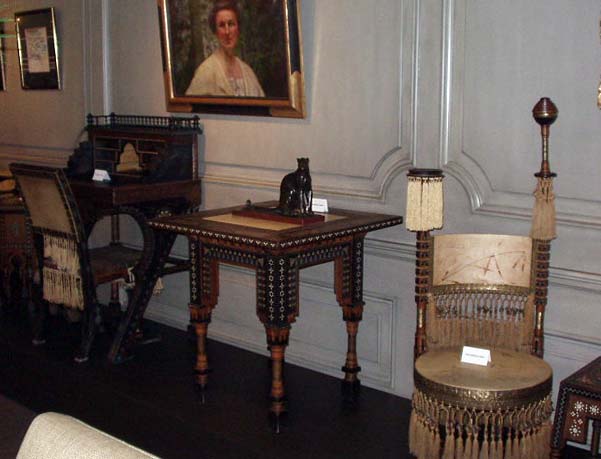
photo by Randy Solle

.

Finally, this was a barn find from northern California. It was in dire need of restoration then, but look at it now!

.
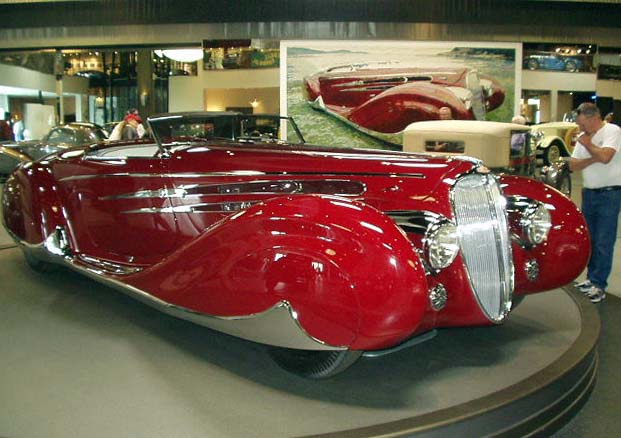
1930 Bugatti Type 46 Cabriolet (photo by Randy Solle)

… and to think this took place in the middle of New York City, and probably even in an indoor riding arena …

from the April 3, 1897, issue of Rider and Driver:

“The Rough Riding Club of New York will give a grand mounted tournament at Durland’s [Riding Academy], on Saturday evening, the 10th [of April, 1897]. In addition to the full-dress military drill, with lance and sabre, there will be contests at tent-pegging between the New York team and a team from the Brooklyn Riding and Driving Club, wrestling on horseback [huh??], single-stick cockade melee [what??], broadsword combat, Cossack riding and vaulting, and as a finale, a realistic attack  upon a fort with rifles, artillery, and mounted lancers.”

[Wow.]

As I mentioned yesterday, the Carthusian (oldest, purest) strain of Spanish horses was bred — starting in the fifteenth century — by the Carthusian monks who lived and worked at this monastery:

.

.

The horse-breeding operation is now carried out at a modern facility farther outside of town, and this former monastery is now, we were told, a private convent. Sadly, it’s not open to the public, so we could merely admire the facade and imagine how ornate and beautiful it must be on the inside.

Following along from yesterday’s video of a Doma Vaquera performance, let’s go back briefly to southern Spain with our group of CAA travelers. And let’s concentrate today on the horses, because they’re so darned beautiful.

During our CAA trip to Andalusia earlier this year, we toured the Yeguada de la Cartuja. This official stud farm for the Carthusian strain of Spanish horses (the oldest and purest strain) is located near Jerez de la Frontera.

First, we were given a brief history of the Carthusian monks’ breeding program (which began sometime in the fifteenth century) and its evolution into the modern breeding farm we were visiting on that Saturday in April.

Then, we visited the stud farm’s small collection of carriages, two of which you can see here:

.

.

.

Next, we enjoyed a tour of the stables, the hospital, and the rest of the modern facility.

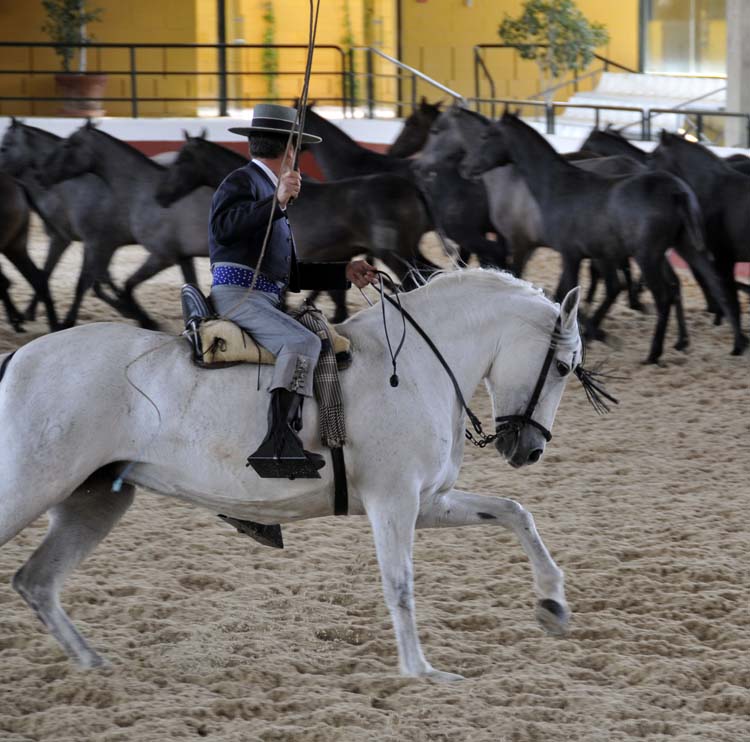
Finally, we attended the Yeguada’s spectacular daily show. It’s held in a covered arena, but one end is open to the outside … all the better for allowing herds of horses to gallop into the arena!

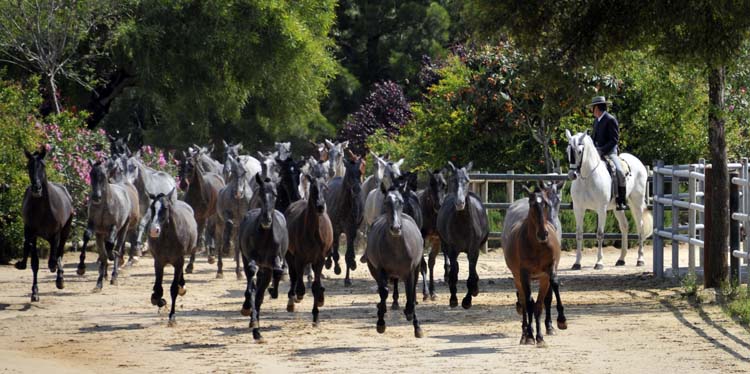
The first in was a large group of yearlings:

.

.

.

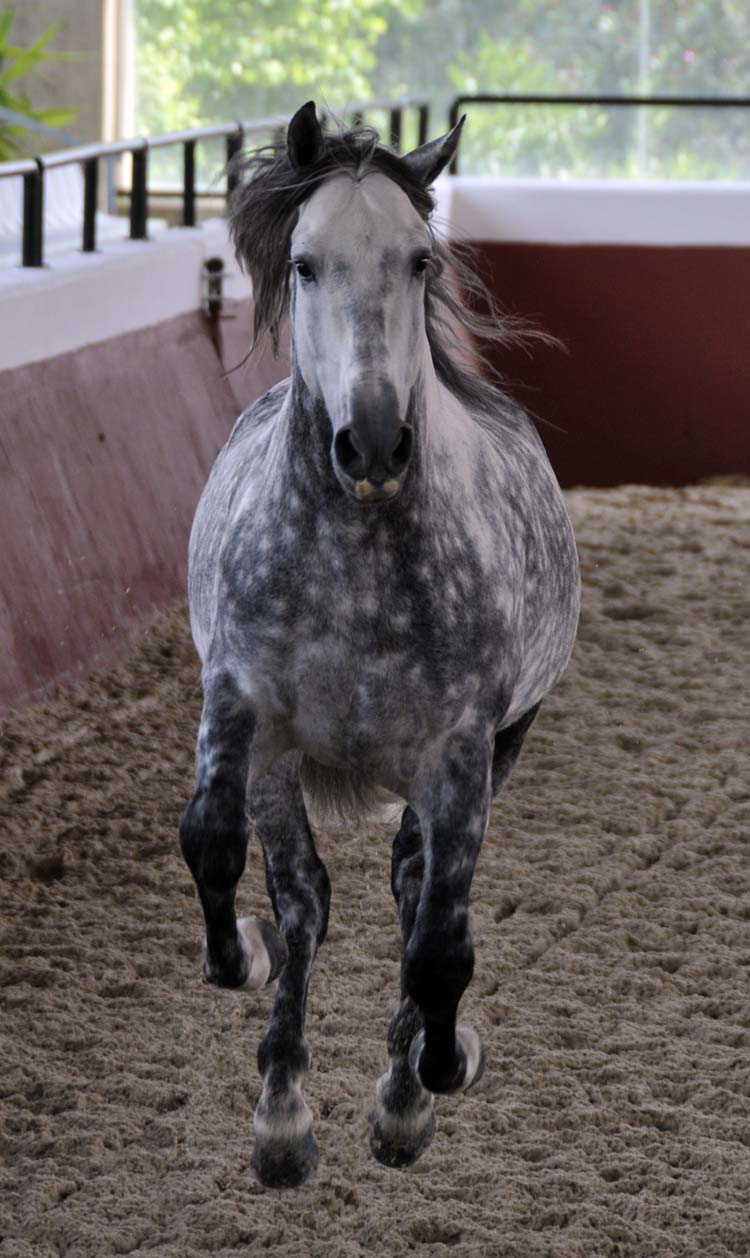
Then, after they left, a gorgeous young stallion was given the entire arena to show off:

.

.

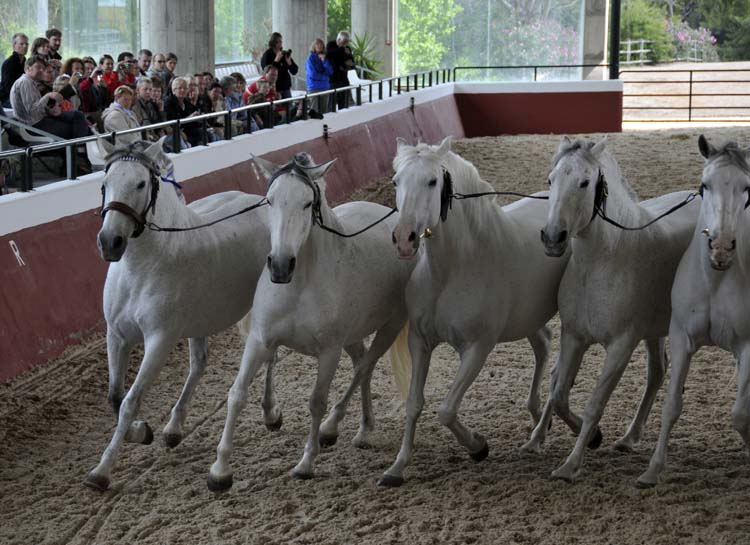
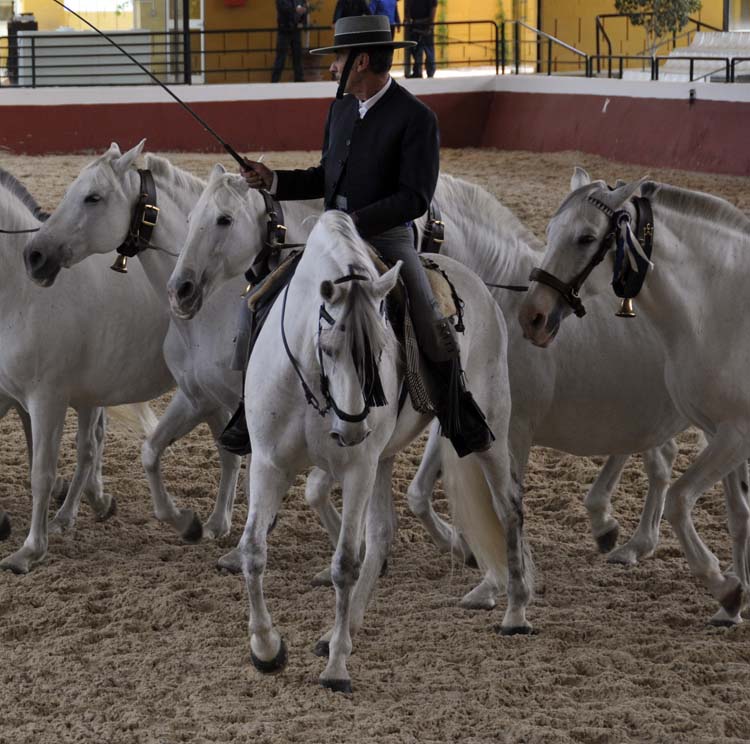
And then came a lovely group of mares. Each one wears a neck collar, with a bell attached. And the neck collars are all attached to each other, creating a row of mares. The mares’ “handler” is not physically connected to them in any way but controls the entire row with his voice and whip (which is, of cours, snapped in the air, not at or on the mares).

.

.

.

.

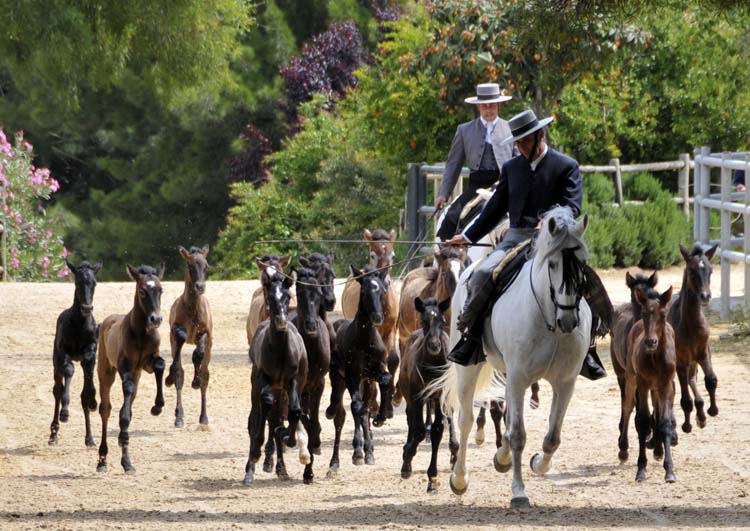
A herd of foals!!

.

.

As the show was wrapping up, I stepped outside the arena for a minute and witnessed two of the most iconic Spanish-horse scenes of the day:

.

.

I think it’s almost time to head back to Spain, here on the blog, and share some more photos and stories from our CAA group’s trip there earlier this year.

To get us all in the mood, how about some Spanish guitar music and “Doma Vaquera”?

Doma Vaquera is a style of Spanish riding (similar to what we in the U.S. might know as “cowboy dressage”) that evolved from working with cattle and bulls on the ranches of southern Spain.

This show appears to have taken place in Germany, judging from the Warsteiner beer ads along the side of the arena. And, judging by the German-language narration at the beginning, it was broadcast on German TV.

.