When we left Mr. Johnson last week, he had been describing his circuitous method of ascending and descending the bluffs near Alder Point.

… “I am still but a short distance from Eel river. This river is a terror to those who have it to ford. No bridge – no ferry – it must be forded. Had it not been for this river, I should have started on my journey east the first of May [instead of on the first of June]. The rainy season had been longer in duration than in past seasons.

“When I arrived at the river there was a man, with a wagon and four horses ladened with goods. He was in conversation with another person. The teamster came to me and said: ‘We had better get this man to pilot us across, it is dangerous for us to ford.’ ‘What does he ask to help us across?’ ‘Two dollars each,’ said the teamster. ‘Where is this ford, I would like to look at it.’ ‘It is a few rods, just below the bluffs,’ replied the teamster.

“I went down to the bluff, to the river, looked at it a short time. I then took Fanny, my horse, from the wagon, got upon her back and rode into the water, and finding it much better than I expected, continued across. Returning, dismounted, put Fanny back into the carriage, got on and drove down the bank into the river and crossed over all right. The man with the team had just got to the river. I sang out: ‘Teamster, come across and save your money.’ He dared not do it, but gave the man two dollars needlessly, to guide him across. He might have known that if I could cross with my light load he could with his heavy wagon.” …

Stay tuned for tomorrow’s post, in which we hear the rest of Mr. Johnson’s tale from that particular day, during which he has a run-in with a rather vicious stagecoach driver.
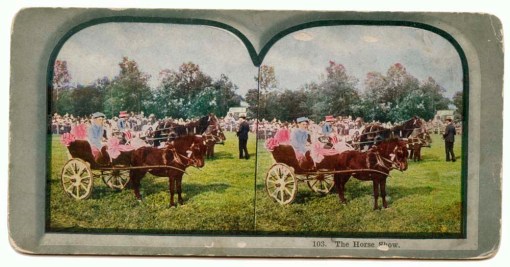
About a week ago, A.J. and I were in an antique store in Georgia, where I found a couple of stereoscope cards with horses and carriages. This brightly colored one shows a line-up of the participants at a horse show, with a fat, furry pony in the foreground.

.

.

I believe the CMA has a few of these cards in its collection as well.

Obviously, I can’t give you the proper 3-D effect here on the blog, nor can you see it by looking at these in person. Clearly, the next thing we’ll need to find is an old handheld viewer.* I know I’ve seen them in various antique stores here in Lexington, so I’ll be on the lookout the next time we’re browsing!

.

* For a brief history of the earliest forms of 3-D, and a photo of a handheld stereoscopic viewer, click here. If you happen to watch the video (about a Canadian museum exhibition on early 3-D methods) embedded in this article, it also has some nice old stereoscopic photos of horses and carriages.

Did you notice the new addition to the blog’s banner / header photo, above?

When I first started this blog, it was meant simply as a place to share stories and photos from CAA trips and events. So we just called it “the CAA blog.”

Over the past couple of years, however, the blog’s scope has expanded so much that I thought it needed a more all-encompassing name; something we could all refer to in conversation. Nearly everything on the blog is somehow related to traveling at the speed of horses walking or trotting: carriage driving then and now, horse-drawn transportation, and travel on early roads … hence “The Slower Road.”

The blog’s official name, as far as WordPress and the various Internet search engines are concerned, is still “The Carriage Association of America.” And the address, of course, remains www.carriageassociation.wordpress.com. But while we’re all zooming around the Internet, I hope you’ll join me in a daily drive down The Slower Road as well.

Here’s a view of Eleventh Avenue in New York City, c. 1910. The street was dubbed “Death Avenue” around the turn of the nineteenth / twentieth centuries because of the large numbers of pedestrians killed by the freight trains (!) that ran, albeit slowly, on these street-level tracks. In an attempt to not frighten the horses, the coal-powered steam locomotives were disguised to look (somewhat) like streetcars. But I do wonder whether the horses were really fooled …

In the foreground, on the left, a delivery van waits by the curb, and a wagon loaded with barrels is driving right on the tracks, between the train’s flag-man on horseback and the train itself. To the wagon’s right (to its left as we look at the photo) is a Hansom Cab. You can see a number of other delivery and commercial vehicles, and a streetcar, next to the train.

According to the caption on this next photo — another view of the same street —  it was supposedly taken about a year later. But I think it was actually taken on the same day (near the same time, even) as the photo above. The horse and delivery van by the curb are clearly the same in both photos.

The street-level tracks were replaced in the 1920s with an elevated track.

Several days after we left Mr. Johnson in yesterday’s post, he …

“Left Blocksberg on the 9th and made Alder Point the same day, distance thirteen miles.

Alder Point. — From Blocksberg to this place proved a very hard day’s journey, the road being very rough, hard, and hilly. It was hard on the cattle, wagon, and myself. The road had been sideling – very much so. It was bluffs, mountains, and canyons. Travelers do not go over the bluffs or mountains, but around them.

“In laying out this road, if it ever was laid out, which I suppose it must have been, as it is a county road, their work was crudely done. If you desire to reach a given point on mountain or bluff, say Alder Point, you start at the base and go on following the same until you have made a half circle, keeping to the right till you come to a point or plateau, you have made a mile. You then turn to the right, cross the end of the canyon, [and] this places you on the right of another bluff. Following its base you travel until you reach the point opposite where you started, thus making a second mile, and so on, until the summit of the bluff is reached. Could you have crossed the canyon at the first point two miles of traveling would have been saved.

“The foregoing gives an idea of the roads and the mode of crossing the bluffs, mountains, or canyons in northern and eastern California, outside of the valleys. I have said the roads are sideling and they are.

“Over the road on which I am traveling, the mail from San Francisco is carried three hundred and three miles in thirty-six hours, nearly nine miles to the hour, by two horses in a wagon that weighs eight hundred pounds; as this team tears round the bluff, it is no wonder that one rut is lower than the other.

“There is no money expended on the roads, only the bridges are kept in repair.”