In our first foray into the fascinating old photos (and the captions!) contained in our big Glimpses of the World book (1892), I said that the captions didn’t usually mention any of the vehicles that may be in the photos. Well, I was wrong. In some instances, it would appear, the vehicles are an integral part of the image and of the story …

.

from Glimpses of the World (1892), page 19

.

The caption for this photo reads: “Beginning at the noble church of the Madeleine, which so forcibly resembles a Greek Temple, there extends for nearly three miles to the Place de la Bastille a series of beautiful thoroughfares known as THE original Paris boulevards par excellence. There are eleven of these streets, succeeding one another like links in a golden chain. The first is the one outlined in this representation, and is called (from the building at its commencement) the Boulevard de la Madeleine. There is a charm about these boulevards which no other streets in the world seem to possess. They are a recognized rendezvous for fashionable idlers and pleasure-seekers. Throngs of elegant vehicles pass and repass here every afternoon in bewildering succession. On their broad sidewalks there are not simply thousands of promenaders, but hundreds of men and women seated at little tables in front of glittering cafés, sipping coffee or eau sucrée, or eating an ice-cream, as an excuse to have the privilege of occupying, as it were, an orchestra chair or proscenium box at this attractive spectacle of life and gaity, of which the boulevard itself is the stage. And if this be true of the boulevards in the afternoon, still more brilliant and animated do these sidewalks become on pleasant evenings, when every café is radiant with lights repeated in innumerable mirrors, and when every jeweler’s windows look like the entrance to Aladdin’s fabled caverns! Two features of Parisian boulevards will be recalled by every traveler. They are the tall circular structures called ‘kiosques,’ some of which are merely covered with theatrical advertisements, while others serve as newspaper stands, or little bars for the sale of unintoxicating drinks.”

(I have to say, I don’t know why the images in the past couple of posts have been so small, as I’m not doing anything differently than normal. But if you click on this one, you’ll get a larger version.)
Last week, I posted a couple more snippets from Mr. Johnson’s tale of his travels across the continent in 1882. In those two posts, he was traveling through the area around Grass Valley, California.

And I heard from two readers (one via blog comments and one by email) that they really enjoyed those particular entries because they live — and drive their horses — in that same area. Thank you both for sharing your stories!

I hope y’all will find this next bit just as interesting. This was Mr. Johnson’s next stop after he’d crossed the canyon …

“North Bloomfield is situated on a high elevation. It is not much of a town for business or population; it is a stop-over place for the teamsters, and about mid-way from Grass Valley to Graniteville. The hotel is about sixty by fifty feet, two stories high, and fronts the east. Its proprietor is a gentleman about sixty-five years old. In front of the building is a store, saloon, and one other building. I think there is also a blacksmith’s shop, which constitutes the town. Standing in front of the hotel, looking east and south, you can see nothing but hills, bluffs, and mountains; to my left, in full view, are the Sierra mountains; to my right are numerous mining districts; in fact, they lay all around. There is an immense amount of freight brought here from around the country, which requires a good road, and they have them. But the way they transport merchandise is a surprise. Sixteen horses harnessed to one wagon and three other wagons attached, making a long train. To me, this was something new, but I found it a common mode of transportation.”

Even though the January issue of The Carriage Journal may still be on its way to some CAA members’ mailboxes, I’ve already started working on the March issue.

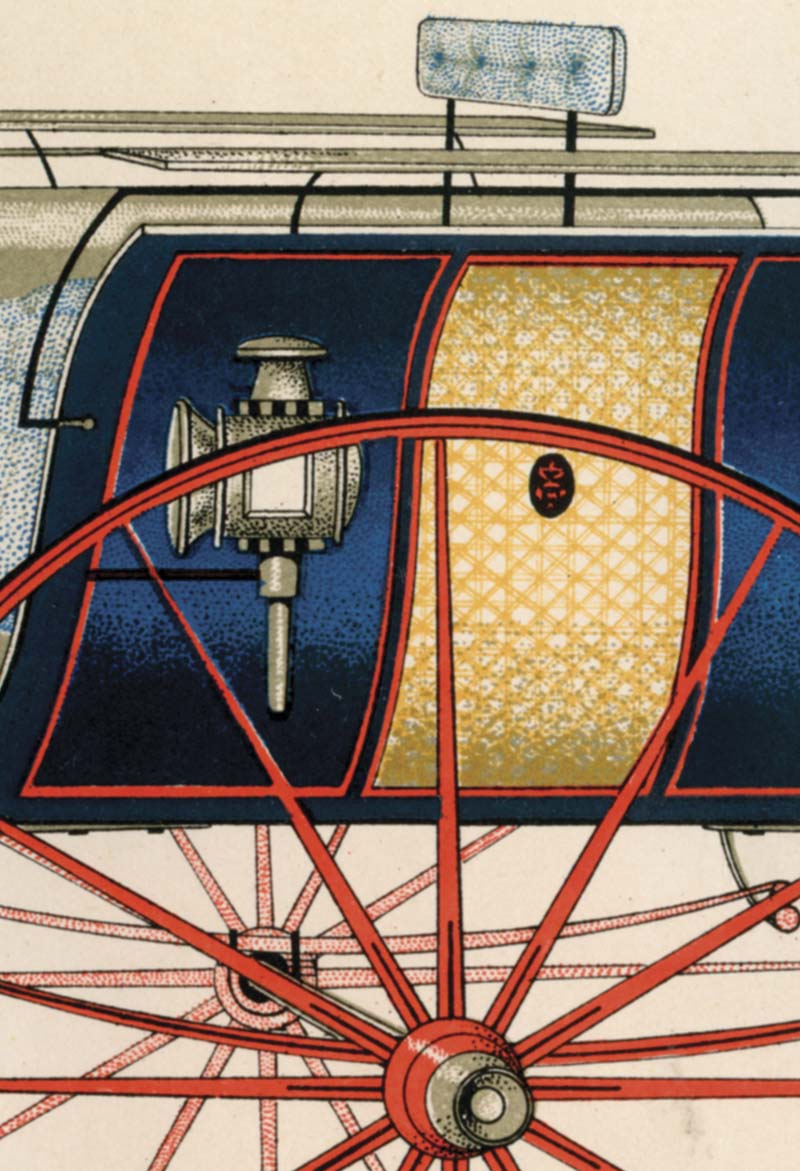
Today, Mindy (who’s in charge of the CMA’s Library & Archives, here in our office) found an 1898 print of a beautiful and colorful vehicle, which we’ll be featuring on the cover. I don’t want to spoil the surprise, but here’s a snippet:

.

cover image - march 2013 cj

.

In 1897, Francis T. Underhill published a book that went on to become an enormously popular guide to carriage driving during America’s Gilded Age. The original book, Driving for Pleasure: The Harness Stable and Its Appointments, has been out of print for many years now, but it was reprinted (at least) twice in a variety of formats in the intervening years. Now even the reprints are out of print.

But the CAA is coming to the rescue! … We have plans to reprint this well-loved, interesting, and enormously useful book sometime this year.

Here, as a glimpse of things to come, and because it’s interesting in its own right, is Chapter 2:

“The preceding chapter is designed to point out the necessity of adhering to simplicity, combined with as much symmetry of outline as is possible, in every variety of carriage.

“This simplicity should be carried out in the harness, livery, etc. The owner, if his means allow, can produce a brilliant effect by means of uncommonly good horseflesh. What can look worse than a poorly designed and gaudily painted brougham with enormous, fantastically shaped lamps resembling those used on the Lord Mayor’s coach of yore? The whole tawdry effect is generally emphasized by an elaborate harness replete with enormous monograms, and partially hiding a pair of ‘screws’ which would disgrace a street car.

“The contrast between such an equipage, and the perfectly-turned-out brougham, which is so quiet in design and treatment as to be almost unnoticeable, is very great. In this case the harness is plain but handsomely made; the servants are clad in smart, well-fitting and well-put-on liveries; they carry themselves with an air of pride, and seem to feel that the effect of their equipage depends on them — as in a great measure it does.

“With such appointments, a carriage will at least look respectable when drawn by even an ordinary pair; and when the horses are really fine and thoroughly adapted to their work, the effect produced will compel the admiration of the intelligent on-looker, although in most cases he will not know what attracts him. This, then, is the ideal which should guide those who wish to turn out really well.

“The coloring of a carriage has much to do with its general effect. Plain black, and the dark shades of green, blue, and claret, produce the best results in carriages for town use of the non-sporting class. Bright-colored wheels and undercarriages should never be attempted unless the owner be more than ordinarily well versed in the remainder of the appointments. A departure such as this requires the extreme of severity in treatment to make it pass muster.

“In England, of course, where family colors have been in use for generations, the conditions are somewhat different, but the family whose colors are quiet is to be congratulated. …

“A well-made harness is often spoiled by excessive ornamentation — gorgeous monograms or crests covering every available surface. Oftentimes the same decorations reduced one half in size would look perfectly proper. …

“Good liveries are essential to a well-appointed equipage; and yet no department is as much neglected in this country. When one has seen the same carriage, well turned out in other respects, either improved or ruined by smart or slouchy servants, he will appreciate the point.

“The very position of the servants contributes largely toward the general finish. Put a slouchy mustached coachman on the box of the best generally appointed carriage procurable, and its good points go for naught. No private coachman wears a mustache or beard, and the presence of such can invariably be considered an indication of ignorance of his calling. Such a man may be a good strapper [groom], and in a general-utility place might be satisfactory; but he should never be employed as a coachman.

“The town coachman must be a man of experience, and reasonable wages paid to such a man will often save a large expenditure in paint and repairs. The thorough coachman can be distinguished at a glance, and it is unfortunate that they are so few and far between.”

Today it’s gray and chilly, quite wintery actually, here in Lexington.

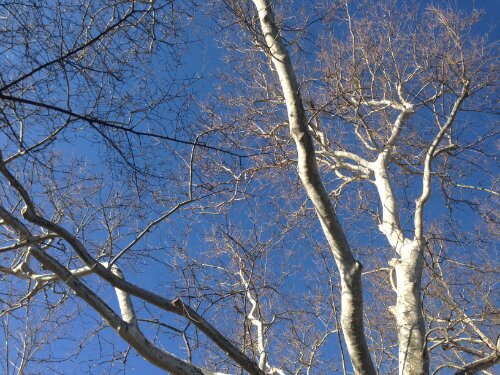
But here’s your moment of sycamore-and-blue-sky zen from our sunshiny yesterday:

.

image

.