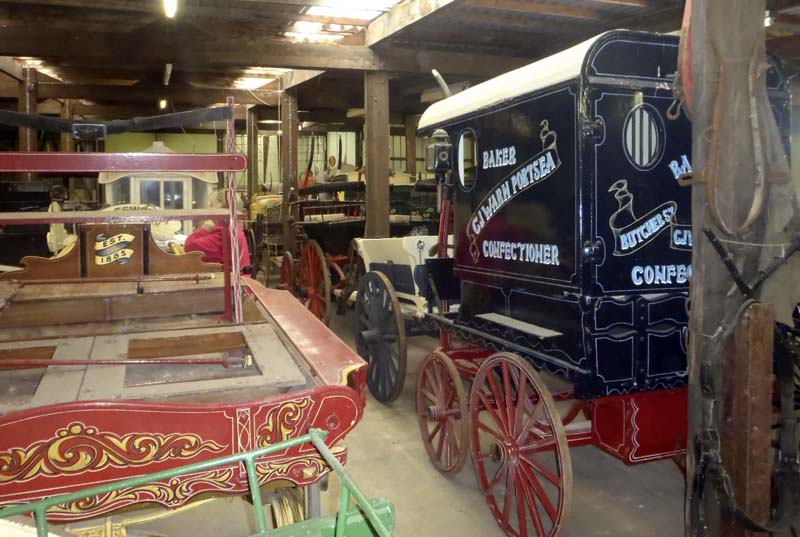
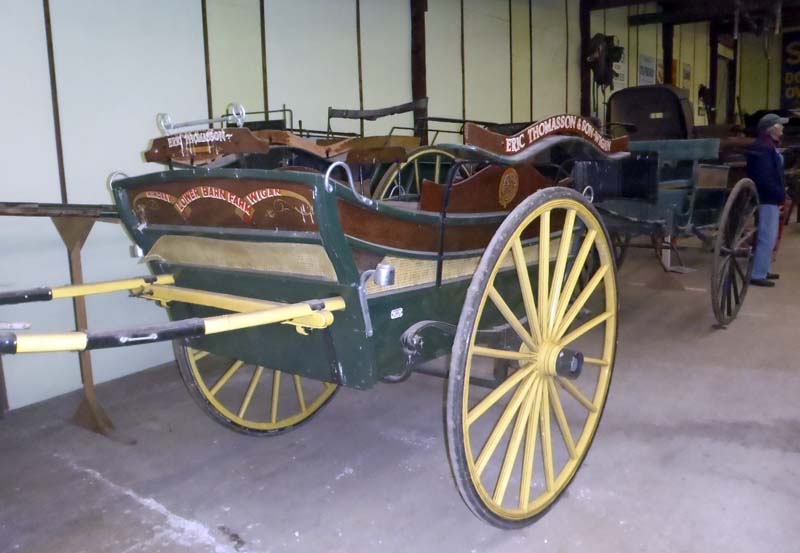
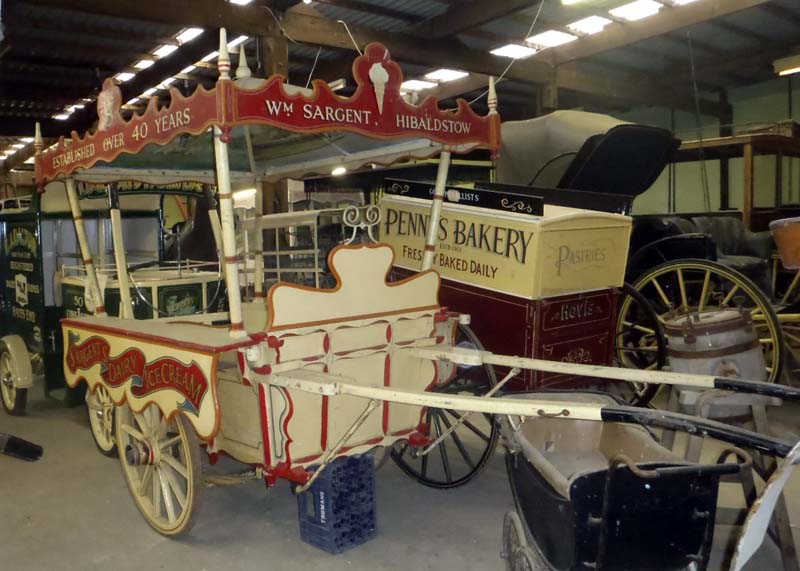
One of my favorite classes at the Royal Windsor Horse Show is always the Light Trade Vehicles class. During the horse-drawn era, businesses all had their own specialty vehicles: each in a different size, shape, and style. And every one of them was, without fail, brightly painted and decorated.

Those in the small CAA group that traveled on to Norfolk from Windsor last week were fortunate to visit the impressive (and colorful!) carriage collection of Jim Lawes and Harriet Crowther. Jill took these photos of some of their trade vehicles …

.

.

.

.

.

.

… After conversing with his host, Mr. Johnson said, “‘Friend, it is now about time to milk my cow, can you let me have a pail and I will go and milk her and give them some water and grain.’ ‘I will go with you, we have plenty of good water.’ While I was milking my host came with two pails of grain for my cattle. This was wholly unexpected. I gave the grain to the cattle and then carried the milk into the house, giving it to the wife, when she remarked, ‘Sammy, what a lot of milk his cow gives, more than all ours put together. Well, stranger, I suppose you would like to go to bed soon?’ ‘Yes, I feel as though I would like some rest.’ ‘Any time when you are ready I will show you to your room.’ ‘But, friends, I always sleep with my cattle; I have had good beds offered me, but I always decline them. I dare not leave my cattle; should someone borrow them I fear they would not return them in season. I carry my bedding, make the cow fast to one wheel and the horse to the opposite, and myself and dog lay between them. Many nights I have been awakened by the snorting of my horse. I always keep my lantern burning. Many times I have been awakened by the wolves around me, but as yet have come to no harm. Tomorrow I would like to reach Wells. What is the distance.?’ ‘Wells is about thirty miles from here. You can not travel to Wells in one day, can you?’ ‘I travel about two and a half miles an hour, day and night if I wish; sometimes I crowd three miles into an hour and sometimes only two, but I average the two and a half miles. I suppose I am not far from the river?’ ‘The river is north of us, about a half mile, and a half mile from here you ford the river, then there is a good road to Wells.’ ‘I must reach Wells tomorrow. I can travel that distance in fifteen hours, with stops, and should like to start at six o’clock. If you make a good fire, I will take advantage of it and make myself some coffee. I have some good [coffee] that I brought with me from San Francisco, so you see what I carry with me. Well, friends, I will go to bed with my cattle.’ ‘Stranger, you had better sleep in the house, it looks like a cold, frosty night; your cattle will be safe.’ ‘You do not know that. When coming through Hallecks I intended to have stopped there overnight, but things did not suit me, so I came on here. Perhaps some of those I saw may follow me; I have been advised to look sharp after my cattle.’ So lighting my lantern I left them for the night and went to my quarters, securing the cattle for the night and laid down for sleep.”

… continued from yesterday …

At six o’clock the next day, Mr. Johnson reached Hallocks station. “The surroundings at this station I did not like. I gave my cattle water and went on, taking the trail that led to the right and followed it until I came to a house, which I found untenanted, so I journeyed on still further and came to another house where I found the people at home, and asked if I could stop there for the night, having coming from Elko and myself and cattle being very tired. ‘Yes, stranger, you can, I like the sound of your voice. It is Eastern, if I am not mistaken; you are or have been an Eastern man.’ ‘I am. Will my cattle do any harm to let them in to those stacks of hay and let them eat all they want?’ ‘You can let them in there and they can have all they need.’ I led them into the yard and turned them loose; the horse took to rolling and the cow to the grass.

“The man of the house asked me in, saying he had a wife and two children and had many questions to ask me. So I went into the house and he said, ‘Wife, this stranger is going to stop with us tonight; get him some supper while I ask him some questions.’ ‘No, Sam, wait till he has had his supper, then we all will listen,’ answered the wife. So as soon as the supper was ready we all gathered around the table and partook of a hearty meal. The man of the house asked for my story, where I was from and where going. I answered, saying, ‘Well, friend, I have come from California, more than three hundred miles north of San Francisco, having left Eureka city on June 1st, following the railroad most of the way, and have traveled more than a thousand miles already.’ ‘What, and brought that cow that distance?’ ‘Yes, just as I am: horse, carriage, cow, and dog.’ ‘And where are you going to, I would like to know?’ ‘Well, friend I belong in Massachusetts, and am going there; that is my intention.’ ‘Well, stranger, ain’t you a little crazy?’ ‘You are not the first that has thought me so, but as yet I am all right.’

“[My host replied,] ‘Well, well; what a long journey before you, and you think you can make this journey. How many miles will you have to travel to make it?’ ‘About four thousand, perhaps a little more.’ ‘Why, that cow can’t stand it; she will wear off her feet and legs.’ ‘But, friend, she has on her feet iron shoes, and so has the horse. So far, the cow has stood the journey the best.’ ‘I did not think she was shod, and should not wonder that the cow did stand it best. Does she give milk?’ ‘Yes, I milk her twice a day; I have milked her three, and once four times a day, and have sold milk all along for fifty cents a gallon to the station agents. When I have sold on the trains I have got twenty cents a quart. When I came through Reno, where I got the cow shod, I was obliged to stop four days, as she was lame from the shoeing. This was her first shoeing and, as she had traveled more than seven hundred miles, her feet were very much worn, and putting on the iron shoes contracted her feet, causing the lameness. The blacksmith told me not to take off her shoes, and the soreness would wear away; she could not have traveled much farther without shoes, so I stopped over. The four days I was at Reno I sold over seven dollars’ worth of milk, so you can easily see that she is worth something on the road.’

“‘What part of Massachusetts are you going to?’ ‘The town of Webster, Worcester county.’ ‘I am from the State of New York, so you see I also come from the East.’ ‘What brought you out here?’ ‘Oh, I came out here to get rich by raising cattle.’ ‘You have got rich, I suppose?’ ‘Well, I am not rich, but I can make more money by raising cattle than I could by raising corn in Nebraska. We can grow potatoes and small grain, but no corn; we can cut any quantity of hay. You see those four stacks? There are eighty tons of hay in them.’ ‘How many cattle have you?’ ‘I have thirty-six head on my own ranch. There are three of us, each having a ranch, about one hundred head of cattle in all.’ ‘Do you feed your cattle in the winter?’ ‘Oh, yes. We do not intend to have them freeze to death. We give them shelter and feed with hay. We do not have such barns as you have down East, as lumber is too costly. We have long sheds fronting to the south, boarded on the north side and ends, about twelve feet wide and seven feet high, covered with straw. This gives our cattle a good, comfortable shelter in a storm and breaks the cold wind. This mode is an improvement of our own, and there are but few in the state like ours.'”
When we last checked in with Mr. Johnson, he had just reached Carlin.

“On the morning of the tenth [of September 1882], I left Carlin for Elko, a distance of twenty-three miles. Leaving Carlin I crossed the railroad and traveled on its left for a distance of ten miles, when I recrossed the railroad to my right, down on to a flat plat of mowing land, which brings me to the river that I had to ford. It is now a fine trail. I came to a house, which was a poor shanty and knocked at the door but no one answered. I then went to the barn, which was much better than the house, but could see no one around. I stopped and made a fire, fed the cattle, and got myself a breakfast of boiled eggs and coffee. After breakfast I traveled about a half mile but could not find a trail. I was on the right of the river, close to its bank, but could see no place to ford, on the right was a high bluff rising from the river. I was completely shut in. I returned to the house again but could find no one around, then I retraced my way back to the railroad. On crossing the railroad I saw some men at work a short distance away.

“I looked around for a place to hitch my horse, but could see no tree or shrub, so I took the horse from the carriage and fastened her to the wheel. I then left them and was just getting on the track to go to the men, when I saw a band of Indians coming down the bluff on horseback; there were eighteen of them, and they were about twenty rods away from me. I called out to them to stop; two of them rode up to me and I saluted them, which they returned. I told them that I had come from Carlin and was going to Elko, but had lost my trail; I had been to that shanty but could not find the trail. ‘Here is the trail to Elko,’ said the Indian. I should not have crossed the railroad, but [should] have followed it a short distance further and then crossed. I put the horse into the shafts again and went on, traveling on the left to a dry canyon. …

“… I am now journeying where it is necessary and we are commanded to open and shut gates in crossing the railroads. This command I always comply with. I am traveling on the river running between Carlin and Elko. I have to open and shut gates as the trail runs from pasture to pasture. I am passing through fields of clover, of which I allow my cattle to eat as they go, it is such a change from the dry, barren canyons and roads I have just left. Those that journey on wheels have to make their own trail, which was bad for me as my carriage was light and was very trying to myself and horse. I arrived at Elko just as the freight train came in at half-past five o’clock. I went for the hotel at once and sought out the proprietor, whom I found and telling him my story, said, ‘My cow is a fine animal, gives good milk and a large quantity. I am short of money and obliged to make what little I have go a long way. Will you take milk in exchange for food?’ ‘I will, sir, with pleasure. You are the man for whom I have been looking for some days. I read in a Reno paper and also in a Battle Mountain paper, that a man from California with a horse, carriage, cow, and dog was on his way east, and you are the man, I suppose?’ ‘I am, sir.’ ‘You are a plucky man. You ought to be following a band of music.'”

First, I saw this beautiful photo on Facebook:

.

.

Then, I got in touch with my FB friend who’d posted it, who was also the photographer: Yogi Howe. And he sent me three more photos he’d taken:

.

.

.

.

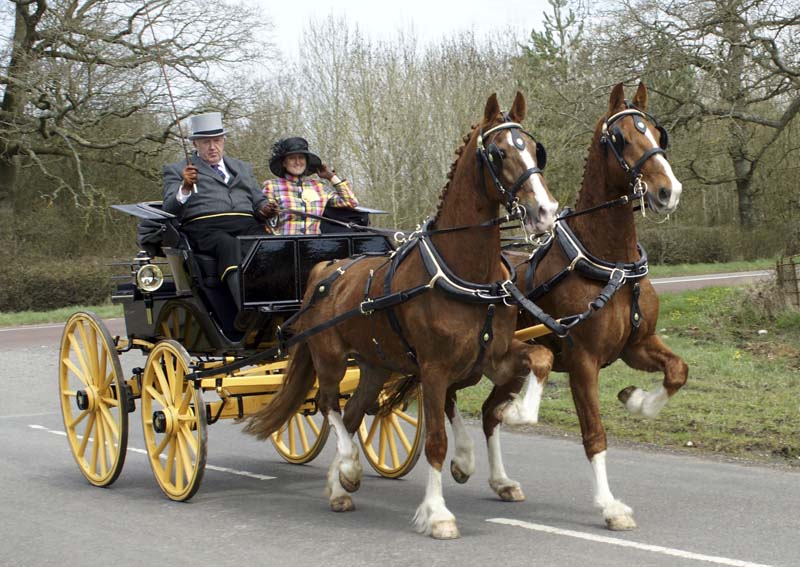
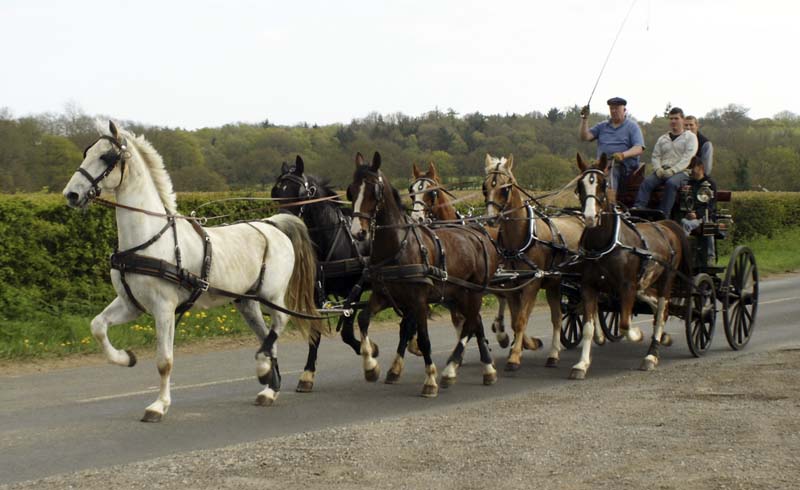
All four of these photos, it turns out, are of CAA member Bob Alexander (of England). According to Yogi, Bob is the largest private owner of Gelderlander horses in the United Kingdom.

The first photo above shows Bob driving a pair of his Gelderlanders in mid-April, at an organized drive at Knepp Castle, in West Sussex. The vehicle is a Mail Phaeton built by Shanks, which was a London coach-building firm from 1840 until the very early twentieth century.

In the second photo, Bob is driving his tandem of chestnut Gelderlanders to a new four-wheeled Tandem Dog-cart. In the third photo, he’s driving his team of chestnut Gelderlanders. And in the fourth photo, he’s driving his six-horse “arrow” of Gelderlanders.

This video was posted on YouTube in 2009, and it shows two of Bob’s Gelderlander youngsters (at the time), on a training drive:

.

.

(If the embedded video won’t play on your computer, click here to go directly on YouTube.)