I wrote to Gerard Paagman to let him know that his story (and photos) on the Olympic torch relay across the frozen lake, with his Friesians and sleigh, has received more comments than any other post on this blog.

Here’s his response:

For sure we are very delighted by the mail you’ve sent us.

I started driving a little pony when I was 8 years old (sometimes the pony drove me in those days!!) and now I’m 53 years old.

The pony became a bigger pony, then a horse and then a pair and the multiples! And we have always done as many things as we could do: from trail driving (or driving on the beach when we were living near the ocean in The Netherlands) to competition driving, from parades to weddings, from taking the horses for a swim to racing with the horses. And so … we feel very fortunate that horses have been taking such an important part of our lives.

And from all those events, shows, performances we have done, our performance in the Olympic torch relay was the very best. What an experience and what an honor!

 Also, here’s a video clip I found on YouTube, which highlights the torch’s  progress and has short clips of the horses during the first half of the video: http://www.youtube.com/watch?v=6Pz7iLn3nMI 

This past Saturday (Feb. 13) was as close to pure basketball heaven as we Lexingtonians have been in quite a long time. I hear that there was a huge party in the street when the Wildcats won the NCAA national championship in 1998, but that was before we moved here, so we can only go on hearsay. We’re happy to report, though, that we were part of all the festivities on Saturday.

Why “basketball heaven,” you ask? In the morning: ESPN College GameDay came to town, for a wildly loud show. Then, at 9:00 p.m.: our Univ. of KY Wildcats played the Tennessee Volunteers. The energy from GameDay carried over to the game, which was so loud that I had to plug my ears a few times. And it was a tough, close game … but we won in the end, which was the perfect end to our basketball day.

We’ll recap the entire food- and basketball-filled day here. I’m including the food because we ate at two of our favorite local spots … and, as we get closer to having hundreds if not thousands of friends and visitors here for the WEG, I’m going to start running occasional (local, non-chain) restaurant reviews here on the blog, along with posts on what to see/do in the area.

The day started, bright and early, at Doodles. We arrived right after it opened at 8:00 a.m., and there was hardly anyone there (we’re usually there a bit later, when it’s more crowded and louder). Doodles is in a former gas station, which gives it kind of a funky, modern vibe (and, yes, the restrooms are outside). They serve fantastic breakfasts and lunches, and the music is always dance-worthy (whether it’s ’80s-music day, ’50s or ’60s music, beach music, etc.).

“the cure”: a perfect, basic breakfast of eggs, sausage, cheesy grits, and toast

the Doodles version of huevos rancheros (eggs, black beans, homemade salsas, and a dollop of sour cream on corn tortillas), before …

… and after

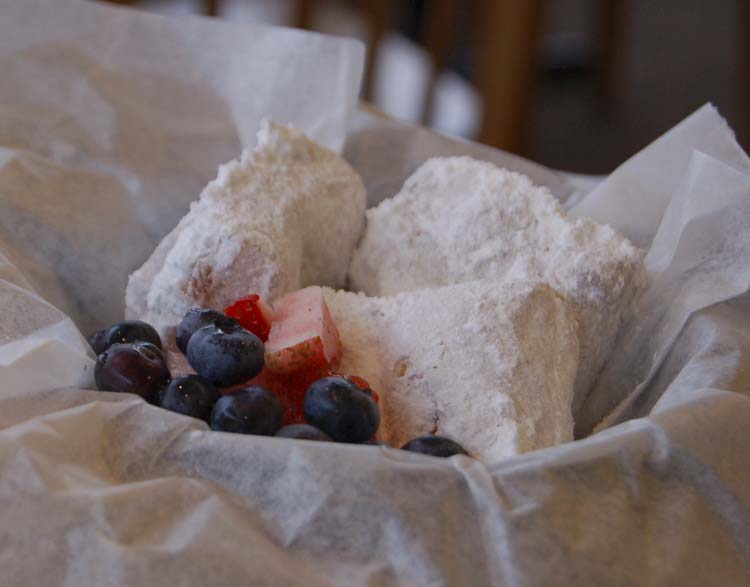
… and you have to try the beignets

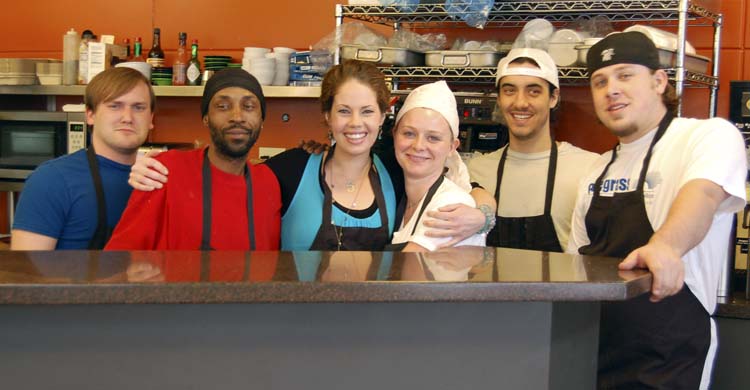
the Doodles gang on Saturday morning

After breakfast, we headed over to Rupp Arena. The doors opened at 8:30 a.m. for the 11 o’clock live College GameDay broadcast, but we didn’t think we needed to be there quite that early!

We found our seats (way up in the upper level, behind the GameDay set) and then kept busy with taking some photos and admiring the many creative costumes and signs. We saw this fan …

it’s a UK-blue storm trooper … with a working light saber, no less!

… and Gumby, a gorilla, a cat (or a bear, I’m not sure), several people entirely in lycra (UK blue and one in fluorescent green), and a guy in a cone-shaped (Asian style) hat painted UK blue, with “The Great Wall” on it.

Tickets for this event were free if one stood in line to get them, or about $5 if ordered online. I hear they sold out within about half a day. It looked to us like there were a lot more kids, families, and college students than are usually at the games. And because Kentuckians are inordinantly proud of such things: the previous ESPN GameDay attendance record was somewhere around 8,000 … which we shattered with a crowd of more than 22,000.

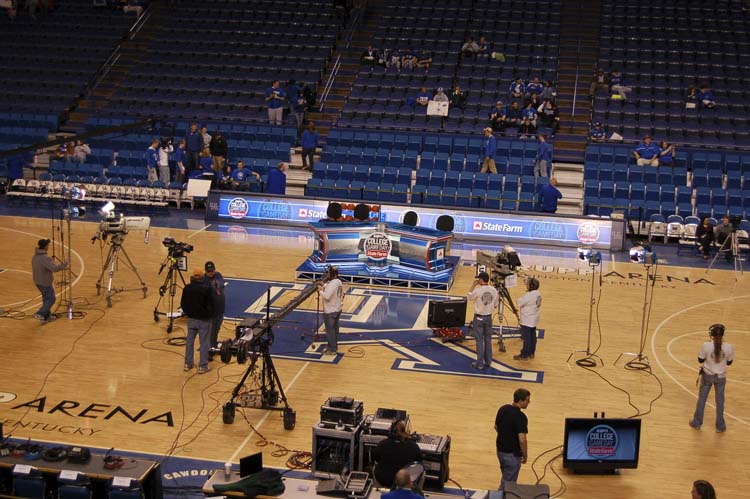
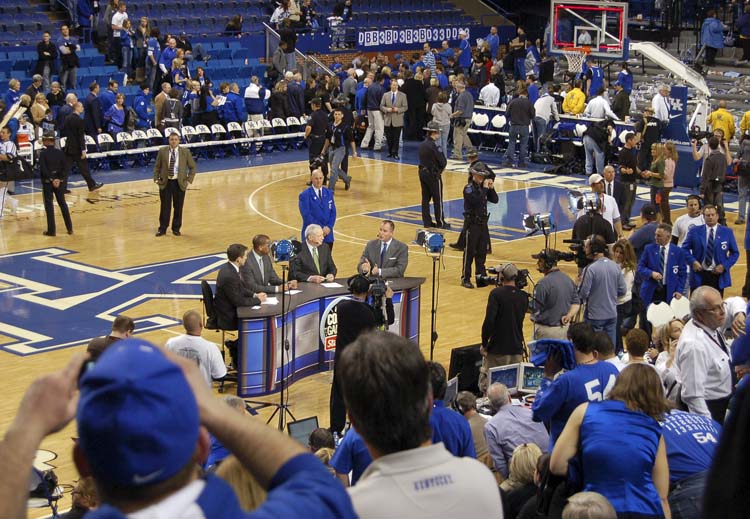
the ESPN GameDay set in Rupp Arena, a couple of hours before the show was to start

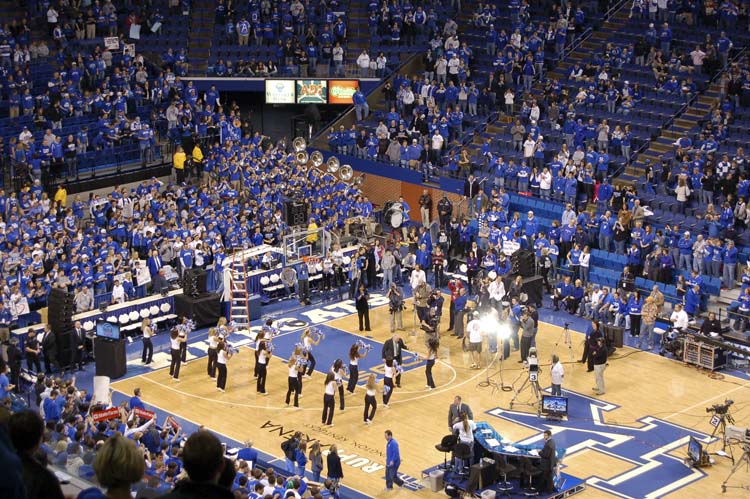
Starting about an hour before the 11:00 broadcast, GameDay’s Digger Phelps started getting the crowd hyped up and loud. The band played, the cheerleaders and dancers did their thing, and we in the crowd screamed and yelled and clapped as loudly as we could. They coached us on what our role would be during the broadcast: to cheer REALLY LOUDLY when they told us (coming out of and going into commercial breaks and at various other times), and then to listen to the show and respond as appropriate.

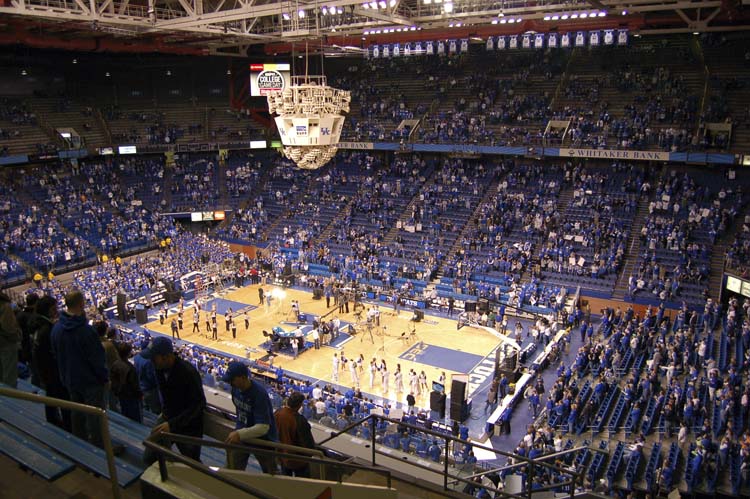
the view from our upper-level seats, while the crowd arrives for GameDay

And then Digger Phelps danced while the pep band played.

GameDay’s Digger Phelps dancing with the UK dance team

Here’s a link to a video of his dancing: http://www.youtube.com/watch?v=zabwPJeso7k

When the show finally started, all 22,000+ people REALLY got into the spirit of the thing. We had taped the program and watched it later in the afternoon … what fun it was!

GameDay is starting!

UK’s Coach Cal being interviewed on GameDay

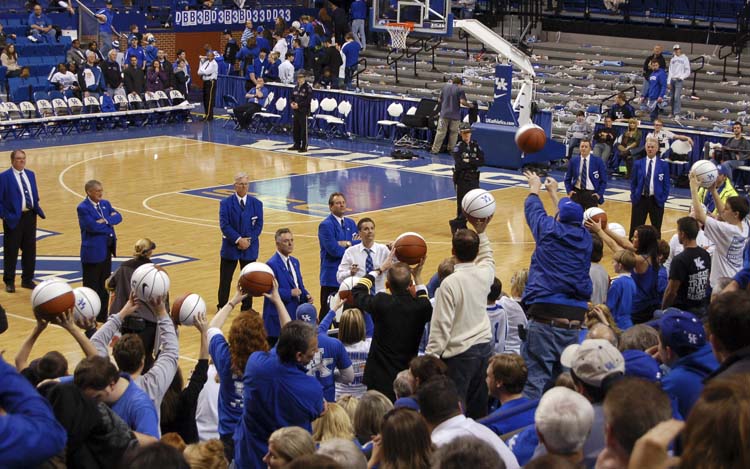
after GameDay finished, the crowd stayed for a few more festivities … here, a bunch of former Wildcat stars are introduced to the fans and, as you can see, photographed

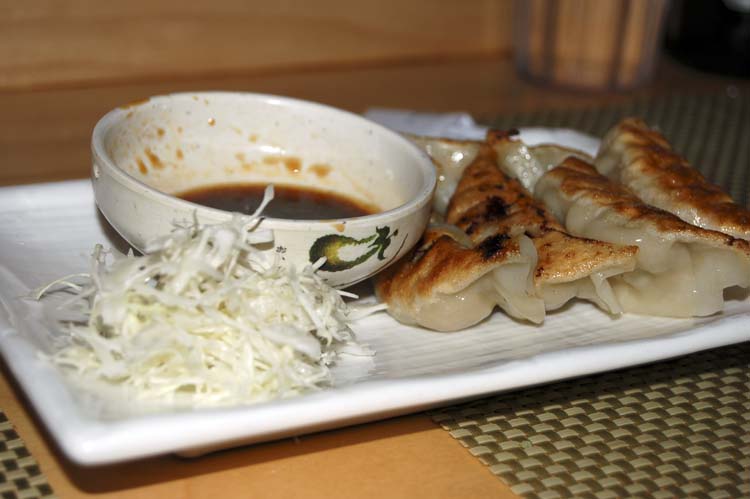
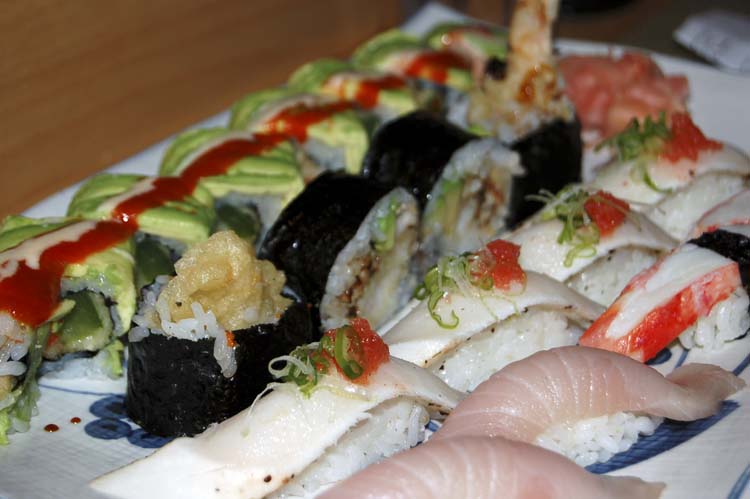
Before heading back to round 2 of “basketball heaven,” we stopped at our favorite neighborhood sushi restaurant, Tomo, for some …

gyoza …

… and some of the best sushi in town (left to right: a veggie veggie roll, a tempura roll, seared white tuna, and yellowtail and behind that, king crab)

Once again, we got to Rupp Arena well before game time. It’s always fun to watch the shoot-around and introductions and opening festivities (including fireworks!).

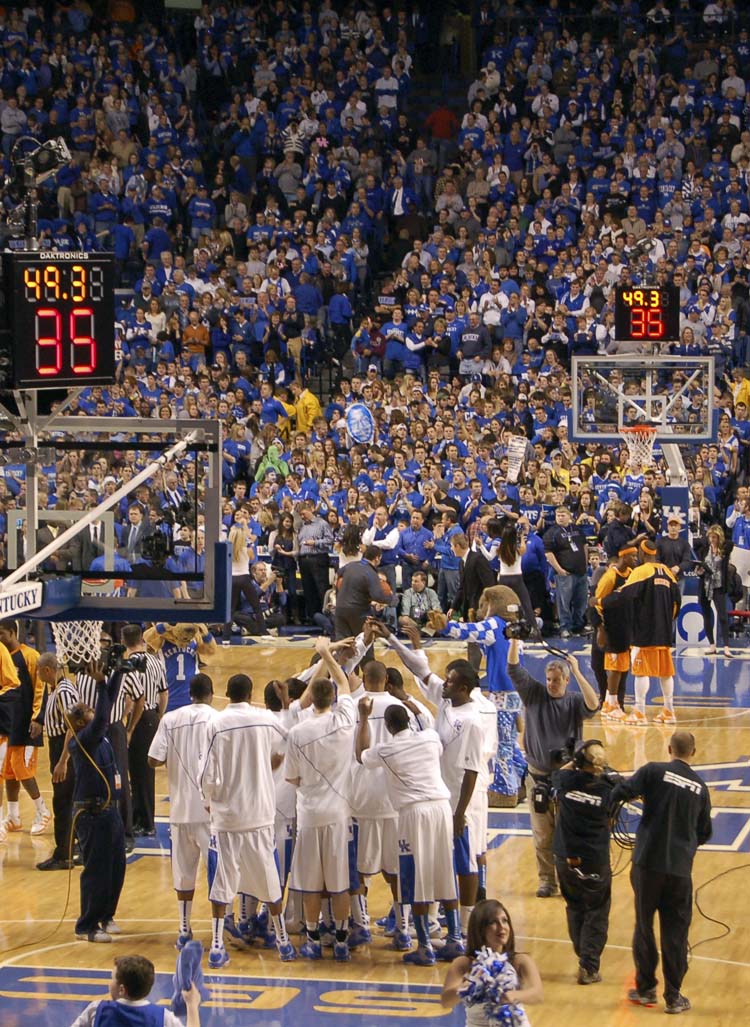
the team gathers at the end of the shoot-around

our freshman phenom, John Wall, shooting a free throw

the cheerleaders, the Wildcat, and a really big flag … everyone stands and cheers as this entire ensemble pivots to face each side of the arena

After a tough but exciting game, the Cats had won! After each home game, one player and then the coach come to the radio broadcast table for radio interviews. These have become so popular that an estimated 5,000 or so people stay to watch and listen (and to try to get basketballs autographed).

the GameDay cast doing their wrap-up broadcast after the game, while a large crowd gathers for the radio show

Coach Calipari signing basketballs during break in his radio show

nearly the entire long side of the arena (and part of the upper level as well) filled with people who had stayed to watch a radio broadcast … at 11:30 p.m.

And there you have it … a long but exciting basketball day. We’ll let you know how the Cats do in March!

In celebration of tonight’s opening ceremonies for the 2010 Vancouver Winter Olympics, we bring you the following story and photos from our friends at Drive Canada.

The text and photos are from Gerard Paagman of Invermere in British Columbia, Canada.

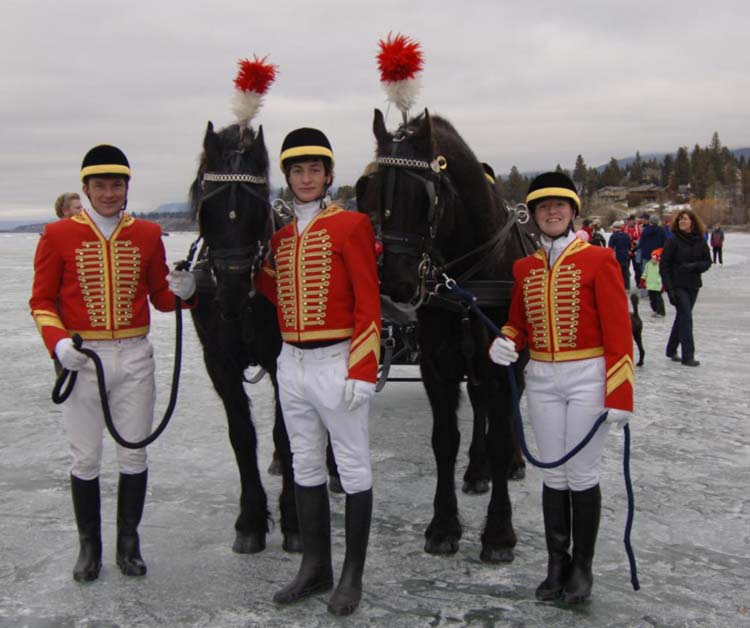
In October 2009, we were contacted by the Olympic Torch Relay Committee with the question, “Are you willing to help us with your Friesian horses and a sleigh in bringing the Olympic Torch across a frozen lake for the first time in history?”

Of course we immediately said, “Yes.” What a great opportunity and privilege to have driving and the Friesian horses placed in the world spotlight!

In December 2009, it turned really cold and Lake Windermere in British Columbia (the lake we would have to cross) froze. So, we started practicing with a four-in-hand team of our horses. At that time, we did not know how the ice would be when the Olympic torch would actually cross the lake. Would it be plain ice? Would the ice be covered with two or three feet of snow? Or would we be facing heavy snow banks? In order to make sure that we were well-prepared, we worked together with our farrier, Dan Higs from Cranbrook, and tested all the different shoes for all possible conditions that we could encounter.

And there were meetings; many meetings. And most of the topics discussed were about safety and protocol. How heavy are our horses? Will the ice be strong enough to hold four horses and a sleigh and six passengers (approximately 7,000 pounds)? Can the horses keep up to the requested speed of 10 miles per hour? Are the horses “bomb proof,” or will a helicopter above their heads scare them?

And then … January came and the weather changed! Instead of turning even colder, we noticed that it was turning really warm and that all the snow on top of the ice melted and a thick layer of water was on top of the ice. Normally, during the winter, there is an official road on the ice of Lake Windermere, but as it turned out to be so warm a week before the torch would cross Lake Windermere, the road was closed!

So, more meetings. Alternative plans were made.

And then we were lucky: it started freezing again!

On Thursday night (the evening before the day on which the Olympic torch would cross Lake Windermere) we got the final YES; the Olympic torch would cross Lake Windermere for the very first time in history! We had planned to hitch up four horses to our sleigh, but the security people only gave us permission to hook up two horses (as a pair) because of the ice conditions on the lake.

The next morning (Friday), around 6:00 a.m., we arrived with our horses at Lake Windermere for the final testing. The cars that were escorting the Olympic Torch Relay Committee were driving next to us and providing us with enough light, by means of the high beams on their cars, as it was still dark. The ice was then tested again to make sure that we would also be able to keep up with the requested speed of 10 miles per hour. Security people were yelling through big speakers mounted on their trucks to test whether the horses were really bomb proof!

And then, at 8:00 a.m., we got the final approval from the security people; our horses, sleigh, harnesses, and driving skills were good enough and the show could start!

The torch was scheduled to leave the Invermere beach at 1:10 p.m. To make sure that we were on time, we arrived at the beach an hour early. Never in their entire lives have our horses had so much attention from the press, photographers, and spectators as during that unique hour!

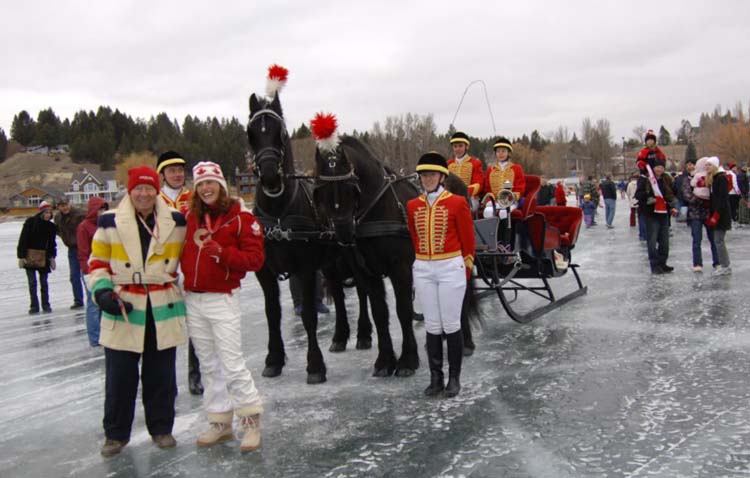
We got our special passengers in our sleigh: two former Olympic gold medalists, meaning that we got even more attention from press and spectators! The director of the Torch Relay Committee arrived at the beach. When he saw the sleigh and the horses, he decided that he also wanted to sit in the sleigh! And so … the head of security also had to come with us in the sleigh.

photo courtesy of Gerard Paagman

In just a few minutes, the security people filled our sleigh with a lot of communication and safety devices. At this point, we were constantly surrounded by at least four security people around the horses and the sleigh. In addition, they also made sure to put a number of spare torches in the bottom of the sleigh.

photo courtesy of Gerard Paagman

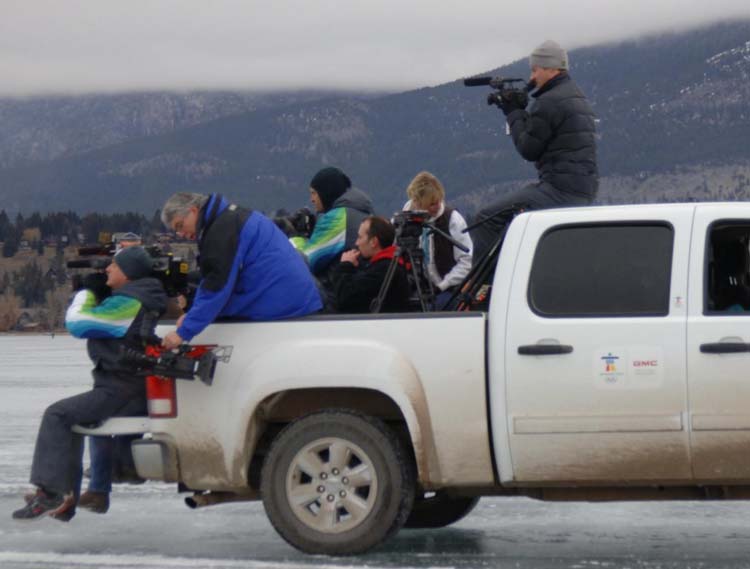
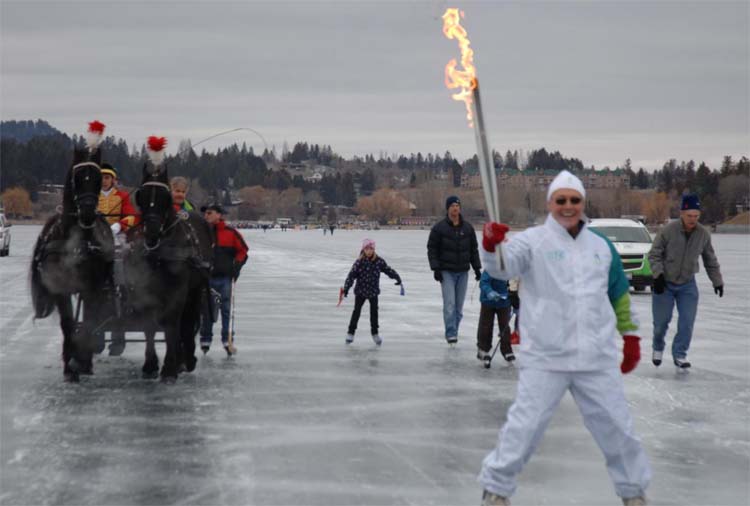
At 1:10 p.m. exactly, the torch arrived at the beach. What great energy and excitement was in the air! Our tour across the lake started. Trucks filled with media were all directed to drive next to us. We were live on television!

photo courtesy of Gerard Paagman

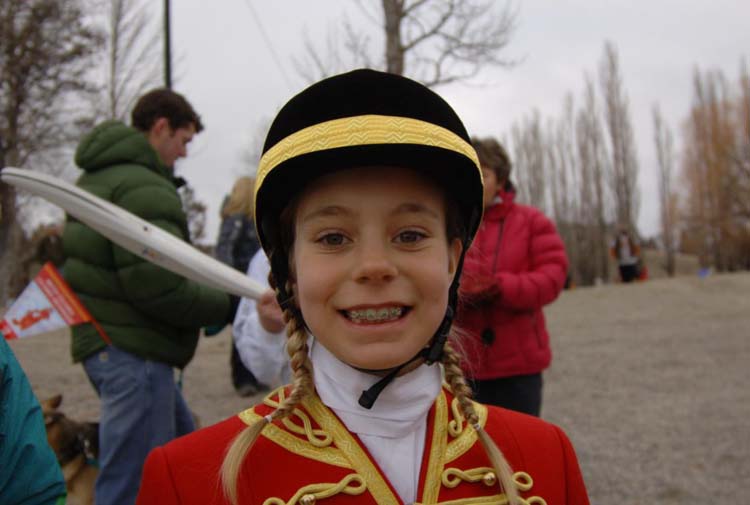
The horses were doing great. It was pretty easy for us to keep the requested speed and so we let Balance (a twelve-year-old girl) drive the horses.

photo courtesy of Gerard Paagman

At one point, the head of the security said he had just been informed that 22 million people were watching the Olympic Torch Relay live! For the first time in history, the torch was going over a frozen lake, and for the first time in history accompanied by Friesian horses and a sleigh!

photo courtesy of Gerard Paagman

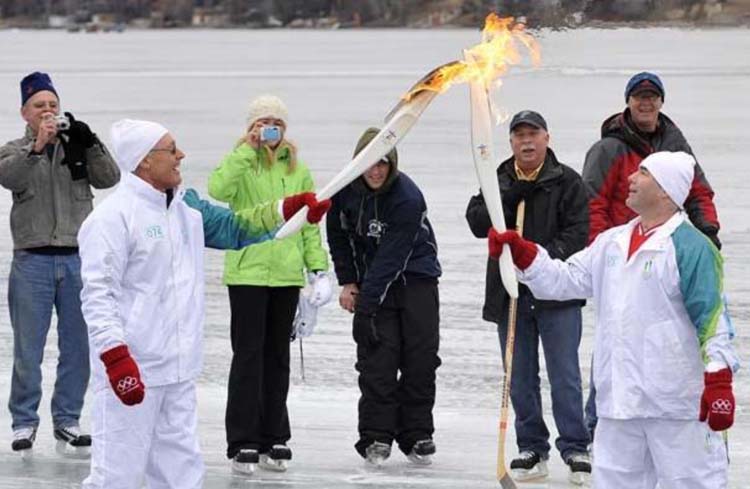
We got instructions from security to increase our speed to 11 miles per hour because we were a little bit behind schedule. Not a problem for us or for our horses. But the new speed was too fast for the torch: the flame went out! Our whole group stopped, and the television companies got instructions to switch to a commercial. A new torch was taken out of our sleigh, lighted, and given to the torch bearer. After this has been completed, we continued our journey of crossing the lake while keeping the original speed of 10 miles per hour.

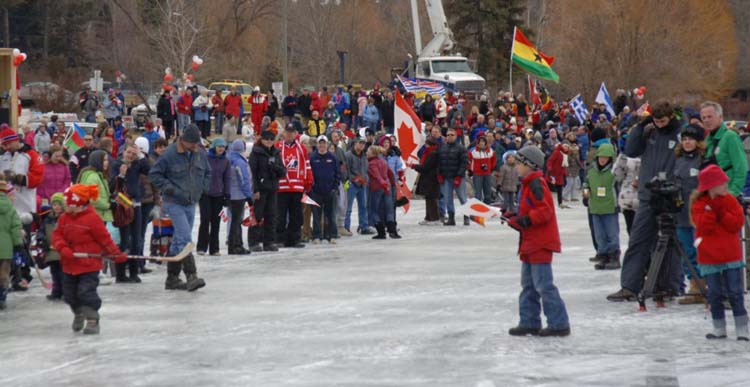
In about forty minutes, we arrived at the Lake Windermere beach, where we were welcomed by a great and enthusiastic crowd. More security swarmed around the torch, and the torch immediately continued on its way to Vancouver.

photo courtesy of Gerard Paagman

For the very first time in history, the Olympic torch had crossed a frozen lake. We felt so honored that we had been part of it, and we were so proud of our Friesian horses, our Ideal Harnesses, our sleigh, and our whole team of people!

The Friesian horse, again, had proven to be reliable and versatile and it was great that the 22 million people who had been watching in North America had now witnessed the Friesian horse showing her elegance and beauty.

photo courtesy of Gerard Paagman

… we haven’t run off and joined the circus or anything, even though nothing’s been posted here in days and days.

This, in fact, is just a quick note to say that (although we have nowhere near as much snow as folks on the east coast) we have enough snow and ice on the ground to make travel to and from the office a bit treacherous.

And I’m buried under mountains of computer files as I finish up the March issue of The Carriage Journal.

None of which is particularly conducive to blog-posting.

But don’t despair … new posts are coming! In fact, we have an interesting one in the works regarding Friesians, a sleigh, crossing a frozen Canadian lake, and the Olympic torch. Stay tuned!

The next participant in our Q&A interview series is Bill Neel, an avid driver and promoters of draft mules.

Where do you live?  My wife, Lyn, and I live on a ranch, just south of Eugene, Oregon, that sits alongside the original Oregon-to-California stage road.

How are you involved in the driving/carriage world?  We own and drive Belgian-cross draft mules and collect and restore antique vehicles. I have four pair [eight mules] and attempt to drive each pair twice a week year round. We compete at shows in the West from May to Oct., usually lay off the month of Nov., and then begin working inside in Dec. to prepare for the show season in May.

I won the title of World Champion Driver at the Bishop Mule Days Show in 2005 and 2007. I was Reserve Champion in 2006. We skipped Bishop in 2008 and 2009 but will be back this year. Our last, and fanciest show each year is in Sandpoint, Idaho. At that show in 2009, I placed second in Singles, first in Pairs and Unicorn, third in Team, third in Four Abreast, and first in Six-Up Conformation.

Since I maintain eight draft mules, about sixteen vehicles, and twenty-two sets of harness from show to military, I guess you could say I’m in it up to my ears.

How long have you been driving? How did you become interested in this sport/world?  We started driving in 1975 with a pair of Morgan/Hackney crosses and graduated to draft mules in 2000. We drove a Platform Spring Wagon with a local history on which we did some preservation. I’ve ridden on and off most of my life. Lyn and I both showed cutting horses on the Oregon, Northwest, Pacific Coast, and national circuits for about twenty-five years, beginning in 1972.

Do you come from a driving/horsy family?  I’m from a routine western ranching family, not particularly “horsy.” Lyn was from Pasadena and had no horse experience there.

If you have children, do they ride or drive?  We have a son and a daughter. They both rode cutting horses competitively and our son competed in high school and college rodeo, but neither ride or own horses at this time. We have two grandsons of high school and college age, neither of whom will even ride with me in a wagon/carriage!

Are you a CAA member?  Yes, we’ve been members for about eight years. We have attended CAA events at the KY Horse Park and in California, and plan on attending more. We have been to Windsor to meet the Queen and have made some wonderful friends.

What was your first equine? What do you drive now?  Our first horses were ranch Quarter Horses, followed by high-quality cutting horses. Our first driving experience was with a pair of Morgan/Hackney crosses. We did not drive single until very recently, and now, only as necessary for competition. We compete in Singles and Pairs, Unicorn, Team, Four Abreast, and Six-Up, as well as Timed Obstacles (cones), and Gambler’s Choice classes, all with our draft mules. We also participate in a number of parades and competitions where period dress and turnout are judged. We particularly enjoy two- to five-day trail drives with our Chuck Wagon, particularly over portions of the Oregon Trail.

What types of carriage(s) do you drive/collect?  We collect and restore western vehicles suitable to mules and we drive everything we collect. At the present time we own: a Platform Spring Wagon, often called a Mountain Wagon (c. 1885 with local history; this was our first vehicle); a Henderson Long-spring Sierra Mountain Wagon built for the Yellowstone trade (c. 1905, restored); a Weber Chuck Wagon (c. 1890–1900, with original paint, some new parts, and a solid reach); a Weber Farm Wagon (c. 1900–1915, with original paint, some new parts, and a swivel reach); a country-style Hearse mfg. by Samuel Convers, Lowell, Mass. (c. 1854, restored by Morgan Carriage); a Portland Cutter (with doors) mfg. by Lull Carriage Works, Kalamazoo, Mich., restored; an Army Escort Wagon, model of 1906 mfg. by Moline Plow Co. in original preserved condition; a Spring Wagon (with most unusual axles and springs, original condition and paint); a Studebaker Rockaway, restored; a Hitch Wagon (Express Wagon) with local history, restored; a Show Wagon that we use in competition; and a contemporary Road Cart that we use in competition. In addition, we have a second Hitch Wagon, a Wagonette, a Pole Cart, two Forecarts, and a Stone Boat, all contemporary vehicles and in daily use.

Do you have a favorite vehicle among your own collection?  Choosing among vehicles is like choosing among children. I just finished two-and-a-half years of work completely restoring my Hitch Wagon so it is probably my current “favorite,” followed by my Henderson, which is the most appropriate Western wagon. My Hearse is the most nearly perfect and interesting, and I love my Escort Wagon—in that order, but it may change next week. It should be noted that EACH vehicle has appropriate harness and attire for a complete turnout. I do a great deal of restoration but also have employed experts (Morgan Carriage Works and Oxbow Trading Co.) when prudent. Most of my vehicles fall under the wagon rather than the carriage class, but then I am a westerner and I have mules.

What is the most interesting/far-flung place that your driving has taken you?  The forty-mile section of the Oregon/California Trail across the Humbolt Sink known as “The Fearful Crossing” while reading the journal of my great-great-grandfather, who wrote of the same crossing in 1849.

Do you have a favorite carriage museum or vehicle?  I don’t have a favorite carriage museum, but I thoroughly enjoy original Henderson Mud Wagons, manufactured in Stockton, Calif., and used – with mules of course – in the West.

Do you have a favorite carriage type, builder, era, etc.?  Milton Henderson, M. P. Henderson & Son of Stockton, Calif., is my favorite builder, and I love his Mud Wagons, though I will probably never own one, and his Yosemite vehicles, which I do own.

Is there a particular era/time period/type of vehicle in history that you would enjoy traveling back to … and driving in?  We participate in Rendezvous of the fur-trade era (1820–40), and reenactments of the Civil War era (with the Hearse) and the Cattle Drive era (1875 to 1885). We do WWI reenactments with the Escort Wagon. We both probably prefer the Cattle Drive era since it suits our mules and our Chuck Wagon, and the drives are often several days with overnight stays in a trail tent alongside the wagon.

Our outfits were featured in Bob Mischka’s mule calendars in 2008 (we were on the November page with the Escort Wagon for Armistice Day) and 2009 (on the May page for the Rendezvous Fur Trade).

Do/did you ride or participate in other horse sports?  I ride and pack my pair of John mules, though not in competition. I also hunt in wilderness areas with my mules.

What do you like best about driving/collecting as a hobby/sport?  When sitting on the box with four on the ribbons, all the world is right.

What spectator sports do you enjoy watching? Who is your favorite team/player?  None and double none.

What was your first / favorite car?  My first car was a classic 1947 MG-TC, which I used in sportscar rallies and showed in Concours de Elegance, including Pebble Beach in 1957. I now own a 1991 limited-edition (one of 3,000) racing GMC Syclone pickup, which is my “toy” car.

Do you have any other pets?  Lyn and I own a pair of working English Setters, Max and Gus, over which we shoot grouse, pheasant, chukar, huns, and quail.

What is your favorite food/cuisine?  Lyn and I both enjoy cooking. Our fare tends to gravitate to Western and Chuck Wagon dishes with a lot of game thrown in. As to our favorites, it would be a toss-up among venison medallions (or venison liver, bacon, and onions), Indian-style smoked Chinook salmon with sage and garlic, or grouse with herbs du Provence.

What is your favorite holiday?  We participate in parades on Memorial Day, Independence Day, Armistice Day, and Labor Day so each is different and fun. Thanksgiving to Christmas is catch up and rest time in a busy year. We spend the time turning the mules out, cleaning harness, and counting our blessings.

Bill also sent photos of his mules and wagons; here are just a few:
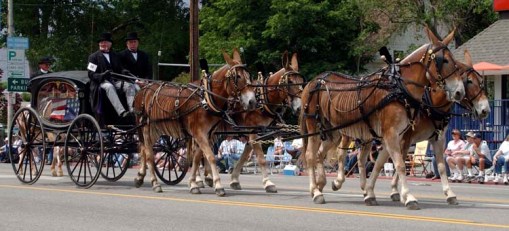
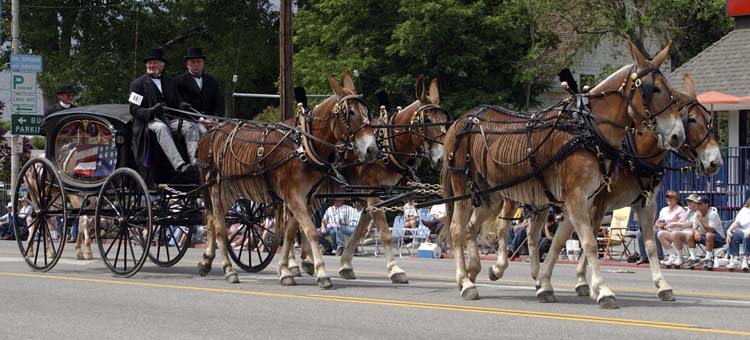
Bill driving four of his draft mules to his restored Hearse, in a parade
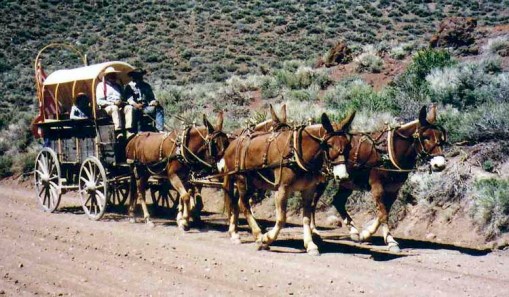
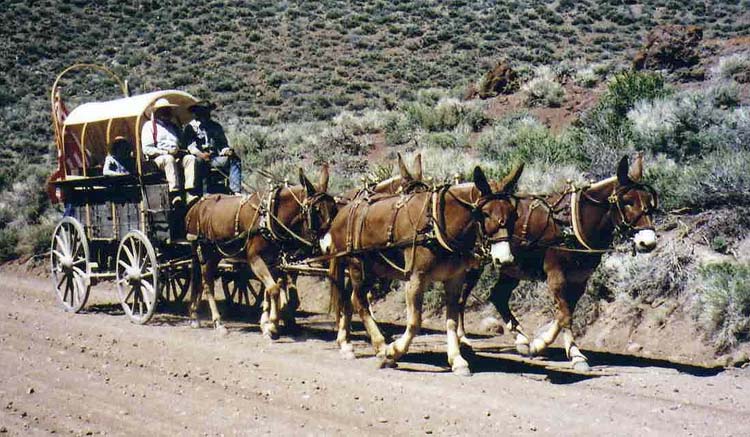
the Neels driving in the desert
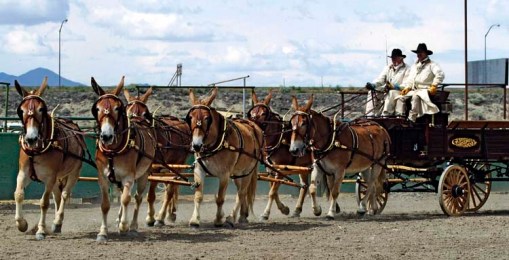
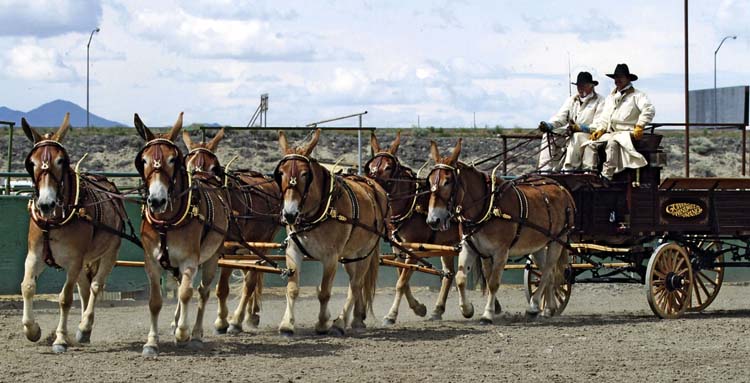
Bill driving a six-up of his draft mules in a competition
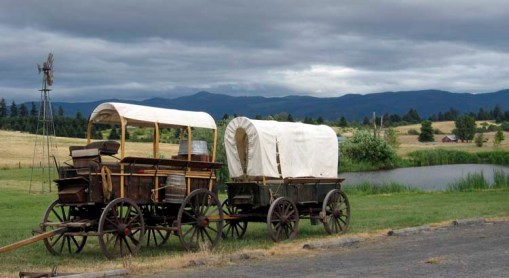
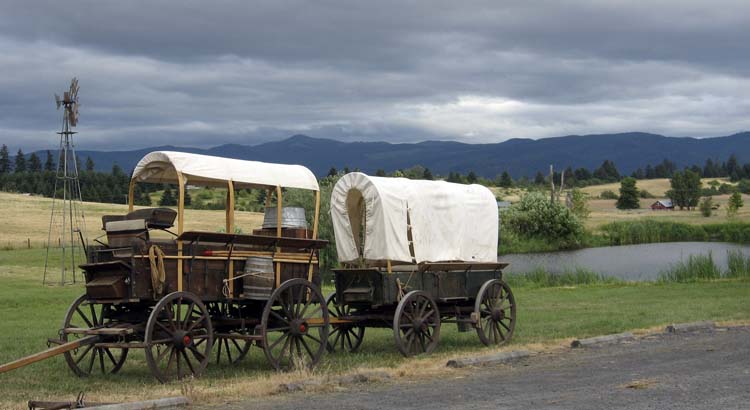
two of the Neels’ wagons

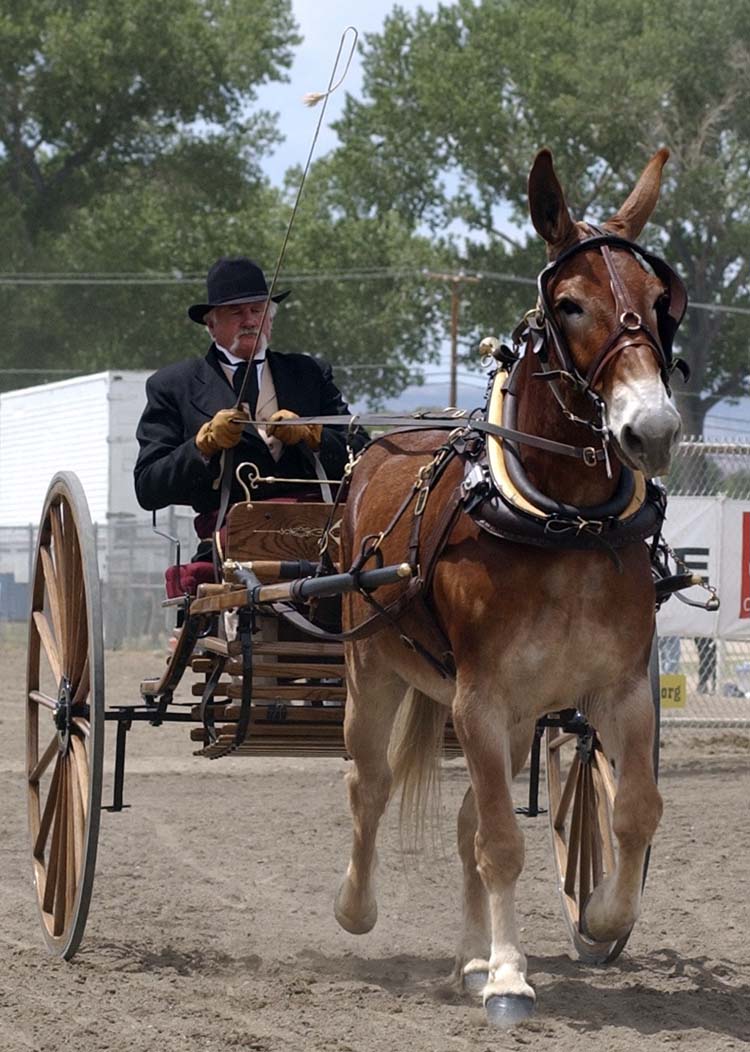
a close-up look at one of the Neels’ beautiful draft mules