… Andaluza del Arte Ecuestre — the Royal Andalusian School of Equestrian Art — was the first visit on our recently concluded CAA trip to Spain.

So I think it’s a good place to start with the stories, additional photos, and photo captions that I’ve been promising to post.

.

At the start of our trip, nearly everyone arrived and gathered for a lovely welcome dinner on a Wednesday, and then we met in the hotel lobby at 8:30 the next morning (jet lag be damned!) to drive to Jerez de la Frontera, which is about an hour south of Sevilla.

We were welcomed at the Real Escuela by Maria Angeles, who is in charge of the foundation’s museums, and she ushered us into the theater to see a movie about the school and its horses. Before the trip had even started, Kathy and I had been practically taking bets on which one of us would tear up during this particular visit. I don’t know about her, but I was almost undone by the movie … and we hadn’t even seen any real horses yet at that point!

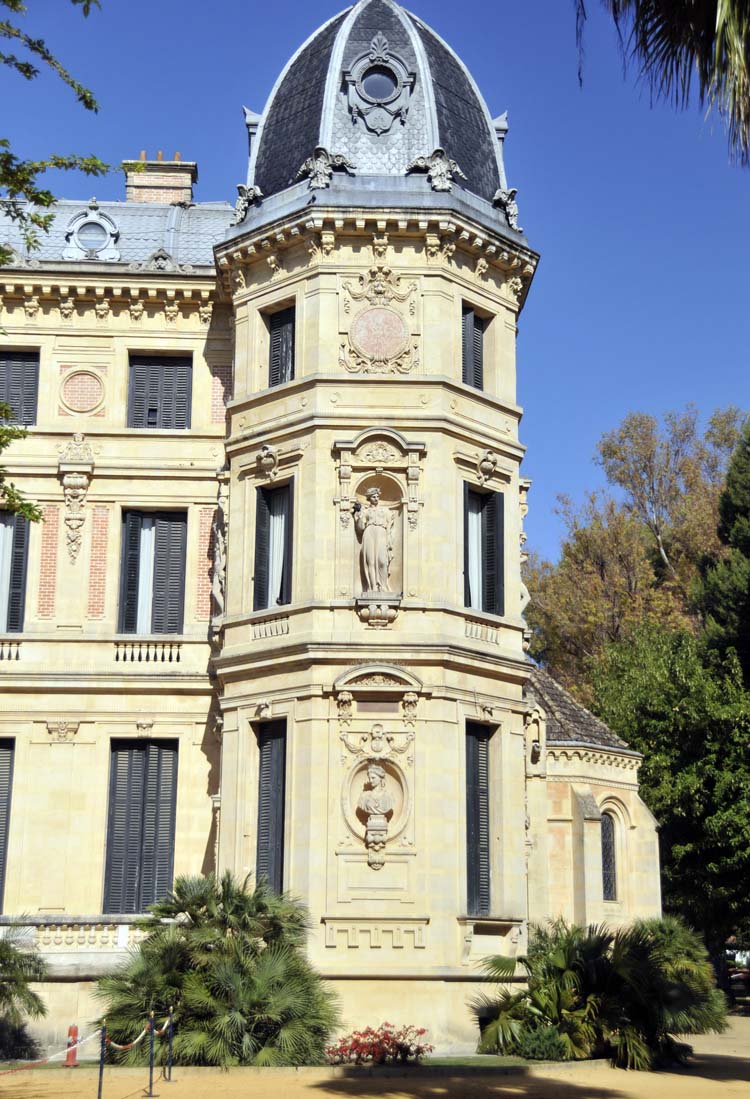
From there, we walked through the park-like setting to the property’s original palace:

.
.
.

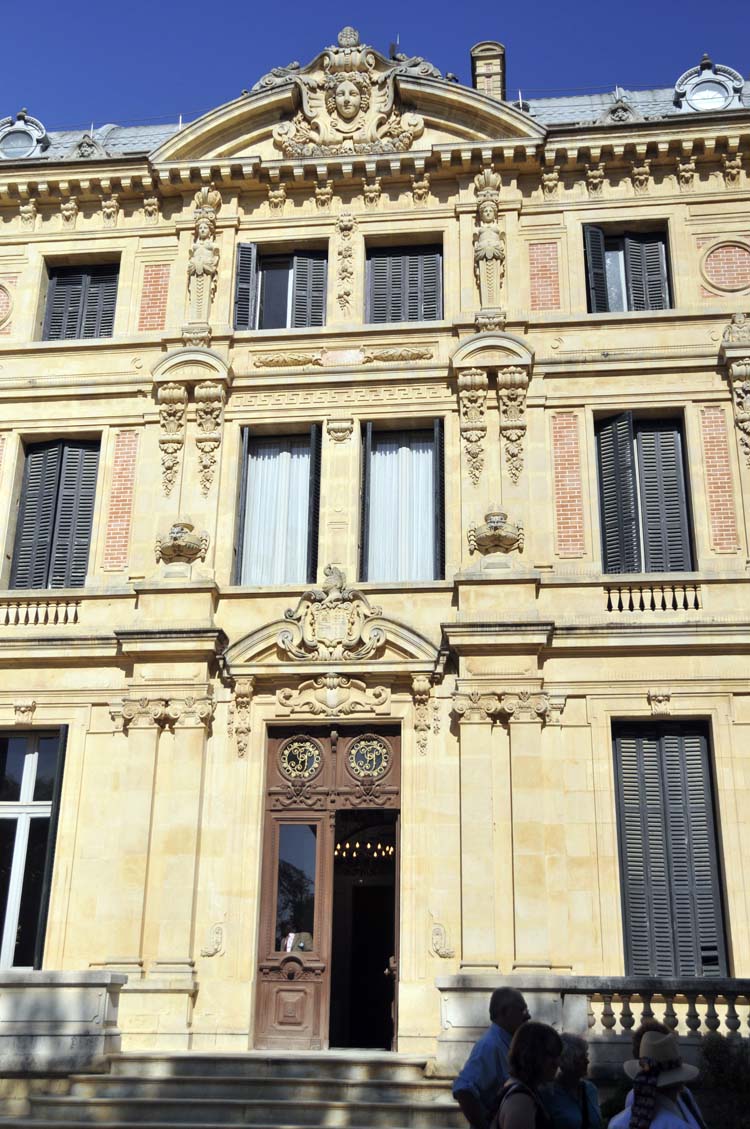
… which we toured. But not before noticing the (gorgeous, of course) Spanish horse standing outside the palace. The horse and its traditionally dressed rider are what have captured the attention of the CAA members in the lower right corner of the photo above. It turned out that he was standing there so that visitors could get an “official” portrait of their visit. Such as, say, this one:

.
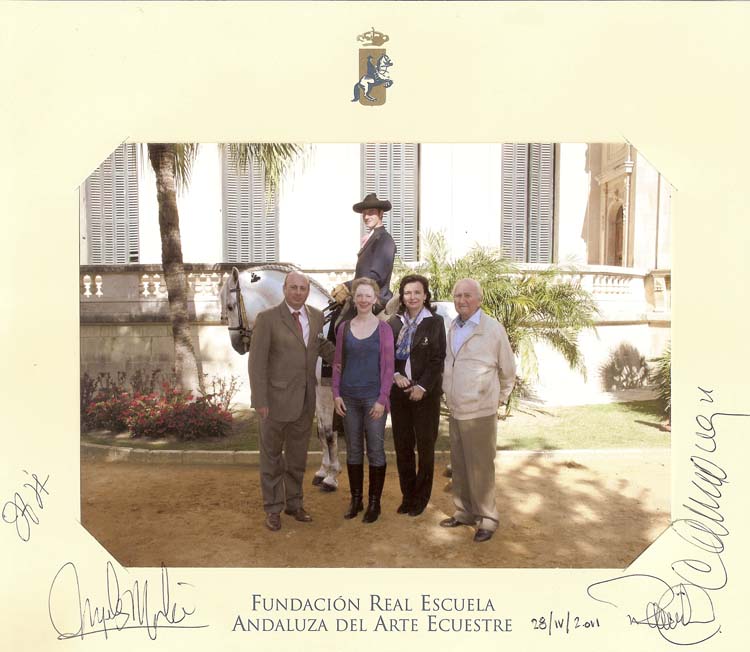
standing in front of the Spanish horse and rider are (left to right) Raimundo Coral Rubiales, me, Maria Angeles Mata Lagomazzini, and Pepe Carmona

.
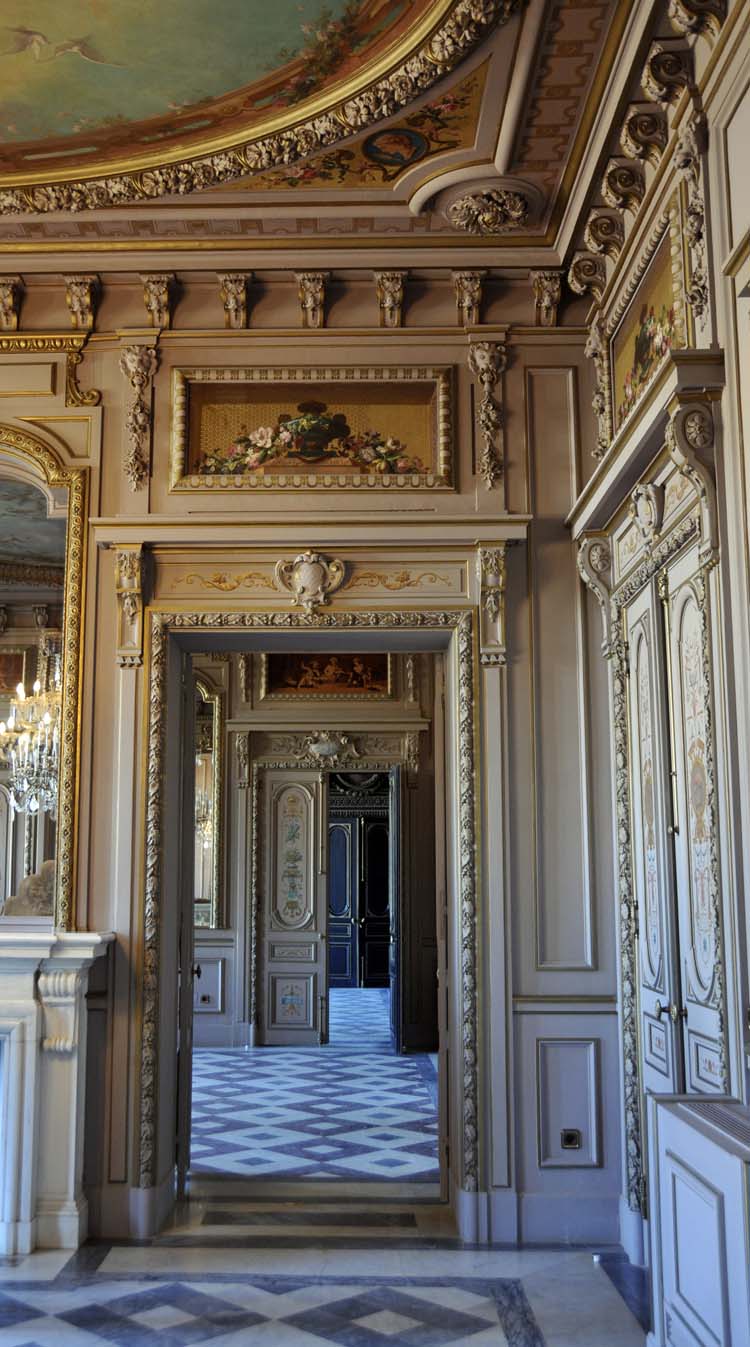
inside the palace

.

From there, we toured the foundation’s museum. It’s packed into a small space, but the museum’s interactive (and holographic!) exhibits provide quite a lot of interesting information about the property, the palace we had just seen, the riding school, the Spanish horse, and various types and styles of riding and driving. We even learned about the differences between the area’s traditional livery styles from the eighteenth and nineteenth centuries, both of which are still used today. Needless to say, this tour provided the perfect background information for much of the rest of our trip.

During the noon-time performance showcasing the school’s horses and riders, we weren’t allowed to take photographs. But, rest assured that it was beautiful and awe-inspiring. If you ever find yourself in Jerez, you won’t want to miss out on seeing these gorgeous, talented horses.

During the intermission, Maria Angeles invited Vicki (as our highest-ranking CAA “VIP” … she’s a past president), me, Raimundo, and Pepe (who was our “local” guest) to take a quick tour of the stables. What a treat! Vicki was introduced to all of the riders, and then we had our photo taken with them:

.
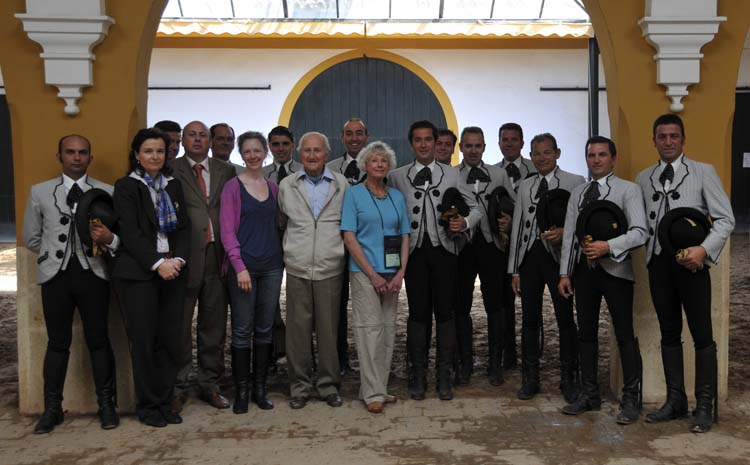
Maria Angeles, Raimundo, me, Pepe, and Vicki with the Real Escuela's riders; third from the right is Rafael Andrade Soto and on the far right is Ignacio Ramblas Algarin, both of whom have represented Spain in major international dressage competitions

.

Then we were given a quick tour of the tack room. Although it is undeniably lovely, we were assured that it is also functional and used daily.

.
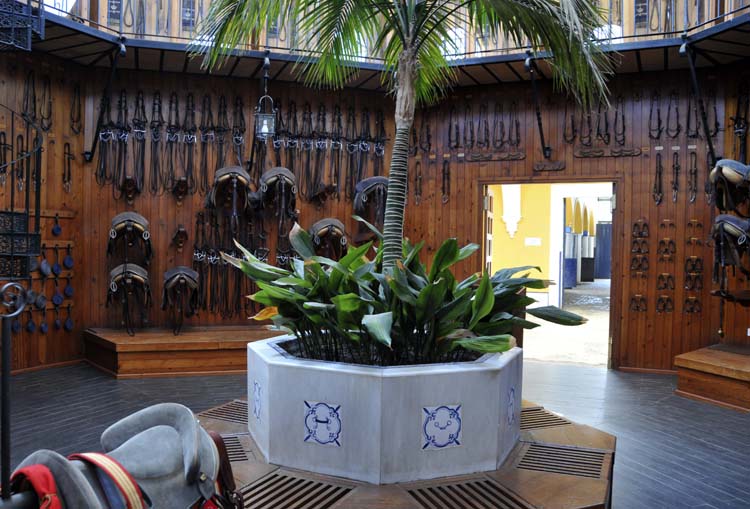
.
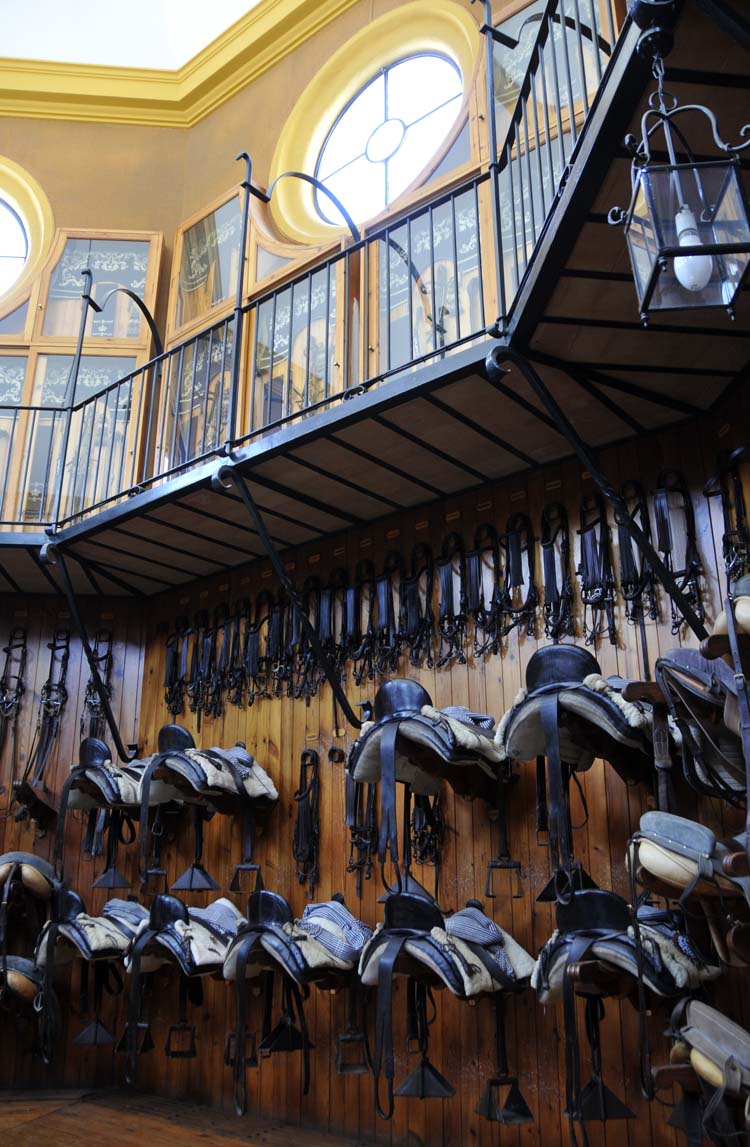
.
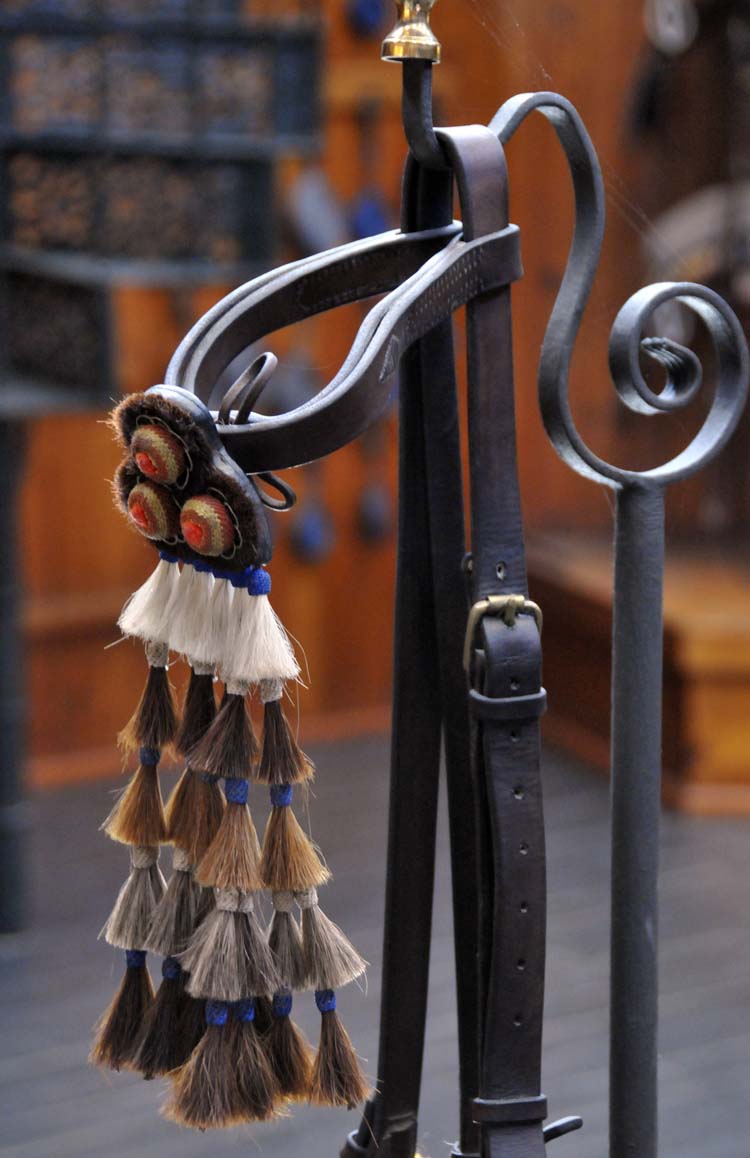
.
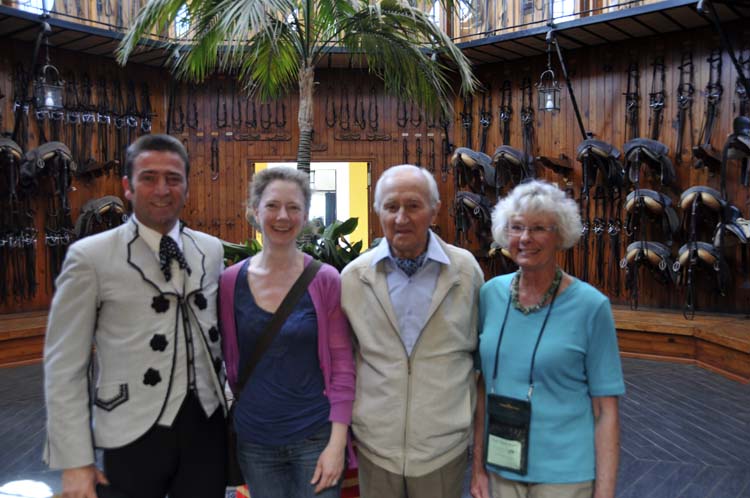
this photo is a bit fuzzy (the person using my camera was focused on the background instead of us!), but I have to include it because it was a treat to be introduced to one of Spain's Olympic dressage riders, Ignacio Ramblas Algarin

.

As we left the stables to head back for the second half of the performance, I was finally able to take a photo of horses!

.
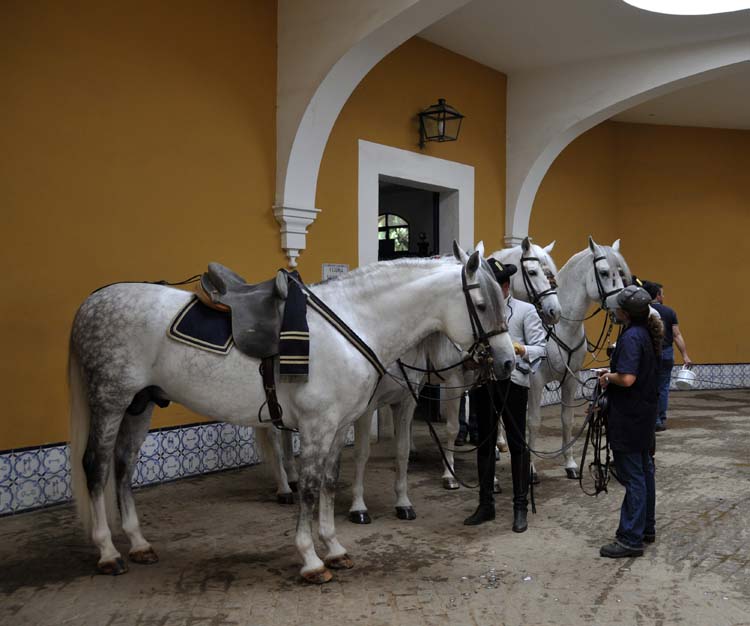
even just standing still: what beauties
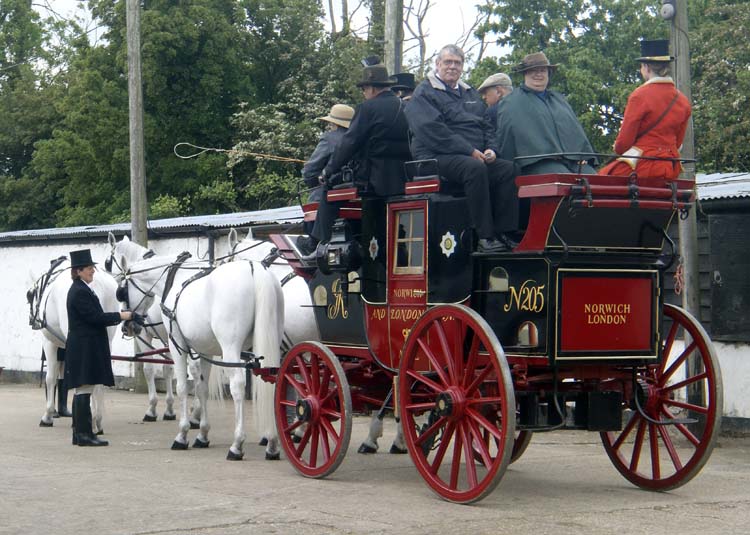
After the conclusion of the CAA’s trip to the Royal Windsor Horse Show, Jill and several others traveled to Norfolk to spend a couple of days enjoying coaching runs, lessons, and the neighborhood hospitality at the driving facility owned by John Parker and Susan Townsend.

Today, the travelers arrived back in Eton (where there is a working Internet connection!), and so Jill sent this report and the these photos. Tomorrow, everyone heads home.

.

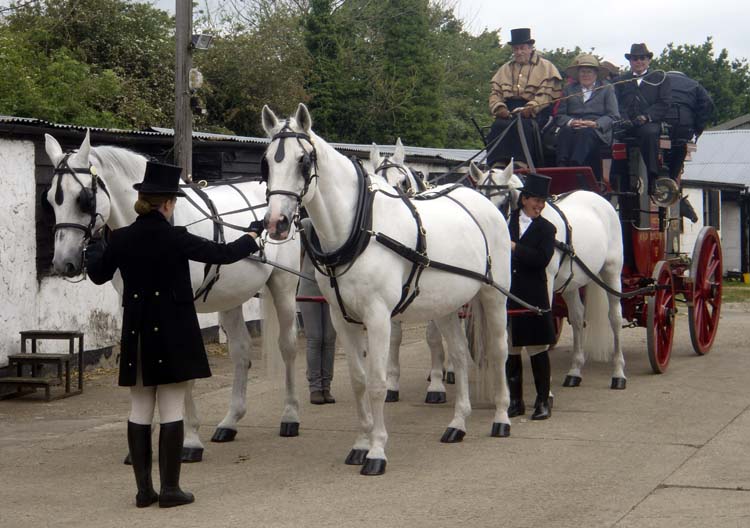
Royal Mail Coach N205 with CAA members aboard (photo by Susan Townsend)

.

N205 is probably the most famous coach in Great Britain today. The history of the N205 Royal Mail Coach can be traced back to 1870, but the coach is believed to be considerably older.

The coach weighs 1.25 tons without passengers, is equipped with wooden wheels and steel tires, and has a fifty-two-foot turning circle. It is built on a perch undercarriage with two sets of platform springs and mail axles attaching the wheels to the body.

Like all Mail Coaches, it is painted black with scarlet wheels and undercarriages. The notation “GR” identifies the reign in which it was built (that of King George IV), and the upper quarter panels feature the four stars of the Order of Knighthood. The number N205 identifies the route traveled as London-to-Norwich.

The coach was re-registered in 1969, enabling it to carry the Royal Mail. It is the only coach currently accorded this honor in the modern era.

In order to make the postal service viable, the coach was also one of the first built to accommodate passengers, and it can carry twelve plus the coachman and the guard, who protected the mail and passengers from highwaymen. The guard also acted as the horn-blower, alerting people to the arrival of the mail. Mail Coaches traveled at ten miles per hour, had right of way over everyone else on the road, and paid no tolls.

It is known that N205 was owned by James Selby, who drove it until his death in 1888. Thereafter, its career is a little unclear but records show that it was owned by Bertram Mills, who sold it in the late 1950s. In 1966, John Parker found the coach languishing behind a pub in Wales; he brought it home, and the rest is history.

James Selby himself had two entries in the record books: one for the longest distance ever driven by one coachman, and the other for the fastest time a team of horses could be changed for another — namely, 47.2 seconds, a record set in 1888.

A century later, N205, driven by John Parker, broke both those records. John’s grooms reduced the time for the team change when in a challenge on TV’s You Bet, they changed horses in an incredible 21.2 seconds!
 
In June 1996, John broke the long-distance record when he drove the coach nonstop from the Guildhall in London to Norwich Cathedral — a distance of 139 miles — in twenty-one-and-a-half hours.

.

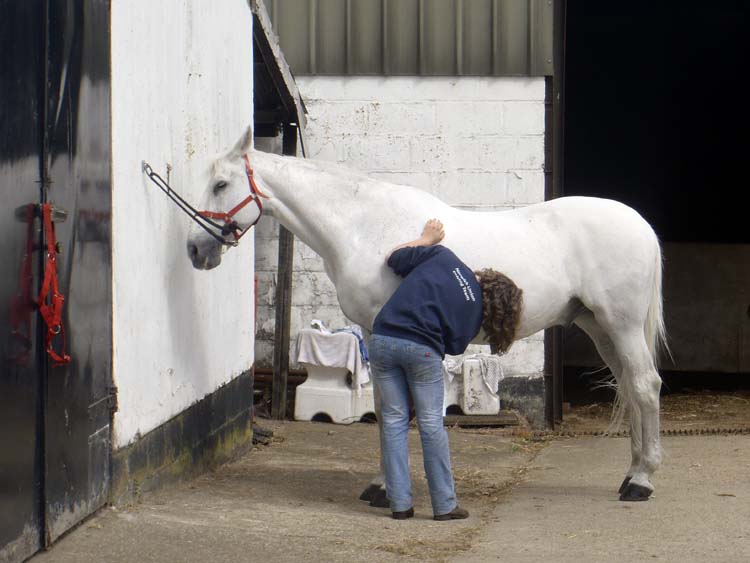
Anna grooming one of the coach horses before the group sets out on a coaching run (photo by Jill Ryder)

.

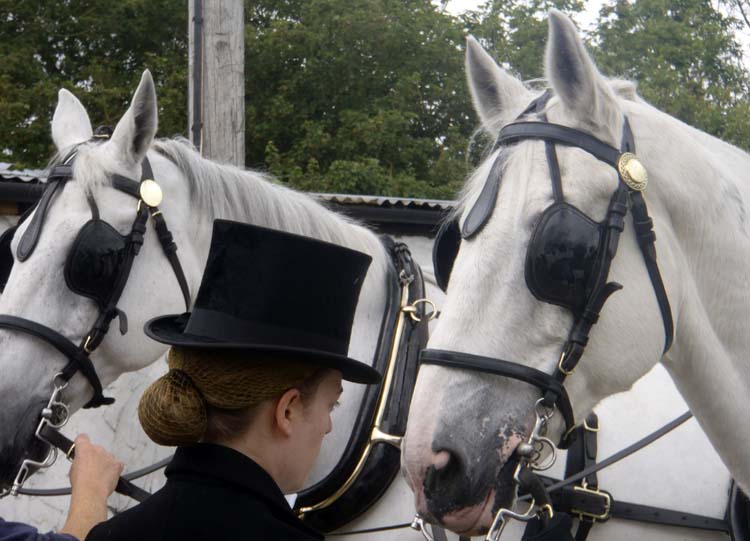
(photo by Jill Ryder)

.

ready to head out! (photo by Susan Townsend)

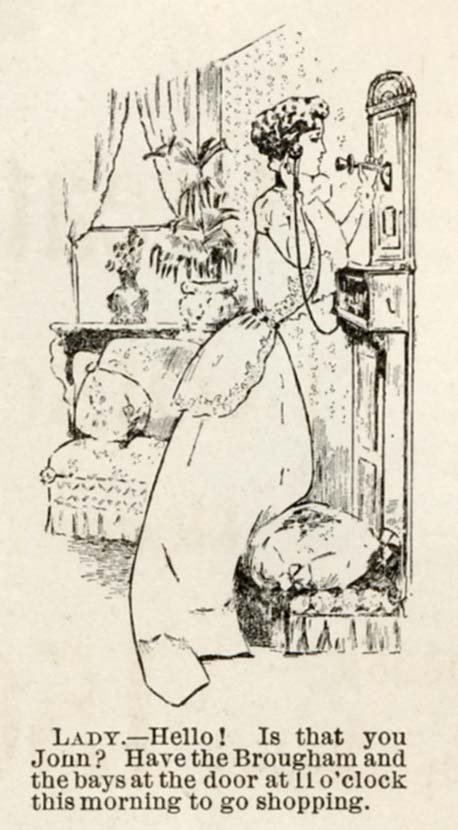
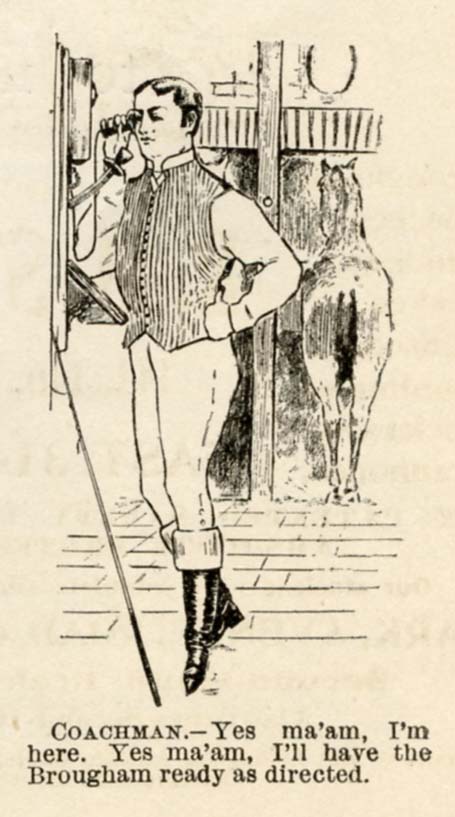
from the November 26, 1898, issue of  The Rider & Driver(published in New York City):

Houses, Stables and Telephones

That the telephone service is one of the most useful adjuncts to life in a large city goes without saying. As the New York Telephone Company tersely states the matter, “telephone service in your house puts the whole organization of a large city at your fingers’ ends.” And this is literally true, for in every center of life in New York you find the ubiquitous telephone. Hotels, theaters, clubs, restaurants, stores of all descriptions, livery stables, express companies, railway and steamer ticket offices — in short, every place of any consequence where business is done with the public, or with a section of it, is tapped on to the telephone service and is the next door neighbor, on demand, to everybody else who has telephone service. The enormous convenience of this state of affairs has only gradually become appreciated by private house-holders. The telephone service at one time was considered by many a rather expensive luxury to have in a private house. But the system of charging by the message, adopted some years ago, has changed all that, and a first-class residence in New York is now not considered completely equipped unless it is connected with the telephone service.

.

.

The same applies to a private stable. Private stables in New York are usually separated from the owners’ houses by considerable distances and without the telephone service communication between house and stable is slow and unsatisfactory. If both places have telephone service, not only is the stable as easily available for orders as if it were next door, but it is better supervised, as the moral effect of the presence of the telephone ready to call up at any moment has a decided influence on the stable force.

.

.

The New York telephone system is considered by experts to be the best-equipped and to give the best service in the world. The telephones supplied to subscribers are all long-distance instruments and may be used for talking to any part of the country; the lines are all underground, so that interruptions are very rare, and the service is quick, and available night and day. The actual use of the service, on which the rates are based, is of course much less in a private house or stable than in a business office, so that the cost of the service at such places is proportionately less. The great convenience of the service by reason of its widespread use in all departments of the city life, the ease with which emergencies small and great may be disposed of without friction or delay are what give the telephone service its value in a private house. To many people the feeling of security that results from having at hand a ready means of communicating with the outside world at any moment of the day or night is alone worth all that the service costs.

.

And to think that we now wonder how we ever survived before cell phones and the Internet!

Jill sent this report from the CAA group’s final day at the Royal Windsor Horse Show:

The sun shone again on Sunday morning. We were very lucky with the weather all week: sun each day and just one short shower. But yesterday afternoon, the clouds came in and the wind blew and it was cold!

Despite all that, we had a great day at the show, enjoying the BDS drive and the cones competition for the FEI driving event. Added to that were the Shetland Pony Grand National finals, the meet of the hounds, the ladies’ side saddle competition, the Alltech jumping finals, and lots of awards. Her Majesty the Queen gave out many of the trophies, including for the FEI driving.

Bruce Springsteen and his wife were there all day in the Members Enclosure supporting their daughter, who was show-jumping!

Today, a small group of us have headed off to Norfolk for three days of coaching and driving with John Parker.

 .

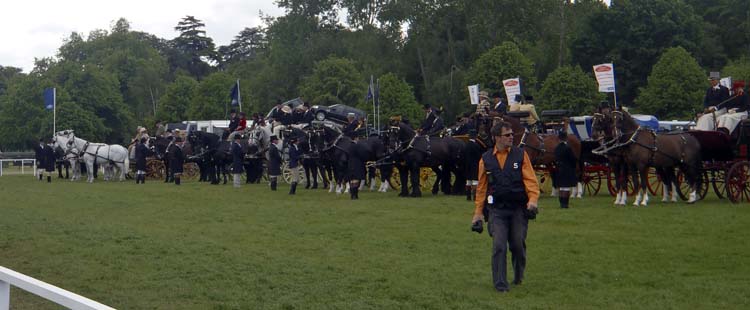
thirty-five members of the British Driving Society lined up before being led by HRH Duke of Edinburgh on a five-mile drive (photo by Jill Ryder)

.

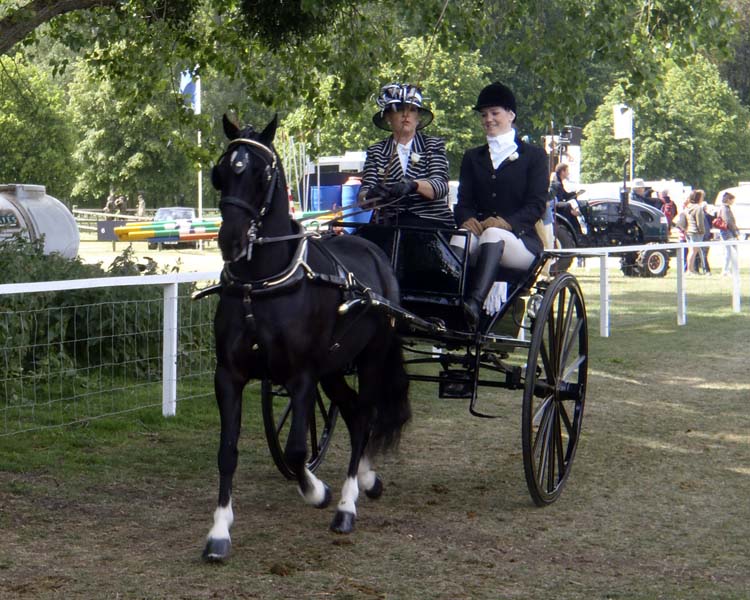
one of the participants in the BDS drive (photo by Jill Ryder)

Jill sent this report (and these photos) from Saturday’s CDE marathon at the Royal Windsor Horse Show:

On Saturday morning Richard Nicoll met the CAA group early and walked them around the marathon obstacles. He is in Windsor for an FEI meeting, and so he was enjoying himself instead of working! 

.

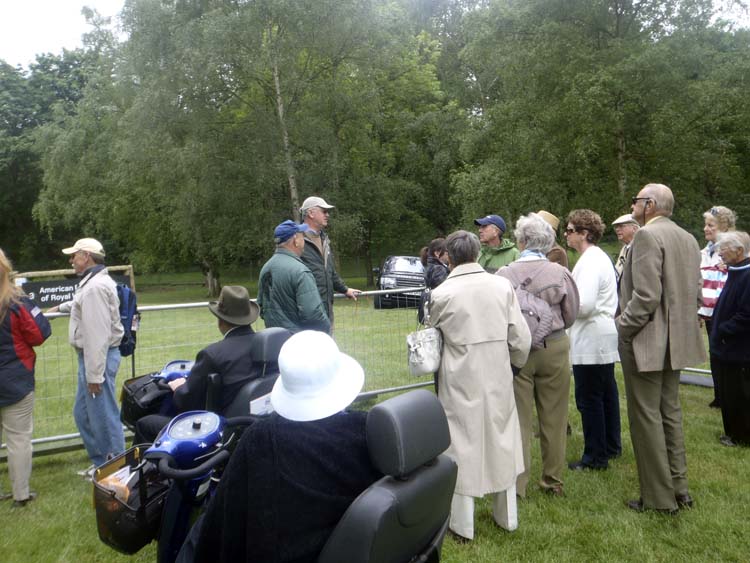
early on Saturday, Richard Nicoll gave the CAA group a tour of the marathon obstacles (photo by Jill Ryder)

.

... in the water obstacle, presumably before the horses and ponies came through! (photo by Jill Ryder)

.

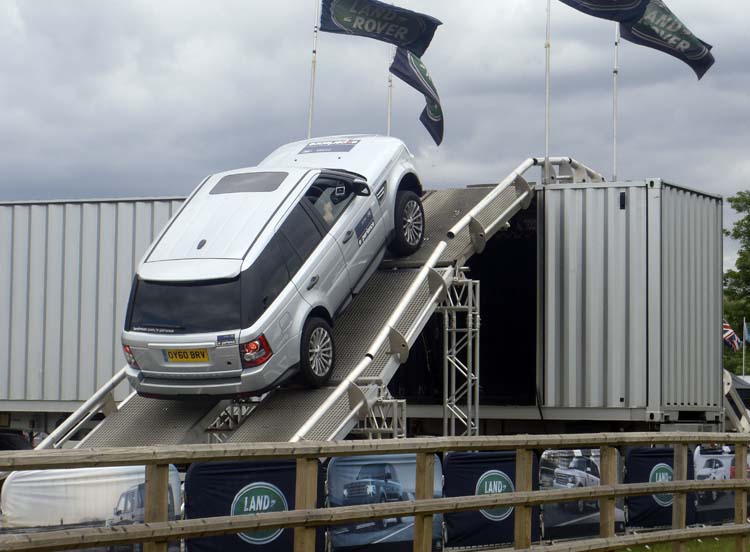
part of the display for Land Rover, sponsor of the driving event (photo by Jill Ryder)

.

The marathon started at 10:00 a.m. and went on most of the day, starting with the pony fours, then horse pairs and, finally, the horse fours. All seemed to go well on the marathon until the horse fours. The team that went just before George Bowman (GBR) had a turnover and runaway in Obstacle 3, and the horses all ended up in the ditch, which was full of water. It was scary and dramatic, but all horses (and people) were ok.

The CDE scores are available at www.hoefnet.com.