Recommendations for Long-Distance Hauling

article reprinted with permission from the Kentucky Horse Council

.

Hauling horses over long distances is quite stressful for them, but with an understanding of good trailering practices, it can be managed.

The vehicle and trailer you select for distance hauling should both be reliable. Well in advance of your trip, you should have your hauling vehicle and trailer serviced to ensure that both are equipped for a long haul. In addition to verifying the roadworthiness of both, you will also want to be sure that all lights are in working order, brakes are fully operational, doors will open fully and latch properly, vents will open and close fully, windows will open and close fully, the trailer floor has been thoroughly checked, emergency trailer brake box has been tested and is in working order, tire pressure has been checked and adjusted according to the manufacturer’s suggested levels, spare tire is accessible and properly inflated, and vehicle is stocked with an appropriate trailer and truck jack, as well as tire chocks.

It is especially important that the trailer used for long distance horse transport has adequate ventilation and ample space to accommodate the size of the horses hauled.

Your horse also needs to be prepared for the long transport, and you’ll want to make sure that he will safely and calmly load and unload from the trailer. You may need to spend time well in advance of the journey training your horse.

Additionally, you need to have proof that your horse has the proper testing and vaccinations, and meets the health requirements for the state into which you are traveling. At a minimum, all state-to-state travel requires a current negative Coggins test (usually within six to twelve months, depending on the state) and a certificate of veterinary inspection or health certificate (within thirty days of the date of travel). Depending on current disease outbreaks and threats, states may require additional documentation, testing, etc. Always contact the office of the state veterinarian (for the state of destination) and your veterinarian in advance to learn about equine travel requirements to which you are subject.

If the transport will be so lengthy that you are unable to bring enough of your home water for the duration of the trip, you may consider acclimating your horse to flavored water in advance. You can do this by adding a flavored drink like Kool-Aid or Gatorade to your horse’s water daily for a week prior to the trip. As you travel, simply continue to add the flavoring to your horse’s water at the same ratio. This reduces the potential for your horse’s water intake to be affected by changes in water smell and flavor.

Some experts also recommend feeding electrolytes prior to and during transport, as it can encourage the horse to drink. This should be done very cautiously, as a horse that consumes extra salt without increasing water intake may need veterinary attention.

In advance of a long trip, talk to your veterinarian about equine vital signs assessments, hydration during transport, preventing respiratory illnesses commonly caused by long-distance transportation, use of electrolytes, health documentation, stocking a first-aid kit, feeding regimen during transportation, and strategies for managing long-distance transport.

Pack your trailer with: a supply of water (at least 24-hours’ worth) from the farm where the horse has been staying, a supply of flavoring (if used), your horse’s normal hay (enough to feed him throughout the trip and for a few days after his arrival in the new location or throughout the duration of his stay), equine first-aid kit, blanket (for cold-weather hauling), spare halter(s), spare lead rope(s), spare trailer tie(s), bucket(s), bedding, and fire extinguisher.

On the day of travel, prior to loading, follow your horse’s normal routine with one exception: reduce or eliminate grain intake immediately prior to and during transport.

Make and maintain a good layer of bedding in the horse compartment throughout travel. This will help absorb moisture from urine and manure, as well as reduce the likelihood of slipping.

Allow your horse the opportunity to eat his normal hay as he travels. The act of chewing will help keep your horse occupied, and digesting will help maintain gut function. If you hang a hay net, hay bag, or feeder, make certain that it is at chest height or higher (preferably higher for hay nets).

Your horse should wear a well-fitted leather halter or a nylon halter with a breakaway feature during all transport. For long trips, you might consider placing fleece halter tubes over part or all of the halter; this may be especially helpful for sensitive-skinned horses, as the fleece will help prevent rubbing and sores.

The use of shipping boots/bandages can be of benefit, as they protect the horse’s lower legs during transport. However, during lengthy transport, the risks of use can outweigh those benefits. A horse wearing shipping boots/bandages for several hours at a time may suffer decreased blood flow, increased heat, and sores. Therefore, it is generally not advisable to use shipping boots/bandages for long-distance hauling.

Standing in a horse trailer takes a lot of effort. It is a constant balancing act for your horse, as the transport vehicle increases and decreases speed and maneuvers into and out of traffic. It is especially important for trailer drivers to gradually increase and decrease speeds and change lanes and turn corners much more slowly than with a non-towing vehicle. Even with good driving, your horse will get tired during transport and will need a break.

Be sure to take parking breaks, of twenty minutes or more, about every four hours. The stopped break gives your horse an opportunity to relax in the trailer and “unlock” his legs. Leave your horse on the trailer during parking breaks, but be sure to park in a well-shaded area. If it’s possible to do so safely, and depending on the weather, increase the airflow through the trailer by opening drop-down windows and upper doors during your parking breaks.

During parking breaks, 1) check your horse’s overall health and demeanor. Carefully check him for signs of colic, heat/cold stress, and dehydration. 2) Adjust your trailer’s ventilation as necessary. You may need to open additional vents/windows during summer travel and close some vents/windows and/or blanket your horse during winter travel. Horses tend to get hot in the trailer, so it is important to monitor their temperature closely and blanket only if necessary. 3) Offer your horse water. Do not be surprised if he doesn’t drink at first. During transport horses will often not drink for several hours. Regardless, you should offer your horse water at every parking break. 4) Refill the hay supply. 5) Keep your horse on the trailer. It is unsafe to remove your horse from the trailer at rest stops, along the highway, at gas stations, etc.

If traveling more than twenty-four hours, you may need to make accommodations for your horse to rest in a stable or paddock. Horse hotels are an option and, in some areas, fairgrounds can be rented for such stays.

During overnight off-loads, monitor your horse’s health carefully and allow him free-choice access to water. Continue to reduce or eliminate his grain intake, and allow him to eat ample amounts of the hay to which he is accustomed.

To learn more about long-distance horse transport, you can download this pamphlet by the Colorado State University Cooperative Extension.
I’ve just missed two days in a row here on the blog — days #4 and 5, I think, that I’ve missed posting something since I started this “post a day” thing at the beginning of the year. So that averages to missing only one day a month so far in 2011. Not bad, I suppose. And because it’s a holiday weekend, you didn’t even notice that I hadn’t posted anything all weekend, did you? Right??

At any rate, here’s another interesting video on wheelwrighting. This one shows the wheelwright using Victorian-era tools and techniques.

.

For your Friday: an interesting series of videos on carriage building, which were originally shown on Irish TV. Judging by the outfits these men are wearing, I would guess that these were filmed in the 1970s.

.

.

.

.

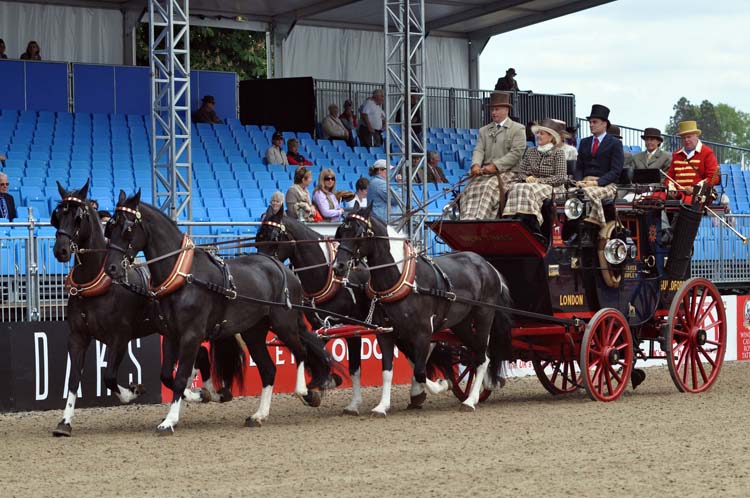
We were sent this lovely photo of CAA member Ken Ruthven, driving a team of horses and coach owned by CAA member Ian Smith. They were the winners of the Road Coach division in the coaching marathon at this year’s Royal Windsor Horse Show:

.

Continuing on from yesterday’s post, which featured the first half of an article on mail and Collinge’s axles, as published in the December 1834 issue of the London Mechanics’ Magazine:

.

The next kind of axle, and the best which has been hitherto invented as applicable to ordinary wheels, is that known under the name of “Collinge’s Patent.” The original specification was, I believe, “a cylinder secured between two cones.” But an axle on such a principle would not run smoothly; it would jar violently in the end play against the shoulder cone, and consequently the axles are never made so. The collar at the shoulder, against which the face of the wheel-box runs, is made very broad, flat, firm, and solid, and is, moreover, provided with an external rim or guard, which covers the end of the box, and excludes dirt and water. Close to the face of the box there is a reservoir of oil, and between the box and the collar there is a washer of solid leather. The centre of the arm is slightly turned down in the lathe, below the surface, to afford a lodgement for oil. The front of the arm beyond the box is turned down about a quarter of an inch, and a flat side filed on it. Upon this a small collar of gun-metal slides, the outer side of which projects in a conical form against the front end of the box, which is formed into a similar shape to receive it. Through this gunmetal collar a small hole is pierced to allow the passage of oil. It is thus evident, that when the wheel is in motion, owing to the flat side, the coned collar has no lateral motion, though it can slide along the arm, and regulate the play of the wheel. This collar is turned in the lathe when fixed on the arm, consequently it must fit accurately the end of the box, which is ground on to the arm. To adjust this collar to its place, and keep it firm there, two nuts of gun-metal, with right and left hand threads, one of smaller size than the other, are affixed. In adjusting, the first nut is screwed to the proper place, and then the second is screwed tight against it, one nut wedging the other. As a further security, a spring linch-pin is driven into the end of the arm beyond the nuts. Over the whole a large cap of gun-metal is screwed against the end of the box, with a washer of thin leather. This cap contains oil in its lower circumference, reaching to the horizontal level of the leakage point at the shoulder. The cap may be entirely filled, if it be wished, but it is useless, because the action of the wheel in turning would pump it away and waste it very rapidly. If it be wished to increase the quantity of the oil, the proper plan is to increase the circumference of the cap. The mode of feeding the axle is by the two reservoirs turning with the wheel, and the oil thus washing up; and this is the only principle upon which locomotive axles can be fed with oil without wasting it. Properly supplied with oil, a set of Collinge’s axles, as they are at present made, will run about 5,000 miles without sticking fast. The wheel is 5 feet 6 inches in diameter, which is about the height of the fore wheels of a full-sized carriage weighing about a ton. The hind wheels would, of course, run farther with the same quantity of oil. As the arms of the axles are not horizontal, but dip downwards, the bearing is principally against the shoulder, and there is consequently little strain on the nuts; and the cap, also, in this position, holds more oil. But the friction must be increased. A horizontal arm runs with much less friction than a dipping one, because the dip serves to remove a part of the weight from the hardened arm against the softer washer. With the exception of those used in railway and steam vehicles, axles are all but universally dipped, or inclined downwards at the arms. There are sundry reasons for this. First, the extra security against the wheels coming off. Secondly, the greater facility of retaining the oil; and, thirdly, the facility it gives for using dished wheels. The advantages of the dished wheels are, that while keeping the same track on the ground, the length of the axle is not increased, and greater space is afforded for the body of the vehicle; and, at the same time, the dished form is stronger than the plane. When rightly adjusted, the under spokes should be in a line exactly vertical to the base, and the upper ones form the angle. The strongest form of wheel is that in which the spokes are framed angle-wise to the nave, alternating both ways, to form a double cone, but this materially increases the length of the axle arm, and renders the nave unsightly.

The disadvantages attending “Collinge’s Patent Axle” are considerable extra weight, owing to the thickness of the box, which is usually made of cast iron. The length of the arm is also increased by reason of the collar, double nuts, and cap; and, altogether, a nave larger than ordinary is required for its insertion. But the advantages are so great, that whoever uses a vehicle with common wheels, traveling at the rate of five miles or more per hour, must be ignorant of the science of profit and loss, if he does not use them. The mere labor of keeping other axles properly greased or oiled, and the risk of abrasion from neglect, together with the waste of oil and grease, and extra risk of coming off, will make a heavy balance against the comparative cheapness in the first cost of the common axles.

The axles which I have examined bearing the name of “Charles Collinge, Lambeth,” are for the most part as well made as the best engineers’ work usually is; in short, they are as accurately finished as is necessary for any practical purpose. The only thing objectionable in them to the general purchaser, is their high price; but for a man who keeps a pleasure carriage, and is not a judge of workmanship, the wisest course is to pay that high price, and place it to the account of what Mr. Babbage has so well termed verification. Twenty-five guineas is the price, I believe, but they may be had of other makers for two-thirds of that price, some of them equally well made with those marked Charles Collinge, and some of them the merest rubbish. Without good workmanship, this axle is worse than a common one. The well-made ones are formed of thin bar-iron, welded by hand into a mass and case-hardened, both arms and boxes. After hardening, the boxes are ground on to the arms with oil and emery, consequently they cannot be perfectly true cylinders, though intended to be so. Birmingham made axles have of late, on account of their cheapness, come much in use; but unless coming from a known maker, they are not to be trusted, as, to save expense, they are commonly made from square rolled bars, good or bad, subject to flaws, sand-cracks, and cold shorts. For self-axles; i.e., axles which are bolted to two springs at the ends, and have no other bearing, as is the case with the street cabs and gigs generally, a good method would be to make the centre or bed of the axle of drawn or rolled tube; weight might be thus saved without loss of strength, and tolerable security would be taken for the goodness of the metal.