Today, we have another guest post from the CMA’s Mindy Groff …
.
As a student of history and a native Kentuckian, I find myself especially interested in this state’s carriage manufacturers. I recently came across this gem from the Kentucky Wagon Manufacturing Company, which was founded in 1879 in Louisville.
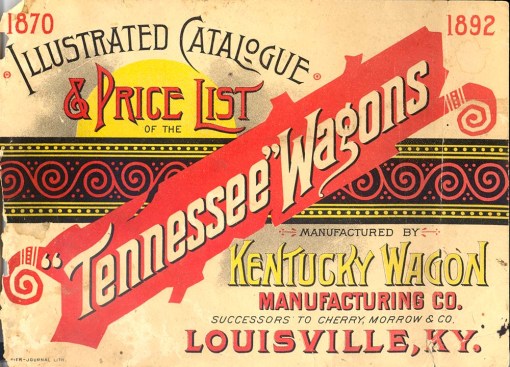
This 1892 catalog announces their succession to Cherry, Morrow & Co. in production of the “Tennessee” wagons. The Kentucky Wagon Manufacturing Company eventually because well known for this line of vehicles, and also for their “Old Hickory” farm wagons.
.
.
In their introductory announcement entitled “To the Trade,” the company explains that they are more than qualified to produce the Tennessee wagon to the “highest standard of excellence” because of their new factory, which is featured in the catalog:
.

.
The introduction goes on to include the following excerpt: “With unequaled advantages for obtaining the highest grade of materials, and a capacity of one hundred and fifty finished wagons every working day, the ‘Tennessee’ will not only continue synonymous with ‘perfection’ in its fullest sense, but the trade will be supplied promptly, a very important consideration, which will no doubt be appreciated by those who have suffered in the past through unavoidable delays incident to inadequate manufacturing facilities.”
I was interested in the reference to “inadequate manufacturing facilities,” so I did a little digging. Apparently Cherry, Morrow & Co. operated out of a state penitentiary in Tennessee. This was a part of Tennessee’s convict lease system, in which convicts and prison facilities were hired out in order to support the prison system. Production at the penitentiary was limited to about sixty wagons each day, which explains Kentucky Wagon Manufacturing Company’s boast of their own production capacity. [As an aside – I couldn’t find documentation explaining why Cherry, Morrow & Co. stopped manufacturing the Tennessee wagon themselves, but I did read of another company whose hired prisoners burned down their shops in protest!]
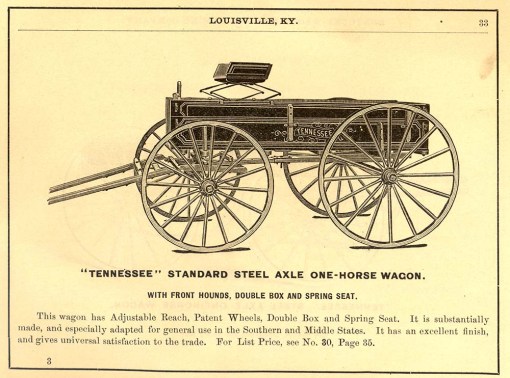
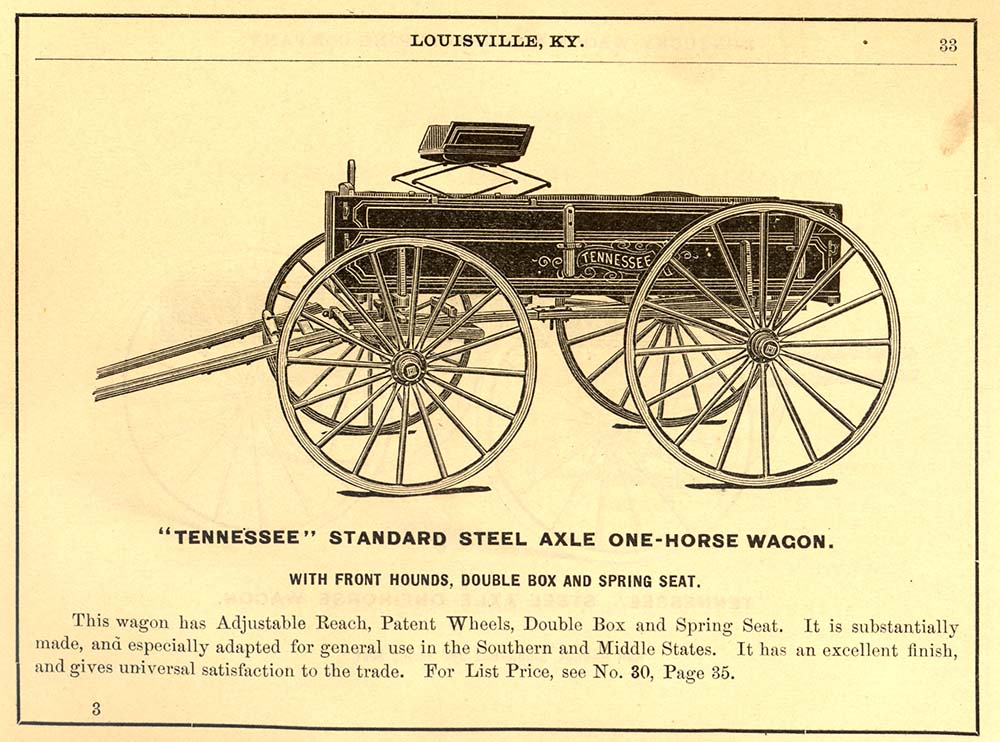
After seventeen pages of introductory material, with images and descriptions of the factory, machinery, and workmanship involved in the creation of these vehicles, the catalog moves on to feature the vehicles themselves. This is just one of the many models available for purchase:
.
.
In 1916, the Kentucky Wagon Manufacturing Company branched into automobile manufacturing, acquiring Hercules Motor Cars and producing the Dixie Flyer motor car. The company still exists today in the form of Kentucky Trailer, which operates out of a new location in Louisville. They apparently have a Heritage Museum at their headquarters. If I can find a free day to go visit, I’ll let you know what else I learn!






 The Slower Road