travel / destinations


Yesterday, we drove out into the countryside to see a show at “Acampo Abierto.” The beautiful property is owned by Alvaro Domecq, whose family is known for breeding and training horses and for breeding and raising toros bravos (literally, “brave bulls”), or as we usually know them: fighting bulls.

The family has put together a two-hour show that they put on three times a week to introduce their horses, their bulls, their beef cattle, and their way of life to visitors. Anything like this is of course a bit touristy because it’s just for show, but this one also appears to be a labor of love borne of goodwill and a desire to educate. It’s also clear that the entire family is involved in each performance. The riders range from small children to someone who is probably their grandfather — perhaps even Mr. Domecq himself. When we were there, the mother of several of the children in the show sat next to me, taking photos. And several other family members drove out to the arena to watch or to help.

Over the course of two hours (with a ten-minute intermission), they bring all the riders into the arena; bring the cows and calves into the arena; bring a herd of mares and foals in; demonstrate the life of the old Spanish drovers (“cowboys”) by bringing in the steers, bringing the cows and calves back in and, with horses and dogs, separating the calves out; and, finally, they bring in a group of fighting bulls. Of course, all of this happens in sequence and not all at once! In between these very active segments of the show (many of the herds are “brought in” to the arena at a full gallop, starting from a quarter of a mile away!) were a few more sedate demonstrations, including classical dressage and traditional Spanish “ranch” dressage. Because everything is explained along the way (in Spanish, French, and English) it was interesting to learn that they breed purebred Andalusian horses for dressage work and, I would imagine, for driving (these they often leave “whole”). But they typically cross their Andalusians with Arabians to obtain the horses they use for working with the cattle and the bulls (these horses they geld).

Here are some photos from the show:

four riders enter the arena, including three young boys (Domecq grandsons, perhaps?)

four riders enter the arena, including three young boys (Domecq grandsons, perhaps?)

preparing to go to work, using the traditional pole with which they tap the cows
preparing to go to work, using the traditional pole with which they tap the cows

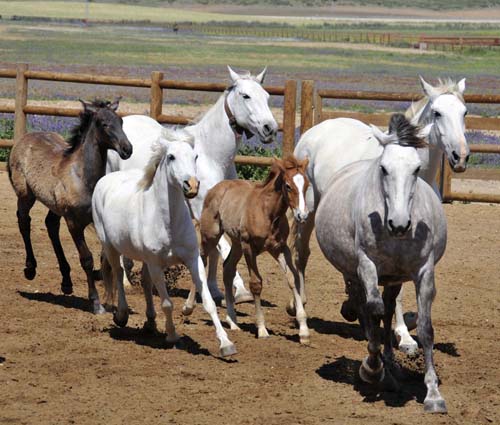
a herd of mares and foals running into the arena

a herd of mares and foals running into the arena

bringing the steers in to the arena for the "reenactment" part of the show

bringing the steers in to the arena for the “reenactment” part of the show

the traditional "ranch dressage" is vaguely similar to reining

the traditional “ranch dressage” is vaguely similar to reining

working with the fighting bulls

You can’t really tell from any of these photos, but it’s been really windy here the past couple of days. I understand that we’re in the midst of a “levante” wind, which comes from the east. This time of year, it just makes the wheat fields ripple constantly, but in the summer a levante brings hot air and dust from Africa.

Having grown up in the Santa Ana wind country of southern California, where the warm (sometimes hot) wind comes in from the desert and blows all the smog back out to sea, I’ve always had a bit of a soft spot in my heart for a good strong wind, as long as it doesn’t do any harm.

And, speaking of California, the countryside here in southern Spain continues to remind me of home. Or, at any rate, of the California I wish I could have known, before all the people arrived. In a strange sort of way, this visit to modern, rural Spain is a bit like a time-travel visit to old California. While on our way to and at Campo Abierto, we saw eucalyptus trees, palm trees, oleander, cactus, dry creek beds, and all sorts of delicate wildflowers thriving on all the rain the area received this winter. There are red poppies, and various pink, yellow, purple, and magenta wildflowers. Today, we drove along the coast, past Trafalgar and through a forest of “umbrella” pines and scrubby oak trees.

Tomorrow, we’re going to visit the Royal Andalusian School of Equestrian Art in Jerez de la Frontera (site of the 2002 World Equestrian Games). And on Tuesday, we may be going (through the generous help of a cousin of a friend of a friend) to yet another private carriage collection, this one at a farm on the way to Jerez.


an old fort on a hill, and farmland, near the Domecq property

an old fort on a hill, and farmland, near the Domecq property

In a comment on the previous post was a question about the bridles on the driving horses, in both the photos and the videos seen here. And, if you’ve never before seen what I was taking about, my mention of pom-poms may not have made much sense.

With the traditional style of harness here, the bridles of the driving horses (or mules) are covered in pom-poms that look like they’re made of wool. They typically come in one, two, or three colors per turnout.

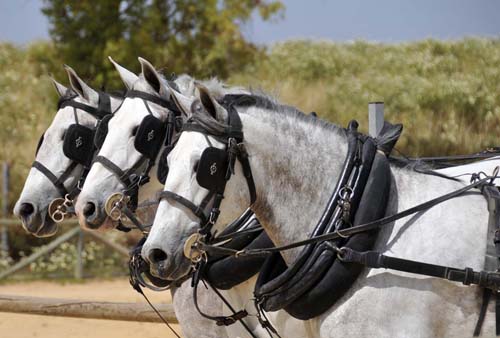
So, to help dispel any confusion, here are two photos for you to study: the first is a close-up of the bridles (with pom-poms and bells) on the three leaders of a five-in-hand team at the feria, and the second is a close-up of a single pom-pom.

bridles on three horses at the Seville feria, showing the traditional pom-poms and bells

bridles on three horses at the Seville feria, showing the traditional pom-poms and bells

a close-up look at a single pom-pom, which would be one of about 30 on a bridle

a close-up look at a single pom-pom, which would be one of about 30 on a bridle

While we were at Mr. Ordas’s farm last week, watching the horses in the arena, Sue Murray used her camera’s video feature to film the horses and carriages. This link will take you to six minutes’ worth of Andalusian horses: a four-in-hand team and a five-in-hand. If you have sound on your computer, you can hear the guitar music in the background and the bells on the harness.

http://www.youtube.com/watch?v=sPE-oL6S5pg

And here are links to three videos that Sue shot at the feria:

http://www.youtube.com/watch?v=867EC29dIJg

http://www.youtube.com/watch?v=O9FId9uM0Lk

http://www.youtube.com/watch?v=RZ5lwi1T7cw

Enjoy!

I know you’re tired of hearing this by now, but “Wow!”

After having heard about and seen pictures of the feria, I was looking forward to seeing it in person. But I have to say that being there, in the middle of all the color and life and action and the sound of hooves and wheels on cobblestones, was far better than I had imagined.

But I’m getting ahead of myself. In the morning we had a guided tour of the city by bus and on foot. Our first stop was the Spanish Square (Plaza de Espana), where we had been briefly once before. We learned that the beautifully painted tiles around the base of the semicircular building depict a variety of stories from Spain’s history. From here, we went to the Santa Cruz neighborhood (Seville’s old Jewish quarter), which is a maze of extremely narrow, crooked lanes that lead into a series of very small plazas. From the second of the plazas we visited, we followed yet another little alleyway and ended up in a lovely large plaza with the alcazar (the moorish-inspired medieval royal palace) on one side and the cathedral on another. Seville’s cathedral is the third-largest in the world, and it’s quite an imposing, ornate edifice.

In the plazas around the cathedral were a large number of the tourist carriages that we had seen all around town on previous days. These aren’t your typical tourist turnouts, though. Many of the carriages are antiques, and nearly all of them are kept in beautiful condition. The horses look fit, healthy, and lively. Everyone in our group commented on how impressed they were with the apparent good condition and cleanliness of both the horses and the carriages. It’s clear that these drivers (all licensed) take great pride in their work and their turnouts.

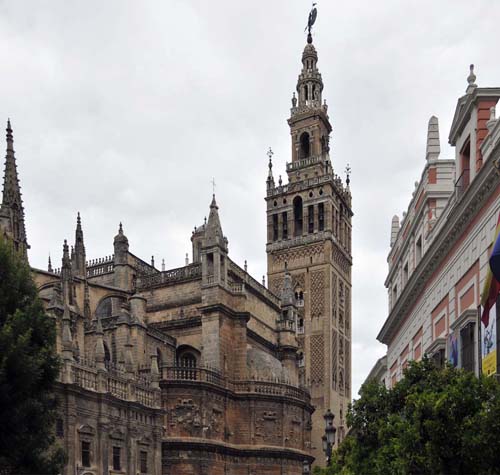
one view of Seville's cathedral

one view of Seville’s cathedral

We went into the cathedral with Raimundo, who had met us along our walk, and our tour guide and what seemed like thousands of other people. It’s a huge space, and it was packed with tourists.

And then it was on to the feria! The day we went was, apparently, also the day that most of the inhabitants of Seville go as well. The first full day of the feria, we were told, is an official holiday in the city so that anyone who wants to can go to the fair.

For anyone unfamiliar with the idea of the feria: the “fairgrounds” are like a village of colorful tents that look like small houses. These are arranged side-by-side on three long cobblestone streets with quite a number of cross streets. Between the tents (casetas) and the streets are packed-dirt sidewalks. In the casetas (almost all of which are invitation-only) are people sitting and eating and drinking and visiting with friends and watching the spectacle. And what is the spectacle, you may be wondering?

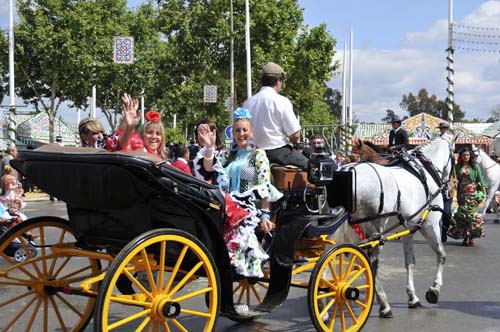
There are horses (nearly all Andalusians, and many stallions) being ridden by men, women, teenagers, and small children, all in traditional Andalusian dress. And there are hundreds of carriages, including many antiques and a couple of coaches, being driven with singles, pairs, fours-in-hand, and fives-in-hand. Many of these are in the traditional Andalusian harness — pom-poms and bells galore. So the riders promenade through the streets of the “town,” stopping for drinks at their own or friends’ casetas along the way. And the carriages, too, promenade through town, stopping in front of their casetas to pick up and drop off passengers, probably family, friends, and clients. And weaving in and around all of this are probably thousands of people — walking on the sidewalks and in the streets. Most of the women are in the fancy, colorful Andalusian dresses, whereas the men all seem to be wearing suits. This is probably the best-dressed fair I’ve ever been to.

Enjoy these photos of the feria, as our group heads home. I’ll be in staying in Spain for a few more days and will continue to post a few thoughts and photos here along the way. Then, starting in May, be sure to check back here for the CAA’s blog from the Royal Windsor Horse Show!

women waiting to cross the street at the feria

women waiting to cross the street at the feria

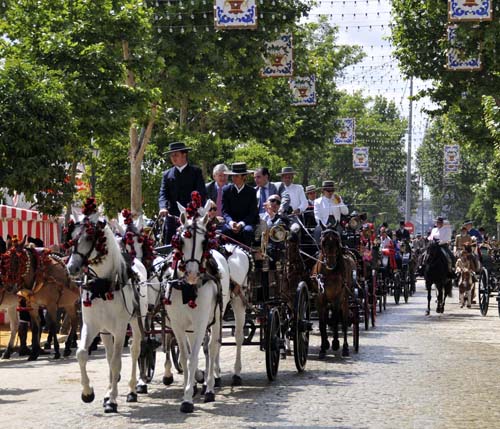
a long line of horse-drawn carriages parading down the streets of the feria

a long line of horse-drawn carriages parading down the streets of the feria

hildren on the back of a carriage and a lady sitting on a horse in the traditional style

children on the back of a carriage and a lady sitting on a horse in the traditional style

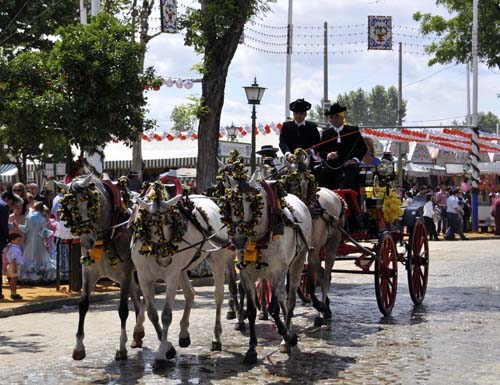
the five-in-hand team and carriage of one of our hosts during our trip

the five-in-hand team and carriage of one of our hosts during our trip

one of the (many!) beautiful Andalusian horses at the feria

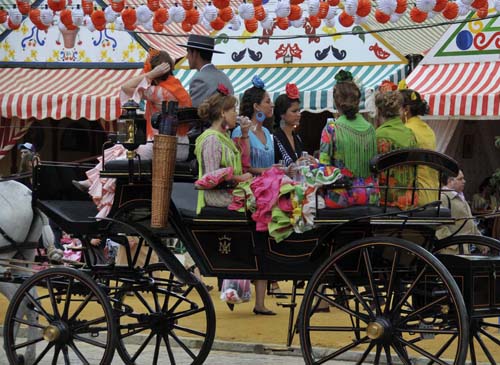
with the casetas and the traditional outfits, the feria is wonderfully colorful

with the casetas and the traditional outfits, the feria is wonderfully colorful

goodbye from Seville and the feria!

April 27, 2009

at a loss for words

Posted by Jennifer under carriage collections, horses & driving, Spain, travel / destinations
1 Comment 

I don’t know what to say. Today was amazing-, spectacular-, marvelous-, “perfecto” day number three. Wow.

Our first stop was to see the enormous carriage collection of Mr. Aranda. He’s putting the finishing touches on his new (huge!) carriage museum. Because the museum’s not finished, it’s not actually open yet and so it was a treat to be invited to see it.

I’ve been told that the entire collection numbers more than 200 carriages, and just looking at the size of the museum building, I would believe the claim. There were all sorts of vehicles, although as one of our group said, they are not necessarily representative of everyday life of the time. These were unique and high-end vehicles, most of which had been restored in an on-site restoration shop. The carriages were displayed with a lot of space around each one, which made it easy to walk all the way around and look closely at them. The ubiquitous water (usually a bucket of water under each axle to help with the humidity level) was here a whole series of spouting fountains, with one big landscaped fountain in the center of the building.

After a long look through this building, we walked into the beautifully landscaped garden (to the sound of even more fountains) and, surprisingly, into another building with even more carriages. Most of these were large and ornate, and one was being cleaned and polished to be driven in the feria later in the week.

one of the unusual coaches in Mr. Aranda's huge collection

one of the unusual coaches in Mr. Aranda’s huge collection

After exploring this hidden museum building, we were led deeper into the garden and given a view of a paddock with horses. Mr. Aranda also breeds Andalusian horses, but he specializes in black ones, as opposed to the ubiquitous grays. From here, we strolled down a shady lane at the far end of the garden and into a delightful courtyard, which is surrounded by what appear to be the oldest buildings on the farm. Around a corner into another yard, and we were introduced, one by one, to several of the farm’s stallions. Back into the first courtyard, through a doorway and in we went to the harness room. There was yet another courtyard to see, and even a small chapel. And there was a very friendly barn cat who demanded ear scratches and then followed us around for quite a while.

the first of the lovely courtyards in the oldest section of Mr. Aranda's farm

the first of the lovely courtyards in the oldest section of Mr. Aranda’s farm

On the way back to the bus, I heard the story (from Mr. Aranda’s son) of the three-month-old orphaned filly who was bottle-fed (in the house) and now thinks she’s a person. She plays with the family, lies down with them in the grass when they sunbathe, watches TV and, if they’re sitting on the sofa, hangs her head over the back until they scratch her. I would’ve thought he was pulling my leg unless I’d seen the photos of it all on his iPhone.

Our final stop in this marathon of carriage collections was the smallest, but in no way the least. To get there, we drove to the lovely-looking town of Alcala, which stretches up a hillside to the base of an old castle. On the other side of town, we turned and headed out past fields of tall grasses, daisies, red poppies, and more horses. When we arrived at the Olivera farm, we were introduced to “Pepin,” the owner (the original owner’s nephew), and his wife. They and their driver, grooms, and family (even their granddaughter, a toddler) welcomed us with a spread of bread, olives, several kinds of ham, Spanish “tortilla” (potato and egg “pie,” served cold), and more. They were even grilling delicious ham and ribs and sausages in the fireplace/grill corner of the old wash-rack room. They had a table and chairs set out for us in the small courtyard surrounded by the wash-rack room on one side, their house on one side, and the harness/carriage room on a third side. Out the other side of the wash-rack room was yet another courtyard, this one a little larger, with a barn of horse boxes off to the left.

After most of the food was gone, out came a bowl of strawberries. Then, a little later, a pot of coffee, a carafe of hot milk, and a tray of cups and saucers. Needless to say, we were very well taken care of!

When everyone had eaten and visited and relaxed, Pepin and Raimundo gave a tour of the harness/carriage room, which houses several sets of traditional Andalusian harness and both old and new sets of English-style harness. Displayed on chairs are several styles of Andalusian livery from various time periods. And arrayed across the tops of the harness cases, on the walls, and on the tables are the many trophies, ribbons, and awards the family has won for their horses, their carriages, and their driving. On the other side of the room are six carriages: five antiques that have been expertly restored and one 25-year-old reproduction. All are painted in the family’s colors of red and black.

the gorgeous finish on one of the Olivera farm's carriages

the gorgeous finish on one of the Olivera farm’s carriages

After this tour and a close look at the carriages, we met some of the horses and watched a five-in-hand do some work in preparation for driving in the feria tomorrow.

the three leaders in the five-in-hand team

the three leaders in the five-in-hand team

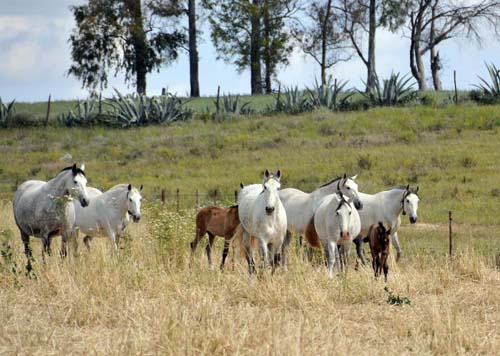
And then, as a final treat, we walked out the back of the yard to a large field, where we went with Pepin to see a herd of his Andalusians. There were 25 or more mares, a number of new foals, and one stallion. When we headed slowly into the field, the older mares went around to arouse the sleeping foals and get everyone moving away from us. So the group of us stopped about mid-way in and waited while Pepin walked slowly toward the herd, talking to the mares. In the end, the mares were mostly curious about us and what we were doing there, and the foals didn’t seem to take any notice at all. The stallion, however, chased any overly curious mares back to the herd. Pepin made his way around to the back while the stallion wasn’t looking and managed to move the lot toward us before the stallion realized what was going on and moved them away again. Watching the interactions among the herd was fascinating. And the horses … well, it goes without saying that they’re beautiful.

curious mares and nonchalant foals

curious mares and nonchalant foals

« Previous PageNext Page »