travel / destinations


Yesterday (Thursday) was a long, full day at the horse show.

The members of our group went their separate ways to find the things they most wanted to see. And there were so many choices!

First, there were the horse pairs and pony four-in-hand teams in the FEI driving event … they had their dressage tests yesterday (all the many horse teams will go today). The only American competing in this event this year is Miranda (“Randy”) Cadwell, who right now sits in fifth place out of 21, with a dressage score of 54.78 penalty points.

In the other three rings of the horse show were such diverse classes as jumping, riding horses, “fancy dress” for riders with disabilities, light trade turnouts, hackneys, polo ponies, driving for the disabled, hunters, mounted games, and more (see the photos below).

Each year, the layout of the venue changes ever so slightly, so that I always spend part of the first day at the show getting my bearings. This year, in the middle of the circle created by the three rings and the warmup areas, and next to the vendors and food court, is a big display of military vehicles. Most of these are open for peering or even climbing into. 

one of the competitors in the riding horse championship is standing here in the collecting ring, and on the other side of the rail is an RAF plane on display

one of the competitors in the riding horse championship is standing here in the collecting ring, and on the other side of the rail is an RAF plane simulator on display
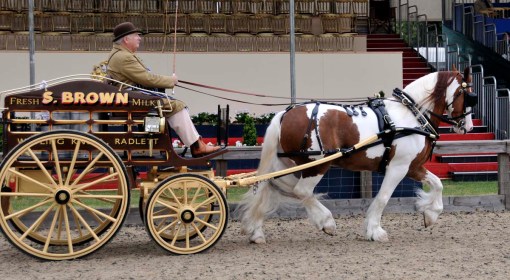
one of the colorful turnouts in the light-trade class
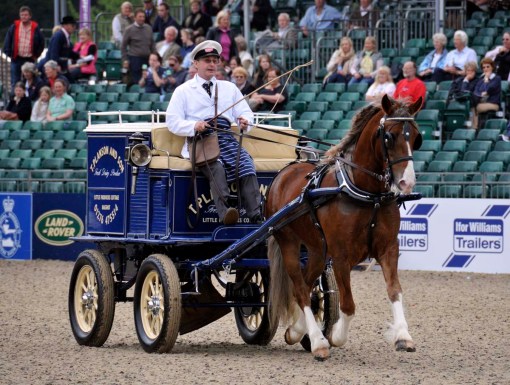
one of the colorful turnouts in the light-trade class

... and a different sort of milk-delivery wagon from the one above

… and a different sort of milk-delivery wagon from the one above

this butcher's cart won the two-wheel division and was reserve champion overall; they won the championship a couple of years ago

this butcher’s cart won the two-wheel division and was reserve champion overall; they won the championship a couple of years ago

these were the champions in the light-trade turnout class: T. Cribbs and Sons' funeral service delivery van (they won the class last year as well)

these were the champions in the light-trade turnout class: T. Cribbs and Sons’ funeral service delivery van (they won the class last year as well)

a competitor in the "heavyweight hunter" class

a competitor in the “heavyweight hunter” class
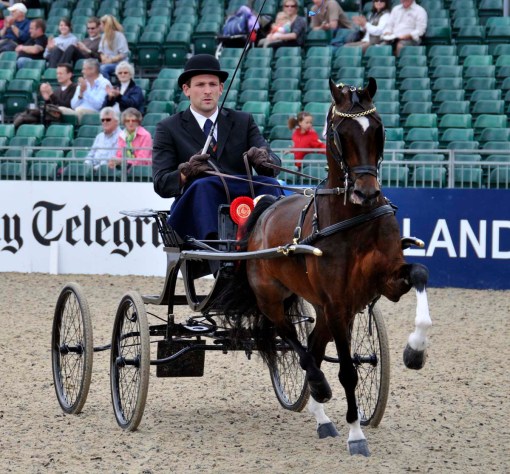
this hackney pony was declared reserve champion for the hackney division (check back for the pony's name because, after I've touted it, the show's website doesn't have these results posted yet)

the Hackney pony Westbourne Hi-Tec (a 5-year-old stallion by Plaistow Pippit, owned by Mr. E.A. Ward) was declared reserve champion in the hackney division
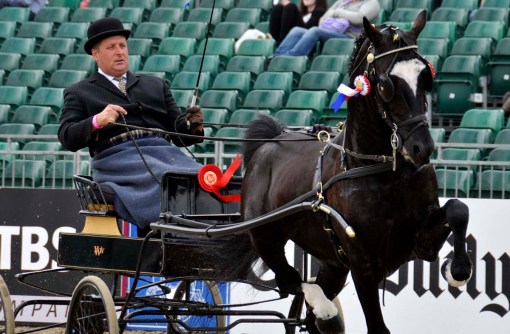
... and the champion in the hackney division (check back for the horse's name because, after I've touted it, the show's website doesn't have these results posted yet)

… and the champion: the Hackney horse Forewood Brave Heart (an 8-year-old stallion by Heldon Expectations, owned by Mr. J. Wenham)

one of the exciting classes of the afternoon was a team jump-off between various hunts; for the awards, these hounds were in the ring as well and led the way for the victory gallop

one of the exciting classes of the afternoon was a team jump-off between a number of hunts; these hounds were in the ring for the awards ceremony, and they led the way for the victory gallop

Near the end of the day, many in the group made our traditional trek under the Victoria Bridge, over to the stable area, and on to the Bowman/Fawcett “camp” for drinks and a visit. The Bowmans are actually not here this year, but the Fawcetts did a marvelous job of making the Pim’s in their stead! We all had a nice chat under the trees by the river. That part of the stable area, where the caravans park by the Thames, is always very peaceful and friendly. While we were there, several of the group met and struck up a conversation with a woman and her family, returning to their horse box from the arena. She had shown her “coloured” horse (pony-sized, actually)  in the in-hand class. He was an adorable youngster, only two and a half, that she had bought from the gypsies when he was six months old. Someone offered him a bit of his Pim’s cup, and the young pony was only too happy to have a slurp or two.

Later that evening, at least two members of our group who had so enjoyed the tattoo the night before went back again. Unfortunately, it poured rain for about ten minutes in the middle of the performance, but then it let up. We’ll hope it didn’t put too much of a damper on the festivities.

Today is the coaching marathon and such diverse horse-show classes as tent-pegging and skill-at-arms.

For combined driving or other horse-show results, don’t forget to check www.rwhs.co.uk or www.hoefnet.com.

Last night, we went to the Windsor Castle Royal Tattoo — a spectacular nighttime show featuring  military bands, horses, and military tributes.

On the horse side of things, we saw the always-thrilling musical drive of the King’s Troop and the musical ride of the Household Cavalry. If you’ve never seen the King’s Troop, they have about 75 or so horses and six guns in the main arena. They do an exciting pattern of driving the guns (each one hitched to six horses) around the arena and (at high speed) across the diagonal from alternating sides. Near the end of the show, they unhitch the guns, take all the horses to the other end of the arena, and then shoot off all six guns, one at a time and then all together. The smoke from the guns is quite impressive at night! Once the guns are hitched back up and the show almost over, each team (six horses pulling a gun, with three riders behind) takes turns exiting the arena at a full gallop. The Household Cavalry, in their traditional uniforms, performed their own thrilling show, with the drum horse at the center. They also had four “trick” riders … at one point, two of the “trick” riders were each being circled by half of the cavalry riders. The “trick” riders made their horses lie down and then lay their heads in the riders’ laps (they were sitting on the ground at this point). Then, on cue, the horses jumped halfway up, the riders got on, and the horses leaped up the rest of the way. I’m not sure what the purpose of this is/was, but it was impressive nonetheless. At the very end of this performance, the cavalry galloped out of the arena in small groups. Then each of the “trick” riders galloped out, one at a time, each carrying a flag. At a full gallop, the flags streamed straight out behind them. First went the English flag, then the Scottish and the Welsh, and finally the British flag. This final one received a really loud cheer from the crowd.

We were also treated to a number of impressive military bands, from here and abroad. There was a fife and drum corps and drill team from Denmark and a marching steel drum band from Trinidad and Tabago. The Royal Air Force’s concert jazz band played some lively swing music. The Royal Navy band played while students from the Navy’s physical fitness school (or somesuch, I don’t remember the exact name) danced the hornpipe. And, of course, the military marching bands from the various branches of the Army and Marines thrilled the crowd, as did the massed bagpipe band.

Sorry for the lack of pictures from the tattoo, but we were sitting too far away for photos. As soon as I finish this, I’m heading over to the show, so we will have photos of today’s events!

If you want to follow the show results, don’t forget to check www.rwhs.co.uk. You can also find results for this weekend’s FEI driving event at www.hoefnet.com.

I’ve been here in Windsor for a few days now … glorious, warm, sunshine-y days. Then a cool breeze set in. And now that today is the first full day of our CAA trip, it’s of course turned misty and rainy. As I’m writing this, it looks dry outside, but it’s still gray. As long as it doesn’t actually set in and rain, we’ll do just fine.

On our CAA trip this year, we have a group of nearly 30 people from across the U.S., Canada, Bermuda, Argentina, England, and even Austria. That number includes me and our intrepid group leader, Jill. Nearly everyone arrived here in Windsor yesterday, and so our first group activity was (of course!) afternoon tea. After a short walking tour of Windsor and Eton, everyone met at a quaint restaurant known as the “Crooked House.” 

.

it's easy to see why the "Crooked House" was given its name

it’s easy to see why the “Crooked House” was given its name

.

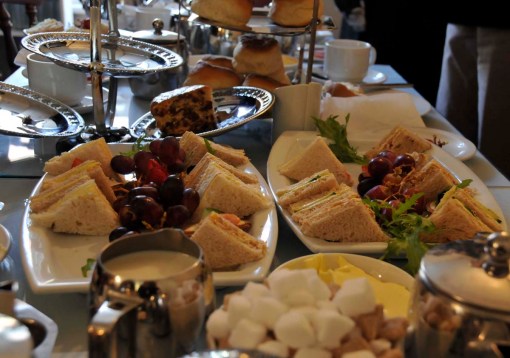
And here’s what one of our three tables looked like after we’d had our fill of tea, sandwiches, scones with clotted cream and jam, and fruit cake:

.

these are just the leftovers, after we'd enjoyed a typical afternoon tea

these are just the leftovers, after we’d enjoyed a typical afternoon tea

This morning, the group had a behind-the-scenes tour of the King’s Troop Royal Horse Artillery, which is stabled in the Royal Mews for the duration of the horse show this week. Normally, the troop is stabled and stationed in London.

The King’s Troop will perform its famous “musical drive” once each evening during the military Tattoo and then one final time on Sunday afternoon. After our tour guide met us and led us through the guarded gate into the mews, we were given a brief history lesson on the troop and then taken to see various areas: the farriers’ shop, one of the harness-cleaning rooms, some of the stables, and the indoor riding school, where the six guns are stored (and cleaned) during the week.

Each morning while here, the King’s Troop has taken its horses out for about 30 minutes of exercise. We learned on our tour that, when they’re at home in London, they go for a similar exercise walk each day for an hour and a half.

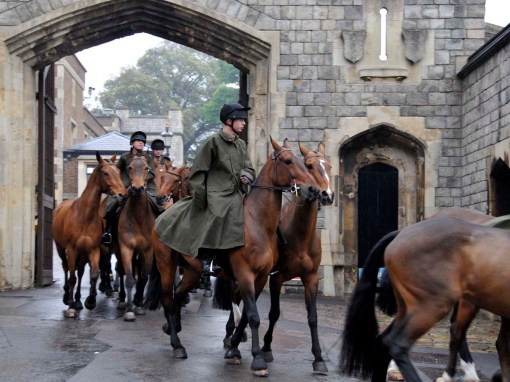
a portion of the large contingent of King's Troops horses, leaving the Royal Mews this morning for their daily exercise walk

a portion of the large contingent of King’s Troops horses, leaving the Royal Mews this morning for their daily exercise walk

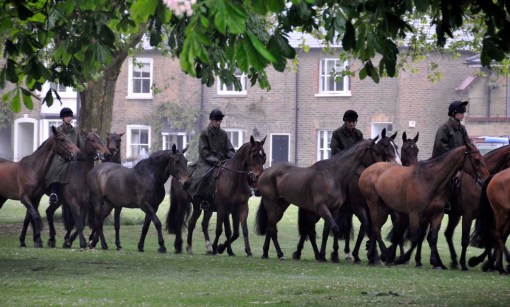
another section of the long line of King's Troop horses, walking on the grass beside the Long Walk

another section of the long line of King’s Troop horses, walking on the grass beside the Long Walk; each rider is leading two other horses

 In a very slight departure from my practice of years past, my plan for the blog for this trip is NOT to run through each day’s results. We’ve been informed that the results will be uploaded to the show’s website almost immediately as they happen, so if you do want to follow the results, you’ll be able to look them up faster than I would be able to get them to you through the blog. What I’ll be doing instead is trying to give you some of the “flavor” of this incredible horse show, and let you know what we’ve been up to on the CAA trip. If you followed the blog while we were in Spain, you already know that there will be lots of photos! To check the results from any of the horse show classes, visit www.rwhs.co.uk. If you have any questions about the show, or if you can’t find specific results that you’re looking for, post a comment here, and I’ll see what I can do.

Cheers!

… really. I mean it this time!

Tomorrow I fly from Seville (through Lisbon) to London, where I will spend the next week at the Royal Windsor Horse Show. As that is another official CAA trip, I’ll be blogging from there daily again, starting on Tuesday. So check back often for more reports and photos, this time from England!

To finish off my reports from Spain, let’s go back to yesterday’s visit to the private carriage collection.

My parents have a good friend here in Spain who, in turn, has a good friend we met on this visit. She has a cousin (well, 73 cousins, actually!) whose family owns the farm and the carriages we visited.  The farm and carriages belong to the Terry family, which used to own and run the Terry bodega (sherry winery) here in El Puerto, until they sold the bodega (and the brand name) about ten years ago. Our new friend’s cousin is a Terry on his father’s side, and the cousins are related through their mothers. The mothers were two of eleven children (hence the 74 cousins), and they were part of the Osborne family, who are also major sherry producers here in El Puerto. I think the Domecq family (also big sherry producers and horse people) are related to this large extended family as well.

After our visit to the farm, we stopped at a beautiful hotel here in town for a drink and a snack. It’s next to the Terry bodega and was probably once part of the same facility. It boasts exquisite architecture, including an ornate private chapel that was part of the original building (the priest would come from the local church each morning to say mass). The courtyard in the center is now covered but would have, I’m sure, once been open. And there’s a lovely fountain in its center. On one side is a huge garden with pathways between the trees and plantings, and several semicircular stone benches with small fountains at the center of the circles and rosemary bushes growing behind the benches. We understand that the furniture is not the same as it once was, years ago, but the feel of the place (overstuffed sofas, portraits on the walls) is of someone’s home. And, in fact, as you may have guessed, this was someone’s home (the grandparents of our new friend, if you hadn’t already figured that out as well!) before it was turned into a hotel.

But I’m getting ahead of myself.

Our visit to the farm was all the more delightful because the family was so kind in allowing us to even see it, as it’s simply their private getaway. The family’s small collection of carriages (most acquired by our host’s grandfather) are stored in two rooms. Some have been restored and some appear to be in original condition. All but one are driveable, although they are not driven as often anymore because the family’s horses are now mostly ridden.

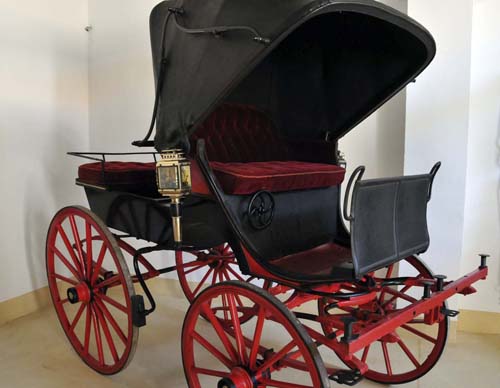
one of the old carriages in the Terry family's collection -- this one has flower decorations painted on the woodwork

one of the old carriages in the Terry family’s collection — this one has flower decorations painted on the woodwork

one of the family's carriages in the second storage area

one of the family’s carriages in the second storage area

The harness and tack room is a cosy place, full of old harness, traditional saddles, hunting trophies, and horse-show trophies. There’s even a Breyer horse that was modeled after one of the family’s Andalusian stallions.

part of the harness / tack room

part of the harness / tack room

As I’m learning is the case at most of these Andalusian farms, there was a succession of delightful courtyards, patios, and outdoor “rooms,” both sunny and shady. The ones here were filled with pots of geraniums, rose bushes, palm trees and, in one case, an arbor of grape vines. Off of the grape-vine courtyard were four stalls with horses in them; Andalusians, of course. This one here was quite friendly and didn’t want us to stop scratching his nose.

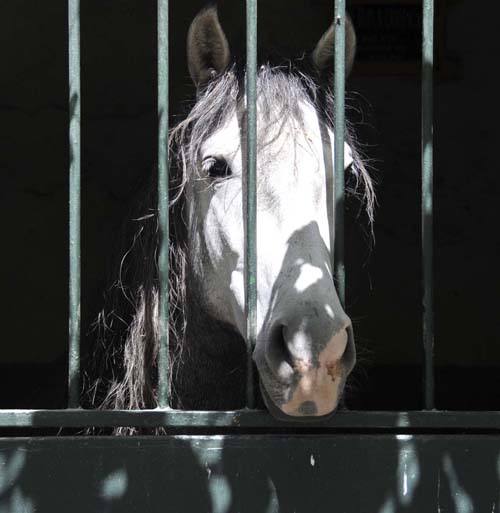
this horse really wanted his nose scratched and his photo taken

this horse really wanted his nose scratched and his photo taken

Later that day, we went to El Puerto’s feria, which is just as colorful as Seville’s but has far fewer horses. One thing this feria has much more of, though, is singing and dancing. It’s a treat to see so many girls and women (and a few men) in their bright, colorful feria dresses (not the men, obviously!), dancing the traditional Sevillana. And everyone so happy! Just as we’ve been for our springtime visit to southern Spain.

Here I am (suddenly, it seems) on the last day of my visit to Spain.

We (my parents, who used to live here, and I) have had a wonderful time during these extra days of our visit to Spain, after the CAA trip. And we continued with the horse theme throughout which, as you may have gathered by now, is quite easy to do here in Spanish horse country.

On Monday, we drove the short distance to Jerez de la Frontera to visit the Royal Andalusian School of Equestrian Art. There were no performances that day, but our entrance ticket allowed us to wander through the park-like grounds, see the palace and the riding school’s exhibition building, and watch the riders and horses during their training sessions. We were even able to walk through the saddle shop, where the harness-maker instructors and students make bridles and saddles by hand. There’s a small room off to one side of the building that has examples of the various stages in the construction of a traditional saddle, and there’s a short video that shows the process and explains it in several languages. 

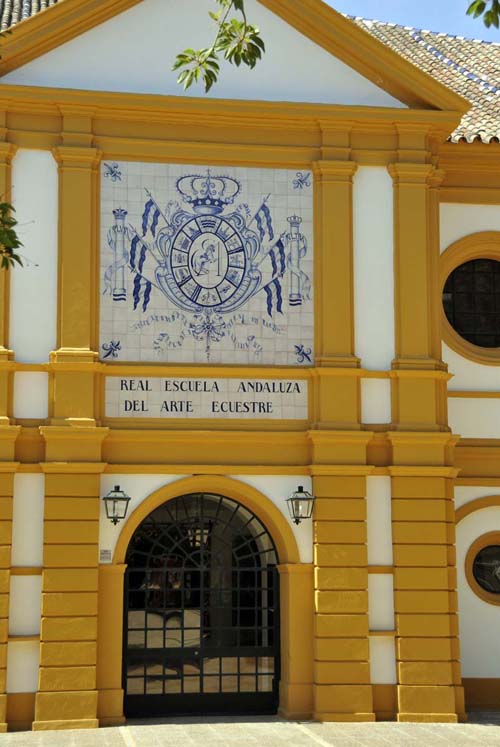
a beautifully decorated entrance to the exhibition hall at the Royal Andalusian School of Equestrian Art in Jerez de la Frontera

a beautifully decorated entrance to the exhibition hall at the Royal Andalusian School of Equestrian Art in Jerez de la Frontera

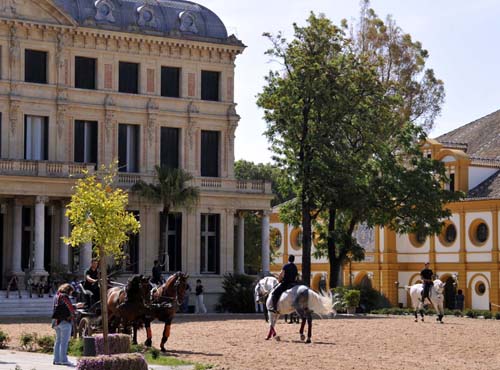
the back of the palace (the exhibition hall is to the right) and the outdoor practice arena at the riding school

the back of the palace (the exhibition hall is to the right) and the outdoor practice arena at the riding school

Also wonderfully informative and interactive is the riding school’s carriage museum. They have a fairly small collection (I counted ten vehicles), but they represent a variety of types, styles, and makers. Each one has quite a lot of space around it, making them all easy to see, and each one also has a computer screen with information about the particular vehicle in a variety of languages, making it a user-friendly museum for visitors who may know little or nothing about carriages or driving. On larger screens at several locations are videos of the carriages being driven, which is another nice touch that breathes some life into a static museum display.

On Wednesday, we went back to Seville for a short visit. While exploring the narrow streets around the bullring, we found the harness shop of Angel Gonzalez, who is a cousin of our local host for the CAA trip, Raimundo. We had met Angel during one of our farm visits with the group, and he recognized us when we came into the shop to look around. He immediately welcomed us to his shop and asked if we would like to see the workshop as well, so we walked a couple of blocks away to a small space on a side street. Here were Angel’s father (whose father started the business) and their one other harness-maker. The shop was full of leather, bits and pieces of things, tools, forms, and both finished and partly finished projects. Angel explained that they do new work (bridles, harness, and saddles) as well as repair work, mostly on pieces they originally made. All the work is done entirely by hand.

sewing leather by hand at the workshop of Angel Gonzalez

sewing leather by hand at the workshop of Angel Gonzalez

After saying our goodbyes, we wandered through the old part of Seville until we found (a short but disorienting walk away) the impressive cathedral. Here, we saw more of the ubiquitous horse-drawn tourist carriages. The day was quite hot and most of the drivers had kindly parked their waiting carriages so the horses were in the shade.

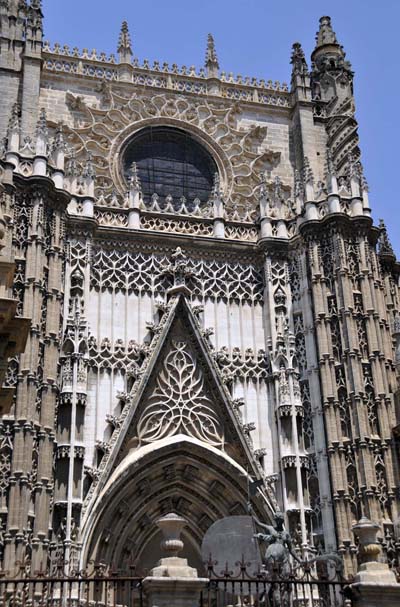
elaborate stonework on one of the entrances to Seville's cathedral

elaborate stonework on one of the entrances to Seville’s cathedral

this driver trotted his lovely horse by the cathedral, executed a one-handed "u"-turn, and parked the carriage so that the horse was standing in the shade of a tree

this driver trotted his lovely horse by the cathedral, executed a one-handed “u”-turn, and parked the carriage so that the horse was standing in the shade of a tree

On Thursday, we visited a lovely private farm and carriage collection in the countryside between Jerez and El Puerto de Santa Maria. This was the visit that had been arranged by a friend of a friend, whose cousin’s family owns the farm and the carriages. I’ll post some photos from that visit in my next report, later today.

« Previous PageNext Page »