travel / destinations


After a lovely morning of sight-seeing, farmers’ market-ing, and shopping, we had typical Westphalian food for lunch, in the old, wood-paneled interior in the restaurant at Münster’s only remaining local brewery, Pinkus Müller. After lunch, we of course had to stop for ice cream. Hey, it’s summer in Germany – even if it’s threatening rain, one must have ice cream!

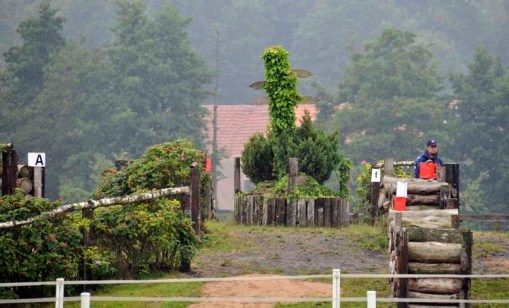
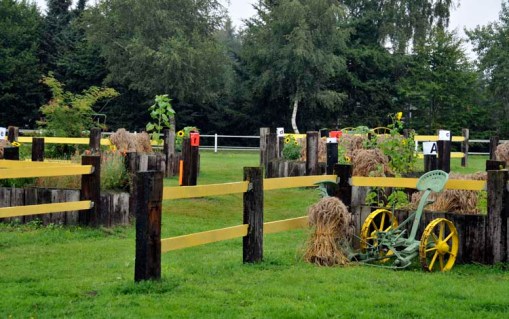
 Our next stop was the championship site to take a look at a few of the marathon obstacles:

one of the marathon obstacles ...

one of the marathon obstacles …

... and another

… and another

… and then to drop off all the decorations we had brought with us for the U.S. team’s table at tonight’s Nations’ Party. Everyone was drafted to help with the decorations, and we’re headed back there shortly to see the final results and to enjoy Phil’s famous barbecued ribs and the food and drink provided by all the other nations.

our group helped to decorate the U.S. table for the Nations' Party ...

our group helped to decorate the U.S. table for the Nations’ Party …

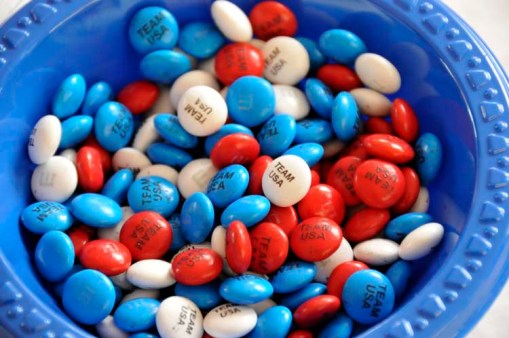
... which features A LOT of red, white, and blue

… which features A LOT of red, white, and blue

Go Team USA!

Go Team USA!

Our small group of four world travelers met us yesterday afternoon to begin the CAA’s trip to this year’s FEI World Pony Driving Championships. They had flown in to Munich in the morning and taken the train (a series of trains, actually) all the way north so they could see the scenery on the way, through the length of Germany. When they called to say they would be arriving in Münster at 5:20 p.m. (and sounding quite tired after their long day of train adventures), we said we’d pick them up at the Münster train station, instead of waiting for them to find the bus to the airport (which is much closer to our hotel). At any rate, we were emboldened by my husband’s mastery (after a day and a half) of the German roads and our Mercedes minivan, and so off to the main train station, in the middle of rush hour, we went! Needless to say, our tired foursome was grateful, and the driving here is really not that bad, as long as you remember to watch out for all the bicycles!

Earlier in the day, we had visited the championship site to check in for our press passes and to figure out the lay of the land. The site is the permanent home of a local riding and driving club and so already has a number of the necessary amenities. It all appears quite nice after our first look. The main “marquee” tent is right along the long side of the dressage/cones arena, with grandstands along the other sides. The vendors and various official tents are in this area as well. The marathon obstacles are grouped together in such a way that it should be VERY easy for spectators to see almost everything or to get quickly from one to the other. When we were there, most of the obstacles weren’t decorated yet, and water was still being pumped into the water obstacle, so everything looked a bit forlorn. But I’m sure it won’t take long for the entire area to come alive with flowers, fruits and vegetables (we’re guessing) in the “farmstand” obstacle, and more.

We’ve been informed that the “jog” (vet inspection) is being held in such cramped quarters in the stable area (which only one of the six of us is allowed in anyway) that we’re better off not trying to go to watch any of it. We’ve been invited to the Nations’ Party this evening, though, so we will definitely be there for that! With the jog off the schedule, our little group has decided to do some sightseeing in Münster.

My husband and I actually arrived in Germany last Friday and had done quite a bit of sightseeing on foot throughout Münster, before we picked up the minivan and checked into our group hotel out here in the country (yes, we’re out in the country – there are cows outside our window!).

So we’ll be playing tour guides this morning. After just a couple of days in Münster, we’ve already acquired a few favorite places, and we hope to share these with the group.

One of the first things we want to show everyone is the farmers’ market, which takes place every Wednesday and Saturday morning. From 7 a.m. to 2 p.m., the cathedral square is filled with the most amazing variety of fresh fruits, vegetables, flowers, meats, fish, bread, and more. There’s even a café set up in a corner of the square, so you can get a cup of coffee while you shop. While we were there on Saturday, a huge thunderstorm blew through while everyone ran for cover or waited under tent awnings. It will be nice to see it in (we hope!) more temperate weather.

The old, central part of the town itself is unique. A huge percentage of the city was destroyed in WWII but, when it came time to rebuild, the city’s leaders decided to do so in the old style. They took renovated buildings back to their medieval roots, they built new buildings with old-style facades, and they rebuilt everything according to the original medieval city plan. The result is a wonderful mix of old and new, all connected by curvy, narrow, cobblestone streets.
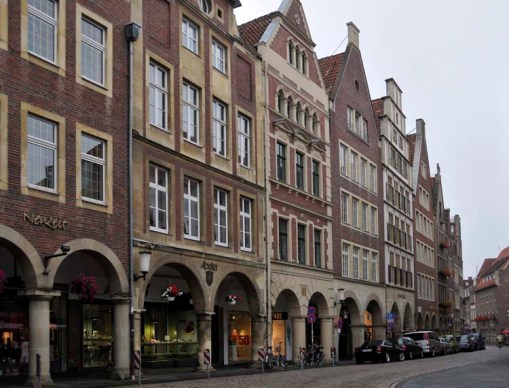
 

a long line of old buildings, and newer buildings built to look old, in Münster's old town

a long line of old buildings, and newer buildings built to look old, in Münster’s old town

About three blocks out from the center of town is a lovely park. Known as the Promenade, this peaceful tree-lined avenue is reserved for (and used heavily by) walkers, joggers, and bike riders. This part of Germany, being so far north and so near Holland, is flat, flat, flat. So in their early days, the area’s towns and castles relied on wide water moats for defense. The remnants of Münster’s moat are found now in the 4½-kilometer Promenade, which encircles the center of the city.

a small section of Münster's lovely, tree-lined Promenade

a small section of Münster’s lovely, tree-lined Promenade

Back in the center of town, the St. Lamberti church dominates the main shopping street (which was the main shopping street way back when and still is today).
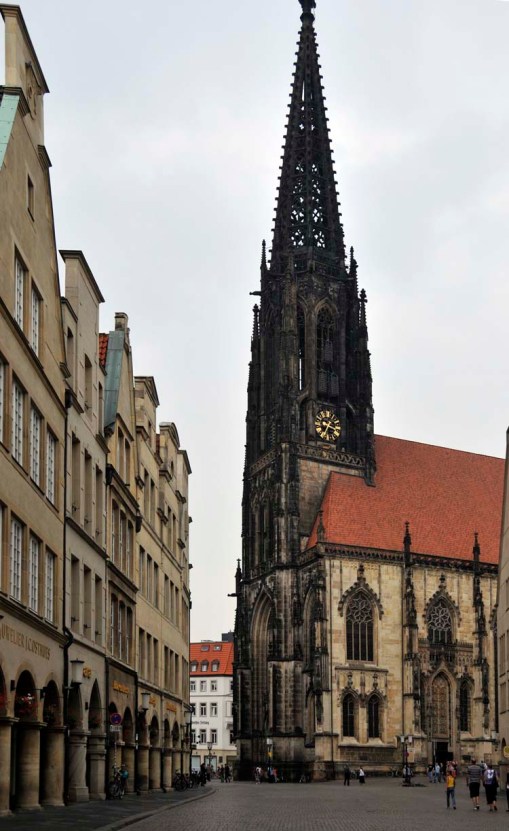
the elaborately gothic St. Lamberti church in the center of Münster's old town

the elaborately gothic St. Lamberti church in the center of Münster’s old town

part of the elaborate gothic decoration over the main front doors of the St. Lamberti church

part of the elaborate decoration over the main front doors of the St. Lamberti church

On Sunday, when the fancy shops and boutiques are closed for everything but window shopping, musicians set up in the arcades across the street from the church. In addition to the frequent ringing of the church bells, we heard Vivaldi’s “Four Seasons,” tango music, and even some snippets of organ music and voices, wafting out from the church during mass.

Over on the cathedral square, after the round of bell-ringing that announced the end of a mass, the cathedral was opened back up to visitors. We went in to have a look around amid the smoky, incense-scented air. Every day at noon (at 12:30 on Sundays) the cathedral’s astrological clock chimes the hour and performs for the crowd, exactly as it’s been doing since it was built in 1540. First, the chime on the top right is struck four times to indicate the top of the hour and the angel flips over the hourglass he’s holding. Then, the chime on the top left is struck twelve times. The first door opens and a soldier comes out, followed by the three magi. These three each turn one at a time to face Mary and the baby Jesus, and they bow, and then continue on. All the while, the melodies of several hymns are played on the glockenspiel. None of this is particularly amazing by modern standards, certainly, but the fact that it’s been doing this every day for nearly 500 years certainly is. 
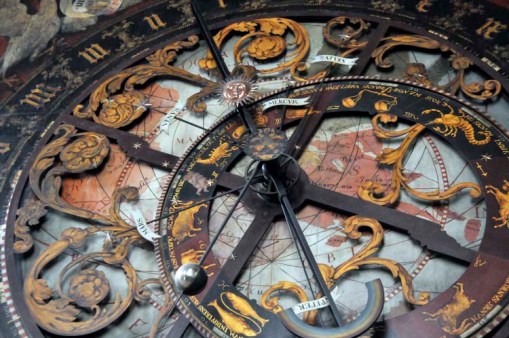
a portion of the fascinating and elaborate astrological clock in Münster's cathedral

a portion of the fascinating and elaborate astrological clock in Münster’s cathedral
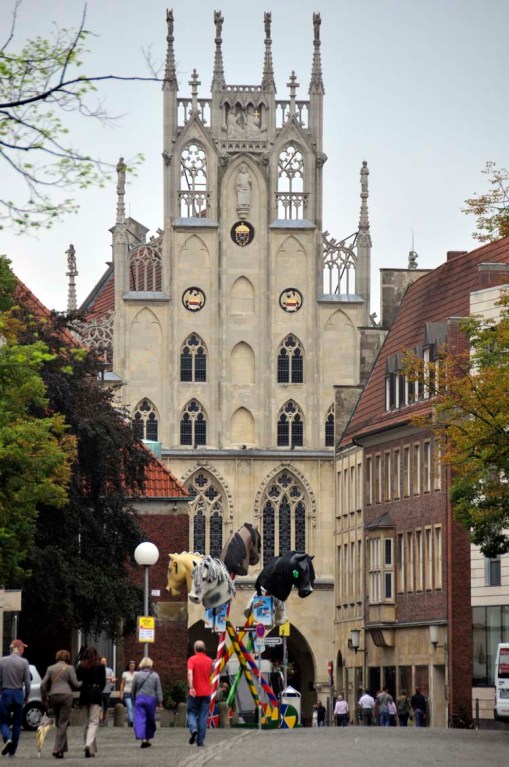
Münster’s rebuilt Rathaus (city hall) is where the Peace of Westphalia Treaty was signed in 1648 to end the Thirty Years’ War
Münster’s rebuilt Rathaus (city hall) is where the Peace of Westphalia Treaty was signed in 1648 to end the Thirty Years’ War

The final day of this year’s Royal Windsor Horse Show was as exciting as you might expect. With the final phase of the FEI driving, the beautiful “private drive” of the British Driving Society, and final rounds and championships in many of the show’s most popular classes, there was a lot to see. I missed most of the show jumping, unfortunately, but some of the biggest classes, including the grand prix, are held on the final Sunday of the show.

The weather on Sunday was variable. I awoke to bright sunshine, and then by a bit later in the morning, it was pouring rain. The rain was so steady and the clouds so solid that it looked as if it were set in for the day, but by late morning it had blown over and the sun was back out. Then, in the early afternoon, it rained again, and then cleared up again. And on and on it went. As you might imagine with all this rain blowing in and out, it was really quite windy.

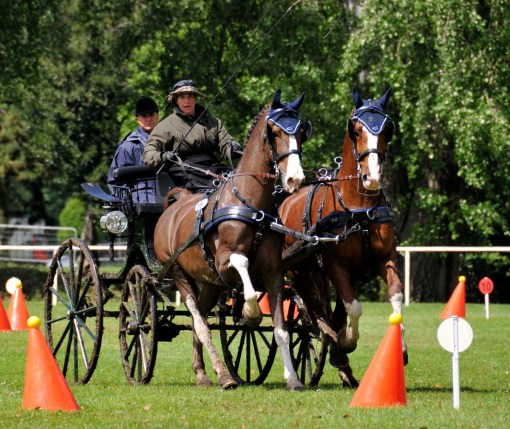
In the FEI driving, the rain, hooves, and carriage wheels had turned the warm-up area into a sea of mud, and the carriage cleaners must’ve had quite a job at the end of the day! When everything was finished, Dieter Hoefs of Germany had won the pony four-in-hand division with a score of 170.89, Beat Schenk of Switzerland had won the horse pair division with a score of 130.98, and the reigning world champion, Ysbrand Chardon of the Netherlands, had won the horse four-in-hand division with a score of 134.09. In the horse pairs, American driver Randy Cadwell finished in 9th place overall, with a score of 154.57. In the middle of the afternoon in the main arena, HM The Queen presented the awards to the winners of the FEI driving competition.

American driver Randy Cadwell on the cones course with her pair of horses

American driver Randy Cadwell on the cones course with her pair of horses

in the horse pair division, Austria's Isidor Weber won the cones phase and finished sixth overall; his horses are owned by one of the members of our CAA group at the show

in the horse pair division, Austria’s Isidor Weber (shown here on the cones course) won the cones phase and finished sixth overall; his horses are owned by one of the members of our CAA group at the show

Ysbrand Chardon, saluting the crowd and celebrating his victory after the awards ceremony in the main arena

Ysbrand Chardon, saluting the crowd and celebrating his victory after the awards ceremony in the main arena

In the early afternoon, a large number of beautiful turnouts gathered in one of the arenas and then left for a lovely (and, unfortunately, rainy) long drive through the park. This annual class in composed of BDS members and is judged as a concours d’elegance of sorts. The judge each year is an artist (this year, it was Joy Claxton), and her task is to pick the turnout that makes the lovliest picture, the one she’d most like to paint.

as is tradition, HRH Prince Philip led the way for the BDS drive

as is tradition, HRH Prince Philip led the way for the BDS drive

a long line of carriages, heading out of the showgrounds and into the park for their annual drive

a long line of carriages, heading out of the showgrounds and into the park for their annual drive

Some of the highlights from the rest of the day:

one of the several packs in the annual meet of the hounds

one of the several packs in the annual meet of the hounds

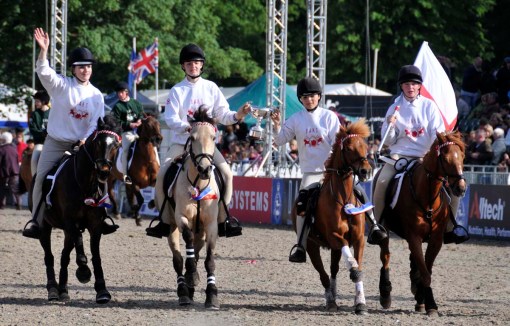
the members of the team from England celebrate their victory in the Pony Club games, which go on throughout the show (with the final on Sunday) and which pit England against teams from Wales, Scotland, Ireland, and Northern Ireland

the members of the team from England celebrate their victory in the Pony Club games, which go on throughout the show (with the final on Sunday) and which pit England against teams from Wales, Scotland, Ireland, and Northern Ireland

a bit of the excitement from the final round of the Shetland Pony Grand National (look at the jumping form of that gray pony!!)

a bit of the excitement from the final round of the Shetland Pony Grand National (look at that gray pony’s form!!)

In the evening, our CAA group met one last time for a farewell dinner. We enjoyed a traditional British Sunday dinner of roast beef, Yorkshire pudding, and vegetables. Speeches were given, stories shared, and then, sadly, goodbyes made. We’ll be back again next year with a new group of travelers and, in the meantime, we’ll be traveling to Germany in August for the 2009 FEI World Pony Driving Championships and to Argentina in November. Whether in person or here on the travel blog, we hope you’ll join us!

Saturday was, of course, marathon day for the FEI drivers: 7 pony four-in-hand teams, 21 horse pairs, and 24 teams of horses (there are no single horses, single ponies, or pairs of ponies at the competition this year). The weather was good, with a few sprinkles but mostly just alternating clouds and sun, and quite a lot of wind. The several hills in and out of the water at the final obstacle, though, had turned to deep, slippery muck by the end of the afternoon. For most of the day, I stayed at the end of this obstacle where the drivers both enter and exit, as I’ve found over the years that I really like the photos I can get there. I did, though, stop at a few other obstacles on my way to the water. One new one is on a slight rise so that the posts and rails are about at eye level, making it a bit hard to see what the horses are doing inside the wooden maze. Another is actually set down into a depression, so this one is easier to watch. The “depression” at this obstacle is, as I understand it, known as the ice rink because it would be flooded with water in the winter and allowed to freeze, at which point Queen Victoria could watch from the castle windows as her grandchildren ice-skated. Of course, this was long before all the trees there now were either planted or allowed to grow.

George Bowman IV (known as “Young George” because he’s the son of the famous George Bowman) had one of the fastest times of the day through the water obstacle. 

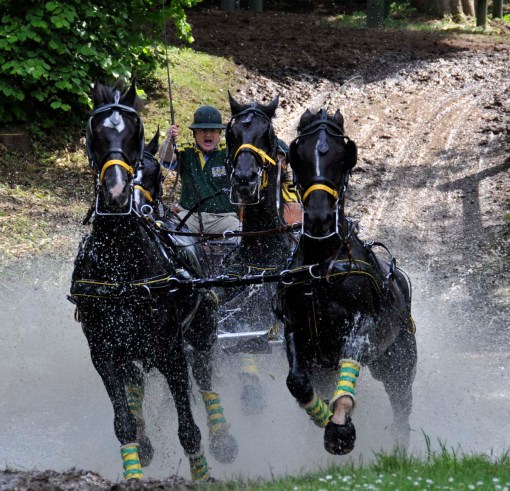
George Bowman IV, on his way out of the water obstacle

George Bowman IV, on his way out of the water obstacle

Near the end of the day, both Pippa Bassett (GB) and Boyd Exell (Australia) had a horse slip and fall coming up the muddy bank out of the water, but both horses appeared to be fine as they left. By the end of the marathon phase, Boyd had overtaken the lead from Ysbrand Chardon (Netherlands), the current world champion, who had led after dressage. We’ll have to see what today brings in the cones. 

The current world champion, Ysbrand Chardon of the Netherlands, in the water obstacle

The current world champion, Ysbrand Chardon, in the water obstacle

After the first two phases, Randy Cadwell (USA) currently stands in seventh place overall.

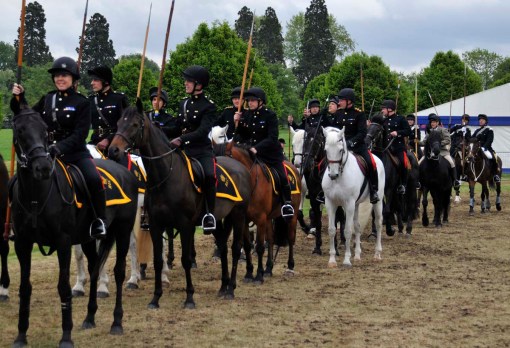
Also on tap yesterday at the show were more show classes, more jumping, the “best turned out trooper” class for the mounted cavalry, service team show jumping (military, police, etc. making up the teams), the Shetland pony steeplechase, and more.

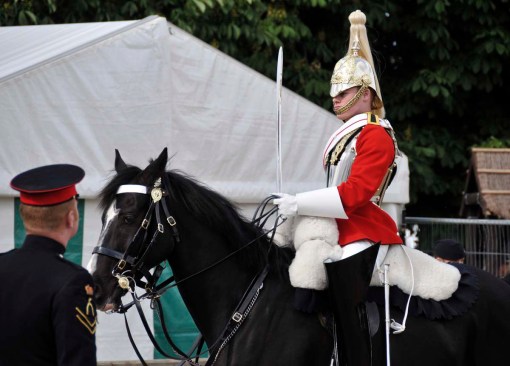
one of the competitors in the "best turned out trooper" class, waiting to go into the main arena

a competitor in the “best turned out trooper” class, waiting to go into the main arena

There were considerably more people attending the show, too, because of the fine, dry weather and because it was Saturday. I walked through the military section of the vendor area, where all the equipment is on display, and there was a tremendous amount of activity: people lined up to go on the various simulators, kids exploring the insides of helicopters and personnel carriers, army cooks making pancakes to give away, push-up contests, kids getting their faces painted with camouflage paint, target shooting, and more. And this in addition to all the booths promoting the various military branches and units. And the vendor area was, as you might imagine, teeming with people.

 Today is the grand finale: the cones phase of the FEI event, the BDS private drive, the final round of the Shetland Pony Grand National (steeplechase), the delightful meet of the hounds, the Alltech Royal Windsor Grand Prix (jumping), and more, including a daytime performance of the musical drive of the King’s Troop. And, for our group, a farewell dinner. So I’ll have one more report after all that, and then I’ll be heading home.

Yesterday was another beautiful day at the horse show. Beautiful in terms of what we watched – the weather was, shall we say, variable. Fortunately for a couple of us, when it did briefly pour down with rain, we had just sat down under a tent to eat lunch. Then it started to sprinkle, then rain, then pour, and a multitude of people crowded into the tent. Luckily, the rain didn’t last very long and, of course, the horse show continued throughout. Unluckily for everyone involved with the coaching marathon, all the coaches had started to assemble for their drive into the main arena when the downpour commenced.

Undaunted, the nearly twenty coaches trotted smartly into the main arena at their appointed time, where they lined up for the judges’ inspection. There were three regimental coaches, four road coaches, and a large number of private coaches / park drags. Once the two judges (Jack Pemberton and John Parker) had a good look at them all, they left for their drive through the park.

One of the members of our group, Dr. Gibelli (president of the Coaching Club in Argentina), had been asked to judge the coach horn competition, and I was lucky enough to be able to ride along with him. Dr. Gibelli, Jill, Bob (who was our navigator and who held the Union Jack at our stops, which was the horn blowers’ signal to play), and I piled into our official Land Rover with our driver, and off we went. Because anyone who’s important at this show is driven around in an official Land Rover, it was kind of funny to see horse-show spectators peering in as we drove by, to see who might be in the car.

The judges were in their own Land Rover, and we all went to a variety of stops. We stopped along the “Long Walk” and along a road in the interior of the park, where, of course, we heard all the coach horns being played. Mr. Pemberton and Mr. Parker, on the other hand, stopped at more places, to watch how the horses were going, to see how the drivers and horses handled a variety of turns, etc.

At the end of the several-miles drive, the coaches all lined up again and came into the main arena in a group for their final judging and awards.

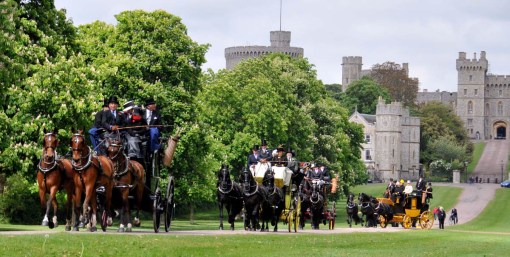
three of the many coaches, heading down the Long Walk, with a portion of Windsor Castle in the background

four of the many coaches, heading down the Long Walk, with a portion of Windsor Castle in the background

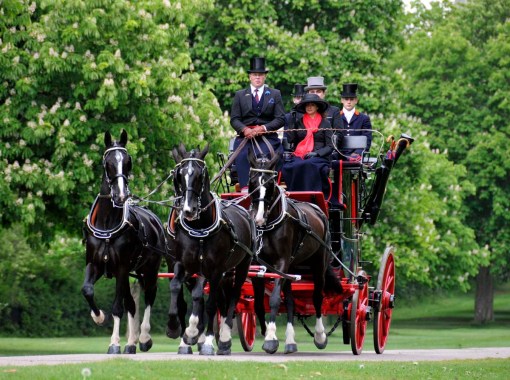
Bill Ginns, here driving his park drag with the castle in the background, won the private coach division

Danny Kindle, driving the Household Cavalry's coach, won the regimental coach division; he also won the award for the best turnout

Danny Kindle, driving the Household Cavalry’s coach, won the regimental coach division; he also won the award for the best turnout and was declared reserve champion overall

Bob Alexander won the road coach division and was declared overall coaching champion

Bob Alexander won the road coach division and was declared overall coaching champion

Bob Elliot won the coach horn award; he was the guard on Ian Smith's original road coach, driven by Ken Ruthven

Bob Elliot won the coach horn award; he was the guard on Ian Smith’s original road coach, driven by Ken Ruthven

Later that afternoon, several members of our group met with Karen Bassett, one of the British four-in-hand drivers, who very kindly took us on a course walk of most of the marathon obstacles. She explained all the ins and outs of driving marathon obstacles and answered everyone’s questions. She also told us that, unfortunately, one of her best horses, a wheeler, had come up lame the day before and might not be able to compete in the marathon. Which would mean that she would have to move a horse that normally goes in the lead into the vacant wheeler position. This particular horse has never been at the wheel, so she’s not sure what to expect on the marathon today. The “problem” with this scenario, as Karen explained it, is that you normally don’t want the leaders to actually do any real pulling. The wheelers are the powerhouse workers, and the leaders, if they’re not really pulling, allow better articulation of the turns in the obstacles. So putting a leader in a wheel spot is a challenge because that horse is now being asked to work harder and pull the carriage around: something it’s not used to having to do. We’ll see what happens today on the marathon!

Additional scenes from the show:

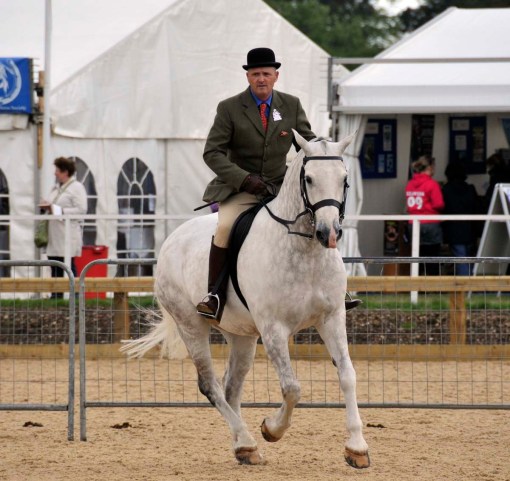
the judge riding one of the entries in a cob class

the judge riding one of the entries in a cob class

competitors lined up and awaiting their turn in the tent-pegging competition; in this class, they gallop across the arena, two at a time, and attempt to spear (and pick up) what appears to be a chunk of styrofoam on the ground

competitors lined up and awaiting their turn in the tent-pegging competition; in this class, they gallop across the arena, two at a time, and attempt to spear (and pick up) what appears to be a chunk of styrofoam on the ground

one of the tent-pegging competitors; unfortunately, she's just missed the mark (you can see the styrofoam by her horses' front hooves)

one of the tent-pegging competitors; unfortunately, she’s just missed the mark (you can see the styrofoam by her horses’ front hooves)

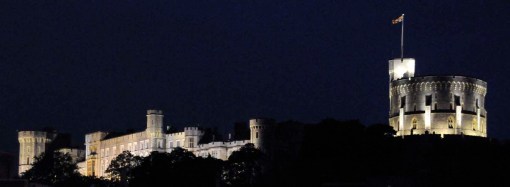
Windsor Castle at night, from the Eton side of the river

Windsor Castle at night, from the Eton side of the river

« Previous PageNext Page »