travel / destinations


A week from today, I’ll be in Germany, getting ready for this year’s World Four-in-Hand Driving Championship at Riesenbeck.

As usual, I’ll be posting updates and photos here during each day of the event. My goal will be to give you a sense of “being there” with us, rather than providing a recap of each day’s competition.

I’ll do my best to provide a few scores, and the top placings each day, on my Twitter page … and you can always check the full results at www.hoefnet.com.

The countdown to Germany is on!

.

If you’re a member of the Carriage Association of America, you may have already seen this news (and the photo) in last week’s issue of The Spokesperson, our e-newlsetter. If you’re not a CAA member but want to learn more, take a look at the CAA website. If you are a member but aren’t getting the weekly newletter, let me know!

.

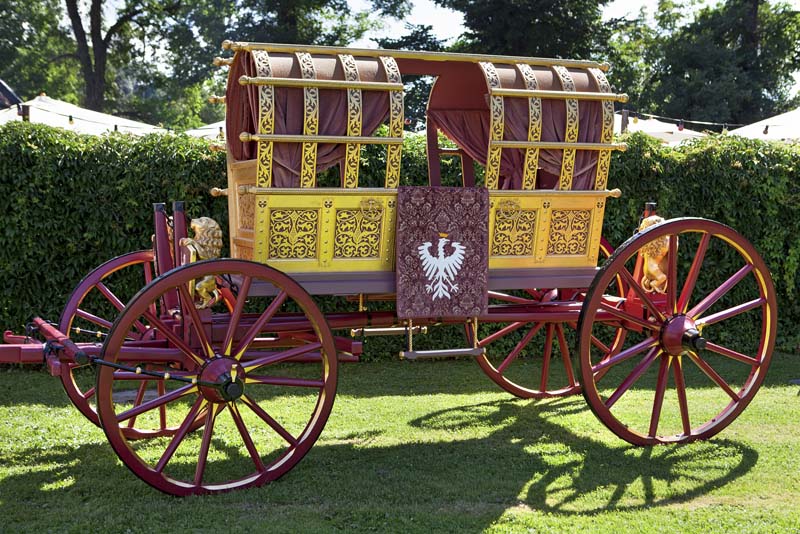
The new bridal carriage for the “Landshut Wedding 1475” festival (in southern Germany) was built in Vienna under the auspices of CAA life member Rudolf H. Wackernagel, a leading expert in the area of medieval coach-building. Thanks to a meticulous analysis of historical sources, it was possible to accurately reproduce medieval construction techniques.

The carriage, which is a unique specimen and the only one of its kind worldwide, was presented to the festival’s organizers at an international press conference on July 7.

.

.

Although paintings in the ceremonial room of the Landshut town hall depict many details of the 1475 wedding (which the festival recreates each year), they do not show the undercarriage of the golden vehicle that Princess Hedwig of Poland used for her long journey to Landshut to wed Duke George the Rich of the Lower Bavarian branch of the Wittelsbach dynasty. Owing to this lack of information, the undercarriage of the festival carriage built in 1903 and used up until now was too small, and its fifth wheel was a modern one. In 2010, the festival’s organizers, in their ongoing effort to improve the festival’s historical details, ordered a “new” bridal carriage.

During next year’s fortieth reenactment of the “Landshut Wedding 1475” (June 28-July 21, 2013), eight dappled horses – the preferred breed of princes – will draw the magnificent carriage, which boasts rear wheels almost the size of a man and two pairs of carved lions bearing the coat of arms of Poland on either side of the axle rods.

James Flint appears to have spent several weeks in Lexington, during the winter of 1818.

On December 5, he wrote that “Lexington is still considered the capital of fashion in Kentucky. There are here many genteel families, a few of which keep coaches. The town, on a whole, exhibits a well-dressed population.”

On Christmas Eve, Mr. Flint was on his way again:

“Left Lexington. On this occasion I was the only passenger in the mail coach. Clear frosty weather allowed the sides of the carriage to be kept open, so that I enjoyed a view of the country. The expedition in traveling is great, considering the badness of the roads. The land that was beautifully verdant a short time ago, is now withered by the cold.”

On Christmas Day, 1818, he continued his account:

“The coach stopped at Washington, from seven o’clock, last night, till three this morning. It overset on my way hither, and though I received no injury, I resolved upon going no further with that vehicle in the dark, and over such bad roads. About five o’clock I was awakened by the firing of guns and pistols, in celebration of Christmas day. I heard no one speak of the nature of the event that they were commemorating. So universal was the mirth and conviviality of the people, that I could not procure a person to carry my portmanteau to Limestone. It remained for me to stop all day at Washington, or sling my baggage over my own shoulders. I preferred the latter alternative, and proceeded on my way.”

And so we leave James Flint, walking toward the Ohio River, to make his way back to the East Coast and home again.

… Two days later (on November 27, 1818), Mr. Flint wrote:

Crossed the river Licking in a boat, at a small town called Blue Licks, from the springs in its neighborhood, from which great quantities of salt were formerly procured. The adjoining timber is exhausted, and the salt-works are abandoned.

After coming to a flooded creek, where there was neither bridge nor boat, I waited a few minutes for the mail coach. The road is in several parts no other than the rocky bed of the stream. It also crosses the same creek four or five times. After riding a few miles, I left the coach. There is no great degree of comfort in traveling by this vehicle; stowed full of people, baggage, and letter bags; the jolting over stones, and through miry holes, is excessively disagreeable; and the traveler’s head is sometimes knocked against the roof with much violence. A large piece of leather is let down over each side, to keep out the mud thrown up by the wheels. The front was the only opening, but as the driver and two other persons occupied it, those behind them were almost in total darkness. A peep at the country was not to be obtained.

I lodged at Paris, the head town of Bourbon county. A cotton-mill, and some grist-mills, are the manufactories of the place. The population is considerable. Several of the taverns are large, and, like many of the others in the western country, have bells on the house-tops, which are rung at meals.

By late November, James Flint had made it to the Ohio River and had crossed over to Kentucky …

November 25, 1818:

Limestone, sometimes [and now] called Maysville, is a considerable landing place on the Kentucky side of the river Ohio. The houses stand above the level of the highest floods. There is a rope-walk, a glass-house, several stores and taverns, and a bank, in the town.

On the 26th, I left Limestone by the road for Lexington, which is sixty-four miles distant. The roads, hitherto scorched by drought, were in a few minutes rendered wet and muddy by a heavy shower of rain. The roads in this western country are of the natural soil.

The high grounds every where seen from the river, are called the river hills; they are in reality banks, the ground inland of them being high. To the south of Limestone it is a rich table land, diversified by gentle slopes and moderate eminences.

At four miles from Limestone is Washington, the seat of justice in Mason County. The town is laid out on a large plan, but is not thriving.

May’s Lick is a small village, twelve miles from Limestone. A rich soil, and a fine undulated surface, unite in forming a neighborhood truly delightful. The most florid descriptions of Kentuckyhave never conveyed to my mind an idea of a country naturally finer than this.

I lodged at a tavern twenty miles from Limestone. Before reaching that place the night became dark and the rain heavy. As the tops of the trees overhung the road, I had no other indication than the miry feel of the track, to prevent me from wandering into the woods.

to be continued …
« Previous PageNext Page »