reference


… more from James Flint’s letter of September 28, 1818:

We passed several family waggons moving westward. The young and the strong walking, the aged and infants riding. Waggons for removing families, and those for carrying goods to Pittsburg, have a canvas cover, stretched over hoops that pass from one side of the wagon to the other, in the form of an arch. The front is left open, to give the passengers within the vehicle the benefit of a free circulation of cool air.  

[Do you recognize the iconic freight wagon of the eastern seaboard and the early western frontier — the Conestoga Wagon — from Mr. Flint’s description?]

At Chambersburg the coach halted during the night. The rough roads already surmounted, and the report of worse still before us, determined two of the passengers, besides myself, to walk, as an easier mode of traveling over the mountains. Chambersburg is 143 miles from Philadelphia, and 155 from Pittsburg; and lies in the intersection of the roads fromYork, Baltimore, and Philadelphia. Several branches of what has been very properly called the current of emigration, being here united, strangers from the eastern country, and from Europe, are passing in an unceasing train. An intelligent gentleman, at this place, informed me, that this stream of emigration has flowed more copiously this year, than at any former period; and that the people now moving westward, are ten times more numerous than they were ten years ago. His computation is founded on the comparative amount of the stage-coach business, and on careful observation. This astonishing statement is, in some degree, countenanced by a late [i.e., recent] notice in a New York newspaper, that stated the number of emigrants which arrived in that port during the week, ending the 31st of August last, to be 2,050.

After a brief delay, in which I forgot to bring Mr. Flint’s letters with me to the office, let’s return today to some of the road- and travel-related details from James Flint’s lengthy journey through the eastern and western United States, which he undertook from 1818 to 1820. In this excerpt, he’s traveling from Philadelphia to Pittsburgh.

September 28, 1818:

On the morning of the 20th of September, I went to the coach office in Philadelphia to take my seat. Such is the number of travelers that I found it necessary to take out a ticket two days previously.

The mail-coach is a large clumsy vehicle, carrying twelve passengers. It is greatly encumbered by large bags, which are enormously swollen by the bulk of newspapers. As a substitute for glass windows, a large roll of leather is let down on each side in bad weather.

… another excerpt from James Flint’s journey through New York State on July 16, 1818:

Four wheeled waggons are the vehicles used in carrying home the crops, carrying manure into the fields, and produce to market. They are drawn by two horses, which trot, whether loaded or not. Small one-horse waggons are also used, they are neat, and are furnished with a seat for conveying families to church, and elsewhere. Many of the farmers who own but small properties, keep one-horse gigs. Ladies drive dexterously.

… not the Wild West of the late nineteenth century, but the West of the early nineteenth century; in other words, Ohio and Kentucky.

From 1818 to 1820, a Scotsman named James Flint traveled extensively in the eastern and (what was at the time) the western United States. He was a very observant traveler and wrote a long series of letters, which were gathered and published, in Edinburgh, in 1822.

Today, and for the next few days, I’ll share a few excerpts from his letters, which describe the state of the roads and the process of traveling at the time.

.

July 16, 1818:

A stage coach runs from Brooklyn to New Utrecht. The distance is nine miles; and the fare for one person, half a dollar. This coach, like the other public ones of the country, has no glass windows in the front or the sides of it, these parts are furnished with curtains, which are let down in bad weather. The coach is long, containing four seats that run across; and travelers sit with their faces forward, as in the pews of a church.

I have agreed to stop for a few days at New Utrecht. My host is an intelligent man, obliging, but not fawning. Sometimes the landlord presides at the head of the table, and at other times he acts as servant. At dinner we were joined by the coach-driver who brought us fromBrooklyn; he is very unlike the drivers of some other coaches, is well dressed, active, and attentive to his business, by no means obsequious, answers every question with propriety, and without embarrassment. He does not depend on the gratuities of travelers for his wages. That system, which so universally prevails inBritain, is unknown here.

At the inn there were three boarders, all Scotsmen. One of them, a young gentleman from Edinburgh, who was confined to bed by a broken thigh bone, occasioned by a horse running away with a gig, from which he fell while attempting to disengage himself; he was occasionally attended by a young lady, whose visits were frequent, although she lived at the distance of ten miles. The people of the neighborhood were also very attentive to this person, often calling for him; and several of the young men sat with him all night by rotation. It was pleasing to see so creditable a display of the benevolent affections.

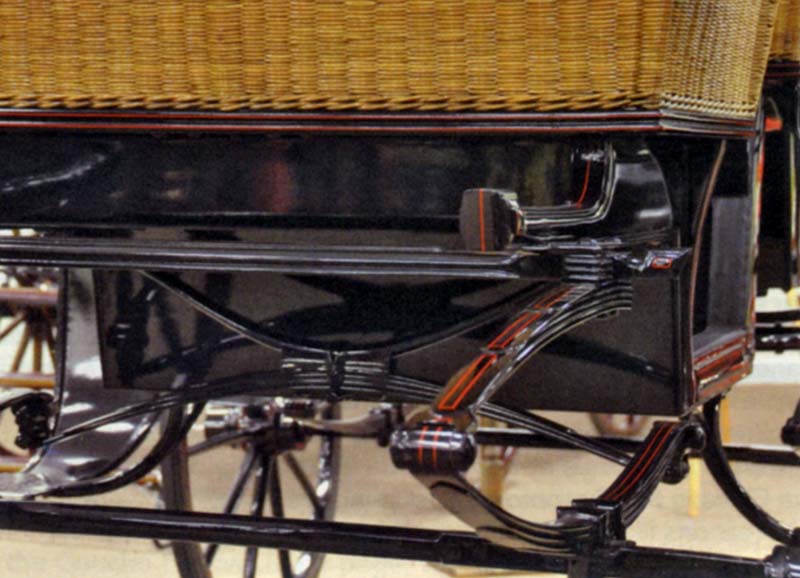
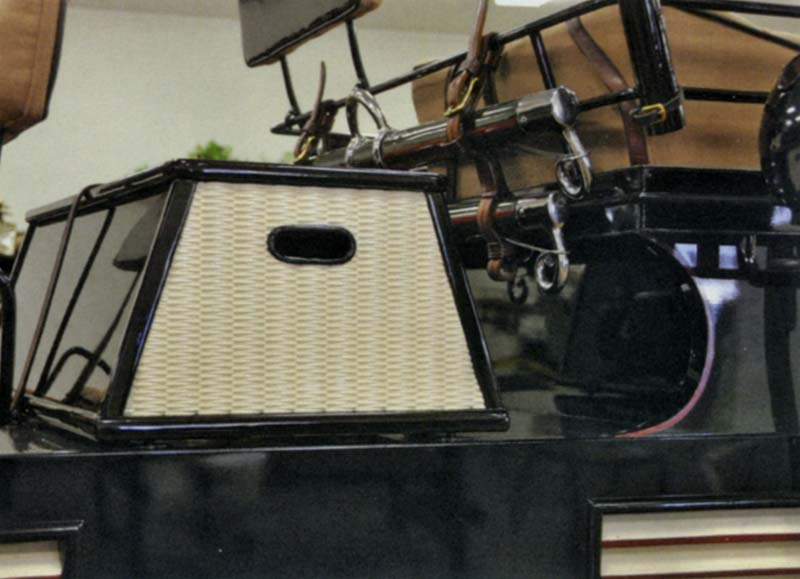
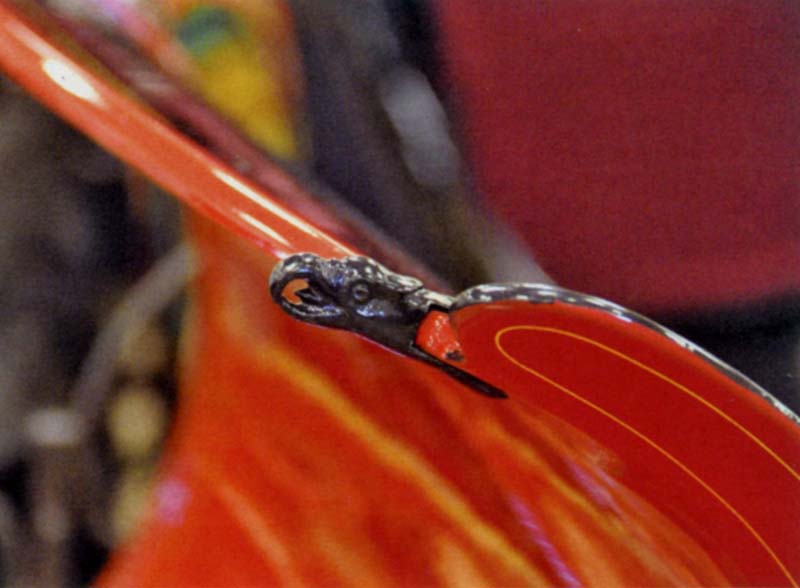
Are you ready for the answers to our carriage-parts quiz?

I’m re-posting all the photos here, in the order that matches the order of their names, which I shared in Friday’s post. See the photo captions for the correct terms.

.

according to an article on traditions in turnout (the August 2011 issue of The Carriage Journal), “Cockades were originally used as brooches to pin up the brims of tricorne and bicorne hats…. When people started wearing top hats, they dispensed with cockades themselves but continued to decorate their servants’ hats with them. …”

.

finials, like this bird, are sometimes found on the corners of sleigh dashboards

.

this vehicle features a French platform spring

.

this spring is being held up by a gallows bracket

.

“imperials” were boxes for luggage and were carried on the roof of a coach

.

according to Berkebile’s Carriage Terminology, a scroll spring is a steel spring with one or both ends bent in the shape of a scroll (C-springs were originally called scroll springs)

.

this vehicle features a side-bar spring

.

according to Berkebile’s Carriage Terminology: a side bar (the wooden bar at the center of the photo) is “a variety of wooden side-spring, of American invention, applied principally to Road Wagons … It commonly consists of two elastic wooden bars, close to and parallel with the body, to which the latter is directly attached; the ends of the side-springs are connected with two half-springs which rest of the axles”

.

an example of a Tilbury spring

.

« Previous PageNext Page »