reference


Here’s the first of several carriage- or driving-related (or otherwise interesting) photos that I found in our Glimpses of the World book. The photo captions, naturally, describe the man-made or natural wonders shown but make no mention of any horse-drawn vehicles in the photos.

I’m sure we wouldn’t say anything about the automobiles that “interfere” with our modern photos of landscapes or buildings, either. I know I wouldn’t mention them and would usually rather they weren’t in my photos at all. Likewise, most of the photos in our old book don’t have any vehicles in them, but some of the streets were just too busy to leave the pedestrians, horses, and vehicles out of their portraits.

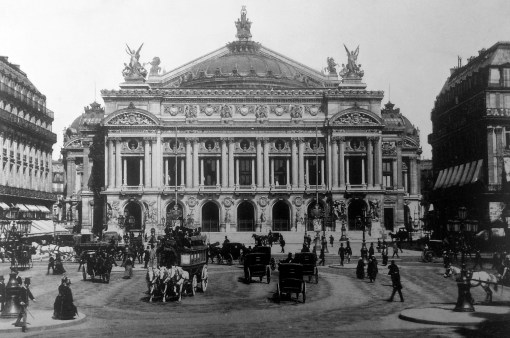
In front of the Paris Opera House, we can see a number of Broughams (serving as taxicabs, no doubt) and a three-abreast of gray horses hitched to a crowded Omnibus.

(To see a larger version of the photo, click on the photo once and then, when a new version comes up, click on it again.)

.
.

This is the photo caption from the book:

“This is not merely one of the most magnificent structures of the French metropolis, but is the largest theatre in the world; not strictly so in regard to its seating capacity, which accommodates about 2,200 people, but in the area of three acres which it occupies in the very heart of the city. The first view of it as one approaches it along the boulevards can never be forgotten. Broad marble steps lead up to a facade adorned with groups of statuary representing Lyric Poetry, Idyllic Poetry, Music, Declamation, Song, and Dance. Above these are medallions of four great composers, and over these extends along the full width of the structure a loggia or gallery embellished with beautiful Corinthian monolithic columns and a marble parapet. Above the windows of this loggia, the eye beholds with pleasure medallion busts, in gilded bronze, of Mozart, Beethoven, Auber, Rossini, Meyerbeer, and Halevy, whose noble works are heard so frequently within the Temple of Music which they thus adorn. To right and left upon the roof colossal groups in gilded bronze stand radiantly forth against the sky, portraying the divinities of Poetry and Music with the muses in their train. While to complete the charm of this extraordinary building, there rises in the center a majestic dome above the crown of which we see, triumphant over all, the statue of Apollo holding aloft a golden lyre, which still reflects the splendor of the setting sun long after evening has begun to spread its shadows over the adjacent streets, which soon will burst forth from that temporary twilight into a blaze of artificial brilliancy almost as light as day, which makes the place of the Grand Opera seem like the diamond-clasp in that long belt of gaity, display, and fashion known as the Parisian boulevards.”

This rather large building was the Algonquin Hotel in Dayton, Ohio, c. 1904.

Parked in front of the hotel are two delivery vans and several bicycles. I can’t read the name on the first delivery van, but the other one is from Pearl Laundry (with a very fancy “L”). Two ladies and a young girl (trying to balance something on her head!) are crossing the street.

There’s a lot going on in this photo of Exchange Place (Providence, R.I.), c. 1910. There are pedestrians; cars, horse-drawn vehicles, and a streetcar traveling down both sides of the large square; cars, carriages, and delivery vehicles parked along the right-hand sidewalk; and a multitude of cars parked in the square itself. Then, in the foreground, are eight working vehicles and trailers of various sorts. It looks like these are being used to haul equipment and supplies for road work or construction, judging by the piles of rocks, etc.

Here, we’re on the Ohio River at Louisville, c. 1905. The river barge in this photo looks like it’s being unloaded, judging by the poultry wagon (far right) being driven down one of the ramps.

According to the caption, the large barrel-like objects (there are three of them on the dray hitched to a pair of horses) are hogsheads of tobacco.

And is it my imagination, or does it look like a calf is being loaded on the delivery van hitched to the single horse?

This photo doesn’t have any horses or carriages in it (or does it?*), but it’s interesting because it shows the rest of the Georgia Lee riverboat at the far left of the first photo.

*Is that a wagon, all packed up in a crate and being shipped somewhere, in the bow of the Georgia Lee?

Here’s a view of Eleventh Avenue in New York City, c. 1910. The street was dubbed “Death Avenue” around the turn of the nineteenth / twentieth centuries because of the large numbers of pedestrians killed by the freight trains (!) that ran, albeit slowly, on these street-level tracks. In an attempt to not frighten the horses, the coal-powered steam locomotives were disguised to look (somewhat) like streetcars. But I do wonder whether the horses were really fooled …

In the foreground, on the left, a delivery van waits by the curb, and a wagon loaded with barrels is driving right on the tracks, between the train’s flag-man on horseback and the train itself. To the wagon’s right (to its left as we look at the photo) is a Hansom Cab. You can see a number of other delivery and commercial vehicles, and a streetcar, next to the train.

According to the caption on this next photo — another view of the same street —  it was supposedly taken about a year later. But I think it was actually taken on the same day (near the same time, even) as the photo above. The horse and delivery van by the curb are clearly the same in both photos.

The street-level tracks were replaced in the 1920s with an elevated track.

« Previous PageNext Page »