carriages / carriage types


Yesterday’s post featured a description (from 1832) of what the author believed to be the first steam coach in Britain.

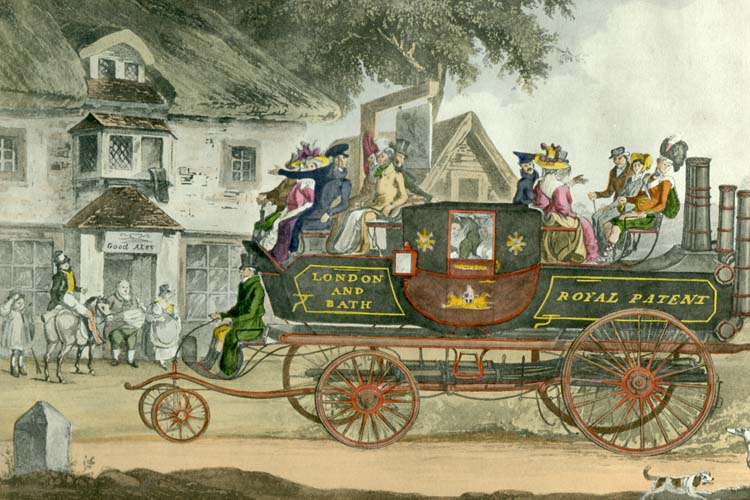
Here, however, we have an engraving of a steam coach that was used in and around London in 1827.

According to the caption on the image itself:  “The Guide or Engineer is seated in front, having a lever rod from the two guide wheels to turn and direct the Carriage and another at his right hand connecting with the main Steam Pipe by which he regulates the motion of the Vehicle. The hind part of the Coach contains the machinery for producing the Steam, on a novel and secure principle, which is conveyed by Pipes to the Cylinders beneath and by its action on the hind wheels sets the Carriage in motion. The Tank, which contains about 60 Gallons of water, is placed under the body of the Coach and is its full length and breadth. The Chimneys are fixed on the top of the hind boot and as coke is used for fuel, there will be no smoke while any hot or rarified air produced will by dispelled by the action of the Vehicle. At different stations on a journey the Coach receives fresh supplies of fuel and water. The full length of the Carriage is from 15 to 20 feet, and its weight about 2 tons. The rate of traveling is intended to be from 8 to 10 miles per hour. The present Steam Carriage carries 6 inside and 12 outside Passengers. The front Boot contains the Luggage. It has been constructed by Mr. Goldsworthy Gurney, the Inventor and Patentee.”

.

This is from Volume III of The Carriage Builders and Harness Makers’ Art Journal (published in London and covering the period July 1861 through June 1862):

The First Steam Coach

In 1832, a gentleman, name unknown, flew into a violent state of enthusiastic delight a propos to the first steam coach he, in common with the rest of the world, had seen. We cannot do better than give in the words of the gentleman himself some account of this remarkable forerunner of a new system of traveling. He commences:

“I have just returned from witnessing the triumph of science in mechanics, by traveling along a hilly and crooked road, from Oxford to Birmingham, in a steam carriage. I enclose you a hasty account of our journey, and a sketch [below] of this truly wonderful machine.”

.
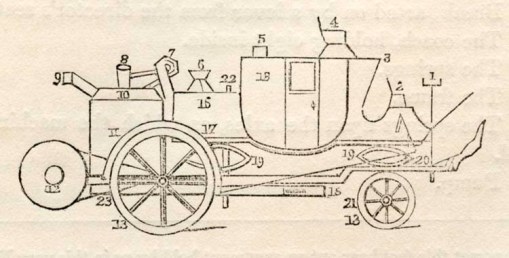
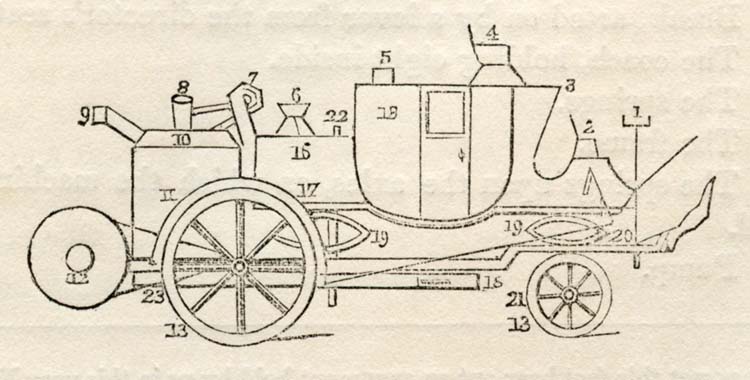
Captain Ogle's 1832 steam carriage, featuring 1: the wheel, or helm; 2: seat for helmsman; 3: boarded seat for four persons; 4: seat for outside passengers; 5: hammer-box for tools; 6: seat for stoker; 7: pipe for surplus steam; 8: jigger through which the furnace is fed; 9: the flue, or chimney; 10: the boiler; 11: the furnace; 12: blower, acted upon by a strap; 13: the wheels, very strong and broad; 14: piston to the pump; 15: the cylinders and machinery carried horizontally; 16: the water tank; 17; brake, acted on by a lever from the director's seat; 18: the coach, holding eight inside; 19: the springs; 20: the frame; 21: the springs upon the axles, on which the machinery is carried; 22: pump; and 23: the cinder-hole, through which the air from the blower goes

.

“It is the invention of Captain Ogle, of the Royal Navy, and Mr. Summers, his partner, and is the first and only one that has accomplished so long a journey over chance roads and without rails.*

“Its rate of going may be called twelve miles an hour; but fifty, or perhaps a hundred, down hill, if not checked by the brake — a contrivance which places the whole of the machinery under complete control.

“The starting from Oxford was a grand spectacle. It was St. Giles’s fair-day; therefore, all the populace, including thousands from the surrounding villages, thronged the streets, reminding the townspeople of the multitudes at a Juggernaut; whilst the wondrous machine, like that idol’s car, appeared ready to crush its votaries. Care was, however, taken to make them understand the danger, and a passage being cleared, away went the splendid vehicle through the beauteous city, at the rate of ten miles an hour, which, when clear of the houses, was accelerated to fourteen. Notice of the intended journey having been carried forward some days before, every town presented an appearance somewhat similar; but it was not till it reached Birmingham that real assistance as well as applause was required, and willingly was it granted. Just as the vehicle was entering the town, the supply of [coal] being exhausted, the steam dropped, and the good people, on learning the cause, flew to the frame and dragged it (the carriage) into the inn-yard of the Hen and Chickens.”

The editors of the Carriage Builders and Harness Makers’ Art Journal continue:

In looking at the above queer statement — and no other term can be applied to it — one almost wonders that so much ingenuity could exist in a man. The idea of a man exultingly saying that such a vehicle could have gone at the rate of 100 miles an hour is laughable, especially when it is considered the roads were in all probability not quite so straight as the crow flies; and, when it is remembered that there were no rails, personally we should not like to have been an inside, much less an outside, passenger. Our candid writer likens the start to that of the triumphal commencement of the ceremonial of the passage of the car of Juggernaut, below the wheels of which it need not be said the [Indians] used to cast themselves to obtain the death of martyrs, till British dominion happily put an end to the practice; but when the hundred miles downhill is considered, we must come to the conclusion that, under the circumstances, the occupants of the carriage ran far more danger of being annihilated than did the good people of Oxford, who made the triumph so complete.

But the best “fun” in the whole of this narrative is the new importation of a term into carriage building and steam-engineering. It will be remarked that the inventor is Captain Ogle, of the Royal Navy; now the captain cannot forget the salt water and all appertaining thereto, even when hard at work upon a manufacture which certainly cannot be expected ever to plough the sea waves. The directing agent of a coach is usually called the driver; this term will not do for Captain Ogle, neither will the appellation of “engineer” suit him, though he himself is a practical engineer, so the captain, having his mental eyes on the “man at the wheel,” calls the director of his steam coach the “helmsman.” Thus we have it at No. 2 [in the sketch above], “seat for helmsman.”

It were curious to ponder on the fate of this steam coach — that it never came into practical operation is very clear; but one would like to know its history, and whether it did really finally make its exit by going over a steep embankment, which surely was its fate if the helmsman took it downhill at the rate of twenty, much less fifty or a hundred, miles an hour.

.

* See tomorrow’s post for an image of a steam carriage being used in and around London in 1827!
… as described and pictured in The Carriage Builders and Harness Makers’ Art Journal, Vol. III (July 1861 through July 1862):

Indian Dress Buggy

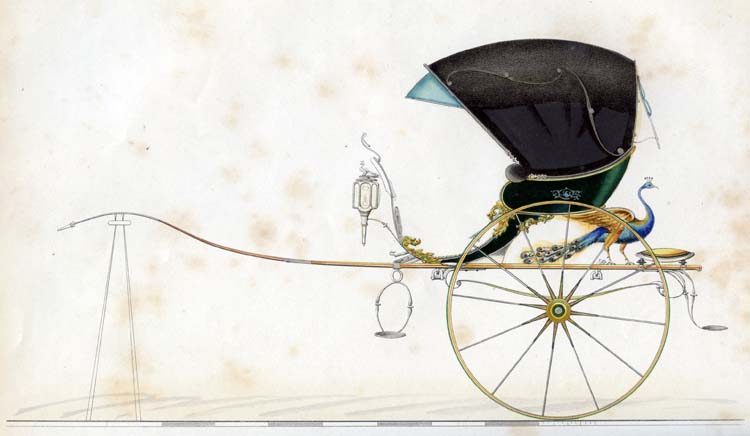
This is a design for a Dress Buggy, to which Messrs. Silk & Sons, of Long Acre [London], have recently built three carriages for Sir Jamsetjee Jejeebhoy, Bart., the millionaire Parsee merchant, of Bombay; one being intended for his own use, and the other two as presents for members of his family.

Of the construction of the carriage we need say little, as our illustration supplies a most faithful design of the original. The body is rounded on all sides; but perhaps the great peculiarity of the design is in the peacocks, which appear to support the hinder part of the body. This is not so in fact, as the support consists in the curved double slips passing from the center of the hind cross-spring to the body.

The peacocks themselves are really works of art. After settling the exact size, form, and proportions required, a pattern bird was carved by a London figure carver. This formed a pattern, or “captain,” as it is called by the herald chasers, from which the real birds are eventually made out of sheet copper, brought up in detail equal to an ordinary chased arm or hammercloth crest. … By this unusual means (at least in coach-building) of making them in copper, great strength was obtained at less weight than in wood, each bird weighing but six pounds. To prevent any sonorous noise, they were filled with wool.

The painting of the body was dark glazed verdigris green, picked a light maize and slightly edged crimson; carriage and wheels a very light maize picked green, and a very small edging line of crimson. The inside lined with light green morocco to all the lower parts; the head being lined throughout with drab silk tabaret, of a small figure, and a sun shade of green silk. The peacocks were painted from life by the herald painter, with the same care, precision, and taste as he would exercise in painting an ordinary crest on a panel. The mountings, such as lamps, wheel-hoops, and headjoints, etc., were of silver, and the armorial bearings were painted in maize relief, showing the peacock crest, with baronet’s helmet and distinctive badge, the whole forming an elegant carriage, and one perfectly unique.

.

Over the past three Sundays, I’ve doled out the lower left, upper left, and upper right squares of the image featured on the cover of the August Carriage Journal.

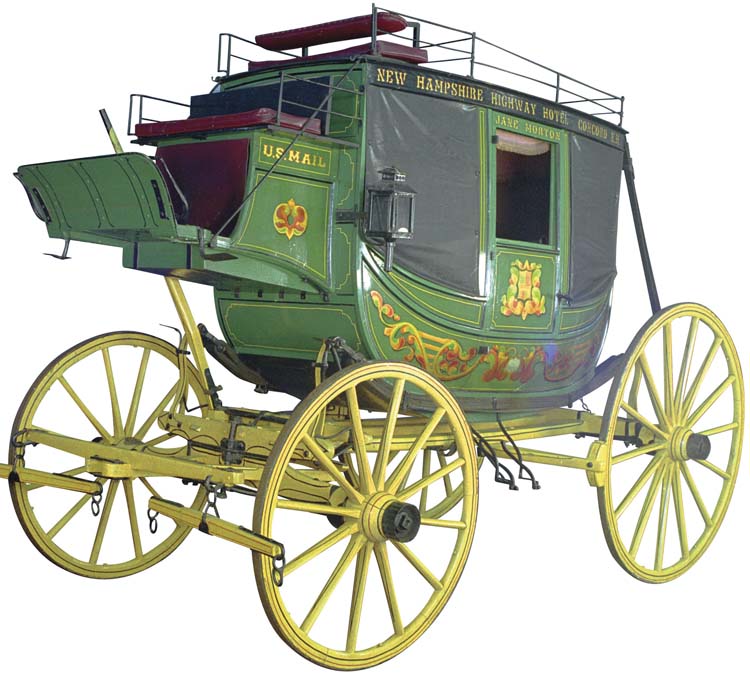
In case you haven’t already guessed, the vehicle is a Concord Coach.

Here is the full image:

.

photo by Bob Mischka

.

This vehicle is owned by Sut & Margaret Marshall, and it’s one of the many in the book The Marshall Collection: Horse-drawn Commercial Vehicles.

Here is Ken Wheeling’s description of this coach, borrowed from the book:

Concord Coach #23

The small, six-passenger Concord Coach was made with one of two types of seating arrangements. A very narrow coach body has three seats, including a middle seat, accommodating two passengers on each seat. The middle seat, unlike the three-piece folding seat found in nine-passenger coaches, was either a single solid board seat which folded forward to permit entry, or a removable, two-part double seat mounted on a stanchion at the center and risers on the outside, such as this coach has. There were five different company configurations, since Lewis Downing founded his shop in 1813. The first of these was Downing & Abbot, founded in 1828. It lasted until 1847, when each of the partners, Lewis Downing and J. Stephen Abbot, founded their own companies: L. Downing & Sons and J. S. Abbot.

This coach is thought to have come from the shops of L. Downing & Sons’ new coach yards across the street from the original shop site. The identifying number “23” is carved into the outermost cross piece of the luggage rack. Since Downing bought coach bodies made in the J. S. Abbot shops and mounted them on his own carriage gear, it is quite possible that J. S. Abbot made the body, at least. The coach, which was originally painted green, was restored by James Morton, owner of the Highway Hotel, Concord, New Hampshire.

Those of you who (like me) love beautiful old cars just as much as beautiful old carriages will enjoy the story and photos sent by CAA member Randy Solle:

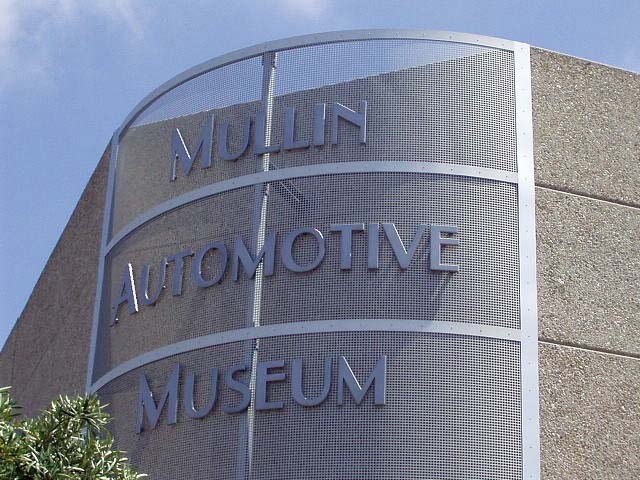
Last weekend, our Solid Axle Corvette Club (1953–1962 Corvettes) went up to Oxnard, California, which is about an hour up the coast from Los Angeles. There, one of our stops was the Mullin Automotive Museum, which contains mainly Art Deco era French automobiles.

.

photo by Randy Solle

.

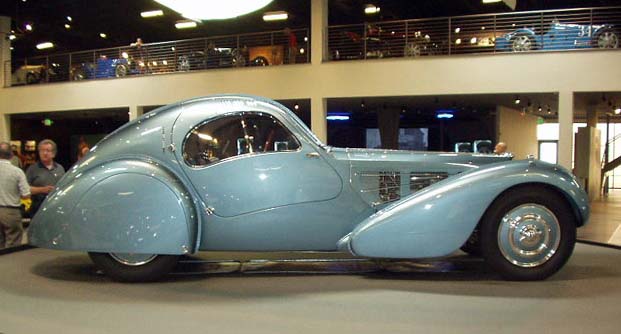
Among the beautiful collection of vehicles is this $40,000,000 (no, that’s not a misprint) Bugatti:

.

photo by Randy Solle

.

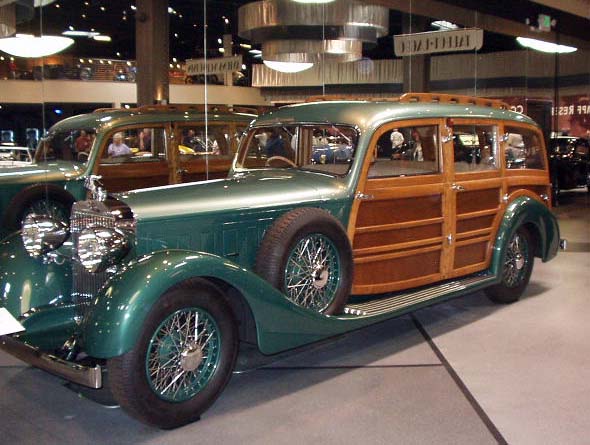
I was surprised to find that they still used the term Shooting Break for some of their vehicles:

.

from the museum label for this 1937 Hispano Suiza K6 Shooting Break: the body type is called a "shooting break," a term used to describe a cross between a two-door sports coupe and an estate car; it was designed for the well-heeled to carry large amounts of cargo, such as dogs and hunting guns for grouse shooting; it is also described as a "woody" due to the wooden exterior paneling; the car also has natural buffalo upholstery and seagrass floor mats (photo by Randy Solle)

.

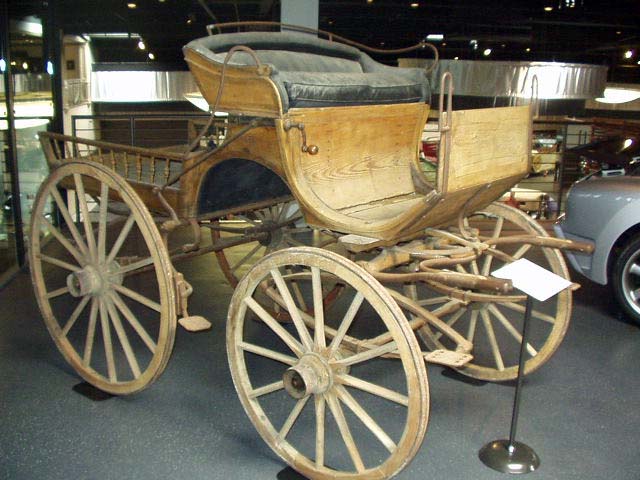
I did manage to find a horse-drawn vehicle in the collection. This is one of the three vehicles that were built for Ettore Bugatti by his family’s automobile company. I would guess that this was one of the vehicles that came from the Kluge Collection.

.

according to the museum label, this vehicle was built in the 1930s by the Bugatti company for Ettore Bugatti, who was an avid horseman; this and two others were intended to be used on the family estate and for short trips (photo by Randy Solle)

.

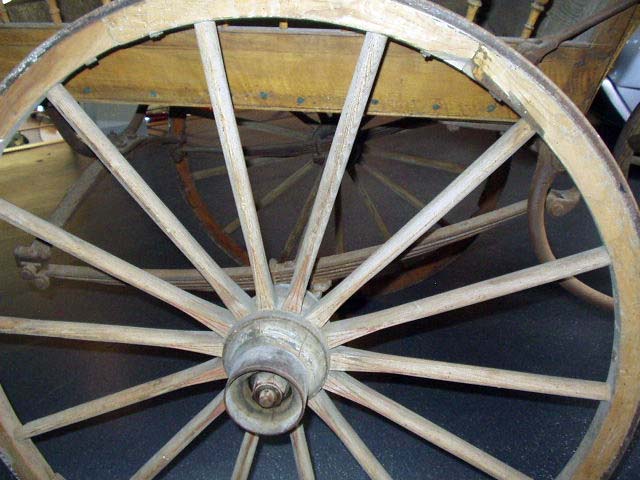
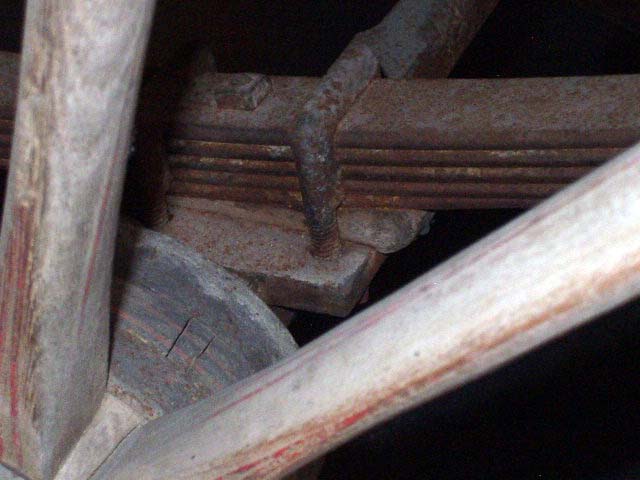
I thought that the rear spring angle was rather unusual on this vehicle. In the second (detail) picture of the springs, you can see a wedge that has been inserted under the spring – by the looks of it, some time ago.

.

photo by Randy Solle

.

photo by Randy Solle

.

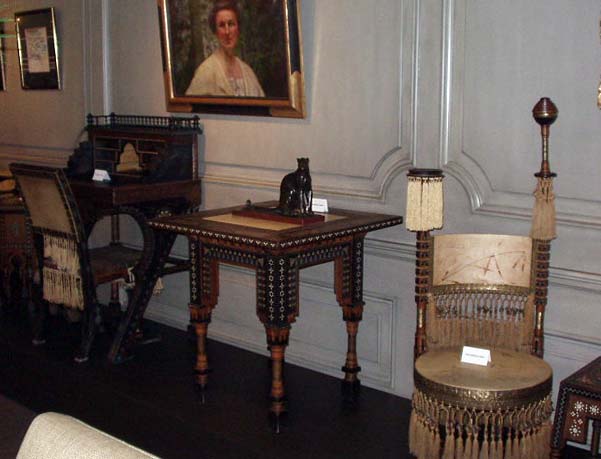
Carlo Bugatti was also very interested in building furniture, which seems to have something of an Asian influence:

.

photo by Randy Solle

.

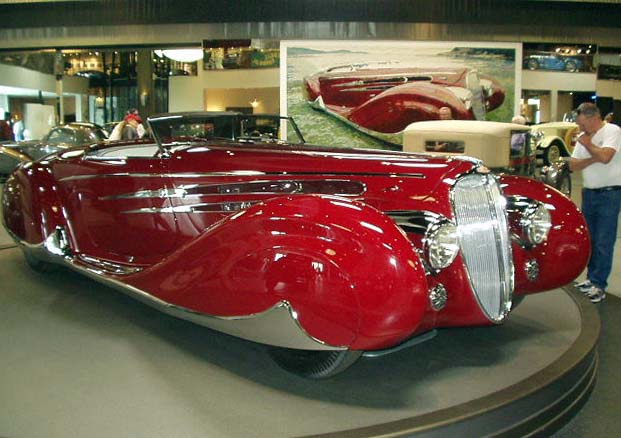
Finally, this was a barn find from northern California. It was in dire need of restoration then, but look at it now!

.

1930 Bugatti Type 46 Cabriolet (photo by Randy Solle)

« Previous PageNext Page »