carriages / carriage types


I was sticking loads of stamps on stacks of envelopes today, for a big mailing we’re doing, and I started thinking about horses and carriages / wagons on stamps.

After an Internet search, I found these interesting specimens: a 1958 stamp celebrating the hundredth anniversary of Butterfield’s Overland Mail service to California; a 1974 stamp honoring the hundredth anniversary of the Chautauqua tradition in rural America; a 1983 stamp honoring America’s first streetcar (1832); a 1983 stamp honoring a 1926-era style of streetcar; a 1989 stamp with a Stagecoach; and this 1996 stamp honoring the U.S. Post Office’s Rural Free Delivery service.

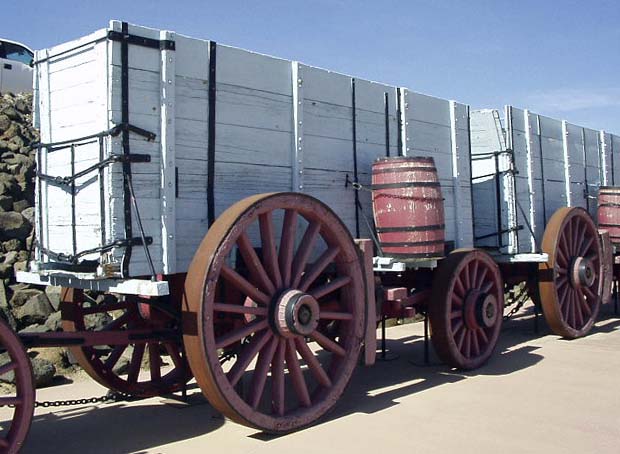
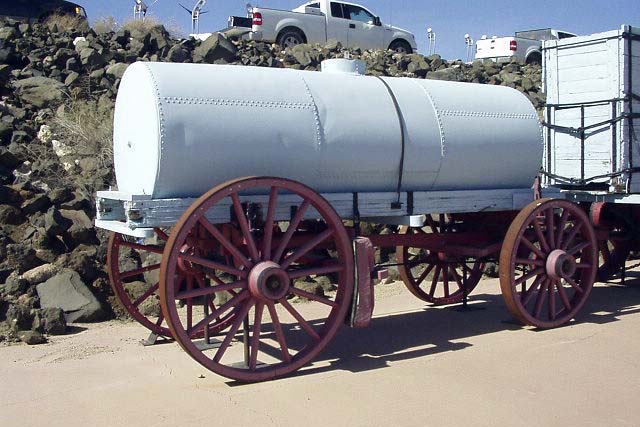
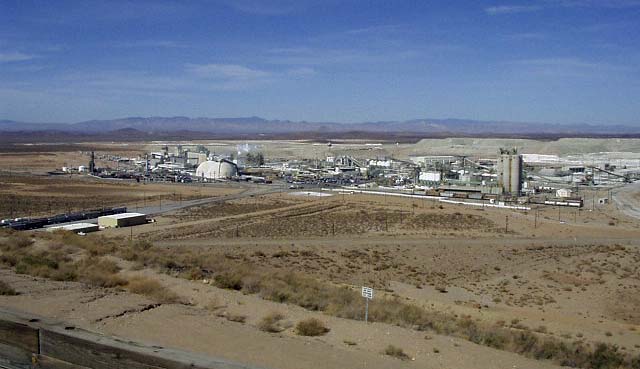
After reading the post about Thom Mezick and Linda Freeman’s visit to Death Valley, Randy Solle sent some photos from the borax mine in Boron, California. Having already seen photos of the old mule-drawn vehicles, let’s take a look at the mine itself, shall we?

.

(photo by Randy Solle)

.

(photo by Randy Solle)

.

(photo by Randy Solle)

.

This modern mine produces more than 12,000 tons of borax each day.

From 1883 to 1888, each twenty-mule team (pulling two loaded wagons and a water tank) took ten days (round trip) to travel from the Death Valley mine to the nearest railroad junction in Mojave. Each team carried about twenty tons of borax per trip, and the teams delivered more than 10,000 tons of borax during their years of operation.

This set of two wagons and water tank are on display at the mine:

.

(photo by Randy Solle)

.

(photo by Randy Solle)

.

(photo by Randy Solle)

.

(photo by Randy Solle)

.

If you’re a CAA member, you may have read in the e-newsletter about Harley Chandler’s latest project.

Harley is a coachmaker in northern Kentucky, and he’s been commissioned by the Colonial Williamsburg Foundation to build an eighteenth-century-style Phaeton. You can keep up with this ongoing project here. My understanding is that Harley will finish the vehicle “in the white,” meaning that the ironwork and woodwork will be done, but nothing more. The finish work — painting, upholstery, etc. — will then be completed by craftsmen at Colonial Williamsburg.

It will certainly be interesting to watch this project as it unfolds.

Continuing with our reading of portions of Charles Dickens’s American Notes (based on his visit to the U.S. in 1842), and in the spirit of his practice of publishing stories in a serialized format, this final excerpt is so long that I’ve broken it into five parts. Enjoy!

Today, the final part of our excerpt from Chapter XIV:

… Still, it was a fine day, and the temperature was delicious, and though we had left Summer behind us in the west, and were fast leaving Spring, we were moving towards Niagara and home. We alighted in a pleasant wood towards the middle of the day, dined on a fallen tree, and leaving our best fragments with a cottager, and our worst with the pigs (who swarm in this part of the country like grains of sand on the sea-shore, to the great comfort of our commissariat in Canada), we went forward again, gaily.

As night came on, the track grew narrower and narrower, until at last it so lost itself among the trees, that the driver seemed to find his way by instinct. We had the comfort of knowing, at least, that there was no danger of his falling asleep, for every now and then a wheel would strike against an unseen stump with such a jerk, that he was fain to hold on pretty tight and pretty quick, to keep himself upon the box. Nor was there any reason to dread the least danger from furious driving, inasmuch as over that broken ground the horses had enough to do to walk; as to shying, there was no room for that; and a herd of wild elephants could not have run away in such a wood, with such a coach at their heels. So we stumbled along, quite satisfied.

These stumps of trees are a curious feature in American travelling. The varying illusions they present to the unaccustomed eye as it grows dark, are quite astonishing in their number and reality. Now, there is a Grecian urn erected in the centre of a lonely field; now there is a woman weeping at a tomb; now a very commonplace old gentleman in a white waistcoat, with a thumb thrust into each arm-hole of his coat; now a student poring on a book; now a crouching negro; now, a horse, a dog, a cannon, an armed man; a hunch-back throwing off his cloak and stepping forth into the light. They were often as entertaining to me as so many glasses in a magic lantern, and never took their shapes at my bidding, but seemed to force themselves upon me, whether I would or no; and strange to say, I sometimes recognised in them counterparts of figures once familiar to me in pictures attached to childish books, forgotten long ago.

It soon became too dark, however, even for this amusement, and the trees were so close together that their dry branches rattled against the coach on either side, and obliged us all to keep our heads within. It lightened too, for three whole hours; each flash being very bright, and blue, and long; and as the vivid streaks came darting in among the crowded branches, and the thunder rolled gloomily above the tree tops, one could scarcely help thinking that there were better neighbourhoods at such a time than thick woods afforded.

At length, between ten and eleven o’clock at night, a few feeble lights appeared in the distance, and Upper Sandusky, an Indian village, where we were to stay till morning, lay before us.

They were gone to bed at the log Inn, which was the only house of entertainment in the place, but soon answered to our knocking, and got some tea for us in a sort of kitchen or common room, tapestried with old newspapers, pasted against the wall. The bed-chamber to which my wife and I were shown, was a large, low, ghostly room; with a quantity of withered branches on the hearth, and two doors without any fastening, opposite to each other, both opening on the black night and wild country, and so contrived, that one of them always blew the other open: a novelty in domestic architecture, which I do not remember to have seen before, and which I was somewhat disconcerted to have forced on my attention after getting into bed, as I had a considerable sum in gold for our travelling expenses, in my dressing-case. Some of the luggage, however, piled against the panels, soon settled this difficulty, and my sleep would not have been very much affected that night, I believe, though it had failed to do so.

My Boston friend climbed up to bed, somewhere in the roof, where another guest was already snoring hugely. But being bitten beyond his power of endurance, he turned out again, and fled for shelter to the coach, which was airing itself in front of the house. This was not a very politic step, as it turned out; for the pigs scenting him, and looking upon the coach as a kind of pie with some manner of meat inside, grunted round it so hideously, that he was afraid to come out again, and lay there shivering, till morning.
Continuing with our reading of portions of Charles Dickens’s American Notes (based on his visit to the U.S. in 1842), and in the spirit of his practice of publishing stories in a serialized format, this final excerpt is so long that I’ve broken it into five parts. Enjoy!

Today, part 4 of our excerpt from Chapter XIV:

… We reached Columbus shortly before seven o’clock, and stayed there, to refresh, that day and night: having excellent apartments in a very large unfinished hotel called the Neill House, which were richly fitted with the polished wood of the black walnut, and opened on a handsome portico and stone verandah, like rooms in some Italian mansion. The town is clean and pretty, and of course is “going to be” much larger. It is the seat of the State legislature of Ohio, and lays claim, in consequence, to some consideration and importance.

There being no stage-coach next day, upon the road we wished to take, I hired “an extra,” at a reasonable charge to carry us to Tiffin; a small town from whence there is a railroad to Sandusky. This extra was an ordinary four-horse stage-coach, such as I have described, changing horses and drivers, as the stage-coach would, but was exclusively our own for the journey. To ensure our having horses at the proper stations, and being incommoded by no strangers, the proprietors sent an agent on the box, who was to accompany us the whole way through; and thus attended, and bearing with us, besides, a hamper full of savoury cold meats, and fruit, and wine, we started off again in high spirits, at half-past six o’clock next morning, very much delighted to be by ourselves, and disposed to enjoy even the roughest journey.

It was well for us, that we were in this humour, for the road we went over that day, was certainly enough to have shaken tempers that were not resolutely at Set Fair, down to some inches below Stormy. At one time we were all flung together in a heap at the bottom of the coach, and at another we were crushing our heads against the roof. Now, one side was down deep in the mire, and we were holding on to the other. Now, the coach was lying on the tails of the two wheelers; and now it was rearing up in the air, in a frantic state, with all four horses standing on the top of an insurmountable eminence, looking coolly back at it, as though they would say, “Unharness us. It can’t be done.” The drivers on these roads, who certainly get over the ground in a manner which is quite miraculous, so twist and turn the team about in forcing a passage, corkscrew fashion, through the bogs and swamps, that it was quite a common circumstance on looking out of the window, to see the coachman with the ends of a pair of reins in his hands, apparently driving nothing, or playing at horses, and the leaders staring at one unexpectedly from the back of the coach, as if they had some idea of getting up behind. A great portion of the way was over what is called a corduroy road, which is made by throwing trunks of trees into a marsh, and leaving them to settle there. The very slightest of the jolts with which the ponderous carriage fell from log to log, was enough, it seemed, to have dislocated all the bones in the human body. It would be impossible to experience a similar set of sensations, in any other circumstances, unless perhaps in attempting to go up to the top of St. Paul’s in an omnibus. Never, never once, that day, was the coach in any position, attitude, or kind of motion to which we are accustomed in coaches. Never did it make the smallest approach to one’s experience of the proceedings of any sort of vehicle that goes on wheels. …

« Previous PageNext Page »