carriages / carriage types


For our next Glimpses of the World photo, and the last from France, we have this magnificent coach:

.
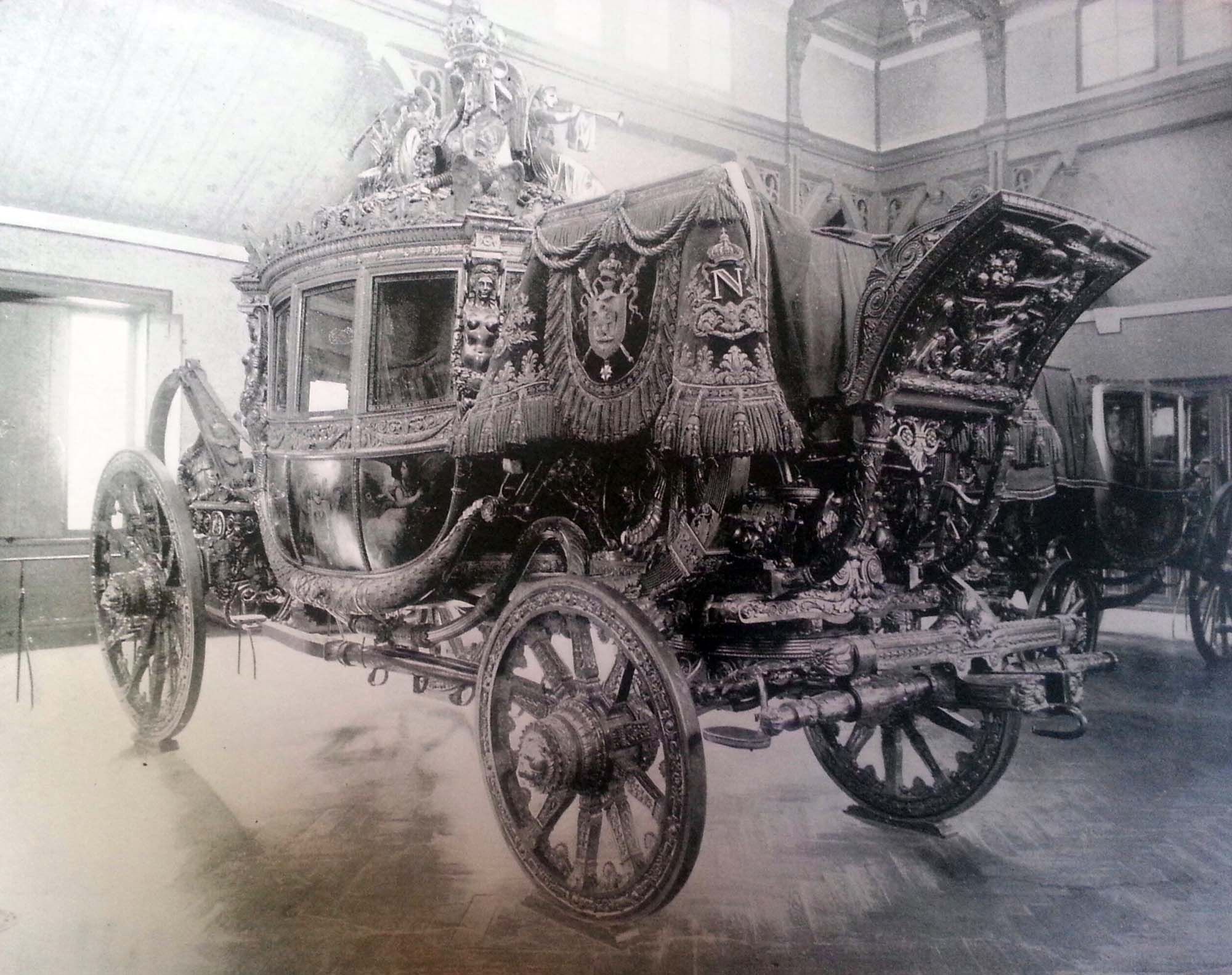
from Glimpses of the World (1892) - page 55.

Here is the caption that accompanies the image in the book:

Among the relics of royalty and of the empire displayed at Versailles is this magnificent vehicle, the woodwork of which is one mass of gilding, while the interior decorations are of the most elegant description. This is said to be the carriage in which the Emperor Napoleon I went with the Empress Marie Louise to solemnize their [1810] marriage in the Cathedral of Notre Dame. [Their wedding actually took place at the Louvre.] All Paris was in the greatest excitement, and Napoleon’s future seemed then brilliant beyond all precedent in modern history. Yet in reality these gilded wheels were swiftly bearing him to what Napoleon himself subsequently called, “an abyss covered with flowers.” And such indeed proved to be this fatal marriage following his divorce from Josephine. No doubt Napoleon’s pride was gratified, as in this gorgeous vehicle he sat beside his Austrian bride, but it was certainly impossible for him to ever love her as he had once loved Josephine. The latter, slightly older than himself, had been his life-long confidant and friend. She had at first contributed much to his success. Her intuitions made her a most useful counselor. But what was Marie Louise? A simple, inexperienced girl, with whom the emperor always wore a mask, lest his designs should through her reach the court of Austria! The one possessed a character as weak and vacillating at her face would indicate. The other proved herself a heroine by sacrificing to the interests of France not only the most enviable throne in Europe, but also the most famous of earth’s sovereigns, and the man she loved. “It will not bring him fortune,” said the common people when the divorce had been proclaimed, and they were right.

.

Interestingly, even though our book was published only eighty-two years after the events of 1810, the caption is incorrect.

This coach was not used by Napoleon I. Rather, a whopping thirty-four ceremonial Berlins were ordered (from fourteen Paris coachbuilders) specifically for the wedding procession. The two known as “La Victoire” and “La Cornaline” were used by the imperial couple.

The ornate coach shown above was built in 1814 and was used in 1825 as Charles X’s coronation coach. In 1856, it was renovated — and the Napoleonic “N”s were added — and was used for the baptism of Napoleon III’s son.

It’s now in the collection at the Palace of Versailles and is, in fact, currently on display in the “Roulez carrosses!” exhibit (through November 10) at Le Musée des Beaux-Arts d’Arras in France.

You can see color photos of the coach and read more about it here.

This first of my new (thank you, Elizabeth!) old English postcards is this undated photo card, which shows a fully loaded coach and four … on a ferry crossing the Windermere.

.

Here’s our next photo (and a wonderful caption) from the 1892 Glimpses of the World book

.

from Glimpses of the World (1892), page 33

.

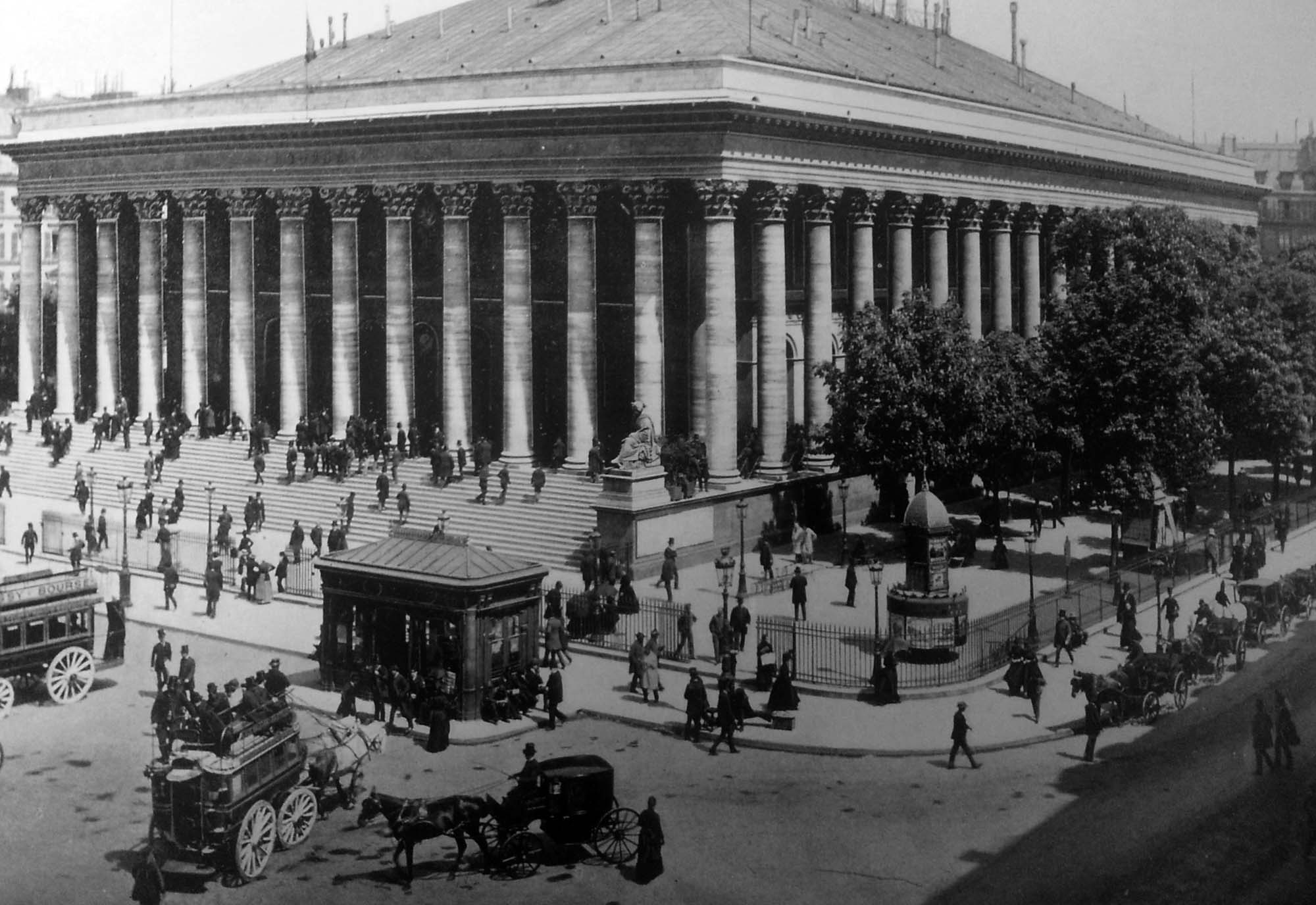
The Bourse (or Exchange), Paris

A handsome structure is this edifice where fortunes are so easily made and lost. Surrounded by sixty-six Corinthian columns this building is not unlike the model of a temple in the Roman Forum. When the traveler has seen the stock exchange of New York or the Board of Trade in Chicago, there is nothing especially new or strange in the transactions of this Paris Bourse. Nevertheless, the tumult and incessant uproar which wake the echoes of these walls from twelve o’clock to three are well worth noting, as an indication of the feverish excitement of the “Bulls and Bears,” whose characteristics do not differ materially, whether the arena where their combats take place be in Wall Street or by Lake Michigan, in the vicinity of the Thames or here in Paris. To stand in the gallery of this Bourse and watch the pandemonium below or merely, as one lingers on these steps, to scrutinize the faces of successful or unfortunate speculators as they leave the building, affords an admirable chance to study interesting phases of human experience. This square, or “Place de la Bourse,” is a great point of arrival and departure of the Parisian omnibuses, the demand for which is usually greater than the supply. But no such crowding is possible here as in our public vehicles in America. Each passenger is entitled to a seat, which he secures by applying for a “number,” at the office in the square. The rule of “first come, first served” is rigidly enforced, and when the seats in the coach are filled, it rolls away, displaying over its door the word “Complet” (full). Who does not recollect the story of the disappointed tourist who exclaimed that the only place in Paris he did not go to was one called “Complet.” “Whenever I see an omnibus going there,” he cried, “it will never stop for me!”

In our first foray into the fascinating old photos (and the captions!) contained in our big Glimpses of the World book (1892), I said that the captions didn’t usually mention any of the vehicles that may be in the photos. Well, I was wrong. In some instances, it would appear, the vehicles are an integral part of the image and of the story …

.

from Glimpses of the World (1892), page 19

.

The caption for this photo reads: “Beginning at the noble church of the Madeleine, which so forcibly resembles a Greek Temple, there extends for nearly three miles to the Place de la Bastille a series of beautiful thoroughfares known as THE original Paris boulevards par excellence. There are eleven of these streets, succeeding one another like links in a golden chain. The first is the one outlined in this representation, and is called (from the building at its commencement) the Boulevard de la Madeleine. There is a charm about these boulevards which no other streets in the world seem to possess. They are a recognized rendezvous for fashionable idlers and pleasure-seekers. Throngs of elegant vehicles pass and repass here every afternoon in bewildering succession. On their broad sidewalks there are not simply thousands of promenaders, but hundreds of men and women seated at little tables in front of glittering cafés, sipping coffee or eau sucrée, or eating an ice-cream, as an excuse to have the privilege of occupying, as it were, an orchestra chair or proscenium box at this attractive spectacle of life and gaity, of which the boulevard itself is the stage. And if this be true of the boulevards in the afternoon, still more brilliant and animated do these sidewalks become on pleasant evenings, when every café is radiant with lights repeated in innumerable mirrors, and when every jeweler’s windows look like the entrance to Aladdin’s fabled caverns! Two features of Parisian boulevards will be recalled by every traveler. They are the tall circular structures called ‘kiosques,’ some of which are merely covered with theatrical advertisements, while others serve as newspaper stands, or little bars for the sale of unintoxicating drinks.”

(I have to say, I don’t know why the images in the past couple of posts have been so small, as I’m not doing anything differently than normal. But if you click on this one, you’ll get a larger version.)

Here’s the first of several carriage- or driving-related (or otherwise interesting) photos that I found in our Glimpses of the World book. The photo captions, naturally, describe the man-made or natural wonders shown but make no mention of any horse-drawn vehicles in the photos.

I’m sure we wouldn’t say anything about the automobiles that “interfere” with our modern photos of landscapes or buildings, either. I know I wouldn’t mention them and would usually rather they weren’t in my photos at all. Likewise, most of the photos in our old book don’t have any vehicles in them, but some of the streets were just too busy to leave the pedestrians, horses, and vehicles out of their portraits.

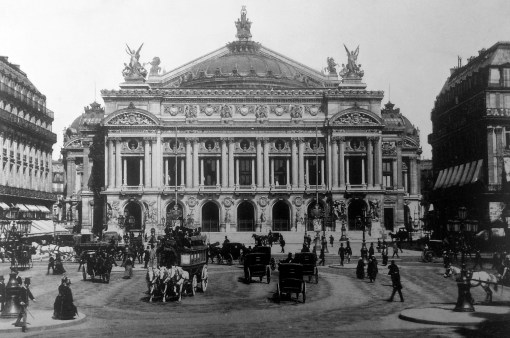
In front of the Paris Opera House, we can see a number of Broughams (serving as taxicabs, no doubt) and a three-abreast of gray horses hitched to a crowded Omnibus.

(To see a larger version of the photo, click on the photo once and then, when a new version comes up, click on it again.)

.

.

This is the photo caption from the book:

“This is not merely one of the most magnificent structures of the French metropolis, but is the largest theatre in the world; not strictly so in regard to its seating capacity, which accommodates about 2,200 people, but in the area of three acres which it occupies in the very heart of the city. The first view of it as one approaches it along the boulevards can never be forgotten. Broad marble steps lead up to a facade adorned with groups of statuary representing Lyric Poetry, Idyllic Poetry, Music, Declamation, Song, and Dance. Above these are medallions of four great composers, and over these extends along the full width of the structure a loggia or gallery embellished with beautiful Corinthian monolithic columns and a marble parapet. Above the windows of this loggia, the eye beholds with pleasure medallion busts, in gilded bronze, of Mozart, Beethoven, Auber, Rossini, Meyerbeer, and Halevy, whose noble works are heard so frequently within the Temple of Music which they thus adorn. To right and left upon the roof colossal groups in gilded bronze stand radiantly forth against the sky, portraying the divinities of Poetry and Music with the muses in their train. While to complete the charm of this extraordinary building, there rises in the center a majestic dome above the crown of which we see, triumphant over all, the statue of Apollo holding aloft a golden lyre, which still reflects the splendor of the setting sun long after evening has begun to spread its shadows over the adjacent streets, which soon will burst forth from that temporary twilight into a blaze of artificial brilliancy almost as light as day, which makes the place of the Grand Opera seem like the diamond-clasp in that long belt of gaity, display, and fashion known as the Parisian boulevards.”

« Previous PageNext Page »